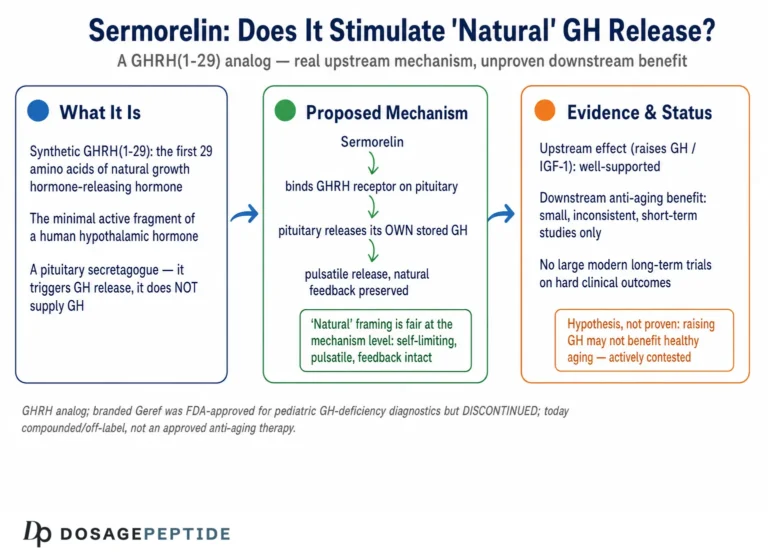
Sermorelin works through a single, well-mapped route: it is a synthetic copy of the first 29 amino acids of growth hormone-releasing hormone, it binds the GHRH receptor on somatotroph cells in the anterior pituitary, and that binding triggers a cascade ending in a pulse of growth hormone. Unlike most research peptides, whose mechanisms are inferred backwards from their effects, sermorelin’s mechanism is defined by its molecular identity. Below, each step in that chain, in order.
What it is not is an approved anti-aging therapy, a proven longevity intervention, or a validated treatment for adult GH decline. The branded product Geref (sermorelin acetate) was once approved by the U.S. Food and Drug Administration — in a diagnostic formulation for probing pituitary GH reserve, and later in a therapeutic formulation for idiopathic GH deficiency in children — but both were discontinued and their approvals withdrawn, for commercial and manufacturing reasons rather than because of any safety or efficacy failure.11 Today sermorelin exists almost entirely as a compounded or research-grade material used off-label; it is not an FDA-approved drug for adult GH deficiency, aging, body composition, or any of the indications most often attached to it in marketing. Keeping that regulatory reality in view is essential, because the elegance of the mechanism has a way of being borrowed to imply a clinical legitimacy that the evidence does not support.
This piece is written for researchers and scientifically literate readers who want a precise account of the receptor pharmacology: what sermorelin binds, what second messengers it raises, how those signals translate into GH synthesis and pulsatile release, how the pituitary’s own feedback machinery constrains the response, and why all of this made sermorelin a useful endocrine research tool in the first place. We will also draw the honest boundaries — where the mechanism is solid, where it is inferred, and where enthusiasm has outrun data.
How Sermorelin Works, Step by Step
- The molecule. Sermorelin is GRF(1–29) — the shortest fragment of natural GHRH that retains full biological activity.
- The target. It binds the GHRH receptor, a class B G-protein-coupled receptor found on somatotrophs, the GH-producing cells of the anterior pituitary. One receptor, one cell population.
- The signal inside the cell. Receptor activation raises cyclic AMP, which activates protein kinase A (PKA), which phosphorylates the transcription factor CREB.
- The output. CREB drives GH gene transcription and the release of stored growth hormone — a pulse, not a plateau.
- The brake. Somatostatin feedback remains intact, so the pituitary shapes the pulse and stops it. This is why timing and dosing schedule change the result more than dose size alone.
Genetic evidence confirms the receptor is the gateway: where the GHRH receptor is non-functional, sermorelin does nothing. That also sets the limit of the mechanism — it can only work where a responsive pituitary exists, and a clean signalling pathway is not by itself a clinical benefit. For what the pulse produced in people, see sermorelin results and timeline in aging adults.
What Sermorelin Actually Is: GRF(1–29)
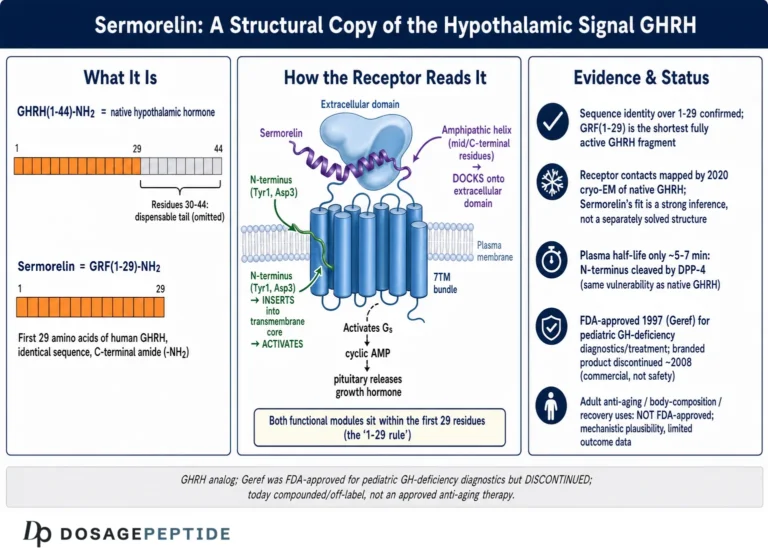
Sermorelin is a synthetic 29-amino-acid peptide corresponding to the first 29 residues of human growth hormone-releasing hormone (GHRH), a hypothalamic hormone whose native form in humans is 44 amino acids long. It is often written as GRF(1–29)NH2 or GHRH(1–29), and it is amidated at its C-terminus. The critical fact about this truncation is that it is not a compromise: GHRH(1–29) is the shortest fragment of the parent hormone that retains full intrinsic biological activity at the GHRH receptor.2 The residues beyond position 29 contribute to circulating stability and to the molecule’s susceptibility to enzymatic processing, but the information needed to bind and activate the receptor is contained in that N-terminal segment.
This is worth dwelling on because it explains why sermorelin behaves, at the level of the somatotroph, essentially like endogenous GHRH. When researchers speak of sermorelin as “bioidentical” or “GHRH-like,” the accurate version of that claim is narrow and mechanistic: the peptide presents the same receptor-facing pharmacophore as the native hormone, so it triggers the same receptor and the same intracellular cascade. It does not mean sermorelin reproduces every feature of endogenous GHRH physiology — the native 1–44 peptide and sermorelin differ in half-life and in how they are cleared, and those pharmacokinetic differences matter a great deal for any practical use. But for the specific question of pituitary signaling, sermorelin is a faithful agonist of the GHRH receptor.
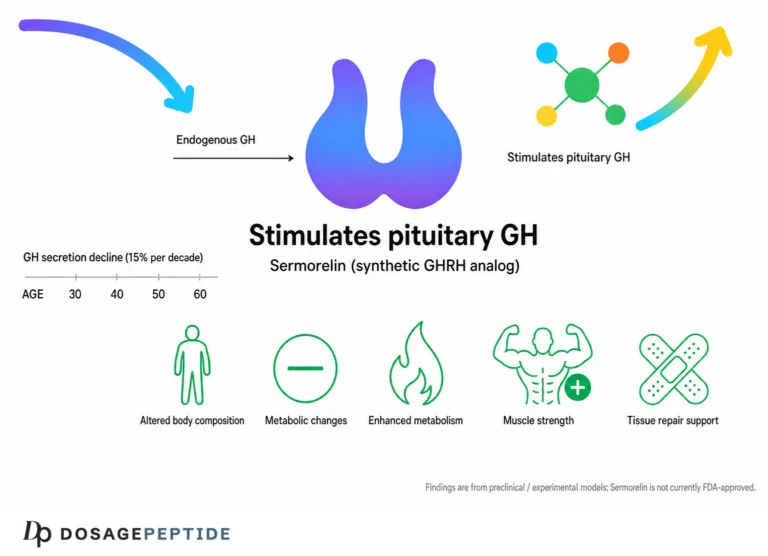
A useful way to situate sermorelin is to distinguish three levels of the molecule. First, the native hormone: GHRH(1–44), released in pulses from neurons in the arcuate nucleus of the hypothalamus into the hypophyseal portal circulation. Second, the active core: the 1–29 sequence that carries the receptor-activating signal. Third, the pharmaceutical entity: sermorelin acetate, the salt form manufactured for injection. Each level narrows toward the receptor event. Much of the confusion in popular writing about sermorelin comes from sliding between these levels — treating a short synthetic fragment as though it recapitulated the entire integrated neuroendocrine behavior of the hypothalamus. It does not; it recapitulates one receptor interaction, and that interaction is the subject of this article. For readers who want the broader physiological framing of how sermorelin is positioned as a GH-stimulating agent, the site’s companion overview of sermorelin’s role in stimulating natural growth hormone covers that ground; here the focus is strictly the receptor and its signaling.
One more identity point deserves emphasis. Sermorelin is a GHRH analog, and GHRH analogs are a distinct pharmacological class from ghrelin-mimetic growth hormone secretagogues such as ipamorelin, GHRP-6, or hexarelin. The two classes both raise GH, but they do so through entirely different receptors — the GHRH receptor for sermorelin, and the GH secretagogue receptor (GHS-R1a) for the ghrelin mimetics. That distinction is not academic; it is the whole basis for the synergy researchers observe when the two classes are combined, and it is a common source of error when the compounds are lumped together as interchangeable “GH peptides.” The contrast with the GHS-R1a agonists is drawn out in the discussion of ipamorelin’s targeting of the GHSR-1a receptor, which is the natural companion to the GHRH-receptor story told here.
The GHRH Receptor: A Class B GPCR on the Somatotroph
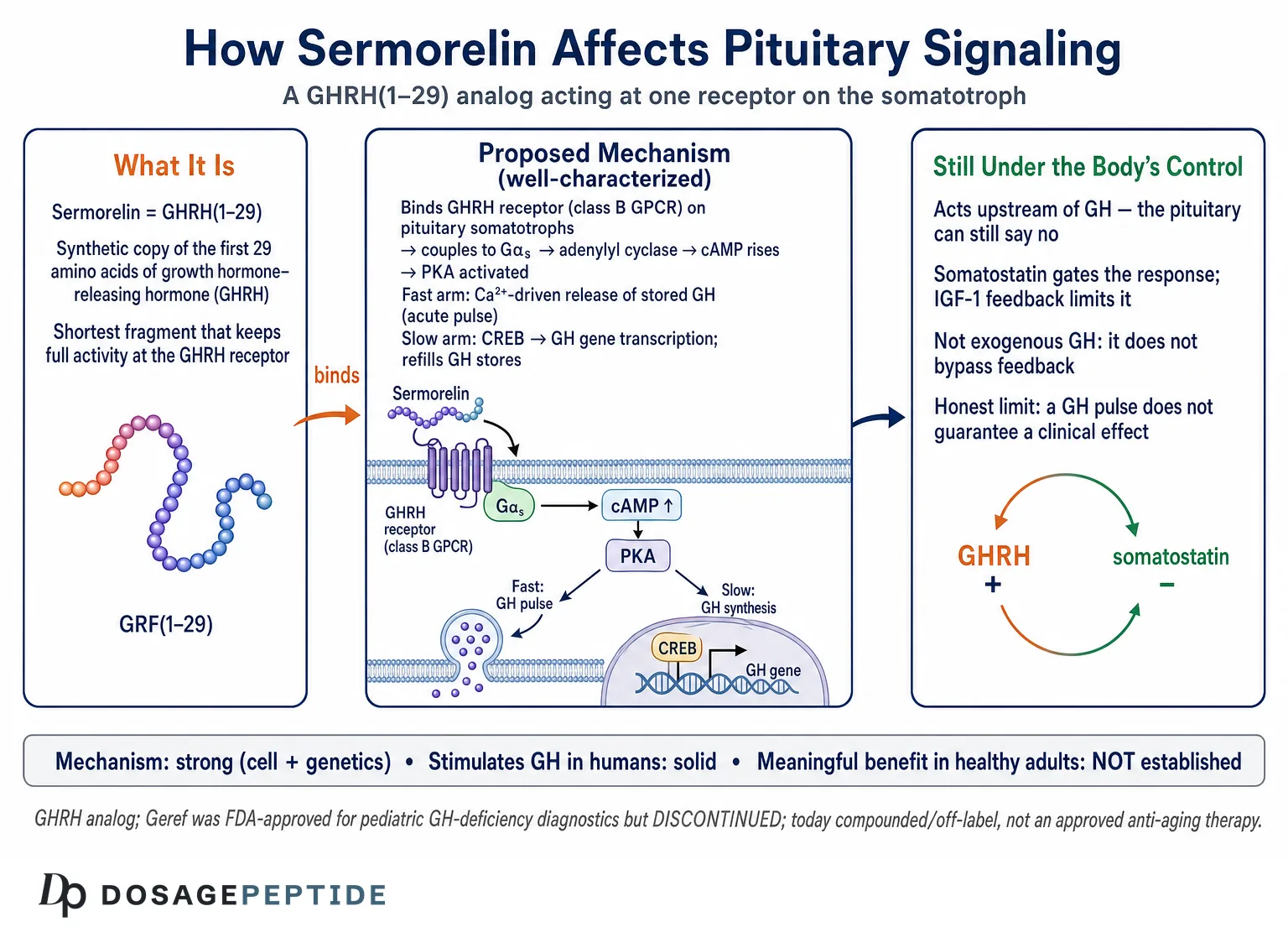
Everything sermorelin does to pituitary signaling begins at one protein: the growth hormone-releasing hormone receptor (GHRH-R). This receptor is a member of the class B (secretin-like) family of G-protein-coupled receptors, the same structural family that includes the receptors for secretin, glucagon, GLP-1, VIP, and PTH.1 Class B GPCRs share a characteristic architecture: seven transmembrane-spanning helices connected by intra- and extracellular loops, coupled to a comparatively large extracellular N-terminal domain that forms much of the peptide-binding surface. The binding of a peptide agonist to a class B receptor is generally described by a “two-domain” model in which the C-terminal portion of the peptide docks into the extracellular domain, positioning the N-terminal portion of the peptide to insert into the transmembrane core and drive the conformational change that activates the receptor.
The GHRH-R is expressed selectively and abundantly on somatotrophs — the GH-producing cells that make up roughly a third to a half of the anterior pituitary’s endocrine cell population. This selectivity is precisely why sermorelin is such a clean signaling probe: the receptor’s expression pattern focuses the drug’s action almost entirely on the cells whose output researchers want to measure. Activation of the GHRH-R does two conceptually separable things to the somatotroph. In the short term, it triggers the release of GH already packaged in secretory granules. Over a longer timescale, it drives transcription of the GH gene to replenish those stores, and it supports the proliferation and maintenance of the somatotroph population itself.4 Both arms flow from the same receptor but through partly divergent downstream branches, which we will trace in the next section.
The clearest demonstration that the GHRH-R is genuinely indispensable — not merely one contributor among many — comes from genetics, and it is worth previewing here because it grounds the entire mechanistic story in hard biology. In the dwarf “little” (lit/lit) mouse, a single missense mutation in the extracellular domain of the GHRH-R abolishes GHRH binding and receptor signaling; the result is profound somatotroph hypoplasia, low circulating GH, and a dwarf phenotype.7 The human parallel was established a few years later, when a homozygous nonsense mutation in the human GHRH-R gene was shown to cause a familial form of severe isolated GH deficiency with pituitary hypoplasia, phenotypically analogous to the little mouse.8 These experiments of nature prove that the receptor sermorelin targets is not a redundant accessory but the rate-limiting gateway through which the hypothalamus commands somatotroph development and GH output. A drug that occupies that gateway is, by definition, acting at the most consequential node of the axis.
Downstream Signaling: cAMP, PKA, CREB, and the GH Gene
When sermorelin binds the GHRH-R, the receptor undergoes the conformational change that allows it to activate its coupled heterotrimeric G protein. The dominant coupling is to Gαs, the stimulatory G-protein alpha subunit, and the immediate consequence is activation of the membrane enzyme adenylyl cyclase.1 Adenylyl cyclase converts ATP into cyclic adenosine monophosphate (cAMP), and the resulting rise in intracellular cAMP is the pivotal second-messenger event of GHRH signaling. Essentially every well-established downstream consequence of GHRH-R activation can be traced to this cAMP surge.
Elevated cAMP activates protein kinase A (PKA). PKA has two functionally important sets of targets in the somatotroph. The first is at the plasma membrane and on intracellular calcium stores: cAMP/PKA signaling, together with the receptor’s effects on ion channels, raises intracellular free calcium (Ca2+), and it is that rise in cytosolic calcium that triggers the fusion of GH-containing secretory granules with the membrane and the exocytotic release of stored hormone.4 This is the fast arm of the response — the acute GH pulse that follows a sermorelin injection within minutes and peaks well within an hour. The second set of PKA targets is nuclear. PKA phosphorylates the transcription factor CREB (cAMP response element-binding protein), and phosphorylated CREB binds cAMP-response elements in the promoter region of the GH gene, enhancing its transcription.1
There is an additional, developmentally crucial layer here. CREB activation contributes to the expression of Pit-1 (POU1F1), the pituitary-specific transcription factor that is required for the differentiation, survival, and function of somatotrophs and for GH gene expression itself.1 In other words, GHRH signaling does not merely open the tap on preformed hormone; over time it sustains the very transcriptional program that defines the cell as a GH producer and keeps its stores replenished so it can respond to the next pulse.4 This helps explain a feature of GHRH biology that distinguishes it from a simple secretagogue: chronic GHRH exposure is trophic to the somatotroph population, promoting proliferation, whereas chronic GHRH deficiency (as in the little mouse) leaves the pituitary hypoplastic.7 Beyond the canonical cAMP/PKA branch, GHRH-R activation also engages MAPK and phosphatidylinositol-3-kinase (PI3K) pathways that are implicated in the proliferative, cell-maintenance side of the response.1
The two-domain binding model is worth unpacking a little further, because it clarifies why a 29-residue fragment suffices and why small modifications to that fragment change the drug’s behavior without changing its fundamental mechanism. In class B GPCRs, the peptide’s C-terminal region provides the affinity — it anchors to the receptor’s large extracellular domain — while the peptide’s N-terminal residues provide the efficacy, inserting into the transmembrane bundle to trigger activation.1 Sermorelin’s 1–29 sequence contains both elements, which is why it is a full agonist and not merely a binder. It also explains why the N-terminus is the vulnerable point: the enzyme dipeptidyl peptidase-4 (DPP-4) cleaves GHRH and sermorelin near the N-terminus, rapidly inactivating the peptide, which is the reason sermorelin’s circulating half-life is measured in minutes. Longer-acting GHRH analogs such as tesamorelin and the modified GRF(1–29) constructs are precisely N-terminal-stabilized versions engineered to resist that cleavage — a pharmacokinetic fix layered onto the identical receptor mechanism, not a different mechanism.
A further nuance that mature accounts of GPCR signaling must acknowledge is receptor desensitization. Sustained or repeated agonist exposure at a GPCR characteristically triggers receptor phosphorylation, arrestin recruitment, and internalization, which blunt the response over time — a homeostatic dampening distinct from the hormonal feedback discussed later. For a pulsatile system like the GH axis, this is arguably a feature rather than a bug: the physiological design delivers GHRH in discrete bursts separated by troughs, allowing the receptor to reset between pulses. It also offers a mechanistic caution against the intuition that “more continuous stimulation must mean more GH.” Continuous, non-pulsatile GHRH-receptor occupancy can, in principle, be less effective than an appropriately spaced pulse, because it collides with both receptor-level desensitization and the somatostatin/IGF-1 feedback that the next sections describe. This is one more reason the timing of a GHRH agonist’s delivery is not a peripheral detail but part of its mechanism of action.
It is worth being candid about the resolution of this picture. The cAMP/PKA/CREB spine of GHRH signaling is exceptionally well supported and is not in serious dispute. The finer branches — the precise roles of specific calcium channels, the relative contributions of MAPK versus PI3K to proliferation, the extent to which β-arrestin-mediated signaling participates — are areas of ongoing work and are characterized largely in cell and animal models rather than in humans. When a source states with great confidence exactly which kinase cascade dominates a given somatotroph behavior, that confidence usually exceeds the primary data. The honest summary is that sermorelin raises cAMP through a Gαs-coupled class B GPCR, and that this cAMP signal drives both immediate GH exocytosis and longer-term GH gene transcription and somatotroph maintenance; the exact wiring of the secondary branches is real but less crisply resolved.
| Step | Molecular event | Functional consequence |
|---|---|---|
| 1. Binding | Sermorelin GRF(1–29) docks onto the GHRH-R extracellular domain; N-terminus engages the transmembrane core1 | Receptor adopts active conformation |
| 2. G-protein coupling | Active receptor engages Gαs1 | Adenylyl cyclase activated |
| 3. Second messenger | ATP → cAMP; intracellular cAMP rises1 | Central signal of GHRH action |
| 4a. Fast arm | cAMP/PKA + Ca2+ influx4 | Exocytosis of stored GH (acute pulse) |
| 4b. Slow arm | PKA → CREB phosphorylation → GH gene transcription; Pit-1 support1 | Replenishment of GH stores; somatotroph maintenance |
| 5. Trophic arm | MAPK / PI3K pathways1 | Somatotroph proliferation and survival |
From Receptor Signal to Pulse: Why Timing Is the Whole Story
A signaling account that stopped at “sermorelin raises cAMP and GH comes out” would miss the feature that makes GHRH pharmacology interesting and that most distinguishes sermorelin from simply injecting GH: the system it acts on is pulsatile and tightly regulated, and sermorelin’s effect is filtered through that regulation rather than overriding it.
GH is not secreted at a constant rate. It is released in discrete bursts, largely during slow-wave sleep, generated by the interplay of two opposing hypothalamic signals: GHRH, which stimulates the somatotroph, and somatostatin (somatotropin release-inhibiting factor), which restrains it.5 Somatostatin acts on the somatotroph through inhibitory G proteins that suppress adenylyl cyclase — in effect the mirror image of GHRH’s stimulatory coupling. The pattern of GH pulses reflects the alternating dominance of these two inputs: a GH burst occurs when GHRH tone is high and somatostatin tone is low, and the trough between bursts corresponds to somatostatin dominance.5
This has a direct, practical consequence for sermorelin. Because sermorelin works by stimulating the somatotroph rather than replacing GH, its effect is gated by the prevailing somatostatin tone. When somatostatin is high — for example, in the waking hours or after a carbohydrate-rich meal — the same dose of sermorelin produces a blunted GH response, because the inhibitory brake is engaged. When somatostatin tone falls, as it does at sleep onset, the identical dose produces a much larger GH pulse. Sermorelin does not bulldoze through this regulation; it adds to the GHRH side of a balance that the hypothalamus is still controlling. This is the mechanistic basis for the frequently repeated claim that sermorelin produces “physiological” or “pulsatile” GH release — a claim that is mechanistically reasonable but that should not be inflated into a promise of clinical superiority, since preserving a pulse pattern is not the same as producing a clinically meaningful outcome.
The system is layered with feedback that further constrains any GHRH agonist. GH secreted into the circulation stimulates the liver to produce insulin-like growth factor-1 (IGF-1), and IGF-1 exerts long-loop negative feedback on the axis. Elegant human infusion studies showed that raising IGF-1 suppresses spontaneous GH secretion substantially, and that this suppression operates in large part by increasing hypothalamic somatostatin release — that is, IGF-1 feeds back not by silencing the somatotroph directly so much as by pressing the somatostatin brake.6 GH also exerts short-loop feedback of its own, promoting somatostatin release within the hypothalamus.5 The net picture is a self-limiting loop: sermorelin drives a GH pulse, GH drives IGF-1, and IGF-1 (via somatostatin) damps subsequent GH output.
Two honest implications follow. First, this intact feedback is genuinely a safety-relevant feature of the mechanism: unlike exogenous recombinant GH, which floods the circulation regardless of feedback, a GHRH agonist acting on a responsive pituitary is subject to the body’s own ceiling. If IGF-1 rises, the loop tends to restrain further GH release. Second, and less flatteringly, this same feedback caps what a GHRH agonist can achieve. In one study of healthy older men, a single nightly subcutaneous dose of GHRH(1–29) increased nocturnal GH release and pulse amplitude but did not significantly raise circulating IGF-1, and single nightly dosing was explicitly less effective than more frequent dosing at producing IGF-1-mediated effects.9 That is a mechanistically instructive result: it shows that stimulating GH pulses is not automatically the same as moving the downstream hormone that mediates most of GH’s peripheral actions. The feedback architecture that makes sermorelin comparatively self-limiting also makes it comparatively easy to under-dose into biological irrelevance.
Genetic Proof That the Receptor Is the Gateway
The reason to trust this mechanistic story — rather than treat it as a plausible cartoon — is that the GHRH–GHRH-R interaction has been validated by loss-of-function genetics in both animals and humans, which is about as rigorous as mechanistic evidence gets.
The little mouse was the founding model. Positional work localized the mutation responsible for its dwarf phenotype to the GHRH-R gene, and characterization revealed a missense change in the receptor’s extracellular domain that disrupts GHRH binding and abolishes signaling.7 The consequence is instructive for everything sermorelin is meant to do: without a functional GHRH-R, the somatotroph population fails to expand normally (pituitary hypoplasia), GH output is low, and — critically — the animals are unresponsive to exogenous GHRH. A GHRH agonist can only work if the receptor works. This is the mechanistic reason a GHRH analog like sermorelin is useful as a probe of pituitary capacity: a normal pituitary responds; a pituitary lacking functional receptors or somatotrophs cannot.
The human counterpart confirmed the model’s relevance to our species. A homozygous nonsense mutation in the human GHRH-R was identified in a consanguineous family, producing a truncated, non-functional receptor and a severe, familial form of isolated GH deficiency with pituitary hypoplasia — the human analog of the little mouse.8 Together these findings establish the GHRH-R as a non-redundant, rate-limiting controller of somatotroph development and GH secretion.
For sermorelin, this genetics matters in two directions. On the one hand, it validates the target: the receptor sermorelin binds is the master switch of the axis, so occupying it is pharmacologically meaningful. On the other hand, it defines the ceiling and the failure modes: sermorelin can only amplify a signal the pituitary is competent to produce. In any condition where the somatotrophs are absent, exhausted, or bearing non-functional receptors — certain forms of pituitary disease, structural damage, or genetic GH deficiency — a GHRH agonist will fail not because the drug is inert but because the substrate it acts on is missing. This is exactly the logic that made sermorelin a diagnostic agent, as we turn to next.
Sermorelin as an Endocrine Research and Diagnostic Probe
The single most legitimate, evidence-backed application of sermorelin in endocrine science is not therapeutic at all — it is diagnostic. Because sermorelin selectively stimulates the somatotroph through the GHRH-R, the GH response to a standardized dose is a readout of pituitary GH reserve: how much hormone the somatotrophs can mobilize when maximally stimulated at the level of the receptor. This is why the diagnostic formulation of Geref was FDA-approved specifically to evaluate the ability of the somatotrophs to secrete GH.11
The clinical-research foundation for this use was laid in the 1980s. In an evaluation combining a provocative test using GRF(1–29)NH2 with somatomedin-C (IGF-1) measurements, investigators tested children and adolescents and characterized how the GH response to the peptide distinguished, imperfectly, between those with and without GH deficiency.3 That work — and the broader literature synthesized in the definitive review of sermorelin’s diagnostic and therapeutic use — established that an intravenous dose of roughly 1 µg/kg produced a rapid, relatively specific GH response, with fewer false-positive results (i.e., fewer normal children mislabeled as deficient) than some older provocative tests such as insulin-induced hypoglycemia.2
There is an important mechanistic subtlety embedded in the diagnostic use, and it is one that made GHRH-based testing genuinely informative rather than merely convenient. Because sermorelin acts at the pituitary receptor, a GHRH stimulation test probes the pituitary’s competence directly. A patient whose GH deficiency originates in the pituitary (an intrinsic somatotroph or receptor problem) will respond poorly to sermorelin, whereas a patient whose deficiency originates in the hypothalamus — a failure to produce or deliver endogenous GHRH — may have perfectly competent somatotrophs that simply have not been stimulated, and such a patient can respond briskly to exogenous GHRH. In principle, then, the GHRH stimulation test can help localize the level of a lesion within the axis. In practice this localization is imperfect: chronically under-stimulated somatotrophs can become sluggish and respond poorly on a single test even when the primary defect is hypothalamic, which is one reason repeated priming with GHRH was sometimes used and why GHRH testing was ultimately one tool among several rather than a stand-alone gold standard.2 This is the correct, measured way to state the diagnostic value: real, historically FDA-sanctioned, and mechanistically rational, but bounded.
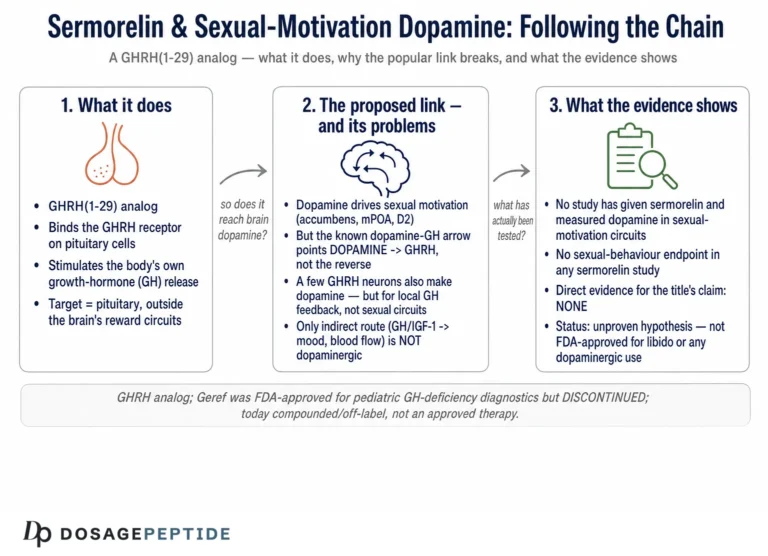
The therapeutic side of the historical record is narrower than the marketing around modern compounded sermorelin implies. As a treatment, sermorelin was approved and used for idiopathic GH deficiency in children with growth failure, where it increased height velocity over 12 months, with more limited data extending toward 36 months.2 That is a legitimate pediatric growth indication built on the same mechanism — stimulate the somatotroph, raise GH, support linear growth — and it is entirely distinct from the adult anti-aging, body-composition, and “wellness” uses that dominate contemporary discussion and that were never the basis of any approval. Readers interested in whether the mechanism plausibly extends into other adult domains can weigh the separate, and considerably more speculative, question examined in the discussion of whether sermorelin supports cognitive function in age-related neurodegeneration, which is best read as an open research question rather than a settled application.
How Sermorelin Compares With Other GH-Axis Agents
Placing sermorelin beside the other pharmacological ways of engaging the GH axis clarifies exactly what its signaling profile buys and what it does not. There are three broad strategies: give GHRH-receptor agonists (like sermorelin), give GH secretagogue-receptor agonists (ghrelin mimetics), or give the hormone itself (recombinant GH). Each hits the axis at a different point.
| Agent / class | Molecular target | Effect on pituitary signaling | Feedback / notes |
|---|---|---|---|
| Sermorelin (GHRH 1–29) | GHRH-R (class B GPCR) on somatotrophs1 | Raises cAMP; stimulates GH synthesis + pulsatile release | Short half-life; subject to somatostatin gating and IGF-1 feedback6 |
| Tesamorelin | GHRH-R (stabilized GHRH analog) | Same receptor; longer-acting, more sustained GHRH signaling | FDA-approved for HIV-associated visceral lipodystrophy10 |
| CJC-1295 / modified GRF(1–29) | GHRH-R | Same receptor; engineered for extended half-life | Not FDA-approved; research/off-label |
| Ipamorelin / GHRP class | GHS-R1a (ghrelin receptor)12 | Different receptor; raises GH via a distinct pathway; synergizes with GHRH agonists | Not a GHRH analog; not FDA-approved |
| Recombinant human GH | None at pituitary — bypasses it | Replaces the hormone directly in the circulation | Overrides pituitary feedback entirely; FDA-approved for defined indications |
Several honest points fall out of this comparison. First, sermorelin and tesamorelin act on the identical receptor; the meaningful difference is pharmacokinetic, not mechanistic. Tesamorelin is a stabilized GHRH analog engineered for a longer duration of action, and it is the one member of the GHRH-analog class to have achieved a modern adult FDA approval — for the reduction of excess visceral adipose tissue in people with HIV-associated lipodystrophy, on the strength of large placebo-controlled trials.10 That approval is often invoked as a halo over sermorelin, but the two are not interchangeable: tesamorelin has an approved indication, a defined dose, and pivotal-trial evidence for a specific population, none of which transfers to sermorelin’s off-label adult use.
Second, the ghrelin-mimetic secretagogues occupy a different receptor entirely, and this is why combining a GHRH agonist with a GHS-R1a agonist produces a larger GH pulse than either alone — the two are pushing the somatotroph through two convergent but distinct signaling systems.12 That synergy is mechanistically real and is the rationale behind many combination research protocols, but “larger GH pulse in a short-term study” is a pharmacodynamic observation, not a demonstrated clinical benefit.
Third, and most important for calibrating expectations: recombinant GH is the only one of these that bypasses the pituitary and its feedback. That is simultaneously its power and its liability. It reliably raises GH and IGF-1 regardless of feedback, which is why it is the approved therapy for genuine GH deficiency; but it also carries the full weight of GH’s dose-dependent adverse effects because nothing restrains it. Sermorelin’s whole selling point is that it works one step upstream, within a system that can still say no. The correct reading of that difference is neither dismissal nor hype: it is a genuinely different pharmacology whose theoretical advantages (physiological patterning, preserved feedback) remain, for adult non-approved uses, largely theoretical rather than proven in outcome trials.
What the Mechanism Does Not Promise
Because the signaling story is so clean, it is unusually easy to over-read. It is worth stating plainly what a solid receptor mechanism does and does not license as a conclusion.
A well-characterized mechanism establishes plausibility and target engagement. We can say with confidence that sermorelin binds the GHRH-R, raises cAMP, and provokes a GH pulse in a competent pituitary; this is not in doubt.14 What a mechanism cannot establish is clinical outcome. The distance between “produces a GH pulse” and “improves body composition, sleep, recovery, or healthspan in adults” is precisely the distance that controlled clinical trials exist to measure, and for adult off-label sermorelin that distance has not been closed by high-quality evidence. The elderly-men study is a cautionary emblem: a real, measurable increase in nocturnal GH pulse amplitude that nonetheless failed to move IGF-1 significantly on a single nightly dose.9 If the immediate downstream mediator does not reliably move, downstream clinical endpoints cannot be assumed to move either.
There is also a mechanistic reason to expect diminishing returns from any GHRH agonist, and it is a point marketing rarely mentions: the feedback loops described earlier actively oppose sustained elevation. As GH and then IGF-1 rise, somatostatin tone increases and damps further secretion.56 The system is engineered for homeostasis, not for indefinite amplification. This means that the honest mechanistic expectation for a GHRH agonist in a person with an intact, healthy axis is modulation within physiological bounds — not the supraphysiological elevation that exogenous GH can force. Whether that bounded modulation translates into anything a person would notice is an empirical question the mechanism cannot answer.
It is also worth stating what the evidence base itself does not contain, because absence of data is easy to mistake for reassurance. There are no adequately powered, long-term, placebo-controlled outcome trials of compounded sermorelin in healthy adults for any of the anti-aging, body-composition, sleep, or recovery uses for which it is marketed; the human record for adults consists largely of small, short pharmacodynamic studies of GH and IGF-1 responses rather than trials measuring the endpoints people actually care about.9 The historical safety record from the approved pediatric and diagnostic uses was reassuring for those specific, supervised contexts,2 but it cannot be extrapolated to open-ended adult self-administration, where dose, duration, and monitoring differ entirely. Any biological argument that chronic stimulation of the GH/IGF-1 axis could carry theoretical long-term concerns — the same axis whose signaling is implicated in cell proliferation1 — is, at present, neither confirmed nor excluded for this pattern of use, precisely because the trials that would settle it have not been done. Honesty about a mechanism therefore has to include honesty about the shape of the gap in the outcome literature, not only the strength of the receptor story.
Finally, the mechanism says nothing about product quality, dose accuracy, or the confounders that plague any compound used outside regulated channels. A perfect receptor story attached to an underdosed, impure, or improperly stored vial yields nothing. For the general vocabulary of the GH axis — somatotroph, somatostatin, secretagogue, pulsatility — the site’s peptide research glossary is a useful reference, and the broader context for how these compounds are named, catalogued, and dosed in research settings appears in the site’s peptide dosage catalog. None of that changes the central caution: a strong mechanism is a reason to investigate, not a substitute for having investigated.
Research Handling and Methodological Context
Because sermorelin is encountered in research settings as a lyophilized (freeze-dried) powder, a brief, strictly educational note on handling is warranted — with the emphasis that this is standard research-peptide practice and not a usage recommendation, and that sermorelin is not an approved therapeutic for adult GH decline or aging.
Sermorelin is a peptide and shares the general fragility of its class. It is typically reconstituted with sterile or bacteriostatic water directed slowly against the vial wall rather than sprayed onto the powder, and mixed by gentle swirling rather than shaking, since vigorous agitation can shear and denature peptide chains. The chosen diluent volume simply sets the working concentration — a fixed mass in a larger volume yields a lower concentration per unit volume, the arithmetic behind any reconstitution calculation. General reconstitution and syringe-math walkthroughs applicable to peptides of this type are collected in the site’s peptide reconstitution guide, which is provided for educational reference rather than as guidance for human use.
| Parameter | Typical research-context practice |
|---|---|
| Lyophilized storage | Cool, dark conditions; freezing favored for long-term stability |
| After reconstitution | Refrigerated; used within a limited window |
| Light and heat | Minimize exposure; both degrade peptides |
| Agitation | Swirl gently; avoid shaking or foaming |
| Freeze–thaw | Repeated cycles degrade peptide; avoid |
| Sterility | Aseptic technique; bacteriostatic water for multi-use practice |
Methodologically, the studies that established sermorelin’s pituitary mechanism span three tiers, and it helps to know which claims rest on which. The receptor and signaling architecture (class B GPCR, Gαs/cAMP/PKA/CREB) derives from molecular pharmacology and cell-based work.1 The proof that the receptor is indispensable derives from mouse and human genetics.78 The demonstration that sermorelin stimulates GH in humans, and its diagnostic performance, derive from clinical-research studies in defined populations, chiefly children evaluated for GH deficiency.23 The adult data are the thinnest tier — small studies such as the elderly-men trial show pharmacodynamic effects on GH pulses but limited or inconsistent movement of downstream endpoints.9 An honest reader should weight conclusions to match the tier: strong for “how the receptor signals,” strong for “the receptor is essential,” solid for “it stimulates GH and can probe pituitary reserve,” and weak for “it produces meaningful clinical benefit in healthy adults.”
Regulatory Status: Approved, Then Withdrawn, Now Off-Label
Sermorelin’s regulatory history is specific and frequently misstated, so precision matters. The branded product Geref (sermorelin acetate) was FDA-approved in two distinct formulations. A low-dose diagnostic formulation was approved for evaluating the somatotrophs’ ability to secrete GH — the GHRH stimulation test discussed above — and a therapeutic formulation was later approved for the treatment of idiopathic GH deficiency in children with growth failure.211 These were real approvals grounded in the receptor mechanism and in pediatric clinical data.
Both formulations were subsequently discontinued. The manufacturer notified the FDA that Geref was being withdrawn from the market, and the agency withdrew the approvals. Crucially, a later FDA determination in the Federal Register stated explicitly that Geref was not withdrawn for reasons of safety or effectiveness — the withdrawal reflected commercial and manufacturing considerations.11 This is an important nuance: the disappearance of branded sermorelin does not represent a regulatory judgment that the drug was unsafe or ineffective for its approved uses. But neither does it convert the current, unapproved status into an endorsement. The situation is simply that there is at present no FDA-approved sermorelin product on the U.S. market.
What exists today is compounded sermorelin, prepared by compounding pharmacies and prescribed off-label, most visibly for adult indications — anti-aging, body composition, sleep, recovery — that were never the basis of any approval and are not supported by pivotal adult trials. It is essential to state plainly that off-label prescribing and compounding do not constitute FDA approval of those uses, and that the marketing narratives built around adult sermorelin routinely borrow the credibility of the historical pediatric approval and of the (distinct) tesamorelin approval to imply an evidentiary standing that adult sermorelin does not have. Sermorelin’s use in performance and anti-aging contexts also raises anti-doping considerations, since GHRH analogs and GH secretagogues fall within categories prohibited in sport. The clean, single-target mechanism described throughout this article is genuine; it is also, on its own, not a substitute for the outcome evidence and regulatory review that define an approved therapy.
Frequently Asked Questions
How exactly does sermorelin affect pituitary signaling?
Sermorelin is the 1–29 active fragment of GHRH. It binds the growth hormone-releasing hormone receptor (GHRH-R), a class B G-protein-coupled receptor expressed on pituitary somatotrophs, and couples through Gαs to activate adenylyl cyclase.1 The resulting rise in cAMP activates PKA, which drives both the immediate exocytosis of stored growth hormone (via calcium-dependent signaling) and, over time, CREB-mediated transcription of the GH gene and support of the somatotroph-defining factor Pit-1.14 In short, it stimulates the pituitary’s own GH machinery at the most upstream druggable point of the axis.
Is sermorelin the same as taking growth hormone?
No, and the difference is mechanistic. Recombinant GH replaces the hormone directly in the bloodstream and bypasses the pituitary and its feedback entirely. Sermorelin acts one step upstream, stimulating the somatotroph to release its own GH, so its effect remains subject to hypothalamic somatostatin gating and to IGF-1 negative feedback.56 This is why sermorelin is described as producing more “physiological” pulsatile release — a reasonable mechanistic statement, but not by itself proof of clinical superiority.
Was sermorelin ever FDA-approved?
Yes. The branded product Geref was FDA-approved both as a diagnostic agent to evaluate pituitary GH reserve and, in a separate formulation, to treat idiopathic GH deficiency in children with growth failure.211 Both were later discontinued and their approvals withdrawn. An FDA Federal Register determination clarified that the withdrawal was not for reasons of safety or effectiveness but reflected commercial/manufacturing factors.11 There is currently no FDA-approved sermorelin product; today’s material is compounded and used off-label.
Why is sermorelin useful as a diagnostic tool?
Because it acts selectively on the somatotroph via the GHRH-R, the GH response to a standardized sermorelin dose reflects the pituitary’s capacity to secrete GH.11 Early studies established that intravenous GRF(1–29) at about 1 µg/kg gives a rapid, relatively specific GH response with fewer false positives than some older provocative tests.23 A GHRH stimulation test can also help distinguish, imperfectly, pituitary-level from hypothalamic-level GH deficiency, since a competent but under-stimulated pituitary can respond to exogenous GHRH.2
Does sermorelin reliably raise IGF-1 in adults?
Not necessarily. In a study of healthy older men, a single nightly subcutaneous dose of GHRH(1–29) increased nocturnal GH release and pulse amplitude but did not significantly raise IGF-1, and single nightly dosing was less effective than more frequent dosing.9 Because IGF-1 mediates most of GH’s peripheral actions, a GH pulse that does not translate into sustained IGF-1 elevation is a reminder that stimulating the pituitary is not the same as producing a downstream clinical effect.
How does sermorelin differ from ipamorelin or other “GH peptides”?
They work through different receptors. Sermorelin is a GHRH analog acting on the GHRH-R; ipamorelin and the GHRP-class secretagogues act on the ghrelin receptor (GHS-R1a).12 Both raise GH, but through distinct signaling pathways, which is why combining the two classes can produce a larger GH pulse than either alone. Lumping them together as interchangeable is a common and mechanistically incorrect simplification.
What proves that the GHRH receptor is really the key target?
Loss-of-function genetics. The dwarf “little” mouse carries a missense mutation in the GHRH-R extracellular domain that abolishes signaling, producing somatotroph hypoplasia and low GH; the animals are unresponsive to exogenous GHRH.7 A homozygous nonsense mutation in the human GHRH-R causes an analogous severe isolated GH deficiency with pituitary hypoplasia.8 These show the receptor is a non-redundant gateway — and that a GHRH agonist can only work when that receptor and its somatotrophs are intact.
Is compounded sermorelin an approved anti-aging or body-composition therapy?
No. Adult anti-aging, body-composition, sleep, and recovery uses were never the basis of any FDA approval and are not supported by pivotal adult outcome trials. The historical approvals were a pediatric GH-deficiency treatment and a diagnostic test.211 Marketing frequently borrows the credibility of those approvals, and of the separate FDA-approved GHRH analog tesamorelin, to imply a standing that adult off-label sermorelin does not have.10
References
- Halmos G, Szabo Z, Dobos N, Juhasz E, Schally AV. Growth hormone-releasing hormone receptor (GHRH-R) and its signaling. Rev Endocr Metab Disord. 2025;26(3):343-352. PMID 39934495; PMCID PMC12137518. https://pmc.ncbi.nlm.nih.gov/articles/PMC12137518/
- Prakash A, Goa KL. Sermorelin: a review of its use in the diagnosis and treatment of children with idiopathic growth hormone deficiency. BioDrugs. 1999;12(2):139-157. PMID 18031173. https://link.springer.com/article/10.2165/00063030-199912020-00007
- Ranke MB, Gruhler M, Rosskamp R, et al. Testing with growth hormone-releasing factor (GRF(1-29)NH2) and somatomedin C measurements for the evaluation of growth hormone deficiency. Eur J Pediatr. 1986;145(6):485-492. PMID 2880720. https://pubmed.ncbi.nlm.nih.gov/2880720/
- Mayo KE, Miller T, Bhat V, Kim K, Godfrey PA. Regulation of the pituitary somatotroph cell by GHRH and its receptor. Recent Prog Horm Res. 2000;55:237-266. PMID 11036940. https://pubmed.ncbi.nlm.nih.gov/11036940/
- Steyn FJ, Tolle V, Chen C, Epelbaum J. Neuroendocrine regulation of growth hormone secretion. Compr Physiol. 2016;6(2):687-735. PMID 27065166. https://onlinelibrary.wiley.com/doi/10.1002/j.2040-4603.2016.tb00692.x
- Bermann M, Jaffe CA, Tsai W, DeMott-Friberg R, Barkan AL. Negative feedback regulation of pulsatile growth hormone secretion by insulin-like growth factor I. Involvement of hypothalamic somatostatin. J Clin Invest. 1994;94(1):138-145. PMID 7913710; PMCID PMC296291. https://pmc.ncbi.nlm.nih.gov/articles/PMC296291/
- Godfrey P, Rahal JO, Beamer WG, Copeland NG, Jenkins NA, Mayo KE. GHRH receptor of little mice contains a missense mutation in the extracellular domain that disrupts receptor function. Nat Genet. 1993;4(3):227-232. PMID 8358429. https://www.nature.com/articles/ng0793-227
- Wajnrajch MP, Gertner JM, Harbison MD, Chua SC Jr, Leibel RL. Nonsense mutation in the human growth hormone-releasing hormone receptor causes growth failure analogous to the little (lit) mouse. Nat Genet. 1996;12(1):88-90. PMID 8528260. https://pubmed.ncbi.nlm.nih.gov/8528260/
- Vittone J, Blackman MR, Busby-Whitehead J, et al. Effects of single nightly injections of growth hormone-releasing hormone (GHRH 1-29) in healthy elderly men. Metabolism. 1997;46(1):89-96. PMID 9005976. https://pubmed.ncbi.nlm.nih.gov/9005976/
- Falutz J, Allas S, Blot K, et al. Metabolic effects of a growth hormone-releasing factor in patients with HIV. N Engl J Med. 2007;357(23):2359-2370. PMID 18057338. https://www.nejm.org/doi/full/10.1056/NEJMoa072375
- U.S. Food and Drug Administration. Determination That GEREF (Sermorelin Acetate) Injection Was Not Withdrawn From Sale for Reasons of Safety or Effectiveness. Federal Register. 2013;78(42):14275. https://www.federalregister.gov/documents/2013/03/04/2013-04827/
- Ishida J, Saitoh M, Ebner N, Springer J, Anker SD, von Haehling S. Growth hormone secretagogues: history, mechanism of action, and clinical development. JCSM Rapid Commun. 2020;3(1):25-37. https://onlinelibrary.wiley.com/doi/full/10.1002/rco2.9
Educational and research-use disclaimer: This article is provided solely for scientific and educational purposes. Sermorelin is not currently an FDA-approved product; the branded product Geref — approved historically as a pediatric growth-hormone-deficiency treatment and as a diagnostic agent for pituitary GH reserve — was discontinued, and no approved sermorelin product is on the U.S. market today. Sermorelin is not FDA-approved for anti-aging, body composition, adult growth-hormone decline, cognitive, or any wellness indication, and no such clinical benefit has been established by pivotal trials; contemporary use is compounded and off-label. GHRH analogs and growth hormone secretagogues are prohibited in sport by anti-doping authorities. Nothing here is medical advice or a recommendation for human use. Any legitimate investigation of this compound should occur within properly authorized preclinical or clinical research under appropriate oversight, and readers should consult qualified professionals and applicable regulations before making any decisions.