Short answer: PE-22-28 is a seven-amino-acid fragment of spadin that blocks a potassium channel called TREK-1 — and in mice, blocking that channel produces antidepressant-like behaviour within days rather than weeks. It also increased the birth of new neurons and new synapses in those animals.
The limit is just as important: every one of those findings comes from rodents and cell cultures. There are no completed human trials of PE-22-28. It is not an approved medicine anywhere, and nothing here describes a treatment for depression or any other condition in people.
Below: what the molecule is and where it came from, exactly how TREK-1 fits into mood signalling, what the animal experiments measured, how the compound behaves when given by different routes, and what would have to happen before any of this means anything clinically.
Research Context: What Is PE-22-28?
PE-22-28 is a short synthetic peptide—seven amino acids long—engineered as a chemically stabilized analog of a naturally occurring peptide called spadin. It belongs to a research lineage developed primarily at the Institut de Pharmacologie Moléculaire et Cellulaire (IPMC/CNRS) near Nice, France, by the groups of Jean Mazella, Marc Borsotto, and Catherine Heurteaux. The compound’s single defining pharmacological property, established across more than a decade of preclinical work, is that it inhibits the TREK-1 two-pore-domain potassium channel (gene name KCNK2).[1]
The name itself encodes the peptide’s origin. “PE” stands for propeptide, and “22-28” refers to the amino-acid positions 22 through 28 within a larger 44-residue propeptide sequence. That parent propeptide is released when the protein sortilin (also known as neurotensin receptor-3, or NTSR3) is processed inside the cell. Spadin corresponds to positions 12–28 of the same propeptide—a 17-residue fragment—so PE-22-28 is essentially the active core of spadin, trimmed down to the segment that carries the channel-blocking activity.[1]
In practical terms, PE-22-28 is a research chemical. It is sold by peptide suppliers for laboratory and preclinical study, and independent reference pages such as the PE-22-28 research dosage and handling protocol catalog how it is reconstituted and stored in experimental settings. None of this implies a validated human use. The purpose of studying PE-22-28 is to interrogate a hypothesis about depression biology—namely, that fast antidepressant action might be achieved in the future by targeting an ion channel instead of the monoamine transporters that classical drugs act on. Whether that hypothesis holds in humans is unknown, because it has never been tested in a human being.
Why is a shortened peptide interesting at all?
Peptides face a fundamental drug-development problem: they are rapidly chopped up by proteases in blood and tissue, giving them very short functional lifetimes. The original spadin peptide lost its measurable activity beyond roughly seven hours after administration in mice. By studying the fragments that spadin broke down into, the IPMC team reverse-engineered a shorter sequence, PE-22-28, that retained—and, in their assays, improved—the target activity while resisting degradation for longer. That is the core rationale for the entire “shortened analog” strategy: keep the pharmacophore, shed the vulnerable flanks, and extend the window during which the molecule can act.[1] This kind of medicinal-chemistry optimization is common in peptide science, but it is important to note that a longer functional window in a mouse is an engineering result, not evidence of clinical benefit.
From Sortilin to Spadin: The Discovery Story
To understand PE-22-28, it helps to trace the discovery backward through its parent molecules. The story begins not with a peptide but with a receptor protein.
What is sortilin (NTSR3)?
Sortilin is a large sorting receptor found on neurons and many other cell types. It is synthesized as an inactive precursor and then matured by an enzyme called furin in the late Golgi compartment of the cell. This maturation step clips off a 44-amino-acid piece from the N-terminus—the propeptide, or “PE.” For years the propeptide was regarded largely as a byproduct of sortilin activation. The Mazella group’s insight was that this discarded fragment is biologically active in its own right.[7]
Sortilin was already known to physically interact with the TREK-1 potassium channel and to influence how much of that channel reaches the cell surface. That physical partnership between a sorting receptor and an ion channel is what connected the propeptide to depression biology: if the propeptide could modulate TREK-1, and TREK-1 was implicated in mood regulation, then a sortilin-derived fragment might behave like an endogenous regulator of the same pathway that antidepressants engage.[7] Subsequent work in mice lacking sortilin reinforced this link: sortilin-deficient animals showed altered TREK-1 surface expression, reduced depressive-like behavior, increased dorsal raphe neuron activity, and elevated BDNF and TrkB-receptor signaling—molecular hallmarks associated with antidepressant response.[11]
The 2010 spadin paper
In 2010, Mazella and colleagues published in PLoS Biology the first full characterization of spadin—the 17-residue peptide (PE 12–28) generated from that propeptide. They demonstrated that spadin bound TREK-1 with an affinity around 10 nM, blocked the channel’s activity in transfected cells and in hippocampal neurons, increased the firing rate of serotonergic neurons in the dorsal raphe nucleus, and—most strikingly—produced antidepressant-like behavior in five separate rodent tests. A four-day intravenous course of spadin also raised hippocampal CREB phosphorylation and neurogenesis, biological markers usually seen only after weeks of SSRI treatment in animals. The paper framed spadin as “the first natural antidepressant peptide” and as a new conceptual approach to studying depression.[2]
That work built directly on an earlier, foundational genetic observation, discussed in the next section, that mice lacking the TREK-1 gene are resistant to depression-like behavior. Spadin was, in effect, a pharmacological way to reproduce the knockout phenotype without deleting a gene. PE-22-28 is the next iteration: a smaller, more stable, more potent way to attempt the same thing in animals.[2]
A human-serum footnote: the propeptide as a candidate biomarker
One nuance is worth stating carefully, because it is the closest the field comes to any human data—and it is not therapeutic data. In reviewing the sortilin/spadin story, the IPMC group reported that a soluble form of sortilin and the sortilin-derived propeptide can be detected in human serum, and that their levels appear altered in patients with major depressive disorder. On that basis they proposed the propeptide as a possible biomarker of depressive state or remission—that is, a molecule that might one day help characterize or monitor the condition, not a molecule shown to treat it.[7] This distinction matters: measuring an endogenous peptide in blood is a diagnostic-research observation, and it says nothing about whether administering synthetic PE-22-28 would be safe or effective in people. A molecule can be a useful marker of a disease state while being entirely unproven, or even harmful, as an intervention against that same state. No administration study of PE-22-28 in humans exists.
The 2017 birth of PE-22-28
The specific paper that introduced PE-22-28 was published by Djillani and colleagues in Frontiers in Pharmacology in 2017. Working from spadin’s blood-degradation products, they designed the seven-amino-acid PE-22-28 peptide and reported that, on human TREK-1-expressing HEK cells assessed by patch-clamp, it inhibited the channel with an IC50 near 0.12 nM—several hundred-fold more potent than spadin’s reported 40–60 nM in the same assay. They also showed antidepressant-like behavior in the forced swimming test and the novelty-suppressed feeding test, along with neurogenesis after only four days of treatment and enhanced synaptogenesis measured by PSD-95 expression in cortical neurons. The functional action duration extended to roughly 23 hours, compared with about 7 hours for spadin.[1] Every one of these readouts was obtained in cells or in mice.
What Is the TREK-1 Channel and Why Does It Matter in Depression Research?
PE-22-28 cannot be understood without understanding its target. TREK-1 is the entire reason the peptide exists.
Two-pore-domain potassium channels
TREK-1 belongs to the two-pore-domain potassium channel family (K2P), a group of “background” or “leak” channels. Unlike the voltage-gated channels that generate the sharp spikes of an action potential, background K2P channels are open across a wide range of membrane voltages. They continuously let potassium ions leak out of the neuron, which pulls the membrane potential toward the potassium equilibrium—in other words, they help set and stabilize the resting membrane potential and make neurons harder to excite. TREK-1 is unusual even within this family because it is polymodal: it responds to mechanical stretch, temperature, intracellular pH, membrane lipids such as arachidonic acid, and signaling from various neurotransmitter receptors.[8]
Because these channels sit at the crossroads of so many inputs, they are considered attractive but also delicate drug targets. The same review that frames TREK-1 as a depression target also highlights a sibling channel, TASK-3 (KCNK9), as a second K2P candidate implicated in mood, underscoring that the antidepressant hypothesis is really about a small family of leak channels rather than one isolated protein.[8] TREK-1 is also expressed well beyond mood circuits—in pathways relevant to pain, temperature sensing, mechanotransduction, seizure threshold, cardiac function, and protection during ischemia—which is precisely why the selectivity of any TREK-1-directed molecule is a central safety question rather than an afterthought.
The logic connecting this channel to mood is straightforward once stated. Serotonin (5-HT) signaling is central to depression pharmacology. Certain serotonin receptors inhibit TREK-1. If TREK-1 is blocked—pharmacologically or genetically—serotonergic neurons become more excitable and 5-HT neurotransmission becomes more efficient in animal models. That is the same downstream direction that SSRIs push, but reached by a different route.[8]
The TREK-1 knockout phenotype
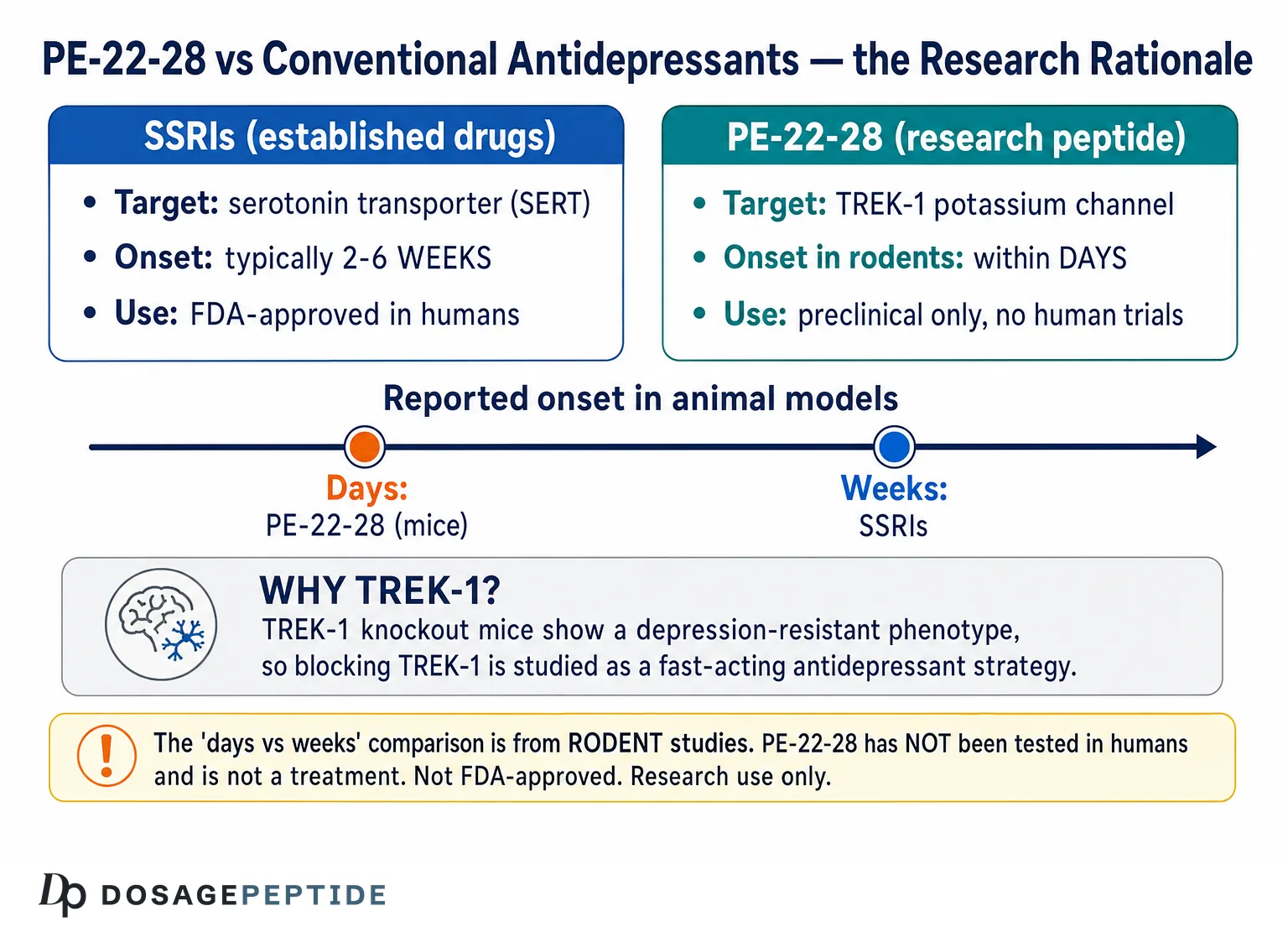
The pivotal piece of evidence came in 2006, when Heurteaux and colleagues reported in Nature Neuroscience that deleting the TREK-1 gene (Kcnk2) in mice produced a “depression-resistant phenotype.” The knockout animals behaved across five different depression models like normal mice that had been treated with fluoxetine. They showed increased efficacy of 5-HT neurotransmission and a blunted corticosterone (stress-hormone) response to stress. The conclusion was that TREK-1 could be a target for a new class of antidepressants—and that blocking it, rather than deleting the gene, might mimic the beneficial phenotype.[3]
This is the intellectual foundation on which spadin and then PE-22-28 were built. The knockout study established the target; spadin proved a peptide could hit it; PE-22-28 optimized the peptide. Every claim about PE-22-28’s antidepressant potential ultimately rests on the validity of the TREK-1 hypothesis of depression—a hypothesis strongly supported in rodents but not yet confirmed through any human therapeutic trial. Independent groups have since reinforced the target using different tools: neuron-specific genetic knockdown of TREK-1 in the mouse hippocampus attenuated depressive-like behavior and protected synaptic proteins under chronic stress.[13]
Mechanisms Studied: How Does PE-22-28 Work?
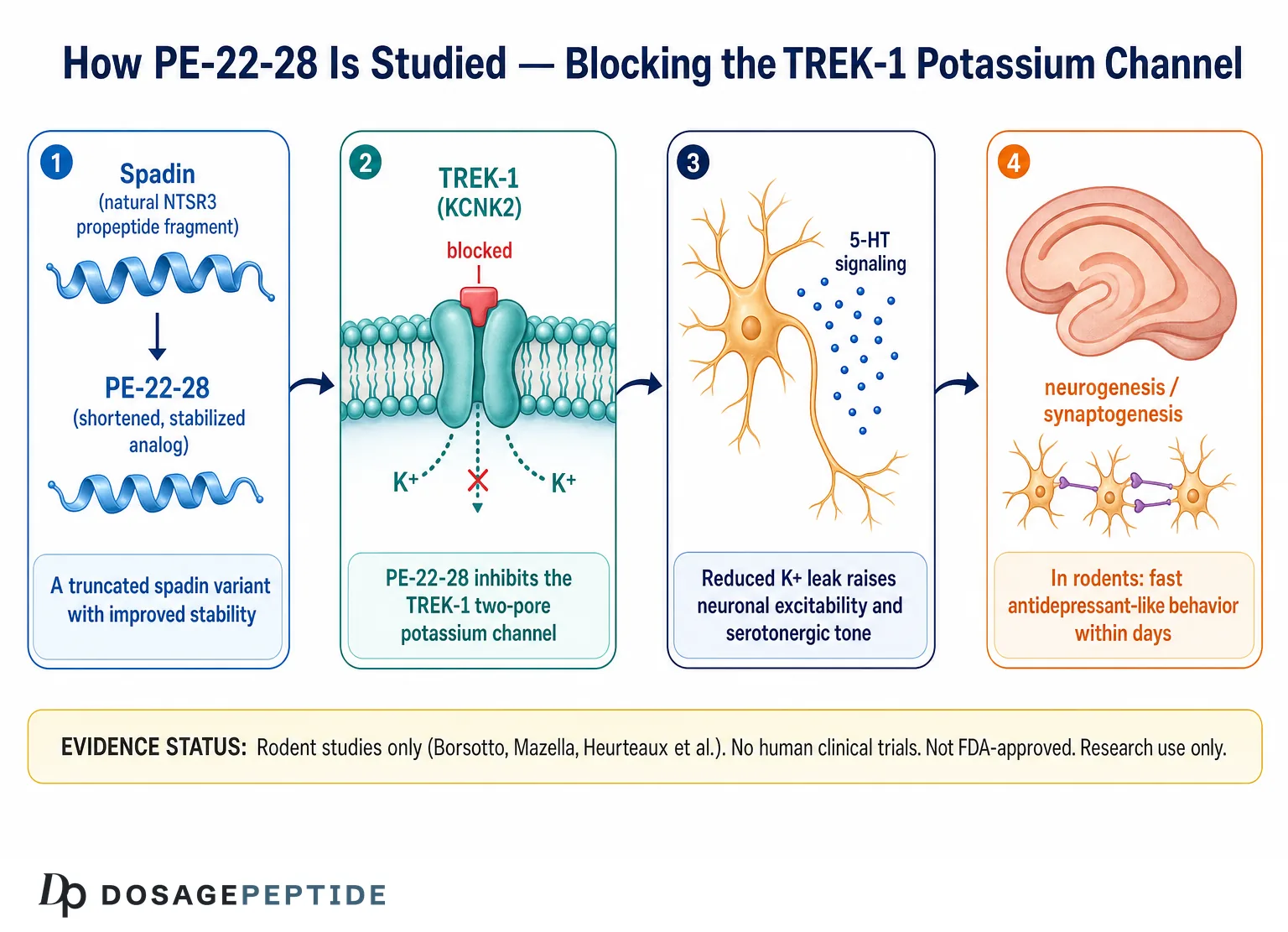
The proposed mechanism of PE-22-28 unfolds in a chain of steps, each of which has been examined in cell or animal experiments. It is worth walking through the chain deliberately, because the strength of evidence varies at each link.
Step 1: Channel inhibition
The most directly demonstrated action is channel block. In patch-clamp electrophysiology on cells expressing human TREK-1, PE-22-28 reduced TREK-1 current with sub-nanomolar potency. The 2017 characterization reported an IC50 around 0.12 nM, positioning PE-22-28 as substantially more potent than spadin in the same experimental system. The researchers also mapped how modifications to the peptide’s N- or C-terminal ends either preserved or abolished channel-blocking activity, which helped identify the residues essential for function.[1]
An important nuance emerged from later independent work. A 2020 study by Ma and Lewis found that spadin did not block basal TREK-1 current under standard conditions in Xenopus oocytes, but instead selectively antagonized the activation of TREK-1 by arachidonic acid, apparently through an allosteric mechanism. Notably, spadin failed to prevent TREK-1 activation by other openers such as BL-1249, CDC, or docosahexaenoic acid, and did not act on the related TREK-2 channel. This suggests the interaction between these peptides and TREK-1 may be more conditional—state-dependent—than a simple pore plug, and it is a reminder that mechanistic details can differ across expression systems and laboratories.[12]
Step 2: Increased neuronal excitability and serotonergic firing
Blocking a background potassium leak makes a neuron less able to hold its polarized resting state, so it becomes more excitable. In the dorsal raphe nucleus—the brain’s main source of serotonin—spadin increased the firing rate of 5-HT neurons, by roughly 113% in one detailed study. That follow-up showed the effect depends on the medial prefrontal cortex and involves 5-HT4 and metabotropic glutamate (mGluR2/3) receptors that are functionally coupled to TREK-1. The same study cautioned that combining spadin with other serotonergic activators could paradoxically drive neurons into a state of depolarization block, underscoring that “more firing” is not linearly “more benefit” and that strategies stacking serotonergic agents should be approached with caution.[9]
Step 3: Downstream plasticity signaling
Enhanced serotonergic tone and altered channel activity feed into intracellular signaling cascades associated with antidepressant response—notably CREB phosphorylation and, in related sortilin-deficiency work, increased BDNF expression and TrkB receptor activation. These pathways are the classic molecular correlates of the neuroplastic changes that conventional antidepressants induce only slowly in animals. In the spadin lineage, they appeared after just a few days of treatment in mice.[2][11]
Step 4: Structural remodeling—neurogenesis and synaptogenesis
At the tissue level, PE-22-28 and its analogs were reported to increase hippocampal neurogenesis after only a four-day treatment, and to enhance synaptogenesis in cultured cortical neurons, indexed by higher levels of the postsynaptic scaffolding protein PSD-95. In the analog family, the glycine/alanine-substituted variant (G/A-PE 22-28) showed a particularly prominent neurogenic effect. Structural remodeling of this kind is thought to be part of how antidepressants ultimately restore mood-regulating circuits.[1]
It is essential to keep the altitude honest here: each of these four steps was measured in rodents or in cultured cells. The chain is biologically coherent and internally consistent, but it has never been traced end-to-end in a human being. For a working definition of technical terms used throughout this mechanism—from “K2P channel” to “synaptogenesis”—the peptide research glossary provides concise reference entries.
Why the “Fast-Acting” Claim? The Speed Hypothesis in Rodent Models
The single most repeated selling point for the entire spadin/PE-22-28 program is speed. Understanding where this claim comes from—and what it does and does not mean—is central to reading the literature critically.
The delayed-onset problem with classical antidepressants
Selective serotonin reuptake inhibitors such as fluoxetine raise synaptic serotonin almost immediately, yet their mood benefits typically take three to four weeks to appear in patients. This therapeutic lag is one of the biggest clinical liabilities of current antidepressants: patients remain at risk during a window when the drug is present but not yet working, and the disconnect between rapid pharmacology and slow benefit implies that downstream adaptive changes—not the reuptake block itself—drive recovery.[6]
What “fast” means in the spadin data
In rodent experiments, spadin produced antidepressant-like effects within about four days—reaching outcomes that classical antidepressants needed roughly 21 days to achieve in the same paradigms. The four-day timeframe also coincided with measurable neurogenesis and CREB phosphorylation. PE-22-28 reproduced rapid behavioral effects while extending the functional duration per dose. This is the empirical basis for calling the approach “fast-acting.”[2][1]
Two cautions are warranted. First, “four days in a mouse” is not the same as “four days in a person”; species timelines and metabolism differ, and behavioral tests such as forced swimming and novelty-suppressed feeding are proxies for antidepressant activity, not diagnoses of depression. Second, the comparison of days-versus-weeks is between a peptide in rodents and a drug in rodents; it does not license any claim about how PE-22-28 would perform in human depression, which has never been tested. The word “fast-acting” is therefore best read as a description of a rodent pharmacology signal and a design goal, not as a demonstrated clinical property.[6]
Neurogenesis and Synaptogenesis: What Rodent Studies Report
Because the neuroplasticity findings are among the most cited—and most easily overstated—aspects of PE-22-28, they deserve a dedicated, careful look.
Hippocampal neurogenesis
The adult rodent hippocampus retains a capacity to generate new neurons, and this process is suppressed by chronic stress and boosted by effective antidepressants in animal models. In the spadin lineage, a short course was reported to increase markers of hippocampal neurogenesis in mice. For PE-22-28 specifically, the 2017 study reported neurogenesis after only four days of treatment, and identified the G/A-PE 22-28 derivative as an especially strong inducer. This positions PE-22-28 as a candidate that might, in principle, engage structural repair processes rather than merely masking symptoms—again, strictly in animal models, and with the caveat that the extent of adult human hippocampal neurogenesis itself remains scientifically debated.[1]
Synaptogenesis and PSD-95
Synaptogenesis—the formation of new synaptic connections—was assessed in cultured mouse cortical neurons by measuring PSD-95, a scaffolding protein concentrated at excitatory postsynaptic densities. PE-22-28 and several of its derivatives raised PSD-95 levels, interpreted as enhanced synapse formation. This dovetails with the independent hippocampal literature showing that TREK-1 knockdown prevents stress-induced loss of synaptic proteins and impairment of glutamatergic transmission in the CA1 region.[1][13]
Beyond mood: stroke and neuroprotection
The plasticity story extends into neuroprotection. A 2019 study of a shorter analog, mini-spadin, in a mouse model of focal ischemia found a striking biphasic action on TREK-1—activating the channel at very low doses (which is neuroprotective during ischemia) and inhibiting it at higher doses (which is associated with antidepressant-like effects). Mini-spadin improved motor and cognitive deficits after stroke, prevented post-stroke depression in behavioral tests, and enhanced neurogenesis and synaptogenesis. While this is a different (shorter) analog than PE-22-28, it illustrates how the sortilin-derived peptide family is being explored across multiple central-nervous-system questions in rodents—and it is a vivid warning that dose can qualitatively flip the pharmacology.[10]
PE-22-28 vs Spadin vs Mini-Spadin: The Analog Family
PE-22-28 is best understood as one member of a designed family of TREK-1-blocking peptides, each representing a different engineering trade-off. Reviewing the family clarifies why PE-22-28 in particular attracted attention.
| Peptide | Length / origin | Reported TREK-1 potency | Functional duration (rodent) | Design goal |
|---|---|---|---|---|
| Propeptide (PE) | 44 aa; furin cleavage of sortilin | Active parent fragment | — | Endogenous precursor |
| Spadin (PE 12–28) | 17 aa; natural fragment | ~10 nM binding; IC50 ~40–60 nM | ~7 hours | First natural antidepressant peptide |
| PE-22-28 | 7 aa; from spadin degradation products | IC50 ~0.12 nM (patch-clamp) | ~23 hours | Higher potency + longer stability |
| G/A-PE 22-28 | 7 aa; Gly/Ala-substituted variant | Retained potent block | Extended | Enhanced neurogenic effect |
| Retro-inverso analogs | D-amino-acid, reversed backbone | Retained antidepressant activity | Increased | Protease resistance |
| Mini-spadin | Shortened; sortilin-derived | Biphasic (activation/inhibition) | Extended | Stroke + post-stroke depression |
The retro-inverso strategy
One notable branch of the family used the retro-inverso approach: building the peptide from D-amino acids in a reversed sequence so that its three-dimensional shape mimics the original while making it far harder for proteases to recognize and degrade. A 2015 study reported that two retro-inverso spadin analogs kept antidepressant-like properties, increased hippocampal neurogenesis after four days, and—like the parent—did not induce side effects on pain, epilepsy processes, or cardiac function in the tested rodent assays. This work demonstrated a general medicinal-chemistry lesson: the same stabilization tricks that helped spadin could be generalized to develop new peptide-drug classes.[5]
Where PE-22-28 sits
PE-22-28 represents the sweet spot the group was chasing: dramatically higher target potency than spadin in their assays, a functional duration roughly three times longer, and a compact seven-residue structure that is simpler and cheaper to synthesize than the 17-residue parent. Its derivatives, especially G/A-PE 22-28, extend specific properties such as neurogenesis. For laboratories choosing a TREK-1-blocking tool compound, these are meaningful advantages—which is exactly why PE-22-28 became the reference research peptide of the series. It is worth repeating that “reference research peptide” is a laboratory status, not a therapeutic one.[1]
Current Evidence Level: What Do We Actually Know?
This section is the honest core of the article. The evidence tier for PE-22-28 must be stated precisely, because it is easy to encounter marketing language that blurs the line between a promising laboratory concept and a proven treatment.
The evidence is preclinical—rodent and in-vitro only
Every antidepressant, neurogenic, synaptogenic, and neuroprotective finding for PE-22-28 and its analogs comes from one of three settings: (1) electrophysiology and biochemistry on cultured or transfected cells, (2) behavioral tests in mice (forced swimming, tail suspension, novelty-suppressed feeding, and related paradigms), or (3) rodent models of chronic stress, ischemia, or genetic modification. There are no completed or published human clinical trials of PE-22-28. It has not been tested for safety or efficacy in people, has no approved indication, and is not an FDA-approved drug. It exists, at present, purely as a preclinical research compound.[1][6]
How strong is the preclinical package?
Within its tier, the evidence is comparatively robust for a research peptide. The target validation is strong: a 2006 genetic knockout, multiple independent pharmacological studies, sortilin-knockout confirmation, and third-party replications by groups in China using entirely different tools all converge on TREK-1 as a legitimate mood-relevant channel in rodents.[3][11][13] A 2023 rat study even proposed a new anti-inflammatory dimension, reporting that blocking TREK-1 with spadin suppressed activation of A1-like reactive astrocytes via the NF-κB pathway in a chronic-stress model of major depressive disorder.[14]
The peptide-specific evidence is thinner. Much of the direct PE-22-28 data traces to a small number of papers from one primary research group, and some mechanistic details—such as whether the peptides block basal current or only channel activation—are still debated between laboratories.[12] Strong target biology plus limited independent compound-level replication is a fair one-line summary of where the field stands.
The translational gap
The history of antidepressant development is littered with compounds that looked excellent in rodent forced-swim tests and then failed in human trials. Behavioral despair tests have real predictive limits. A depression-resistant knockout mouse is a powerful proof of concept for a target, but the path from “interesting channel” to “safe, effective human medicine” is long, expensive, and frequently unsuccessful. Many programs that cleared elegant mechanistic and animal-behavior hurdles have still stalled at first-in-human safety or failed to separate from placebo in controlled efficacy trials, which is exactly the gap that remains completely unaddressed here. PE-22-28 has not begun that clinical journey publicly, and no regulator has evaluated it.[6]
Safety Signals in Animal Studies and Regulatory Status
A recurring theme in the spadin literature is a favorable side-effect profile relative to the risks one might expect from blocking a widely expressed channel. This deserves both acknowledgment and heavy caveating.
The “absence of TREK-1-related side effects” finding
Because TREK-1 is involved in pain sensitivity, seizure susceptibility, and responses to ischemia, a reasonable worry was that blocking it might increase pain, provoke seizures, or worsen stroke damage. A 2011 study specifically addressed this. It reported that spadin did not interfere with pain, epilepsy, or ischemia outcomes; did not inhibit the related K2P channels TREK-2, TRAAK, TASK, or TRESK; did not block the cardiac IKr or IKs currents; and did not alter systolic pressure, cardiac pulse, infarct size, seizure threshold, or glycemia in mice. The interpretation was that spadin’s selectivity spared the other TREK-1-dependent functions.[4]
An interesting mechanistic explanation for this clean profile was later offered: if the peptides antagonize only the activation of TREK-1 rather than blocking the channel outright, they would leave baseline channel function—and its protective roles—largely intact, potentially explaining the lack of side effects observed in animals.[12]
Why this does not mean “safe for humans”
Favorable rodent safety data are encouraging but they establish nothing about human safety. Species differ in channel distribution, metabolism, immune response, and dosing scale. No human pharmacokinetics, immunogenicity, or toxicity data exist for PE-22-28. Peptides can also provoke immune reactions that only appear in humans or with repeated dosing. A clean multi-week rodent readout is not a substitute for the phased human safety testing that any real medicine must pass.[4]
Regulatory status
PE-22-28 is not approved by the FDA, the EMA, or any comparable regulator for any use. It is not a prescription drug, an over-the-counter product, or a dietary supplement. It is sold and handled strictly as a laboratory research chemical for preclinical study. Reference material such as the PE-22-28 research handling and reconstitution reference exists to document what is reported in experimental contexts—not to endorse or instruct human self-administration, which no legitimate evidence supports.
How Does PE-22-28 Compare to Other Mood and Cognition Research Peptides?
PE-22-28 is often discussed alongside other peptides studied in the cognitive and mood space. The comparison is useful for placing it in context—while remembering that all of these are investigational research compounds, not interchangeable products, and that they act through completely different mechanisms.
Mechanistic distinctiveness
What sets PE-22-28 apart is its target class. Most neuroactive research peptides work through receptors or neurotrophic signaling. PE-22-28 is, unusually, an ion-channel-directed peptide—its entire proposed activity flows from modulating a potassium leak channel. That makes it mechanistically distinct from serotonergic drugs, from neuropeptide-receptor agonists, and from growth-factor-mimicking peptides. It is one of relatively few peptides in the research literature whose antidepressant hypothesis is built on ion-channel pharmacology rather than neurotransmitter reuptake or receptor binding.[8]
Anxiety-focused peptides
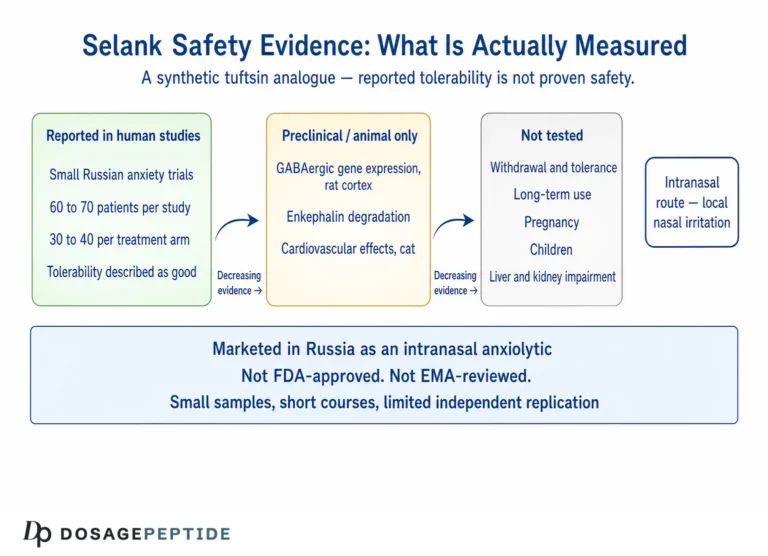
Peptides studied primarily for anxiolytic and nootropic properties, such as the compound reviewed in this overview of Selank as a nootropic peptide for anxiety and cognition, occupy an adjacent but separate niche. Selank derives from an endogenous immunomodulatory peptide and is studied for anxiety-related and cognitive endpoints through mechanisms involving GABAergic and monoaminergic systems—not TREK-1 channel block. Comparing the two illustrates how “mood and cognition” peptides can share a research category while having almost nothing in common at the molecular level.
Sleep-focused peptides
Similarly, peptides investigated for sleep architecture—the subject of this look at whether DSIP influences sleep in research settings—target yet another set of pathways. Because depression, anxiety, and sleep disturbance frequently co-occur, it can be tempting to lump their candidate peptides together, but each compound’s evidence base, mechanism, and evidence tier must be evaluated on its own. PE-22-28’s literature is about a potassium channel and antidepressant-like behavior in mice; it says nothing about sleep or anxiety peptides, and vice versa.
The shared caveat
The one thing PE-22-28 truly shares with these neighbors is evidence-tier: all are preclinical or early-stage research compounds without the human clinical validation of an approved drug. That shared status is the most important comparison of all, because it is the reason none of them should be framed as treatments.
Limitations and Open Questions
A responsible reference on PE-22-28 must foreground its limitations as prominently as its promise. Several major open questions remain.
No human data of any kind
The overriding limitation is the complete absence of human clinical evidence for PE-22-28 as an intervention. Without human pharmacokinetic, safety, and efficacy trials, PE-22-28’s translational value is unknown. Peptide antidepressants also face a practical delivery hurdle: peptides are generally poorly absorbed orally and cross the blood-brain barrier inefficiently, which is why the rodent studies used injection. How a TREK-1-blocking peptide would be delivered to the human brain at a therapeutic and sustained concentration is unresolved.[6]
Mechanistic disagreements
The precise molecular action is not fully settled. The founding studies describe potent channel block, whereas at least one independent group found no block of basal current and instead a selective, allosteric antagonism of channel activation. These are not trivial differences—they affect predictions about efficacy, dosing, and side effects. Reconciling them will require additional independent electrophysiology across standardized systems.[12]
Concentration of evidence in one research program
The bulk of the primary PE-22-28 and spadin data originates from a single laboratory network. While that group’s work is peer-reviewed and internally consistent, and while independent groups have validated the TREK-1 target, the compound-specific behavioral and neurogenic findings would be substantially strengthened by independent replication of PE-22-28 itself, not just of the target.[1]
Predictive validity of rodent tests
Forced swimming, tail suspension, and novelty-suppressed feeding are the workhorses of preclinical antidepressant screening, but their ability to predict human antidepressant efficacy is imperfect and has been criticized. A compound can reduce immobility in a mouse without ever helping a depressed person. This is a general limitation of the field, not unique to PE-22-28, but it applies squarely to it.[6]
Long-term consequences of channel modulation
TREK-1 participates in pain processing, seizure control, cardiac electrophysiology, and ischemic protection. Rodent studies suggest spadin spares these functions, but the long-term effects of chronic TREK-1 modulation in humans—including any biphasic dose effects like those seen with mini-spadin—are entirely uncharacterized. The biphasic activation/inhibition behavior seen with dose in the stroke study is a particularly important reminder that dose could qualitatively change the pharmacology.[10]
What Would It Take for PE-22-28 to Become a Real Therapy?
Framing the road ahead helps calibrate expectations honestly. For PE-22-28 to move from research chemical to medicine, several milestones would need to be reached, none of which has been publicly completed.
- Formal preclinical toxicology: Good Laboratory Practice safety pharmacology and repeat-dose toxicity studies across multiple species, well beyond the mechanistic side-effect screens published so far.
- A viable delivery and formulation strategy: A way to achieve stable, sufficient brain exposure in humans, since peptides are fragile and brain-penetration is limited.
- Independent replication of compound-level efficacy: Confirmation of the antidepressant-like and neurogenic effects by laboratories outside the originating network.
- Phase 1 human safety trials: First-in-human dosing to establish tolerability, pharmacokinetics, and immunogenicity—none of which exists today.
- Phase 2/3 efficacy trials: Randomized, controlled demonstration that it actually helps a defined disorder in people, measured against placebo and standard of care.
Until at least the early clinical milestones are met and published, PE-22-28 remains an intriguing hypothesis-testing tool—valuable for probing TREK-1 biology in the laboratory, but not a treatment for anything in humans.[6]
The TREK-1 Channel Family in Depth
Because PE-22-28 is defined entirely by a single molecular target, a closer look at that target’s biology clarifies both why the peptide is interesting and why its selectivity is such a central question. TREK-1 does not act alone; it is one member of a structurally related subfamily, and its physiological reach extends far beyond the mood circuits that dominate the antidepressant literature.
Structure and gating of a background channel
Two-pore-domain potassium channels earn their name from an unusual architecture: each subunit carries two pore-forming domains in tandem rather than the single domain seen in most potassium channels, and two subunits assemble to build one functional channel with the standard four pore-loops. TREK-1 sits within the thermo- and mechano-sensitive TREK/TRAAK branch of this family, alongside TREK-2 (KCNK10) and TRAAK (KCNK4). What makes the branch distinctive is polymodal gating: the same channel opens or closes in response to membrane stretch, temperature shifts, intracellular acidification, unsaturated fatty acids such as arachidonic acid, phosphorylation by protein kinases downstream of Gs- and Gq-coupled receptors, and direct interactions with partner proteins. This convergence of inputs onto one channel is why TREK-1 is often described as a cellular integrator rather than a simple leak conductance.[8]
The consequence for pharmacology is important. A channel controlled by many convergent signals can, in principle, be modulated at several distinct points—the lipid-sensing site, the C-terminal regulatory domain, or the pore itself—and a peptide that acts at one of these may leave the others untouched. This is precisely the ambiguity that surrounds spadin and PE-22-28: whether they occlude the conduction pathway directly or instead bias one of the channel’s gating modes is still contested between laboratories, and the answer changes what “blocking TREK-1” actually means at the molecular level.[12]
TASK-3 and the wider mood-relevant K2P set
The antidepressant hypothesis is not exclusively a TREK-1 story. The same body of work that frames TREK-1 as a depression target also implicates TASK-3 (KCNK9), an acid-sensitive K2P channel, as a second candidate whose modulation influences mood-related behavior in animal models. Positioning TREK-1 within this small set matters for interpretation: it suggests the underlying principle may be that reducing certain background potassium conductances raises the excitability of specific neuronal populations—particularly serotonergic and their upstream cortical regulators—rather than anything unique to one gene product. A tool compound aimed at TREK-1 is therefore probing a broader hypothesis about leak-channel control of mood circuits, and its selectivity against sibling channels like TASK-3, TREK-2, and TRAAK is part of what any responsible characterization must report.[8]
The double-edged expression profile
TREK-1’s expression is the source of both its therapeutic appeal and its principal safety concern. The channel is enriched in brain regions tied to emotion and cognition, which is what makes it a plausible mood target. But it is also expressed in sensory neurons that process pain and temperature, in smooth muscle, in the heart, and in tissues where it participates in protection against ischemic injury. The original genetic evidence made this concrete: mice lacking the TREK-1 gene are resistant to depression-like behavior, yet the same deletion alters pain sensitivity and neuroprotective responses, demonstrating that the channel is doing several jobs at once.[3] A drug that blocks TREK-1 everywhere would engage all of these functions simultaneously, which is exactly why the reported selectivity of spadin-family peptides—their apparent failure to disturb pain, seizure, and cardiac endpoints in rodents—is treated in the literature as a defining feature rather than a minor detail. The unresolved worry is whether that clean rodent profile would survive translation to humans, where channel distribution and dosing scale differ.[4]
Pharmacokinetics, Stability, and the Delivery Problem
Even setting aside the complete absence of human data, PE-22-28 faces the same hard constraints that limit every peptide considered as a central-nervous-system agent. Understanding these constraints explains why so much of the design work on the spadin family targeted stability and duration rather than potency alone, and why a promising rodent readout does not translate automatically into a workable medicine.
Why stability drove the whole design program
Peptides are intrinsically fragile in the body. Circulating and tissue-bound proteases recognize peptide bonds and cleave them quickly, so an unprotected sequence may lose its activity within hours of administration. The parent peptide spadin illustrated the problem directly: its measurable functional activity in mice faded after roughly seven hours. The entire rationale for PE-22-28 was to salvage the active core while shedding the vulnerable flanking residues, and the reported payoff was a functional duration extended to around twenty-three hours per dose—a roughly threefold improvement achieved without sacrificing, and in the reported assays actually increasing, target potency.[1] This is a clean example of a general medicinal-chemistry logic: identify the minimal pharmacophore, then engineer resistance to the specific degradation routes that destroy it.
Retro-inverso chemistry as a stability lever
The most explicit stabilization strategy in the family was the retro-inverso approach, in which the peptide is rebuilt from D-amino acids arranged in a reversed sequence. Because proteases evolved to recognize L-amino-acid backbones in a particular orientation, a mirror-image, reversed peptide can present a similar three-dimensional shape to its target while being largely invisible to degrading enzymes. Retro-inverso spadin analogs were reported to retain antidepressant-like properties and neurogenic effects in rodents while gaining resistance to breakdown, confirming that the target-recognition surface could be preserved under aggressive backbone modification.[5] This matters for interpreting PE-22-28: it shows the series is amenable to the kinds of chemical hardening a real drug-development program would demand, even though such hardening is only a prerequisite for, not a guarantee of, clinical viability.
The blood-brain barrier and route of administration
Stability solves only half of the delivery problem. To act on TREK-1 in mood circuits, a peptide must reach the brain, and the blood-brain barrier is highly restrictive toward large, charged, water-soluble molecules—a description that fits most peptides. Oral administration is essentially a non-starter for an unmodified peptide, because the digestive tract would degrade it and absorption into the bloodstream would be poor. This is why the rodent studies relied on injection rather than any oral route. For a human program, achieving stable, sufficient, and sustained brain exposure would demand a dedicated formulation or delivery strategy—none of which has been demonstrated for PE-22-28—and the delayed-onset review of the field flags exactly this delivery gap as one of the practical barriers between an interesting TREK-1 pharmacology and a usable antidepressant.[6]
Dose sensitivity is a pharmacokinetic hazard, not just a pharmacodynamic one
A final, easily overlooked point is that the spadin family’s pharmacology can be genuinely dose-dependent in direction, not merely in magnitude. The stroke work on the shorter mini-spadin analog reported a biphasic action on TREK-1—activation at very low doses, inhibition at higher doses—meaning the qualitative effect flipped with concentration.[10] Combined with a peptide’s naturally variable absorption and clearance, this makes exposure control unusually consequential: the same compound could, in principle, push the channel in opposite directions depending on where its concentration lands. For a research tool this is a fascinating property to map; for a hypothetical therapeutic it would be a demanding pharmacokinetic constraint, and it underscores why careful human dose-ranging—work that has never been done for PE-22-28—would be indispensable before any clinical claim could be entertained.
Frequently Asked Questions
What is PE-22-28 in simple terms?
PE-22-28 is a seven-amino-acid synthetic peptide and a shortened analog of spadin, a natural peptide derived from the sortilin (NTSR3) propeptide. Its single studied action is inhibiting the TREK-1 potassium channel, which in rodent experiments is associated with fast antidepressant-like effects. It is a preclinical research chemical, not an approved medicine, and has never been tested in humans.[1]
How is PE-22-28 different from spadin?
Spadin is the natural 17-amino-acid peptide (positions 12–28 of the sortilin propeptide). PE-22-28 is a 7-amino-acid fragment designed from spadin’s breakdown products. In the same patch-clamp assay, PE-22-28 showed much higher TREK-1 potency (IC50 near 0.12 nM versus roughly 40–60 nM for spadin) and a longer functional duration in rodents—about 23 hours versus about 7 hours.[1]
Is PE-22-28 an approved antidepressant?
No. PE-22-28 is not approved by the FDA, EMA, or any regulator for any indication. It is not a prescription drug, over-the-counter product, or supplement. All antidepressant findings come from mice and cultured cells. There are no human clinical trials, so no claim about treating depression in people is supported by evidence.[6]
What is the TREK-1 channel and why does blocking it matter?
TREK-1 (gene KCNK2) is a two-pore-domain “background” potassium channel that helps keep neurons at rest. Mice lacking the TREK-1 gene are resistant to depression-like behavior across multiple tests, so blocking the channel pharmacologically is studied as a way to reproduce that beneficial phenotype and increase serotonergic signaling in animal models.[3]
Why is PE-22-28 described as “fast-acting”?
In rodent models, spadin and PE-22-28 produced antidepressant-like effects within about four days—matching outcomes that classical antidepressants such as fluoxetine needed roughly three weeks to achieve in the same tests. This speed, seen alongside rapid neurogenesis markers, is the basis for the “fast-acting” description. It refers to rodent timelines, not any demonstrated human effect.[2]
Does PE-22-28 cause neurogenesis?
In mice, PE-22-28 was reported to increase hippocampal neurogenesis after only four days and to enhance synaptogenesis in cultured cortical neurons, with a derivative called G/A-PE 22-28 showing a particularly strong neurogenic effect. These are animal and cell-culture findings; whether PE-22-28 promotes neurogenesis in humans is entirely unstudied.[1]
What side effects did animal studies report?
Rodent studies reported a notably clean profile: spadin did not affect pain, seizures, or ischemia outcomes, did not block related potassium or cardiac channels, and did not alter blood pressure or glucose. This may reflect selective antagonism of channel activation rather than total block. However, favorable rodent safety does not establish human safety, and no human toxicity data exist.[4]
Are there human clinical trials of PE-22-28?
No published or completed human clinical trials of PE-22-28 exist. The entire evidence base is preclinical—electrophysiology, biochemistry, and behavioral tests in rodents. This is the single most important fact to keep in mind: PE-22-28 is a laboratory research tool, and any framing of it as a human treatment goes beyond what the science supports.[6]
How does PE-22-28 relate to sortilin?
Sortilin (also called neurotensin receptor-3, NTSR3) is matured by the enzyme furin, which releases a 44-amino-acid propeptide. Spadin, and by extension PE-22-28, are fragments of that propeptide. Sortilin also physically interacts with TREK-1 and controls how much of the channel reaches the cell surface, tying the propeptide fragments to mood-relevant channel biology.[7]
References
- Djillani A, Pietri M, Moreno S, Heurteaux C, Mazella J, Borsotto M. Shortened Spadin Analogs Display Better TREK-1 Inhibition, Stability and Antidepressant Activity. Front Pharmacol. 2017;8:643. PMC5601071
- Mazella J, Pétrault O, Lucas G, et al. Spadin, a sortilin-derived peptide, targeting rodent TREK-1 channels: a new concept in the antidepressant drug design. PLoS Biol. 2010;8(4):e1000355. PMC2854129
- Heurteaux C, Lucas G, Guy N, et al. Deletion of the background potassium channel TREK-1 results in a depression-resistant phenotype. Nat Neurosci. 2006;9(9):1134-1141. PubMed 16906152
- Moha Ou Maati H, Veyssiere J, Labbal F, et al. Spadin as a new antidepressant: absence of TREK-1-related side effects. Neuropharmacology. 2012;62(1):278-288. PubMed 21807005
- Veyssiere J, Moha Ou Maati H, Mazella J, et al. Retroinverso analogs of spadin display increased antidepressant effects. Psychopharmacology (Berl). 2015;232(3):561-574. PMC4302242
- Djillani A, Pietri M, Mazella J, Heurteaux C, Borsotto M. Fighting against depression with TREK-1 blockers: Past and future. A focus on spadin. Pharmacol Ther. 2019;194:185-198. doi:10.1016/j.pharmthera.2018.10.003
- Mazella J, Borsotto M, Heurteaux C. The Involvement of Sortilin/NTSR3 in Depression as the Progenitor of Spadin and Its Role in the Membrane Expression of TREK-1. Front Pharmacol. 2019;9:1541. PMC6331531
- Borsotto M, Veyssiere J, Moha Ou Maati H, Devader C, Mazella J, Heurteaux C. Targeting two-pore domain K+ channels TREK-1 and TASK-3 for the treatment of depression: a new therapeutic concept. Br J Pharmacol. 2015;172(3):771-784. PMC4301688
- Moha ou Maati H, Bourcier-Lucas C, Veyssiere J, et al. The peptidic antidepressant spadin interacts with prefrontal 5-HT4 and mGluR2 receptors in the control of serotonergic function. Brain Struct Funct. 2016;221(1):21-37. PubMed 25233810
- Pietri M, Djillani A, Mazella J, Borsotto M, Heurteaux C. First evidence of protective effects on stroke recovery and post-stroke depression induced by sortilin-derived peptides. Neuropharmacology. 2019;158:107715. PubMed 31325429
- Moreno S, Devader CM, Pietri M, Borsotto M, Heurteaux C, Mazella J. Altered Trek-1 Function in Sortilin Deficient Mice Results in Decreased Depressive-Like Behavior. Front Pharmacol. 2018;9:863. PMC6088259
- Ma R, Lewis A. Spadin Selectively Antagonizes Arachidonic Acid Activation of TREK-1 Channels. Front Pharmacol. 2020;11:434. PMC7154116
- Wu F, Sun H, Gong W, et al. Genetic and pharmacological inhibition of two-pore domain potassium channel TREK-1 alters depression-related behaviors and neuronal plasticity in the hippocampus in mice. CNS Neurosci Ther. 2021;27(2):220-232. PMC7816204
- Cong T, Sun Y, Zhou Y, et al. Blocking Two-Pore Domain Potassium Channel TREK-1 Inhibits the Activation of A1-Like Reactive Astrocyte Through the NF-κB Signaling Pathway in a Rat Model of Major Depressive Disorder. Neurochem Res. 2023;48(6):1737-1754. PMC10119044
Research-use disclaimer: PE-22-28 is an unapproved research chemical intended solely for laboratory and preclinical investigation. This article is an educational reference and is not medical advice. Nothing here describes a treatment for any disease, endorses human use or self-administration, or should be interpreted as a dosing recommendation. All efficacy, mechanism, and safety statements derive from cell-culture and animal studies; no human clinical data exist for PE-22-28. Consult a qualified, licensed healthcare professional for any medical concern.