Short answer: FOXO4-DRI is a synthetic peptide designed to make senescent cells — the “zombie cells” that accumulate with age — destroy themselves, by breaking the FOXO4–p53 interaction that keeps them alive. Its reputation rests almost entirely on one 2017 study in mice and cultured cells (Baar et al., Cell). There is no human clinical trial data, and that gap is the single most important thing to know about it.
The “DRI” is chemistry, not branding: D-retro-inverso, a design that rebuilds the peptide from mirror-image amino acids assembled in reverse order so it resists being broken down. What follows covers the senescence biology that motivated it, exactly how the decoy mechanism works, what the landmark study did and did not show, and where the evidence stands today.
What Is FOXO4-DRI? A Research-Compound Overview
FOXO4-DRI is a synthetic D-retro-inverso peptide derived from a short stretch of the human FOXO4 protein sequence. It was designed as a molecular decoy: a peptide that mimics part of FOXO4 closely enough to compete with the native protein for binding to the tumor-suppressor p53, thereby disrupting the FOXO4 p53 interaction inside senescent cells.[1] The compound was introduced in a 2017 study published in the journal Cell by Marjolein Baar, Peter de Keizer and colleagues at Erasmus University Medical Center and the University Medical Center Utrecht.[1]
The “DRI” in the name is not a brand — it is a chemistry designation. It stands for D-retro-inverso, a peptide-engineering strategy that rebuilds a peptide from mirror-image (D-form) amino acids assembled in reverse order. That single design choice is what makes the molecule interesting as a research tool, because it dramatically changes how the peptide behaves inside a living system compared with an ordinary peptide. We unpack that chemistry in its own section below.
It is essential to state the regulatory and evidentiary status plainly at the outset. FOXO4-DRI is not an approved drug in the United States, the European Union, or anywhere else. It is not in any published, completed human clinical trial. It is best understood as an experimental research compound used to probe the biology of cellular senescence in laboratory models. Anyone reading about it as a “longevity peptide” should keep the evidence tier front of mind. For readers who want to compare terminology across this field, our peptide research glossary defines senolytic, senescence, and related terms in plain language, and the dedicated FOXO4-DRI research reference page collects the reconstitution and handling parameters reported in the laboratory literature.
A recurring theme in this article is the distance between what has actually been measured and what is often claimed online. FOXO4-DRI has a real, published scientific basis; it is not a fabrication or a scam molecule. But that legitimate basis is narrow — a single high-profile primary paper plus supporting mechanistic and review literature — and it lives entirely in cell dishes and mice. Keeping the boundary between “demonstrated in a mouse” and “shown to help a person” visible at every step is the most useful thing a careful reader can do with this compound.
Research Context: Why Cellular Senescence Became a Target
FOXO4-DRI cannot be understood without the biology it was designed to manipulate. Over the past two decades, cellular senescence moved from an obscure tissue-culture curiosity to one of the recognized “hallmarks of aging” — a cell-level process that both protects against cancer early in life and appears to drive tissue dysfunction later on.[2]
What is a senescent cell?
A senescent cell is a cell that has permanently stopped dividing but has not died. Cellular senescence was first described by Leonard Hayflick as the limit on how many times normal human cells will divide in culture, but researchers now recognize many triggers: telomere shortening, DNA damage, oncogene activation, oxidative stress, and chemotherapy exposure among them.[3] Rather than proliferating or undergoing apoptosis (programmed cell death), these cells enter a stable arrest, resist their own death signals, and linger in tissue.
Crucially, the arrest is enforced by cell-cycle machinery — particularly the tumor-suppressor pathways governed by p16INK4a and p53/p21 — which is why those same molecules keep reappearing throughout the senescence and senolytics story. A senescent cell is not simply an old or tired cell; it is a cell locked into a distinctive, actively maintained state with a characteristic pattern of gene expression, enlarged and flattened morphology in culture, and biochemical markers such as senescence-associated beta-galactosidase activity that researchers use to identify it.
Senescence is not purely harmful. As a tumor-suppressive brake, it stops cells with damaged or potentially cancerous genomes from replicating. The problem is chronic accumulation: as an organism ages, senescent cells build up in tissues faster than the immune system clears them, and their persistence is associated with age-related decline.[4]
The “zombie cell” nickname and the SASP
The popular label “zombie cells” captures a real biological feature. Senescent cells are metabolically active and refuse to die, but they no longer perform their normal job. Worse, many of them secrete a cocktail of inflammatory cytokines, chemokines, growth factors, and matrix-degrading enzymes collectively called the senescence-associated secretory phenotype (SASP).[5] Through the SASP, a relatively small number of senescent cells can spread low-grade inflammation to neighboring healthy tissue, remodel the local environment, and, in some models, induce senescence in bystander cells. This paracrine, spreading quality is the reason researchers became interested in removing senescent cells rather than merely silencing them.
The SASP is also a double-edged phenomenon in its own right. In the short term it can be beneficial — the same secreted signals help recruit immune cells to clear damaged tissue and contribute to wound healing and tissue remodeling. It is the chronic, unresolved version of the SASP, sustained by senescent cells that the aging immune system fails to remove, that is thought to feed the low-grade “inflammaging” associated with many age-related conditions. This is why the research goal is usually framed as selective clearance of the persistent, pathological senescent cells rather than blanket suppression of a process that also does useful work.
From clearing cells to “senolytics”
The pivotal proof of concept came from genetic mouse models. In experiments where senescent cells could be selectively destroyed on command — using an engineered transgene that killed cells expressing the senescence marker p16INK4a — clearing those cells delayed or attenuated several features of aging and age-related disease in mice.[6] That genetic result raised an obvious pharmacological question: could a drug or peptide accomplish the same targeted clearance without genetic engineering? Compounds that selectively kill senescent cells were named senolytics, and the search for them became an active field.[7] FOXO4-DRI is one entrant in that search — a peptide-based, mechanism-specific senolytic candidate.
It is worth emphasizing what the genetic experiments did and did not prove. They established, in a controlled model, that removing senescent cells can improve markers of tissue health and certain functional measures — a validation of the concept of senolysis. They did not, by themselves, validate any particular drug. The transgenic approach depends on genetically engineering the animals in advance so that senescent cells can be killed by a synthetic trigger; it is a research tool, not a therapy. Translating that idea into a molecule that could find and eliminate senescent cells in an un-engineered body is the entire challenge that senolytic drug discovery, including the FOXO4-DRI program, set out to address.
What Is a D-Retro-Inverso Peptide?
The design of FOXO4-DRI is inseparable from its function, so the chemistry deserves a careful, non-hand-wavy explanation. The term D-retro-inverso peptide describes two simultaneous modifications applied to a natural peptide sequence.
The two transformations: D-amino acids and reversed order
Natural proteins are built almost exclusively from L-amino acids — a specific three-dimensional handedness (chirality). A “retro-inverso” peptide replaces every L-amino acid with its mirror-image D-amino acid (the “inverso” part) and simultaneously reverses the order of the residues from N-terminus to C-terminus (the “retro” part).[8] These two changes partially cancel each other out geometrically: reversing the sequence while inverting each residue’s chirality can produce a molecule whose amino-acid side chains occupy roughly the same spatial positions as the original, so it can still present a similar binding surface to a partner protein.
The geometry is worth picturing concretely. In an ordinary L-peptide, the backbone runs in a defined direction and each side chain projects from a carbon of fixed handedness. If you reverse the sequence order alone, the side chains end up in the wrong places relative to the backbone; if you invert the chirality alone, they point the wrong way. Doing both at once means the two errors compensate: the topology of the side chains — the part that actually contacts a binding partner — can end up closely resembling the original, even though the backbone chemistry is now “unnatural.” This is why the retro-inverso trick is attractive for making a stable mimic of a short recognition motif, which is exactly what the FOXO4-derived decoy needs to be.
Why bother? Protease resistance and stability
The practical payoff is durability. The enzymes that chew up peptides in blood and tissue — proteases and peptidases — evolved to recognize L-amino-acid peptide bonds. A peptide built from D-amino acids is largely invisible to those enzymes, giving it a far longer half-life inside a biological system than a comparable natural peptide.[8] For a research molecule intended to reach cells throughout the body and act on an intracellular interaction, resisting rapid degradation is a major advantage. In the FOXO4-DRI design, this stability is what allowed the peptide to remain intact long enough to interfere with the FOXO4–p53 complex in the reported mouse experiments.
Stability matters for a second, more subtle reason: an ordinary L-peptide decoy would be degraded so quickly that reaching an intracellular target in a whole animal would be nearly impossible, and any biological effect could be dismissed as an artifact of breakdown products. By building the decoy from D-amino acids, the researchers made a molecule whose observed activity can more plausibly be attributed to the intact peptide engaging its intended target. That is a design feature aimed at interpretability as much as at potency — an important consideration when the whole point of the experiment is to test a specific mechanistic hypothesis about FOXO4 and p53.
The trade-offs of the DRI approach
D-retro-inverso engineering is elegant but not magic. The geometric mimicry between a native peptide and its DRI analog is approximate, not perfect, and whether a given DRI peptide truly reproduces the parent’s binding depends on the specific sequence and how it engages its target. Delivery of any peptide to an intracellular target is also non-trivial, because cell membranes are not freely permeable to peptides. In the FOXO4-DRI reports, the peptide sequence itself includes a cell-penetrating segment that helps it cross membranes. These are exactly the sorts of design details that determine whether a laboratory result will ever translate — and they are why every claim about FOXO4-DRI must be tethered to the specific models in which it was tested.
There is also no guarantee that a strategy that works for one protein–protein interaction generalizes. Retro-inverso mimicry tends to work best for relatively short, extended recognition motifs; complex or conformationally constrained binding surfaces are harder to reproduce. The success of the FOXO4-DRI decoy in its reported experiments does not imply that the approach is a universal template, nor does it settle whether the peptide behaves identically across the many different tissues and senescence subtypes present in a real organism. These caveats are not reasons to dismiss the chemistry — they are reasons to keep interpreting results at the level of the specific systems in which they were obtained.
Mechanism Studied: How FOXO4-DRI Disrupts the FOXO4–p53 Interaction
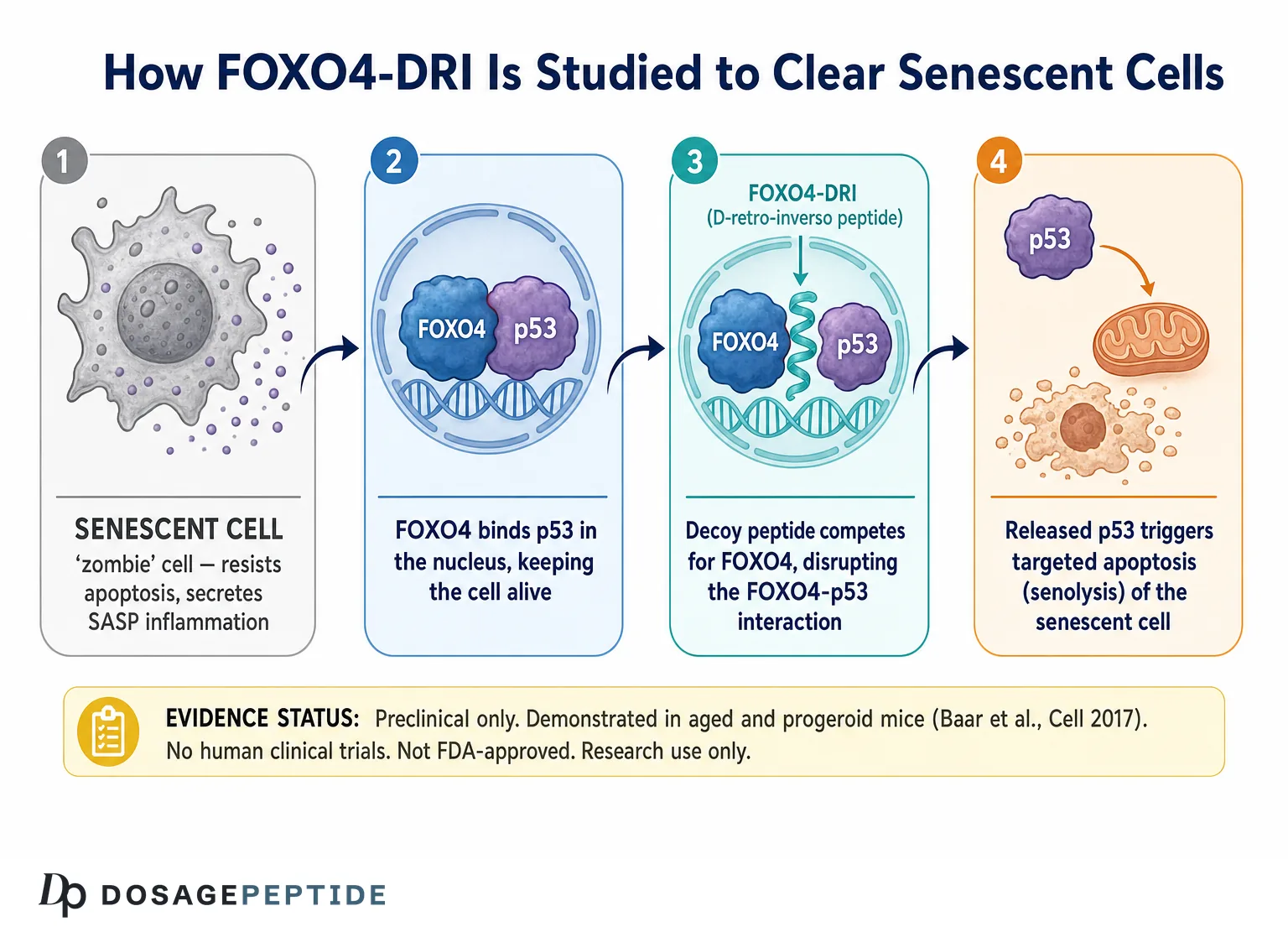
The proposed FOXO4-DRI mechanism centers on a single molecular relationship inside senescent cells: the interaction between the transcription factor FOXO4 and the tumor suppressor p53. Understanding that relationship is the key to understanding why the peptide was designed the way it was.
The role of FOXO4 in senescent cells
FOXO4 (Forkhead box O4) belongs to the FOXO family of transcription factors, proteins involved in stress resistance, metabolism, DNA-damage responses, and longevity signaling across many species.[9] Research on the FOXO4–p53 axis reported that FOXO4 is expressed at elevated levels in senescent cells and helps maintain their viability.[10] In this model, FOXO4 acts as a survival factor for the senescent state.
The FOXO family is best known in longevity biology through its worm and fly homologs, whose activity is tied to lifespan-extending signaling downstream of insulin/IGF-1 pathways. In mammals the family has diversified into several members (FOXO1, FOXO3, FOXO4, and FOXO6) with overlapping but distinct roles. What made FOXO4 specifically interesting for senolysis was the observation, in the mechanistic work underpinning the peptide, that it appears to be preferentially involved in keeping senescent cells alive rather than in the general stress responses handled more broadly by the family. That relative specificity is part of what makes it an appealing point of intervention: disrupting it might affect senescent cells more than healthy ones.
How FOXO4 keeps p53 in check
p53 is often described as the “guardian of the genome” because, when DNA damage is severe, it can trigger apoptosis — ordered cellular self-destruction. Senescent cells carry substantial DNA damage, so in principle they harbor an activated death program that p53 could initiate. The reported mechanism is that FOXO4 binds p53 and sequesters it, keeping p53 anchored in a way that prevents it from switching on the apoptotic program. Specifically, work on this axis described FOXO4 retaining p53 in the cell nucleus and away from the mitochondrial, pro-apoptotic role p53 can otherwise play.[1][10] In other words, the senescent cell survives in part because FOXO4 holds p53’s “kill switch” hostage.
This framing captures why senescent cells are sometimes described as living in a state of tension: they contain enough damage that, in a different context, p53 would have already ordered their destruction, yet they persist because that order is being actively suppressed. The suppression is not passive neglect but an ongoing, energy-requiring arrangement in which a survival factor keeps a death signal restrained. A molecule that could break that specific arrangement would, in principle, let the cell’s own pre-loaded death program run — which is precisely the logic FOXO4-DRI was built to test.
The decoy strategy: p53 disruption and targeted apoptosis
FOXO4-DRI was designed as a competitive decoy for that interaction. By mimicking the region of FOXO4 that contacts p53, the peptide competes with native FOXO4 for p53 binding.[1] When the peptide displaces p53 from FOXO4, the freed p53 is reported to relocate and activate the apoptotic pathway. In senescent cells — which are already primed with DNA damage and a poised death program — this released p53 pushes the cell toward apoptosis. The proposed selectivity comes from the fact that healthy, non-senescent cells are not depending on the FOXO4–p53 clamp for survival in the same way, so they are reported to be much less affected. The result, in the model, is targeted apoptosis (senolysis): preferential elimination of senescent cells while sparing neighbors.
Why this differs from a blunt cytotoxic drug
The conceptual appeal of the FOXO4-DRI approach is specificity. A conventional cytotoxic chemotherapy kills any rapidly dividing or vulnerable cell. A mechanism-targeted senolytic, by contrast, aims to exploit a dependency that is specific to the senescent state — here, the reliance on FOXO4 to restrain p53. Whether that theoretical selectivity holds up across tissues, doses, and species is precisely the open question, and it is why the compound remains a subject of research rather than a therapy.
This distinction also explains why senolytics are sometimes described as exploiting the “Achilles’ heel” of senescent cells — the specific pro-survival dependencies those cells lean on to avoid dying. Different senolytic classes target different dependencies: some block anti-apoptotic BCL-2 family proteins, others interfere with pro-survival kinase signaling, and FOXO4-DRI targets the FOXO4–p53 interaction. The shared logic is that a senescent cell is not invulnerable; it is kept alive by identifiable molecular crutches, and knocking out the right crutch is expected to be more selective than a general poison. Whether any given crutch is truly senescence-specific in the messy environment of a living human, however, is exactly what remains to be proven.
The Landmark Baar 2017 Study: What It Actually Showed
Almost everything commonly claimed about FOXO4-DRI traces back to a single primary source: Baar, Brandt, Putavet, de Keizer and colleagues, published in Cell in 2017.[1] Because this paper is so central, it is worth describing precisely what it reported — and in which subjects.
The experimental systems
The study used cultured cells and three mouse contexts. In cell culture, the peptide reduced the viability of senescent human cells while showing comparatively little effect on non-senescent cells — the in-vitro basis for the “selective” claim. In mice, the researchers tested the peptide in: (1) a chemotherapy model, in which the drug doxorubicin induces widespread senescence and toxicity; (2) fast-aging XpdTTD/TTD mice, a genetic model of accelerated aging; and (3) naturally aged mice.[1]
The choice of these three contexts is informative. The doxorubicin model tests whether the peptide can counter the burst of senescence that chemotherapy induces — a scenario relevant to the well-known long-term side effects of cancer treatment. The fast-aging Xpd mutant, which carries a defect in DNA repair, compresses aging-like changes into a short lifespan and provides a stringent, senescence-rich test bed. Naturally aged mice, finally, are the closest available model to ordinary aging. Testing across all three was a deliberate attempt to show that any benefit was not an idiosyncrasy of one artificial system — though all three remain rodent models, and none of them is a human being.
The reported outcomes
Across these models, the authors reported that FOXO4-DRI reduced markers of senescence and produced functional improvements. In the doxorubicin model, the peptide was reported to counteract chemotoxicity. In fast-aging and naturally aged mice, reported outcomes included restored fur density (regrowth of hair coat), improved renal function as measured by markers of kidney health, and increased spontaneous physical activity — interpreted as restored fitness.[1] These are the specific, concrete findings that seeded FOXO4-DRI’s reputation.
It is worth being precise about what these endpoints are and are not. Fur-density recovery is a visible, easily photographed change that is striking in a mouse but is a coat-quality readout, not a validated measure of systemic rejuvenation. Improved renal-function markers reflect kidney health as captured by specific blood or tissue measurements in these animals. Increased spontaneous activity is a behavioral proxy for fitness. Each is a legitimate scientific signal that senescent-cell clearance had a functional consequence in the model — and each is measured in a mouse, over a mouse’s timescale, under controlled dosing. The leap from “a treated aged mouse regrew fur and moved more” to any statement about human appearance, kidney health, or vitality is not one the data support.
What the study did NOT show
It is equally important to be clear about the study’s boundaries. It was a preclinical, animal-and-cell study. It did not test the peptide in humans. It did not establish long-term safety, optimal dosing for people, cancer risk over time, or durability of benefit. Restored fur density and improved kidney markers in aged mice are biologically encouraging signals of senolysis, but they are not evidence of a safe or effective human anti-aging therapy. A single landmark paper — however elegant — is a starting point for a research program, not a conclusion. Independent replication, dose-ranging, and toxicology across the field remain the necessary next steps before any human relevance can be claimed.
Current Evidence Level: Preclinical Only
This is the section that matters most for honest interpretation. The evidence tier for FOXO4-DRI specifically is preclinical — rodent and in-vitro — with no published human clinical trials. Everything that follows exists to keep that distinction sharp.
Grading the evidence for FOXO4-DRI itself
The direct evidence base for FOXO4-DRI consists chiefly of the 2017 Cell paper and subsequent mechanistic and review work analyzing the FOXO4–p53 axis.[1][10] Senior scientist Peter de Keizer has written broadly about targeting senescent cells as an anti-aging strategy, framing the concept and its caveats.[11] A search of the ClinicalTrials.gov registry does not return completed, published human efficacy trials of FOXO4-DRI as an anti-aging or senolytic intervention. In evidence-grading terms, the compound sits at the earliest rung: promising mechanism, encouraging animal data, unproven in humans.
Framed against a standard evidence hierarchy, this matters. The strongest human evidence comes from large randomized controlled trials and systematic reviews of them; below that sit smaller controlled trials, then uncontrolled human pilots, then animal studies, and finally in-vitro cell work and mechanistic reasoning. FOXO4-DRI’s evidence lives in the bottom two rungs — cell culture and rodents — with nothing above them. That is not a criticism of the science, which is high quality for its stage; it is simply an accurate placement. Many compounds that produce compelling animal data never clear the hurdles above, and until FOXO4-DRI is actually studied in people, no one can say which way it will go.
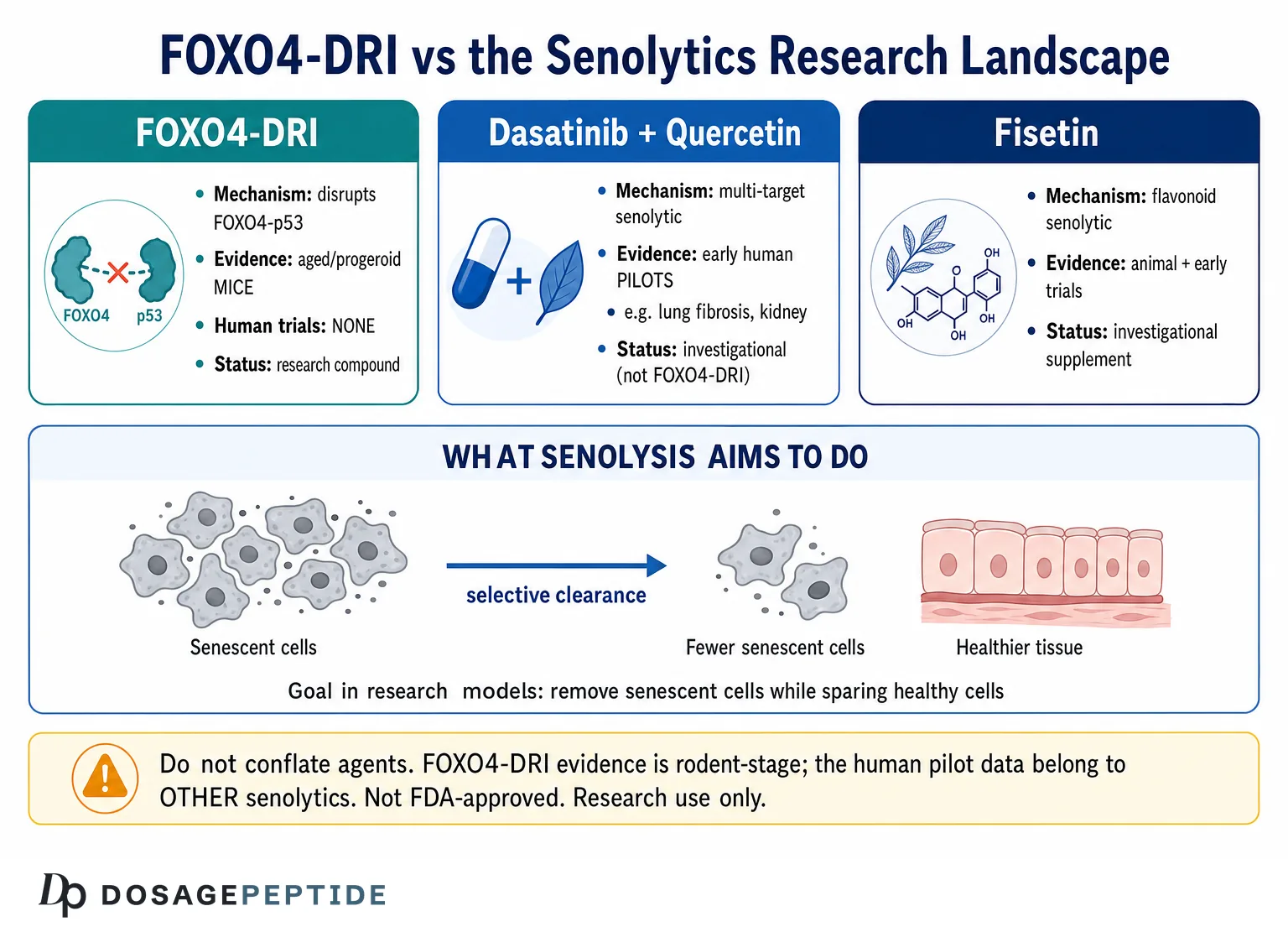
The senolytics field has early human data — but with different agents
A common and important error is to borrow the emerging human data from the broader senolytics field and attach it to FOXO4-DRI. That attribution is incorrect. Human pilot studies in the senolytics space have used different compounds:
- The combination of dasatinib and quercetin (D+Q) — a repurposed cancer drug plus a plant flavonoid — was tested in a small, open-label, first-in-human pilot in patients with idiopathic pulmonary fibrosis, reporting changes in physical function measures.[12]
- D+Q was also studied in a small trial in patients with diabetic kidney disease, where the authors reported reductions in markers of senescent-cell burden in tissue after treatment.[13]
- The flavonoid fisetin has been characterized as a senotherapeutic in preclinical work and is the subject of ongoing human trials.[14]
These agents are structurally and mechanistically unrelated to FOXO4-DRI. Their early clinical data demonstrate that the senolytic concept is being tested in humans; they say nothing about the safety or efficacy of the FOXO4 peptide specifically. Conflating the two would inflate FOXO4-DRI’s evidence tier from “animal-only” to “in human trials,” which is simply not accurate. It is also worth noting how preliminary even the D+Q and fisetin human data are: these are small, mostly open-label pilot studies designed to test feasibility and probe biomarkers, not large controlled trials that establish clinical benefit. So even the most advanced senolytic programs are early — and FOXO4-DRI is not among them.
Why animal senolytic results do not automatically translate
Mouse models of aging have repeatedly generated exciting senolytic results, including improvements in physical function and, in some studies, lifespan.[15] Yet the history of aging and longevity research is full of interventions that looked transformative in mice and did not carry over cleanly to humans, whether because of differences in physiology, dosing, off-target effects, or the far longer and more heterogeneous course of human aging. For FOXO4-DRI, the gap between a promising mouse study and a validated human application is wide and, as of now, uncrossed.
Several concrete factors drive that gap. Mice are short-lived and genetically uniform when bred for experiments; humans are long-lived and enormously varied in genetics, environment, and comorbidity. Doses that are effective and tolerated in a 30-gram mouse over weeks may behave very differently in a human over years. The senescence landscape may also differ between species and between tissues, so a peptide tuned to mouse senescent cells might engage human ones less cleanly. None of this makes translation impossible — it makes it an open empirical question that only properly designed human studies, which do not yet exist for this peptide, can answer.
FOXO4-DRI Compared With Other Senolytic Approaches
Placing FOXO4-DRI alongside other senolytic strategies clarifies both its distinctiveness and its immaturity. The table below summarizes the main research approaches by class and mechanism. It is a research-orientation aid, not a ranking or recommendation.
| Approach | Type | Reported mechanism | Highest evidence tier reached |
|---|---|---|---|
| FOXO4-DRI | D-retro-inverso peptide | Disrupts FOXO4–p53 binding, freeing p53 to trigger apoptosis in senescent cells | Preclinical (rodent + in-vitro) |
| Dasatinib + quercetin (D+Q) | Small-molecule drug + flavonoid | Interferes with senescent-cell pro-survival pathways | Early human pilot studies |
| Fisetin | Dietary flavonoid | Senotherapeutic; reduces senescent-cell burden in models | Preclinical + ongoing human trials |
| Navitoclax (ABT-263) | BCL-2 family inhibitor | Blocks anti-apoptotic BCL-2/BCL-xL that senescent cells depend on | Preclinical senolytic use; oncology trials for the parent drug |
| Genetic clearance (p16-driven) | Transgenic tool | Kills p16INK4a-expressing cells on command | Proof-of-concept in engineered mice |
What sets the peptide apart conceptually
FOXO4-DRI is the clearest example of a rationally designed, interaction-specific senolytic: rather than exploiting a broad pro-survival vulnerability, it aims at one named protein–protein contact. That specificity is scientifically attractive and is exactly why the compound became a talking point in longevity circles. But conceptual elegance and clinical readiness are different things, and on the readiness axis the small-molecule agents like D+Q and fisetin are further along in human testing, while FOXO4-DRI remains at the bench.
The comparison also highlights a practical divide between peptide and small-molecule senolytics. Small molecules like dasatinib, quercetin, and fisetin are orally available, relatively easy to manufacture, and in several cases already familiar to clinical medicine, which is part of why they reached human pilots first. A peptide such as FOXO4-DRI faces additional development questions around delivery, stability in the body, manufacturing, and cost — the D-retro-inverso design addresses some of these but not all. None of this ranks the approaches by ultimate promise; specificity and drug-like convenience are different virtues, and which matters more will depend on data that, for the peptide, has not yet been generated in humans.
Where FOXO4-DRI Sits Among Longevity Research Compounds
FOXO4-DRI is frequently discussed alongside other compounds studied for aging biology, and it helps to situate it within that landscape without blurring the very different evidence levels involved.
Senolytics versus telomere and cell-cycle approaches
FOXO4-DRI targets cells that have already become senescent — a clearance strategy. A different research thread aims further upstream, at the telomere biology and replicative clock that can drive cells toward senescence in the first place. The peptide Epithalon, for instance, has been studied for its reported effects on telomerase and aging biology; readers exploring that upstream angle can review our overview of Epithalon and telomerase aging research. The two approaches — clearing existing senescent cells versus influencing the pathways that create them — represent conceptually distinct bets, and neither is established as a human therapy.
Overlap with DNA-repair and NAD+ biology
Because DNA damage is a principal trigger of senescence, research on FOXO4-DRI intersects with the broader science of genome maintenance. Pathways that support DNA repair and genomic stability — including the roles attributed to NAD+ metabolism — are studied in part for how they influence the accumulation of damaged, senescence-prone cells. Our discussion of the mechanisms linking NAD+ to DNA repair and cancer prevention explores that upstream biology in depth and offers useful context for why senescent cells are damaged in the first place, and why p53 sits at the center of the story.
A note on the “anti-aging” framing
FOXO4-DRI is categorized within growth-hormone and anti-aging research because senescent-cell clearance is one of the more mechanistically specific ideas in the aging field. But “studied in aging models” is not the same as “anti-aging drug,” and readers should treat the anti-aging label as a description of the research question, not of a demonstrated human benefit. The distinction is not pedantic. Marketing language routinely collapses “investigated in the context of aging” into “reverses aging,” and that collapse is precisely where honest reporting on FOXO4-DRI has to hold the line.
Reported Handling, Stability, and Model Parameters
Because FOXO4-DRI is a peptide investigated only in laboratory settings, information about its physical handling reflects research practice rather than any human-use protocol. As a lyophilized (freeze-dried) peptide, it is reported to require reconstitution in an appropriate solvent and cold storage to preserve integrity, consistent with general peptide-handling norms. The D-retro-inverso design is specifically intended to improve stability against enzymatic degradation compared with an all-L-amino-acid peptide.[8]
Researchers working with lyophilized peptides in the laboratory commonly calculate reconstitution volumes and working concentrations before an experiment; a general-purpose peptide reconstitution calculator illustrates the arithmetic of solvent volume and concentration used in that context. The consolidated laboratory parameters reported for this specific peptide are summarized on the FOXO4-DRI research reference page. None of this constitutes guidance for human administration — there is no established, safe human dose, and the compound has not been tested in people.
This point deserves emphasis rather than a footnote. The fact that a research peptide can be described in terms of reconstitution volume, storage temperature, and concentration says nothing about whether it is safe to introduce into a human body, at any dose, by any route. Handling parameters are laboratory logistics; they are the same kind of information one would record for any experimental reagent. Because no human study has established a safe or effective dose — or even whether the compound should be given to a person at all — any numeric “protocol” circulating online should be read as a description of how the material is handled in research, not as a recommendation to use it.
Safety Signals and Toxicology in Preclinical Models
Any honest account of a senolytic that works by triggering apoptosis has to take safety seriously, because a molecule that pushes cells to die must be selective to be safe.
The central selectivity question
The entire safety case for FOXO4-DRI rests on selectivity: it must eliminate senescent cells while sparing healthy ones. The 2017 study reported comparatively limited toxicity to non-senescent cells and reported that treated mice tolerated the peptide well enough to show functional improvements.[1] But selectivity demonstrated in specific mouse strains and cell lines does not guarantee selectivity across all human tissues, ages, and health states. Off-target apoptosis, effects on stem-cell or progenitor populations, and consequences of releasing p53 activity more broadly are the kinds of risks that only rigorous, dedicated toxicology and eventual controlled human studies could characterize — and those do not yet exist for this compound.
The p53 double-edged sword
p53 is a tumor suppressor, and manipulating it cuts both ways. The premise of FOXO4-DRI is to liberate p53 to kill damaged senescent cells — a tumor-suppressive action. But p53 signaling is finely tuned, and how repeated or systemic disruption of the FOXO4–p53 interaction affects cancer risk, tissue regeneration, and normal p53-dependent stress responses over a long human lifespan is unknown. This is not a hypothetical concern to wave away; it is one of the central reasons the compound has not moved to human therapy without much more data.
The concern runs in both directions, which is what makes it genuinely hard. Too little p53 activity is associated with cancer, because damaged cells that should be eliminated survive and proliferate. Too much or mistimed p53 activity can harm healthy tissue, impair regeneration, and, in some experimental settings, accelerate aspects of aging. A therapy premised on nudging p53 free from one of its restraints has to thread that needle precisely, and it has to do so in every tissue it reaches, not just the ones a study happened to measure. Establishing where that balance lies in humans is a substantial research program in itself, none of which has been carried out for FOXO4-DRI.
Immune clearance and the SASP
Killing large numbers of senescent cells also raises the practical question of clearing the resulting cellular debris and managing any transient inflammation, especially given the pro-inflammatory SASP those cells were producing.[5] In a controlled mouse experiment these dynamics can be monitored; in an uncontrolled human setting they would be unpredictable. The gap between “it worked in a monitored animal study” and “it is safe to use” is exactly the gap that clinical development is designed to close, and for FOXO4-DRI that process has not occurred.
Limitations and Open Questions
A rigorous view of FOXO4-DRI is defined as much by what is unknown as by what has been reported. The following limitations should temper any enthusiasm.
1. No human data
The single most important limitation is the absence of published human clinical trials. Everything reported for FOXO4-DRI comes from cell culture and rodents. There is no established human dose, no human safety profile, no human efficacy evidence, and no regulatory approval anywhere.
2. Reliance on a narrow primary literature
The direct efficacy evidence rests heavily on the 2017 Cell study and closely related mechanistic work.[1][10] Robust scientific confidence usually requires independent replication across multiple laboratories, dose-ranging studies, and long-term follow-up — a depth of literature that does not yet surround this specific peptide.
3. Selectivity is model-dependent
The claimed selectivity for senescent over healthy cells was demonstrated in particular systems. Whether that clean separation holds across the diversity of human tissues, senescence subtypes, and disease states is unresolved. Senescence is heterogeneous — different triggers produce different senescent phenotypes — and a peptide tuned to one context may not behave identically in another.
4. Delivery and pharmacokinetics in humans are unknown
The peptide must reach an intracellular target throughout the body. Its D-retro-inverso design improves enzymatic stability, but tissue distribution, cell entry across different organs, dosing frequency, and clearance in a human have not been characterized.[8]
5. Long-term consequences of clearing senescent cells
Senescence is protective as well as harmful. Beyond tumor suppression, senescent cells contribute to wound healing and tissue remodeling in some settings. Chronic or aggressive removal could have costs that short-term animal studies would not reveal. Whether periodic senolytic clearance is net-beneficial over a human lifespan is an open scientific question for the whole field, not just for this peptide.
6. Marketplace claims outrun the science
Finally, a candid limitation: public interest in FOXO4-DRI as a “fountain of youth” peptide has far outpaced the evidence. The honest scientific position is that FOXO4-DRI is an intriguing, mechanistically specific research compound with encouraging animal data and no proven human application. Treating it as more than that misrepresents where the science actually stands.
Frequently Asked Questions
Is FOXO4-DRI FDA-approved or available as a medicine?
No. FOXO4-DRI is not approved by the FDA or any comparable regulator, and it is not available as a licensed medicine. It is an experimental research compound studied in cell cultures and animal models. There are no completed, published human clinical trials establishing its safety or effectiveness, so any use outside a controlled laboratory context is unsupported by human evidence.
What does the “DRI” in FOXO4-DRI mean?
DRI stands for D-retro-inverso, a peptide-engineering method. The peptide is rebuilt from mirror-image D-amino acids arranged in reverse sequence order. This design can preserve a similar binding surface to the original FOXO4 fragment while making the molecule far more resistant to the enzymes that normally degrade peptides, giving it greater stability inside a biological system.
How is FOXO4-DRI supposed to work?
In senescent cells, the FOXO4 protein binds and restrains the tumor suppressor p53, keeping the cell alive. FOXO4-DRI is a decoy peptide that competes for that binding, displacing p53. The freed p53 can then activate apoptosis — programmed cell death — in the senescent cell. The goal is targeted senolysis: eliminating senescent cells while sparing healthy ones. This mechanism has been demonstrated in cell and mouse studies, not in humans.
What are “zombie cells” and why do they matter?
“Zombie cells” is a nickname for senescent cells: cells that have permanently stopped dividing but refuse to die. They accumulate with age and often secrete inflammatory factors (the senescence-associated secretory phenotype) that can harm surrounding tissue. Their persistence is associated with age-related decline, which is why researchers study ways to clear them.
Has FOXO4-DRI been tested in humans?
No published human clinical trials of FOXO4-DRI exist. The most cited evidence is a 2017 study in the journal Cell conducted in cultured cells and mice, including naturally aged mice and a fast-aging mouse model. Reported benefits such as improved fur density and kidney-function markers were observed in rodents, not people, and do not establish human safety or efficacy.
Is FOXO4-DRI the same as dasatinib, quercetin, or fisetin?
No. Those are separate senolytic agents. Dasatinib plus quercetin (D+Q) and fisetin are small molecules studied in early human pilot trials for conditions like pulmonary fibrosis and diabetic kidney disease. FOXO4-DRI is a distinct, peptide-based compound with a different mechanism, and the human data from those other agents cannot be attributed to it.
Who developed FOXO4-DRI?
FOXO4-DRI was described in a 2017 study led by researchers in the Netherlands, with Peter de Keizer as the senior scientist and Marjolein Baar as lead author. The work was carried out at Erasmus University Medical Center and the University Medical Center Utrecht and published in the journal Cell. De Keizer has also written broadly about targeting senescent cells as an aging-research strategy.
What are the main risks or unknowns with FOXO4-DRI?
The principal unknowns are whether its selectivity for senescent cells holds in humans, how disrupting the FOXO4–p53 interaction affects cancer risk and normal p53 functions over time, its human pharmacokinetics and delivery, and the long-term consequences of removing senescent cells, which also serve protective roles. None of these have been characterized in human studies.
Where does FOXO4-DRI fit among longevity research compounds?
It is a clearance-focused senolytic that targets already-senescent cells, distinct from upstream approaches such as telomere-focused peptides. It intersects with DNA-repair and NAD+ biology because DNA damage drives senescence. Within the aging field it is one mechanistically specific idea among several, all of which remain investigational rather than proven human therapies.
References
- Baar MP, Brandt RMC, Putavet DA, et al. Targeted Apoptosis of Senescent Cells Restores Tissue Homeostasis in Response to Chemotoxicity and Aging. Cell. 2017;169(1):132–147.e16.
- López-Otín C, Blasco MA, Partridge L, Serrano M, Kroemer G. The Hallmarks of Aging. Cell. 2013;153(6):1194–1217.
- Kuilman T, Michaloglou C, Mooi WJ, Peeper DS. The essence of senescence. Genes & Development. 2010;24(22):2463–2479.
- Campisi J. Aging, cellular senescence, and cancer. Annual Review of Physiology. 2013;75:685–705.
- Coppé JP, Desprez PY, Krtolica A, Campisi J. The senescence-associated secretory phenotype: the dark side of tumor suppression. Annual Review of Pathology. 2010;5:99–118.
- Baker DJ, Childs BG, Durik M, et al. Naturally occurring p16Ink4a-positive cells shorten healthy lifespan. Nature. 2016;530(7589):184–189.
- Childs BG, Gluscevic M, Baker DJ, et al. Senescent cells: an emerging target for diseases of ageing. Nature Reviews Drug Discovery. 2017;16(10):718–735.
- Fischer PM. The design, synthesis and application of stereochemical and directional peptide isomers: a critical review. Current Protein & Peptide Science. 2003;4(5):339–356.
- van der Horst A, Burgering BMT. Stressing the role of FoxO proteins in lifespan and disease. Nature Reviews Molecular Cell Biology. 2007;8(6):440–450.
- Bourgeois B, Madl T. Regulation of cellular senescence via the FOXO4-p53 axis. FEBS Letters. 2018;592(12):2083–2097.
- de Keizer PLJ. The Fountain of Youth by Targeting Senescent Cells? Trends in Molecular Medicine. 2017;23(1):6–17.
- Justice JN, Nambiar AM, Tchkonia T, et al. Senolytics in idiopathic pulmonary fibrosis: Results from a first-in-human, open-label, pilot study. EBioMedicine. 2019;40:554–563.
- Hickson LJ, Langhi Prata LGP, Bobart SA, et al. Senolytics decrease senescent cells in humans: Preliminary report from a clinical trial of Dasatinib plus Quercetin in individuals with diabetic kidney disease. EBioMedicine. 2019;47:446–456.
- Yousefzadeh MJ, Zhu Y, McGowan SJ, et al. Fisetin is a senotherapeutic that extends health and lifespan. EBioMedicine. 2018;36:18–28.
- Xu M, Pirtskhalava T, Farr JN, et al. Senolytics improve physical function and increase lifespan in old age. Nature Medicine. 2018;24(8):1246–1256.
Research-use disclaimer: This article is provided for educational and informational purposes only and describes preclinical, laboratory-stage research. FOXO4-DRI is an experimental research compound that is not approved by the FDA or any regulatory authority, has not been evaluated in published human clinical trials, and is not intended to diagnose, treat, cure, or prevent any disease. Nothing here is medical advice or a recommendation for human use or self-administration. Consult a qualified, licensed healthcare professional for any health-related decisions.