- Where: the abdomen, the thigh, or the back of the upper arm. Those are the three regions named in current Mounjaro and Zepbound labeling.
- The upper arm is described differently. As revised January 2026, both labels present the abdomen and thigh as the sites the patient injects, and state that another person should inject in the back of the upper arm.
- The site does not change the dose you absorb. Clinical Pharmacology in both labels reports “similar exposure” across all three regions, and neither label contains a site-dependent dose adjustment.
- Rotate with every weekly dose. The labels direct rotation but publish no rotation pattern and give no reason; the usual rationale comes from insulin research, not from tirzepatide data.
- Injection-site reactions are listed in both labels, at low reported rates.
Tirzepatide labeling documents three subcutaneous injection regions: the abdomen, the thigh, and the upper arm. The current FDA-approved prescribing information for both Mounjaro (tirzepatide, first approved May 2022) and Zepbound (tirzepatide, first approved November 2023) names those three regions, directs that injection sites be rotated with each dose, and reports in Clinical Pharmacology that “similar exposure was achieved with subcutaneous administration of tirzepatide in the abdomen, thigh, or upper arm.”[1][2] Both labels, as revised January 2026, phrase the region list asymmetrically: the abdomen and thigh are described for the patient, while the upper arm is described as a site another person injects. This page summarizes what those documents state. It is a reference summary, not administration guidance, and nothing here is a recommendation for human use.
| Site | How current labeling describes it | What the pharmacokinetic section documents | Other documented detail |
|---|---|---|---|
| Abdomen | Named in the Important Administration Instructions of both the Mounjaro and Zepbound prescribing information as a subcutaneous injection region | “Similar exposure” across abdomen, thigh, and upper arm; no site-dependent dose adjustment appears in either label | The Mounjaro label adds that when tirzepatide is used with insulin, the two are given as separate injections, never mixed, and may be in the same body region but not adjacent to one another |
| Thigh | Named alongside the abdomen, with no stated preference or ranking between the two | Same statement of similar exposure; the labels report no separate pharmacokinetic parameter by region | The published SURMOUNT-1 protocol states that participants injected study drug subcutaneously in the abdomen or thigh |
| Upper arm | Both January 2026 labels state that “another person should inject in the back of the upper arm” — it is described as a caregiver-administered site, not a self-injection site | Included in the same “similar exposure” statement as the other two regions | The SURMOUNT-1 protocol likewise specified that a caregiver, rather than the participant, could administer in the upper arm |
What exactly is tirzepatide approved for?
Precision matters here, because tirzepatide is one of the few compounds discussed in peptide research circles that is genuinely FDA-approved rather than investigational — and the approved indications have changed more than once, so older summaries are frequently out of date.
- Mounjaro (tirzepatide) — first approved May 2022 as an adjunct to diet and exercise to improve glycemic control in adults with type 2 diabetes mellitus.[3] That original indication covered adults only; as of the January 2026 labeling, the indication reads “in adults and pediatric patients 10 years of age and older with type 2 diabetes mellitus,” with a 10 mg weekly maximum in that pediatric population.[1]
- Zepbound (tirzepatide) — approved November 8, 2023 for chronic weight management in adults with a body mass index of 30 kg/m² or greater, or 27 kg/m² or greater with at least one weight-related comorbid condition, as an adjunct to a reduced-calorie diet and increased physical activity.[4][5]
- Zepbound — expanded December 20, 2024 to include the treatment of moderate-to-severe obstructive sleep apnea in adults with obesity, in combination with a reduced-calorie diet and increased physical activity.[6] The current Zepbound indication statement combines both uses and now describes the weight indication as reducing excess body weight and maintaining weight reduction long term.[2]
Those are the approved uses. Tirzepatide has been studied in other populations — heart failure with preserved ejection fraction, for instance — but no additional indication had been added to either U.S. label as of this writing, and Drugs@FDA remains the authoritative current record.[15]
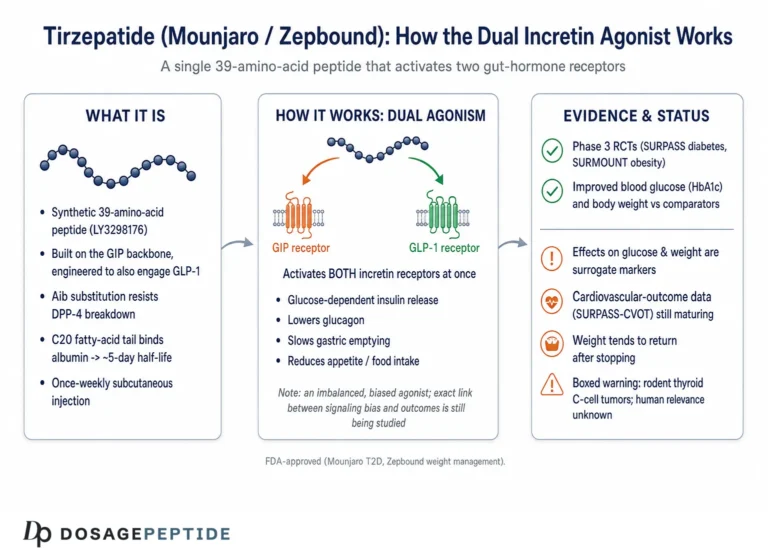
Tirzepatide is a dual GIP and GLP-1 receptor agonist given once weekly by subcutaneous injection. Both labels also carry a boxed warning stating that tirzepatide caused thyroid C-cell tumors in rats and that it is unknown whether it causes such tumors in humans, because the human relevance of the rodent finding has not been determined — a preclinical observation, explicitly not a human finding.[2] The mechanism and approval history are covered in more depth in our overview of what tirzepatide is and how it works.
Where can tirzepatide be injected?
Abdomen
The abdomen appears in the Important Administration Instructions of both labels as a subcutaneous injection region, listed together with the thigh.[1][2] Neither label describes sub-regions of the abdominal wall, marks out any area to avoid, or specifies a distance from the umbilicus. Claims to that effect circulate widely online but are not in the tirzepatide labeling.
One tirzepatide-specific detail is worth isolating: the Mounjaro label states that when tirzepatide and insulin are used together, they are administered as separate injections and never mixed, and that the injections may be given in the same body region but should not be adjacent to one another.[1] That sentence appears in the Mounjaro label, not the Zepbound label.
Thigh
The thigh is listed in the same sentence as the abdomen, with no ranking, preference, or efficacy distinction drawn between them. The published SURMOUNT-1 study protocol is more specific than the label: it states that all participants injected study drug subcutaneously in the abdomen or thigh using the supplies provided, and that the injection site location of every dose was recorded by the participant.[10][11]
A qualification on the trial record: the publicly posted SURPASS-2 protocol — the type 2 diabetes comparison against semaglutide — contains no injection-site anatomy and no rotation language at all, only a requirement that participants be able to self-inject.[7] Statements that “the SURPASS and SURMOUNT programs both rotated across three regions” overstate what the posted documents show. The specific, quotable site language comes from SURMOUNT-1 and from the labels.
Upper arm
The upper arm completes the labeled set, but not on equal terms. As revised January 2026, both labels state that the injection is given subcutaneously in the abdomen or thigh, “or another person should inject in the back of the upper arm.”[1][2] The SURMOUNT-1 protocol used the same division: a caregiver, not the participant, could administer in the upper arm.[10] The distinction is about who administers, not about a separate pharmacokinetic caveat — the exposure statement covers all three regions equally.
For a broader map of subcutaneous regions used across injectable compounds generally, see our guide to peptide injection sites and subcutaneous anatomy.
Does injection site change how much tirzepatide is absorbed?
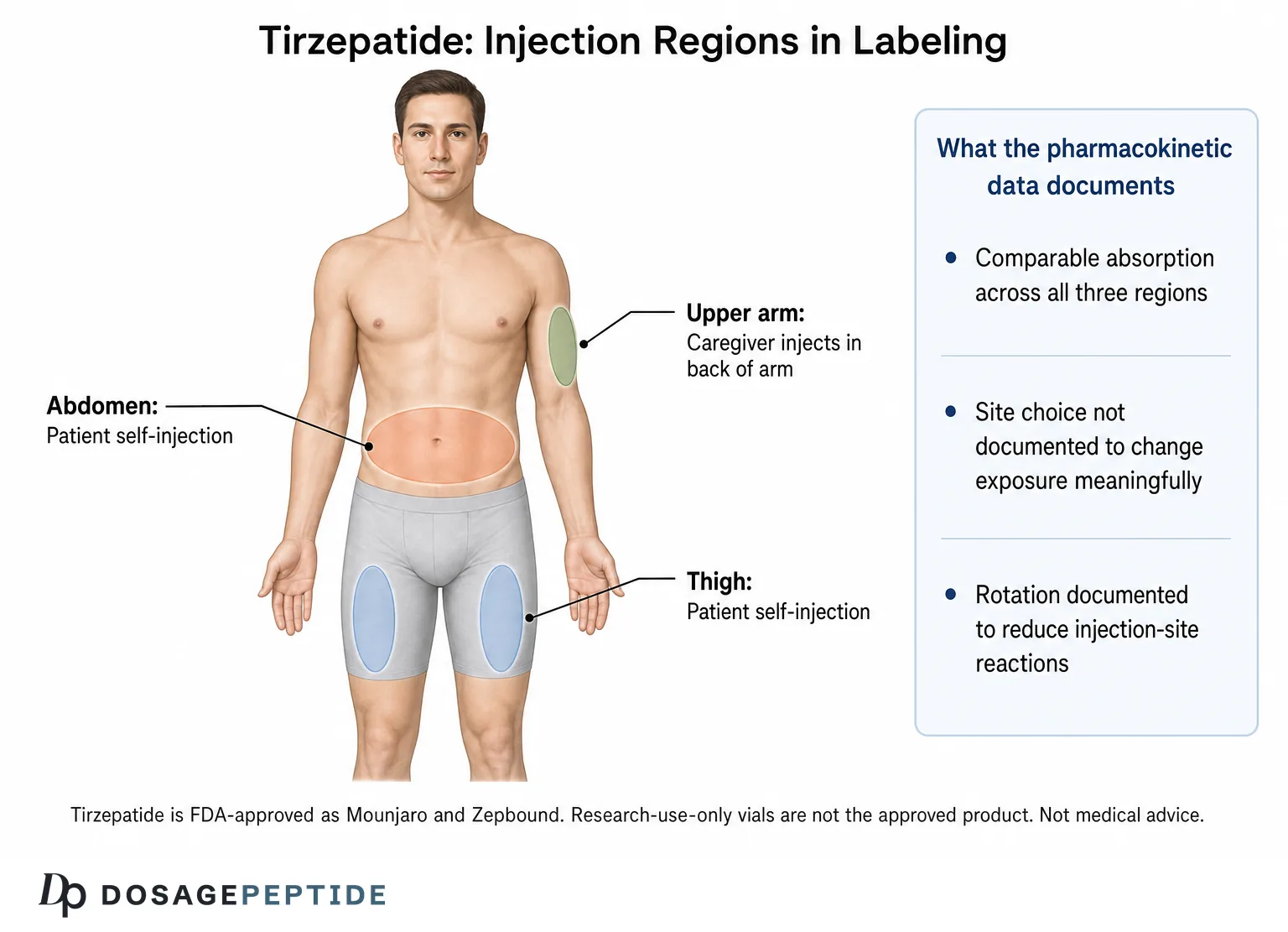
According to the approved labeling, no — not to a degree that changes dosing. The Clinical Pharmacology section of both labels states that similar exposure was achieved with subcutaneous administration in the abdomen, thigh, or upper arm, and neither label contains a site-dependent dose adjustment.[1][2] Worth noting what the labels do not publish: no per-region AUC or Cmax values, no confidence intervals, and no bioequivalence table. “Similar exposure” is the whole of the published finding.
The reported pharmacokinetics are consistent with that. Following subcutaneous administration, time to maximum plasma concentration is reported as 8 to 72 hours (median 24 hours in the Zepbound label), absolute bioavailability as 80%, and elimination half-life as approximately 5 days in type 2 diabetes and approximately 5 to 6 days in patients with overweight or obesity.[1][2] When absorption is that slow and the dosing interval that long, regional differences in subcutaneous blood flow — the mechanism that makes site selection matter for rapid-acting insulin — would be expected to matter far less. That is a mechanistic inference consistent with the labeled data, not a separately published comparison.
The labels also document that the once-weekly dose may be given at any time of day, with or without food, and that the day of weekly administration may be changed provided at least 3 days (72 hours) separate two doses.[1] The practical consequence documented in the labeling is that site choice is not a lever for adjusting effect. Exposure is governed by the dose and the titration schedule. Our summary of the titration schedule documented in trial protocols and labeling covers that side of the equation.
Why rotate injection sites?
Both labels instruct that injection sites be rotated with each dose.[2] Neither states a rationale, publishes a rotation pattern, or claims that rotation preserves efficacy. The instruction appears without justification.
The evidence base usually invoked for rotation comes from insulin injection research, not from tirzepatide trials. The 2016 FITTER consensus recommendations on insulin delivery describe lipohypertrophy — localized thickening of subcutaneous tissue at repeatedly used sites — as a frequent complication that distorts insulin absorption, and recommend systematic site rotation and inspection of injection areas to prevent it.[12]
Two honest qualifications belong here. First, that literature concerns daily or multiple-daily insulin regimens; a once-weekly agent presents a far smaller cumulative injection burden, and the transfer of the finding is an assumption rather than a demonstrated result. Second, the SURMOUNT-1 protocol framed rotation conditionally — participants were to be advised to rotate sites each week if study drug was always injected in the same body region — rather than as an unconditional requirement.[10] Rotation is a generic subcutaneous-injection precaution applied to this product, not a tirzepatide-specific finding.
What injection-site reactions are reported?
The Mounjaro label reports that in the pool of placebo-controlled trials in adults, injection-site reactions occurred in 3.2% of tirzepatide-treated patients compared with 0.4% of placebo-treated patients.[1] The Zepbound label reports injection-site reactions in 6%, 8%, and 8% of patients at 5 mg, 10 mg, and 15 mg respectively, against 2% on placebo, with the term covering bruising, erythema, pruritus, pain and rash at the site.[2] Both are far below the gastrointestinal adverse reactions that dominate the tolerability profile of the class.[8] The labels do not characterize the severity distribution of these reactions, so any claim that they are “typically mild” goes beyond the published record.
One documented association is immunological rather than anatomical: injection-site reactions were substantially more frequent in patients who developed anti-tirzepatide antibodies than in those who did not — 11.3% versus 1% in the pooled Zepbound trials, and 4.6% versus 0.7% in the pooled Mounjaro trials.[2][1]
What the record does not contain is any comparison of adverse event rates between regions. The trials were not designed to compare abdomen versus thigh versus upper arm as an endpoint, so claims that one site “causes fewer side effects” or “reduces nausea” have no published basis. Nausea in this class is a systemic, receptor-mediated effect, not a local injection phenomenon. The documented adverse reaction profile is summarized in our review of tirzepatide side effects reported in clinical trials.
Pens, vials and how much liquid goes in
This is where widely repeated summaries have gone stale. The approved products were originally supplied only as prefilled single-dose pens.[3] As of the January 2026 labeling, both Mounjaro and Zepbound are supplied in three presentations: single-dose pens, single-dose vials, and multi-dose vials containing four weekly doses, each dose drawn as 0.6 mL.[1][2]
That matters for any claim that the approved product removes measurement error entirely. It does for the pen, which meters a fixed dose. It does not for the vial presentations: the labels instruct that a syringe appropriate for the dose be used — a 1 mL syringe capable of measuring a 0.5 mL or 0.6 mL dose — with a new syringe and needle each time.[2] Drugs@FDA is the authoritative current record of which presentations are approved at any given time.[15]
What remains a genuine structural difference from unapproved powders sold for laboratory use is the reconstitution step. Approved vials contain a solution of stated concentration; a lyophilized powder of unstated potency must be reconstituted before any volume is meaningful, which adds a concentration variable on top of the measurement one. Our references on how insulin-syringe units map to milligrams and milliliters and how reconstitution volume changes concentration exist because that arithmetic is where errors concentrate in non-clinical settings.
How does “research” tirzepatide differ from the approved product?
This distinction is the single most important thing on this page. Tirzepatide powder sold by peptide suppliers under “research use only” labeling is not Mounjaro or Zepbound. It has not been through FDA review, is not manufactured under the approved product’s quality system, and carries no assurance of identity, purity, potency, sterility, or endotoxin content. Third-party certificates of analysis vary widely in scope and independence.
This is not a theoretical distinction to the agency. FDA has issued warning letters to websites selling semaglutide and tirzepatide products, characterizing them as unapproved and misbranded new drugs and stating that drugs which have circumvented regulatory safeguards “may be contaminated, counterfeit, contain varying amounts of active ingredients, or contain different ingredients altogether.”[13] Separately, FDA’s standing statement on unapproved GLP-1 drugs documents adverse event reports including dosing errors from patients measuring and self-administering incorrect doses, products arriving warm or inadequately refrigerated, and fraudulent labels naming compounding pharmacies that do not exist or did not make the product.[14] The agency maintains separate guidance on what compounding is and is not permitted to produce.[9]
The site data summarized on this page comes from studies of the approved product. Extrapolating pharmacokinetic conclusions from an approved, characterized formulation to an uncharacterized powder of unverified potency is not a valid inference — if the amount of drug in the vial is unknown, site comparability is not the limiting variable.
Does the site matter more than the dose?
Reading the labeling as a whole, the hierarchy is clear: the dose and the titration schedule determine exposure; the region does not. Both labels document a starting dose with stepwise increases at defined intervals and a maximum weekly dose, and the trials that established efficacy followed those schedules.[2][8]
Our reference pages document those numbers as published — see the 5 mg vial protocol reference and the tirzepatide concentration and volume calculator, which converts a stated vial strength and diluent volume into the corresponding syringe reading. These are documentation and arithmetic tools for interpreting published protocols, not treatment plans.
Frequently Asked Questions
What are the three tirzepatide injection sites in FDA labeling?
The current labeling for both Mounjaro and Zepbound names the abdomen, the thigh, and the back of the upper arm as subcutaneous injection regions. The three are not described symmetrically: as revised January 2026, both labels present the abdomen and thigh as the regions the patient injects, and state that another person should inject in the back of the upper arm. The labeling additionally directs that injection sites be rotated with each weekly dose, without publishing a rotation pattern.
Does the abdomen absorb tirzepatide faster than the thigh?
Not according to the approved labeling. The Clinical Pharmacology section of both labels states that similar exposure was achieved with subcutaneous administration in the abdomen, thigh, or upper arm, and neither label includes a site-dependent dose adjustment. No per-region AUC or Cmax values are published, so “similar exposure” is the entirety of the finding. This differs from rapid-acting insulin, where regional blood flow measurably affects onset.
Why does labeling say to rotate injection sites if exposure is the same?
The labels do not say. They state the rotation instruction without giving a rationale. The reasoning usually supplied comes from insulin injection technique research, where lipohypertrophy at repeatedly used sites is documented as distorting insulin absorption and systematic rotation is recommended to prevent it. Transferring that finding from daily insulin to a once-weekly agent is an assumption, not a demonstrated tirzepatide result.
Is tirzepatide FDA-approved or investigational?
Tirzepatide is FDA-approved. Mounjaro was first approved in May 2022 for glycemic control in type 2 diabetes, and its current labeling covers adults and pediatric patients 10 years of age and older. Zepbound was approved in November 2023 for chronic weight management in eligible adults, with a December 2024 expansion covering moderate-to-severe obstructive sleep apnea in adults with obesity. Products sold as “research tirzepatide” by peptide vendors are not these approved products.
Do the trials show one injection site causes fewer side effects?
No. The SURPASS and SURMOUNT programs were not designed to compare injection regions as an endpoint, and the published results do not attribute differing adverse reaction rates to abdomen versus thigh versus upper arm. The labels report injection-site reactions in 3.2% of Mounjaro-treated adults versus 0.4% on placebo, and in 6% to 8% of Zepbound-treated patients versus 2% on placebo, with no breakdown by region. The dominant adverse reactions in this class are gastrointestinal and systemic in origin.
What does labeling say about injecting tirzepatide and insulin together?
The Mounjaro label states that tirzepatide and insulin are administered as separate injections and never mixed in the same syringe. It further states that the two injections may be given in the same body region but should not be placed adjacent to one another. This is one of the few site-specific administration details the labeling addresses explicitly, and it appears in the Mounjaro label rather than the Zepbound label.
Is a research-grade tirzepatide vial equivalent to Mounjaro or Zepbound?
No. Vials sold under research-use-only labeling have not undergone FDA review and carry no verified assurance of identity, purity, potency, sterility, or endotoxin limits. FDA has issued warning letters describing tirzepatide products sold this way as unapproved and misbranded drugs, and has stated that products circumventing regulatory safeguards may be contaminated, counterfeit, or contain varying or different amounts of active ingredient.
Does the approved product still remove all dose-measurement steps?
Only for the pen. As of the January 2026 labeling, both brands are supplied as single-dose pens, single-dose vials, and multi-dose vials holding four weekly doses of 0.6 mL each. For the vial presentations the labeling instructs that a syringe capable of measuring a 0.5 mL or 0.6 mL dose be used, with a new syringe and needle each time. The pen meters the dose; the vials do not.
Can the weekly injection day be changed?
The approved labeling documents that the once-weekly dose may be administered at any time of day, with or without food, and that the day of weekly administration may be changed if necessary, provided at least 3 days (72 hours) have elapsed between two doses. This is a labeled administration parameter recorded here as documentation, not a recommendation offered for any individual to act on.
References
- U.S. Food and Drug Administration. MOUNJARO (tirzepatide) injection — Full Prescribing Information, revised January 2026. https://www.accessdata.fda.gov/drugsatfda_docs/label/2026/215866s041lbl.pdf
- U.S. Food and Drug Administration. ZEPBOUND (tirzepatide) injection — Full Prescribing Information, revised January 2026. https://www.accessdata.fda.gov/drugsatfda_docs/label/2026/217806s037lbl.pdf
- U.S. Food and Drug Administration. MOUNJARO (tirzepatide) injection — original Prescribing Information as approved, revised 05/2022 (superseded; retained here as the historical record of the original indication and presentation). https://www.accessdata.fda.gov/drugsatfda_docs/label/2022/215866s000lbl.pdf
- U.S. Food and Drug Administration. NDA 217806 Approval Letter — Zepbound (tirzepatide) injection (November 2023). https://www.accessdata.fda.gov/drugsatfda_docs/appletter/2023/217806Orig1s000ltr.pdf
- U.S. Food and Drug Administration. FDA Approves New Medication for Chronic Weight Management (November 8, 2023). https://www.fda.gov/news-events/press-announcements/fda-approves-new-medication-chronic-weight-management
- U.S. Food and Drug Administration. FDA Approves First Medication for Obstructive Sleep Apnea (December 20, 2024). https://www.fda.gov/news-events/press-announcements/fda-approves-first-medication-obstructive-sleep-apnea
- Eli Lilly and Company. SURPASS-2 Study Protocol (NCT03987919), posted on ClinicalTrials.gov; results published as Frías JP, Davies MJ, Rosenstock J, et al., N Engl J Med. 2021;385(6):503–515 (PMID 34170647). https://cdn.clinicaltrials.gov/large-docs/19/NCT03987919/Prot_000.pdf
- Jastreboff AM, Aronne LJ, Ahmad NN, et al. Tirzepatide Once Weekly for the Treatment of Obesity (SURMOUNT-1). N Engl J Med. 2022;387(3):205–216. https://pubmed.ncbi.nlm.nih.gov/35658024/
- U.S. Food and Drug Administration. Compounding and the FDA: Questions and Answers. https://www.fda.gov/drugs/human-drug-compounding/compounding-and-fda-questions-and-answers
- Eli Lilly and Company. SURMOUNT-1 Study Protocol (NCT04184622), posted on ClinicalTrials.gov. https://cdn.clinicaltrials.gov/large-docs/22/NCT04184622/Prot_000.pdf
- ClinicalTrials.gov. A Study of Tirzepatide (LY3298176) in Participants With Obesity or Overweight (SURMOUNT-1), NCT04184622. https://clinicaltrials.gov/study/NCT04184622
- Frid AH, Kreugel G, Grassi G, et al. New Insulin Delivery Recommendations. Mayo Clin Proc. 2016;91(9):1231–1255. https://pubmed.ncbi.nlm.nih.gov/27594187/
- U.S. Food and Drug Administration. Warning Letter: USApeptide.com, MARCS-CMS 696885 (February 26, 2025). https://www.fda.gov/inspections-compliance-enforcement-and-criminal-investigations/warning-letters/usapeptidecom-696885-02262025
- U.S. Food and Drug Administration. FDA’s Concerns with Unapproved GLP-1 Drugs Used for Weight Loss. https://www.fda.gov/drugs/drug-alerts-and-statements/fdas-concerns-unapproved-glp-1-drugs-used-weight-loss
- U.S. Food and Drug Administration. Drugs@FDA: FDA-Approved Drugs (current approval and labeling record). https://www.accessdata.fda.gov/scripts/cder/daf/
Research use only. This page is an independent summary of publicly available FDA labeling and published clinical trial documentation, provided for research and educational reference. It is not medical advice, not a dosing recommendation, and not instructions for administering any substance to a human being. DosagePeptide.com sells nothing and has no commercial interest in any product named here. Decisions about approved medications belong with a licensed healthcare professional.