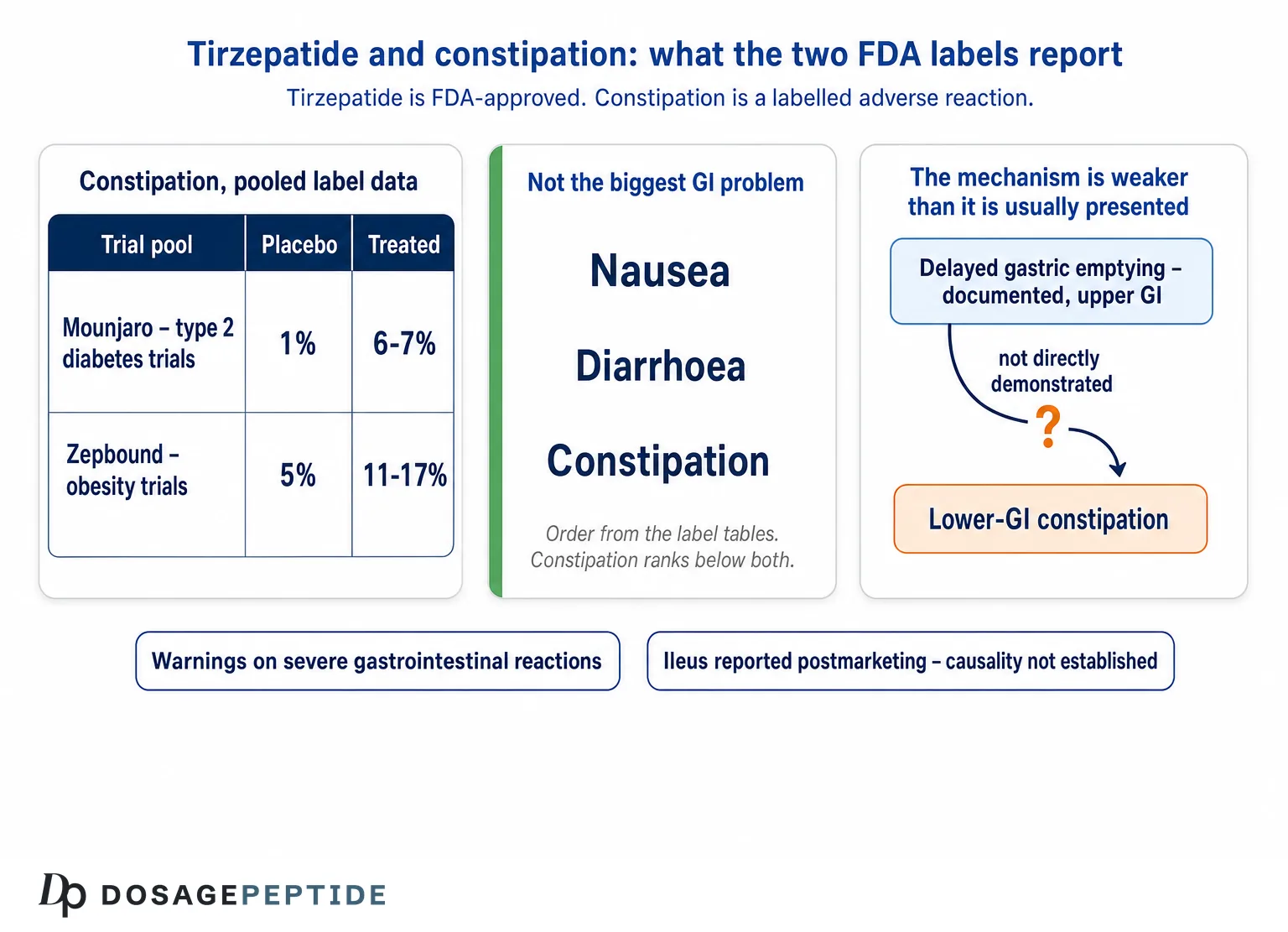
Yes — constipation is a labelled adverse reaction of tirzepatide, and it appears in the FDA-approved prescribing information for both branded products. In the pooled placebo-controlled type 2 diabetes trials behind the Mounjaro label it was reported by 6–7% of treated patients versus 1% on placebo[1]; in the pooled obesity trials behind the Zepbound label it was 11–17% versus 5% on placebo[2].
The part almost every other page gets wrong is how long it lasts. You will read that it is temporary and fades as the body adjusts. Both labels do contain a sentence saying reactions decreased over time after dose escalation — but that sentence names nausea, vomiting and diarrhoea. Constipation is not in it. Nor does constipation rise cleanly with dose in the label tables, the way nausea does. So the honest answer to “when will this stop?” is that the trial documentation does not establish a time course for constipation specifically, and pages that give you one are extending a claim the label made about other symptoms.
| Product and trial pool | Placebo | 5 mg | 10 mg | 15 mg |
|---|---|---|---|---|
| Mounjaro — pool of 2 placebo-controlled type 2 diabetes trials (SURPASS-1 monotherapy + SURPASS-5 add-on to basal insulin ± metformin), mean exposure 36.6 weeks[1] | 1% (N=235) | 6% (N=237) | 6% (N=240) | 7% (N=241) |
| Zepbound — pool of 2 placebo-controlled weight-reduction trials in adults with obesity or overweight, up to 72 weeks[2] | 5% (N=958) | 17% (N=630) | 14% (N=948) | 11% (N=941) |
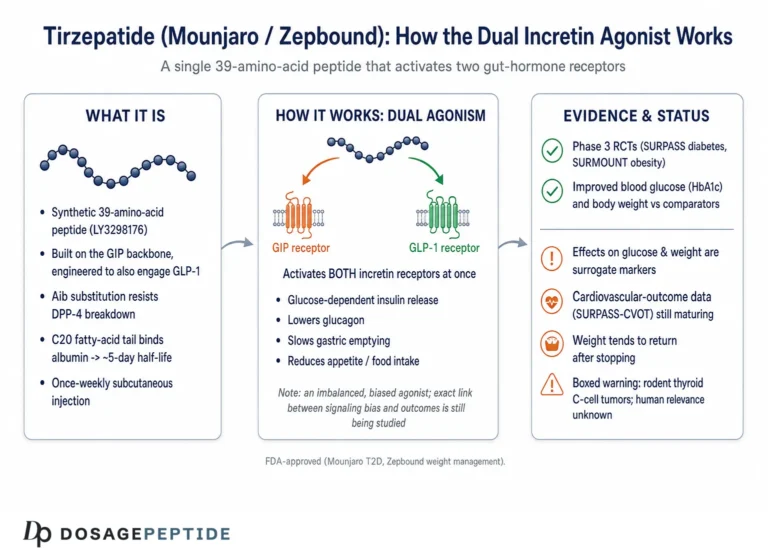
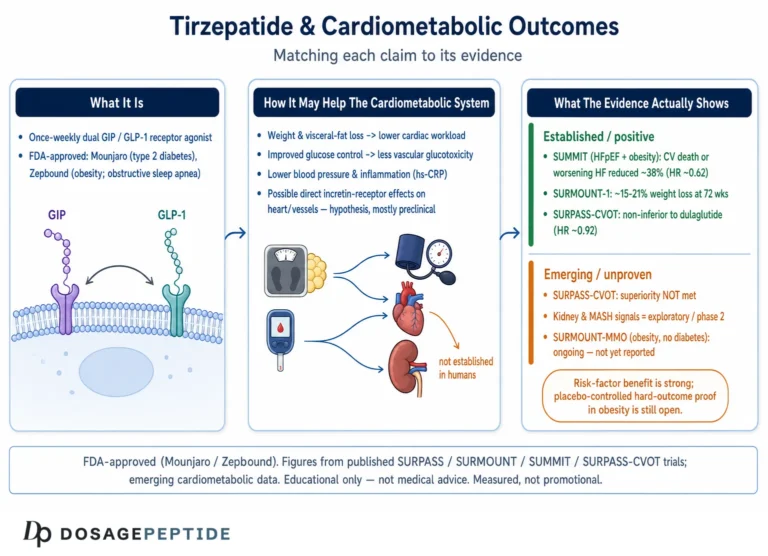
Both tables list adverse reactions reported by at least 5% of tirzepatide-treated patients. Tirzepatide is FDA-approved as Mounjaro, an adjunct to diet and exercise to improve glycaemic control in adults and paediatric patients 10 years and older with type 2 diabetes mellitus[1], and as Zepbound, to reduce excess body weight and maintain weight reduction long term in adults with obesity or overweight with at least one weight-related comorbidity, and to treat moderate-to-severe obstructive sleep apnea in adults with obesity[2] — which is why, unusually for a compound covered on this site, there is real labelled human safety data rather than rodent inference. Readers working through the dosing record can compare the incidence figures above against the assigned-dose framework documented on our tirzepatide 10 mg vial dosage protocol reference, and the broader adverse-reaction picture in our review of documented tirzepatide side effects.
What do the two FDA labels actually report, and why do they disagree?
The two numbers are not in conflict; they describe different people. The Mounjaro table draws on 718 patients with type 2 diabetes treated for a mean of 36.6 weeks in two placebo-controlled trials — SURPASS-1, a 40-week monotherapy trial in 478 adults naive to injectable therapy[3], and SURPASS-5, a 40-week trial adding tirzepatide to titrated insulin glargine in 475 adults[4]. The Zepbound table draws on 2,519 tirzepatide-treated adults with obesity or overweight, from two 72-week trials the label calls Study 1 and Study 2[2] — the first (NCT04184622) enrolling 2,539 adults without type 2 diabetes, published as SURMOUNT-1[12], the second (NCT04657003) enrolling 938 adults with type 2 diabetes.
Three structural differences plausibly account for the gap: the obesity trials ran roughly twice as long, so there was more time for a slow-onset event to be recorded; the obesity population lost far more weight, and therefore ate substantially less; and the placebo rate itself differs (5% versus 1%), which suggests the two populations reported bowel symptoms at different baseline frequencies before any drug effect. The honest reading is that the absolute incidence of constipation on tirzepatide is population-dependent, and no single percentage generalises.
The dose columns are not a dose-response curve
The Zepbound figures fall as the assigned dose rises — 17%, 14%, 11%. That pattern is real in the printed table but should not be read as evidence that higher doses protect against constipation. Two label facts undercut that reading. First, the column sizes are unequal (N=630 at 5 mg versus N=948 and N=941 at 10 and 15 mg), so the three columns are not drawn from identical patient sets within a single trial. Second, every patient in every column began at 2.5 mg once weekly and stepped up in 2.5 mg increments[2], so a column heading records the assigned maintenance dose, not the dose in effect when any individual event was logged. The stepwise structure itself is documented in our reference page on the tirzepatide titration schedule.
What the tables do support unambiguously is a drug effect versus placebo at every dose in both populations. What they do not support is a tidy claim that constipation gets worse as the dose climbs. In the diabetes pool it barely moves across doses (6%, 6%, 7%); in the obesity pool it moves the wrong way.
Is constipation the biggest GI problem with tirzepatide?
No. In the Zepbound pool it sits behind nausea and diarrhoea at every dose, and its rank shifts depending on which column you read: it is the third most frequent gastrointestinal reaction at 5 mg (17%) and 10 mg (14%), and the fourth at 15 mg (11%), where vomiting overtakes it at 13%[2].
| Adverse reaction (Zepbound obesity pool)[2] | Placebo | 5 mg | 10 mg | 15 mg |
|---|---|---|---|---|
| Nausea | 8% | 25% | 29% | 28% |
| Diarrhoea | 8% | 19% | 21% | 23% |
| Constipation | 5% | 17% | 14% | 11% |
| Vomiting | 2% | 8% | 11% | 13% |
| Abdominal pain | 5% | 9% | 9% | 10% |
| Dyspepsia | 4% | 9% | 9% | 10% |
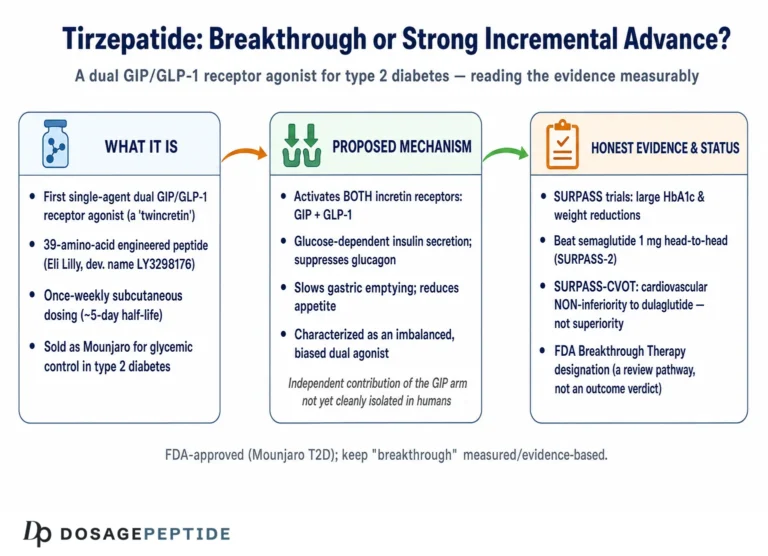
The same ordering holds in the diabetes trials. SURPASS-1 reported nausea in 12–18% of tirzepatide recipients versus 6% on placebo, and diarrhoea in 12–14% versus 8%[3]. In SURPASS-2, the 40-week open-label head-to-head against semaglutide 1 mg, the headline gastrointestinal events named in the primary publication were nausea (17–22% with tirzepatide versus 18% with semaglutide), diarrhoea (13–16% versus 12%) and vomiting (6–10% versus 8%)[5]. Constipation did not make the abstract in any of these papers — a point worth holding onto, because it means the label tables, not the journal articles, are the citable source for constipation figures.
Why is the mechanism weaker than it is usually presented?
The standard explanation is that tirzepatide slows gastric emptying, so everything downstream slows too. The first half of that sentence is well documented. The second half is an inference.
Tirzepatide’s effect on gastric emptying was measured in a dedicated Phase 1 study, NCT04407234, in 36 overweight or obese adults with and without type 2 diabetes[6]. The primary endpoints were the AUC and peak concentration of orally administered acetaminophen — a pharmacokinetic surrogate, not a direct image of the stomach. The label states the finding plainly: “Tirzepatide delays gastric emptying. The delay is largest after the first dose and this effect diminishes over time.”[2] That is consistent with the wider GLP-1 literature, where retardation of gastric emptying is a reproducible class effect that attenuates with long-acting preparations and continued exposure[7]. It is worth flagging that this 2021 review concluded, on the reports available at the time, that dual GIP/GLP-1 agonists did not retard gastric emptying — a position the dedicated tirzepatide study and the subsequent label superseded. The receptor pharmacology behind that class effect is summarised in our explainer on what tirzepatide is and how the dual GIP/GLP-1 mechanism works.
Here is the gap. Gastric emptying is an upper-gastrointestinal measurement. Constipation is a lower-gastrointestinal outcome. No published tirzepatide study located for this review measured colonic transit time, whole-gut transit, stool frequency or stool consistency as an endpoint. The causal chain — delayed gastric emptying causes slowed colonic transit causes constipation — is assembled from plausibility and from class-level observations, not demonstrated for tirzepatide. Anyone writing that tirzepatide “causes constipation by slowing the gut” is stating a hypothesis in the grammar of a finding.
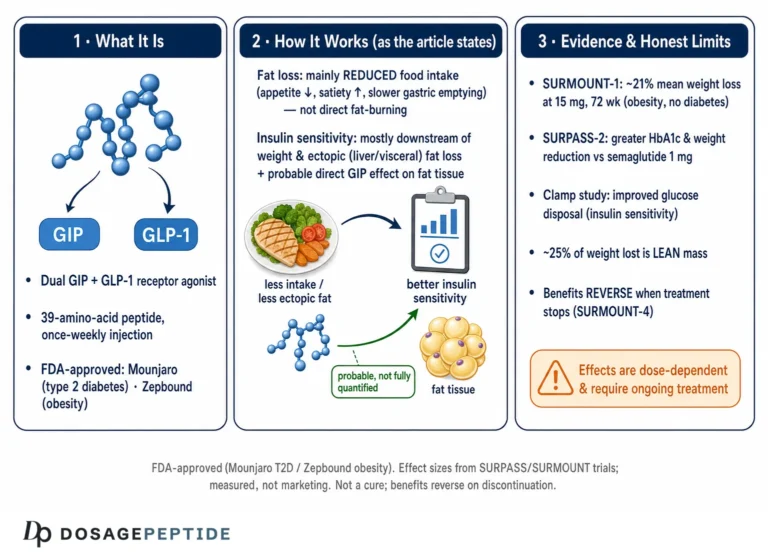
A second, unglamorous explanation is at least as consistent with the data and is rarely stated. The Zepbound label states directly that “tirzepatide decreases calorie intake” and that the effect is “likely mediated by affecting appetite”[2] — and a lower volume of food and fluid passing through the gut is an obvious candidate explanation for less frequent stool that requires no direct action on the colon at all. Since the obesity pool — where weight loss is largest and treatment longest — is also where constipation incidence is highest, intake reduction is a live confounder that the trial designs cannot separate from any direct motility effect. The magnitude and timing of that intake reduction is what our tirzepatide results timeline reference tracks across the trial record.
Does constipation cluster during dose escalation?
This is the point where most articles overreach, so it is worth being precise about what the label says and what it does not.
Both labels contain a sentence about escalation timing, and both name specific reactions: the majority of reports of nausea, vomiting and/or diarrhoea occurred during dose escalation and decreased over time[1][2]. Constipation is not named in that sentence.
The same asymmetry runs through the dedicated tolerability literature. A 2025 post hoc analysis in Diabetes, Obesity and Metabolism pooled SURMOUNT-1 through SURMOUNT-4 to test whether gastrointestinal adverse events explained the weight reduction — and the symptom set it examined was, by its own stated aims, nausea, vomiting, diarrhoea and dyspepsia. It reported that gastrointestinal adverse events were more frequent on tirzepatide (27.8–72.8%) than placebo (12.2–32.5%), that most were non-serious and occurred during dose escalation, and that 1.0–10.5% of tirzepatide-treated participants discontinued for gastrointestinal reasons[8]. Constipation was not among the events analysed. So the frequently repeated claim that tirzepatide-associated constipation peaks during titration and settles afterwards is, on the published record, an extrapolation from the nausea/vomiting/diarrhoea timing data — not a documented finding for constipation itself.
What do the labels warn about severe gastrointestinal reactions and ileus?
Both labels carry a Warnings and Precautions section on severe gastrointestinal adverse reactions, and both quantify it. For Zepbound, severe gastrointestinal adverse reactions were reported in 1.7% (5 mg), 2.5% (10 mg) and 3.1% (15 mg) of patients versus 1% on placebo[2]. For Mounjaro the corresponding figures were 1.3%, 0.4% and 1.2% versus 0.9% on placebo — a much flatter and less clearly separated signal[1]. Both labels state that the product is not recommended in patients with severe gastroparesis. Discontinuation for gastrointestinal reasons in the Zepbound pool was 1.9%, 3.3% and 4.3% by dose versus 0.5% on placebo[2].
Separately, the postmarketing experience section of both labels lists, under gastrointestinal reactions: acute pancreatitis, haemorrhagic and necrotising pancreatitis sometimes resulting in death, ileus, intestinal obstruction, and severe constipation including faecal impaction[1].
That listing must be read with the caveat the label itself attaches to it. Postmarketing reactions are “reported voluntarily from a population of uncertain size,” and the label states explicitly that it is “not always possible to reliably estimate their frequency or establish a causal relationship to drug exposure.”[1] Ileus appearing on a tirzepatide label is a documented report, not a quantified risk and not a proven drug effect. No incidence figure exists for it in either label, because spontaneous reporting cannot produce one.
What has real-world surveillance added?
Less than the volume of commentary suggests. A disproportionality analysis of the FDA Adverse Event Reporting System covering 2022 Q2 to 2023 Q3 examined 20,043 reports naming tirzepatide as the primary suspect drug within a database of 1,904,481 case reports, and identified 46 adverse-reaction signals at the preferred-term level across eight system organ classes. Constipation was not among the detected signals, although nausea, vomiting, dyspepsia, eructation, abdominal distension, gastro-oesophageal reflux disease, pancreatitis and impaired gastric emptying all were[9]. That absence is weak evidence in both directions: the authors note that spontaneous reports are incomplete, that confounders cannot be controlled, that true incidence cannot be calculated because the denominator of users is unknown, and that disproportionality “merely offers statistical significance without quantifying risk or causality.” A well-known, label-listed, non-serious reaction is exactly the kind of event that is under-reported to a pharmacovigilance system relative to its true frequency.
The most direct real-world evidence of a lower-gut effect is class-level rather than tirzepatide-specific. A multicentre retrospective study of 4,876 GLP-1 receptor agonist users propensity-matched to 4,876 controls found inadequate bowel preparation for colonoscopy in 10% of GLP-1 users versus 4% of controls, with GLP-1 use an independent risk factor on multivariate analysis (odds ratio 2.7)[10]. That is a retrospective, class-wide observation about residual colonic contents in a mixed GLP-1 population — not a tirzepatide study, and not a measurement of constipation. It is suggestive of a lower-GI footprint for the drug class; it is not proof of the causal chain described above.
What the record does not establish
Stated plainly, so it is not lost in the numbers above:
- No trial has used constipation as a prespecified endpoint. Every figure quoted here is a spontaneously reported adverse event captured alongside a glycaemic, weight or apnoea endpoint — including in SURMOUNT-OSA, the 52-week obstructive sleep apnea programme, where the publication reports only that adverse events were “gastrointestinal in nature and mostly mild to moderate in severity”[11] without a constipation breakdown.
- No study has measured colonic or whole-gut transit on tirzepatide. The mechanism section above is inference, and is presented as such.
- No published analysis has separated the intake-reduction confounder from a direct motility effect. Both would produce the same table.
- No incidence figure exists for ileus or intestinal obstruction on tirzepatide. They are postmarketing reports of unknown frequency and unestablished causality.
- Compounded and research-supply tirzepatide is not the product these tables describe. The incidence data above come from trials of Eli Lilly’s FDA-approved formulations at the label’s own doses and schedule; nothing here transfers to unapproved material, whether supplied as a 10 mg vial or a 30 mg vial.
This article documents what trials and regulatory records report. It does not offer management strategies, and deliberately names none. Any question about a specific person’s bowel symptoms — including whether they are drug-related, how severe they are, and what should be done — belongs with a licensed prescriber, not a reference page.
How long does it last, and what do the labels say about managing it?
Two questions get asked constantly and deserve direct answers, including where the answer is “not established”.
Duration. No published tirzepatide trial reports a median duration for constipation. The label’s time-course statement covers nausea, vomiting and diarrhoea; the dedicated post hoc tolerability analysis of SURMOUNT-1 through SURMOUNT-4 examined nausea, vomiting, diarrhoea and dyspepsia by its own stated aims. Constipation sits outside both. What the record does show is that gastrointestinal events overall were mostly non-serious and clustered during dose escalation, and that between 1.0% and 10.5% of tirzepatide-treated participants discontinued for gastrointestinal reasons across those trials. A symptom that resolves on its own and a symptom that persists both fit that data. It has not been separated.
Management. The labels do not prescribe a constipation management protocol. What they do carry is a warning that matters more than any remedy list: both products warn about severe gastrointestinal reactions, including reports of ileus — a stall in bowel movement that is a medical emergency, not a bad week. Severe abdominal pain, persistent vomiting, abdominal distension or an inability to pass stool or gas is not the constipation this article is about, and is a reason to seek medical attention rather than to try a remedy.
For ordinary constipation, the general measures discussed in clinical practice — fluid intake, dietary fibre, physical activity — are the same ones used for constipation from any cause, and none of them has been tested specifically against tirzepatide-associated constipation in a controlled trial. Dose escalation pace is a prescriber decision, not a self-adjustment. Anyone experiencing this on a prescribed product should raise it with the prescriber, who can weigh titration speed against symptom burden with the individual case in front of them.
Frequently Asked Questions
Does tirzepatide cause constipation?
Constipation is a labelled adverse reaction of tirzepatide, reported more often than placebo in every pooled trial table published in the FDA prescribing information. In the type 2 diabetes pool the incidence was 6–7% versus 1% on placebo; in the obesity pool it was 11–17% versus 5%. Because these are spontaneously reported events rather than a prespecified endpoint, they establish an association with treatment rather than a measured mechanism.
How common is constipation compared with nausea on tirzepatide?
Substantially less common. In the pooled Zepbound obesity trials, nausea was reported by 25–29% of treated patients and diarrhoea by 19–23%, against 11–17% for constipation. The same ranking holds in the diabetes trials, where nausea reached 12–18% and constipation 6–7%. Constipation is a real labelled reaction, but it is not the dominant gastrointestinal complaint in any published pool.
Is tirzepatide constipation dose-related?
Not cleanly. In the Mounjaro diabetes pool the figures were 6%, 6% and 7% across 5, 10 and 15 mg — essentially flat. In the Zepbound obesity pool they ran 17%, 14% and 11%, decreasing as assigned dose rose. The dose columns are of unequal size and every patient passed through the same escalation, so the label tables cannot be read as a within-trial dose-response curve for this reaction.
Why do Mounjaro and Zepbound report different constipation rates?
They describe different trial populations. The Mounjaro table pools 718 patients with type 2 diabetes over a mean 36.6 weeks; the Zepbound table pools 2,519 adults with obesity or overweight over up to 72 weeks. The obesity trials ran longer, produced far greater weight loss and reduced intake, and had a higher placebo constipation rate (5% versus 1%), which suggests different baseline symptom reporting before any drug effect.
Does delayed gastric emptying explain the constipation?
It is the usual explanation but it is not demonstrated. Tirzepatide’s delay of gastric emptying was established using acetaminophen pharmacokinetics in a 36-participant Phase 1 study, and the label notes the effect is largest after the first dose and diminishes over time. Gastric emptying is an upper-gastrointestinal measure; no located tirzepatide study measured colonic or whole-gut transit, so the link to a lower-gut outcome remains inferred.
Is ileus a proven risk of tirzepatide?
No. Ileus, intestinal obstruction and severe constipation including faecal impaction appear in the postmarketing experience section of both labels. That section carries the label’s own caveat that reports come from a population of uncertain size and that frequency and causal relationship to drug exposure often cannot be established. No incidence figure exists for these events, and their presence on a label is a documented report rather than a quantified risk.
Did the dedicated tolerability analyses study constipation?
Not directly. The 2025 post hoc analysis pooling SURMOUNT-1 to SURMOUNT-4 was built around nausea, vomiting, diarrhoea and dyspepsia, and reported that most gastrointestinal events were non-serious and occurred during dose escalation. Constipation was outside the symptom set it examined, which is why claims that tirzepatide constipation peaks during titration are extrapolations from the nausea and diarrhoea timing data rather than documented findings.
Did real-world pharmacovigilance detect a constipation signal?
A disproportionality analysis of 20,043 FAERS reports naming tirzepatide from 2022 Q2 to 2023 Q3 identified 46 preferred-term signals, and constipation was not among them. That absence proves little in either direction: the authors note that spontaneous reporting cannot yield true incidence, that confounders are uncontrolled, and that disproportionality offers statistical signal without quantifying risk or causality.
How long does tirzepatide constipation last?
Not established. No published trial reports a median duration for constipation specifically. The label sentence about reactions decreasing over time names nausea, vomiting and diarrhoea — not constipation — and the main post hoc tolerability analysis examined the same four symptoms, excluding constipation. Pages quoting a timeframe are extending a claim the documentation made about other symptoms, not reporting a measured figure.
When is constipation a reason to seek medical help?
Both product labels warn about severe gastrointestinal reactions, including reported cases of ileus — a stall in bowel movement that is a medical emergency. Severe abdominal pain, persistent vomiting, marked abdominal distension, or an inability to pass stool or gas is categorically different from ordinary constipation and warrants prompt medical attention rather than a home remedy.
Is constipation worse at higher doses?
The label tables do not show a clean dose-response for constipation, unlike nausea. That is an unusual pattern for a symptom attributed to slowed gut transit, and it is one reason the mechanism story is weaker than it is usually presented. Rates do differ between the two label pools — 6–7% in the diabetes trials, 11–17% in the obesity trials — but those are different populations and trial designs, not a dose comparison.
References
- Eli Lilly and Company. MOUNJARO (tirzepatide) injection, for subcutaneous use — full prescribing information (sections 5.6, 6.1, 6.2, 12.2). DailyMed, U.S. National Library of Medicine. DailyMed SPL d2d7da5d-ad07-4228-955f-cf7e355c8cc0
- Eli Lilly and Company. ZEPBOUND (tirzepatide) injection, for subcutaneous use — full prescribing information (sections 1, 2, 5.2, 6.1, 6.2, 12.2). DailyMed, U.S. National Library of Medicine. DailyMed SPL 487cd7e7-434c-4925-99fa-aa80b1cc776b
- Rosenstock J, Wysham C, Frías JP, et al. Efficacy and safety of a novel dual GIP and GLP-1 receptor agonist tirzepatide in patients with type 2 diabetes (SURPASS-1): a double-blind, randomised, phase 3 trial. Lancet. 2021;398(10295):143–155. PubMed 34186022
- Dahl D, Onishi Y, Norwood P, et al. Effect of subcutaneous tirzepatide vs placebo added to titrated insulin glargine on glycemic control in patients with type 2 diabetes: the SURPASS-5 randomized clinical trial. JAMA. 2022;327(6):534–545. PubMed 35133415
- Frías JP, Davies MJ, Rosenstock J, et al. Tirzepatide versus semaglutide once weekly in patients with type 2 diabetes (SURPASS-2). N Engl J Med. 2021;385(6):503–515. PubMed 34170647
- Eli Lilly and Company. The impact of tirzepatide on gastric emptying (GE) in overweight/obese non-diabetic subjects and in overweight/obese subjects with type 2 diabetes mellitus. Phase 1, n=36, completed 2021. ClinicalTrials.gov. NCT04407234
- Maselli DB, Camilleri M. Effects of GLP-1 and its analogs on gastric physiology in diabetes mellitus and obesity. Adv Exp Med Biol. 2021;1307:171–192. PubMed 32077010
- Rubino DM, Pedersen SD, Connery L, et al. Gastrointestinal tolerability and weight reduction associated with tirzepatide in adults with obesity or overweight with and without type 2 diabetes in the SURMOUNT-1 to -4 trials. Diabetes Obes Metab. 2025;27(4):1826–1835. PubMed 39789843
- Liu L. A real-world data analysis of tirzepatide in the FDA adverse event reporting system (FAERS) database. Front Pharmacol. 2024;15:1397029. PMC11190169
- Abu-Freha N, Yitzhak A, Shirin H, et al. Glucagon-like peptide-1 receptor agonists significantly affect the quality of bowel preparation for colonoscopy. Endoscopy. 2025;57(2):126–133. PubMed 39389565
- Malhotra A, Grunstein RR, Fietze I, et al. Tirzepatide for the treatment of obstructive sleep apnea and obesity (SURMOUNT-OSA). N Engl J Med. 2024;391(13):1193–1205. PubMed 38912654
- Jastreboff AM, Aronne LJ, Ahmad NN, et al. Tirzepatide once weekly for the treatment of obesity (SURMOUNT-1). N Engl J Med. 2022;387(3):205–216. PubMed 35658024
Research use only. Tirzepatide is FDA-approved in the United States as Mounjaro (adjunct to diet and exercise to improve glycaemic control in adults and paediatric patients 10 years and older with type 2 diabetes mellitus) and as Zepbound (to reduce excess body weight and maintain weight reduction long term in adults with obesity or overweight with at least one weight-related comorbidity, and to treat moderate-to-severe obstructive sleep apnea in adults with obesity); the incidence figures on this page come from those approved products’ own labelled trials and do not describe compounded, research-grade or otherwise unapproved tirzepatide. This article is an educational review of published trial data and regulatory records. It is not medical advice, not a protocol, not a treatment recommendation, and not guidance on managing any symptom.