PT-141 has never been tested in people whose low libido comes from depression, and the label of the one approved product goes further than silence: it explicitly excludes them. Bremelanotide, sold as Vyleesi, is approved by the U.S. Food and Drug Administration for a single narrow indication — acquired, generalized hypoactive sexual desire disorder (HSDD) in premenopausal women1 — and it is not indicated when low desire is due to a co-existing psychiatric condition or to the effects of a medication.3 Depression is a psychiatric condition; antidepressants are medications. This article covers what the approval actually tested, why the melanocortin mechanism still interests researchers here, the safety points that matter most in a depressed population, and the options clinicians reach for instead. For how the compound is handled in research settings, see our PT-141 10 mg vial protocol.
So rather than affirm the premise, this article treats it as an honest research question, and the honest answer has two parts. First, there is no clinical trial establishing that PT-141 treats sexual dysfunction that is caused by depression or by antidepressant therapy; that use is off-label and, at best, investigational. Second, there is a genuine and interesting mechanistic argument for why a centrally acting melanocortin agonist might, in principle, be relevant to the kind of desire and arousal problems that depression and serotonergic antidepressants produce — an argument worth laying out precisely because it is so easily oversold. Holding both of those parts in view at once is the whole task here.
This piece is written for researchers and educated readers who want a clear map of what is known, what is plausible but untested, and what is simply marketing. We will cover what PT-141 is and how it became Vyleesi, its melanocortin mechanism and why that mechanism is central rather than vascular, the two distinct ways depression damages sexual function, what the pivotal trials actually measured (and pointedly did not measure), the real size of the evidence gap for depression-related dysfunction, the mechanistic case for and against benefit, how PT-141 compares with the interventions that are used for antidepressant-associated sexual dysfunction, safety in a psychiatric population, research methodology, and regulatory status. The guiding principle throughout is restraint: bremelanotide is not an approved treatment for depression, for antidepressant side effects, or for sexual dysfunction secondary to either, and nothing here should be read as suggesting otherwise.
What PT-141 Is and How It Became Vyleesi
PT-141 is bremelanotide, a synthetic cyclic heptapeptide and an analogue of the naturally occurring hormone α-melanocyte-stimulating hormone (α-MSH).4 It is, in a sense, the pharmacological grandchild of the tanning peptide melanotan II: researchers noticed that men receiving melanotan-family melanocortin agonists reported spontaneous erections, and that observation redirected an entire drug-development program away from pigmentation and toward sexual function.4 Bremelanotide emerged as the metabolite and refined candidate carried forward by Palatin Technologies. Its identity as a melanocortin-receptor agonist — rather than a hormone, a steroid, or a vasodilator — is the fact from which every honest statement about the compound follows.
The clinical history moved in two acts. In the first act, through the early 2000s, PT-141 was developed as an intranasal treatment for erectile dysfunction in men. Early double-blind, placebo-controlled work reported that intranasal PT-141 produced statistically significant, dose-dependent erectile responses in healthy men and in men with mild-to-moderate erectile dysfunction, an effect distinct from the vascular action of the phosphodiesterase-5 inhibitors then dominating the field.5 That was genuinely novel — a drug that appeared to act on the brain’s sexual-response circuitry rather than on penile blood vessels. But the intranasal program ran into a wall: melanocortin agonism raises blood pressure, and the doses needed for reliable efficacy produced transient increases in blood pressure that regulators considered unacceptable for an on-demand lifestyle drug delivered by an uncontrolled route.7 The nasal erectile-dysfunction development was halted.
In the second act, the sponsor reformulated bremelanotide as a subcutaneous auto-injector, changed the target population to premenopausal women with HSDD, and ran the pivotal trials that led to approval. On June 21, 2019, the FDA approved Vyleesi (bremelanotide injection) 1.75 mg subcutaneous, for on-demand use, as the second drug ever approved for HSDD and the first intended to be taken as needed rather than daily.13 This history matters for the depression question because it establishes two things at once: the compound genuinely does something to central sexual circuitry across sexes, and its entire approved evidence base is confined to a female HSDD population defined specifically to exclude psychiatric and drug-induced causes. Readers tracing how the compound’s neuroendocrine profile has been framed across the site may find the companion discussion of how PT-141 influences neuroendocrine pathways a useful map of the same biology from a different angle.
One clarification prevents most confusion downstream. “PT-141” and “bremelanotide” and “Vyleesi” are the same molecule in different guises: PT-141 is the old development code, bremelanotide the international non-proprietary name, and Vyleesi the approved brand and formulation. Material sold in research-chemical channels as “PT-141” is the same peptide but carries none of the quality, dose, and formulation controls of the approved product, a distinction that becomes important when we reach safety.
The Melanocortin Mechanism — Central, Not Vascular
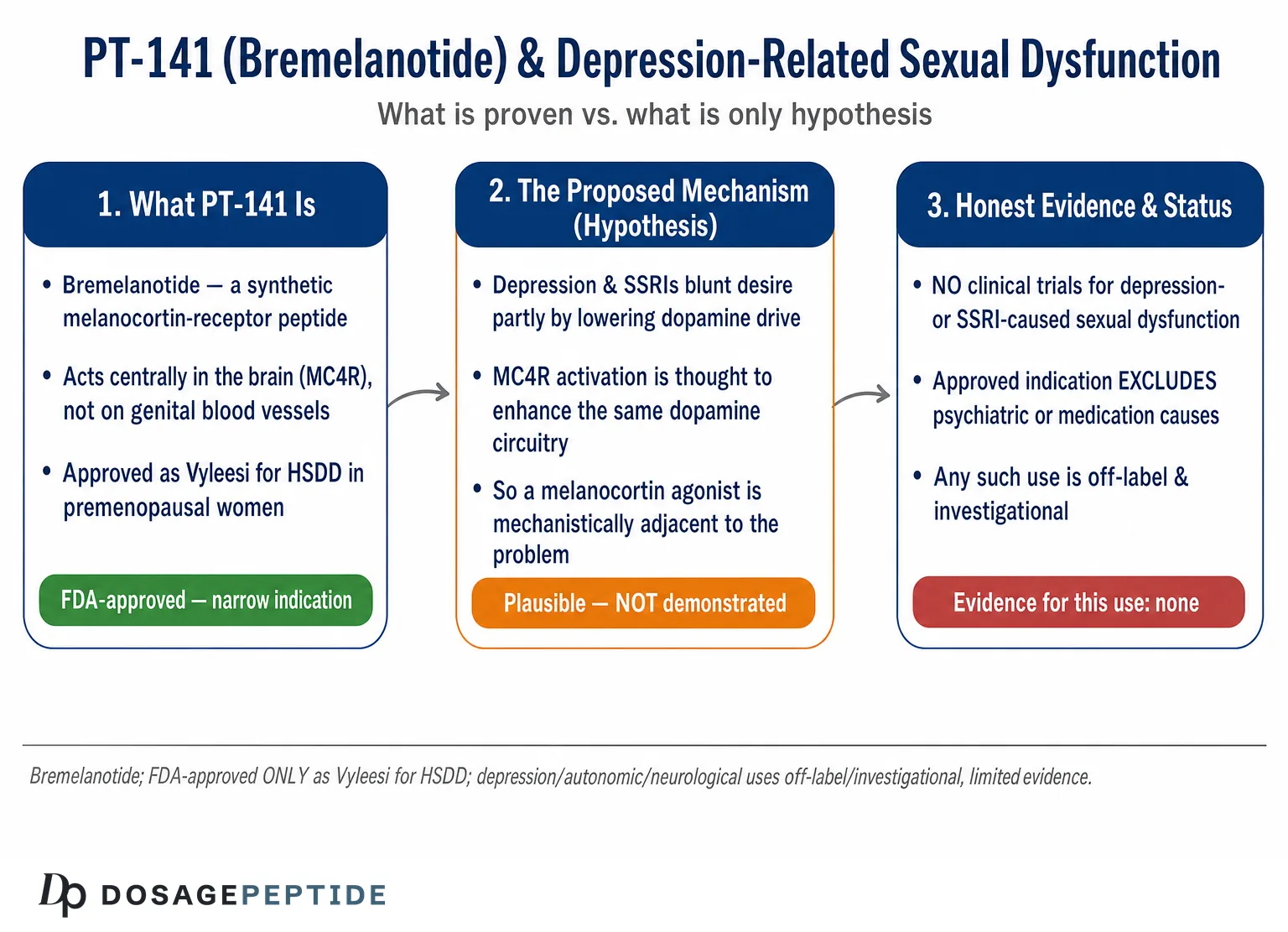
Understanding why PT-141 is even a candidate for depression-related sexual problems requires being precise about where and how it acts. Bremelanotide is an agonist at melanocortin receptors, with its pro-sexual effects attributed chiefly to activation of the melanocortin-4 receptor (MC4R), and secondarily the MC3R, expressed predominantly in the central nervous system.46 The relevant receptor populations sit in the hypothalamus — notably the paraventricular nucleus and the medial preoptic area — and in limbic regions that govern sexual motivation rather than the mechanics of the genital response.6
The distinction from the erectile-dysfunction drugs most people know is fundamental. Phosphodiesterase-5 inhibitors such as sildenafil act peripherally: they potentiate nitric-oxide-driven smooth-muscle relaxation in genital vasculature, improving the plumbing of arousal once desire and stimulation are present. They do essentially nothing for desire itself. Bremelanotide works upstream of the plumbing, on the neural circuits that generate sexual interest and motivation in the first place.4 Preclinical work mapped this with unusual specificity: in female rats, bremelanotide selectively increased appetitive, solicitational behaviors — the behavioral signature of sexual interest — following both peripheral administration and direct infusion into the medial preoptic area, but not into the ventromedial hypothalamus, and without simply driving reflexive consummatory behaviors like lordosis.6 That anatomical and behavioral selectivity is the strongest reason to take the compound seriously as a desire drug rather than a generic stimulant.
How does MC4R activation translate into desire? The leading account is that melanocortin signaling in these hypothalamic and limbic nodes modulates downstream dopaminergic neurotransmission in the brain’s incentive-motivation circuitry — the mesolimbic pathway running to the nucleus accumbens — and interacts with oxytocinergic projections implicated in the efferent control of genital tissues.46 In plain terms, the peptide appears to nudge the brain’s “wanting” system rather than the body’s vascular one. This is exactly the pivot on which the depression argument turns, and we will return to it: if depression and serotonergic antidepressants blunt sexual desire in part by suppressing dopaminergic drive, then a compound that engages a pathway feeding into that same dopaminergic system is at least mechanistically adjacent to the problem — which is not the same as being a proven solution.
Two honest caveats must travel with this mechanism. First, much of the detailed circuitry is worked out in rodents; the human mechanistic picture is inferred, not directly demonstrated at the level of specific nuclei. Second, MC4R is not a private sexual receptor. It is a central hub for energy balance, appetite, and, importantly, cardiovascular autonomic tone — which is precisely why agonism raises blood pressure and provokes nausea.7 The same non-selectivity that makes the compound interesting also makes it a blunt instrument, and no one should imagine that MC4R activation delivers a clean, desire-only signal.
Why Depression Causes Sexual Dysfunction — Two Distinct Routes
To judge whether PT-141 could help, one has to be precise about what “sexual dysfunction caused by depression” actually is, because it is not one thing but at least two, with different mechanisms and different implications for a melanocortin agonist.
Route one: the depressive illness itself. Major depressive disorder degrades sexual function directly. Loss of libido and diminished capacity for pleasure are core features of the syndrome — anhedonia, by definition, blunts the reward and motivation that sexual desire draws upon. Depression is associated with reduced dopaminergic tone in reward circuitry, disrupted sleep, fatigue, low self-worth, and relationship strain, all of which suppress desire and arousal. Notably, the pattern of impairment in depression is not uniform across the sexual response: clinical descriptions suggest desire and arousal are often blunted while some domains are variably affected, and the disturbance frequently improves as the mood episode remits. The key point for our purposes is that this dysfunction is a symptom of the underlying illness, and the evidence-based response is to treat the depression, not to bolt a desire drug onto an untreated mood disorder.
Route two: antidepressant treatment. Paradoxically, the drugs that treat depression are themselves a leading cause of sexual dysfunction. Selective serotonin reuptake inhibitors (SSRIs) and serotonin-norepinephrine reuptake inhibitors are strongly associated with treatment-emergent sexual dysfunction, with reported prevalence ranging widely — commonly cited in the range of roughly 40–70% depending on the agent, the definition, and how actively it is assessed.11 The mechanism is instructive: increased synaptic serotonin, acting through 5-HT2 and 5-HT3 receptors, suppresses dopaminergic and, downstream, nitric-oxide/cholinergic signaling in circuits governing desire, arousal, and orgasm; elevated serotonin also tends to raise prolactin and dampen the very mesolimbic dopamine drive that melanocortin signaling is thought to support.11 SSRI-associated dysfunction classically affects all phases — delayed or absent orgasm is the most notorious, but reduced desire and impaired arousal are common — and, unlike the illness-driven form, it often does not resolve on its own while the drug is continued.
There is also a third, contested category worth naming for completeness: post-SSRI sexual dysfunction (PSSD), in which sexual symptoms — genital numbness, loss of libido, blunted orgasm — are reported to persist after the antidepressant has been stopped. PSSD is recognized as a possibility but remains poorly quantified, with real barriers to measuring its true incidence and mechanism, and it is emphatically not something any PT-141 study has addressed. Mentioning it simply underscores how heterogeneous “sexual dysfunction related to depression and its treatment” really is: it spans an acute illness symptom, an ongoing drug effect, and a putative persistent syndrome, each with different biology and none studied with bremelanotide.
A further complication is that the sexual side effects of antidepressants are among the most common reasons patients quietly stop taking them, which in turn raises the risk of depressive relapse — a genuinely dangerous outcome. This is one reason the management of antidepressant-induced dysfunction is treated as a serious clinical problem in its own right rather than a cosmetic nuisance: solving the sexual symptom in a way that keeps the patient on effective treatment can be the difference between sustained remission and relapse. Any intervention proposed for this space, including an off-label peptide, has to be judged against that stakes-laden backdrop, not merely on whether it might transiently improve a desire score.
These routes are clinically entangled. A patient with depression on an SSRI who reports low desire may be experiencing residual depressive anhedonia, a drug side effect, relationship distress, or all three at once, and untangling them is a genuine diagnostic challenge that shapes which treatment could even make sense.1314 This entanglement is exactly why the HSDD field draws such a sharp line around “acquired, generalized HSDD” that is not attributable to a psychiatric condition or a medication — and why bremelanotide’s approval sits on the far side of that line from the population this article asks about.3 For a broader look at how desire and energy dysregulation travel together in illness states, the site’s discussion of PT-141, fatigue, and libido dysregulation in chronic illness examines a closely related comorbidity problem.
The Approval That Defines the Limits: What Vyleesi Was and Was Not Tested For
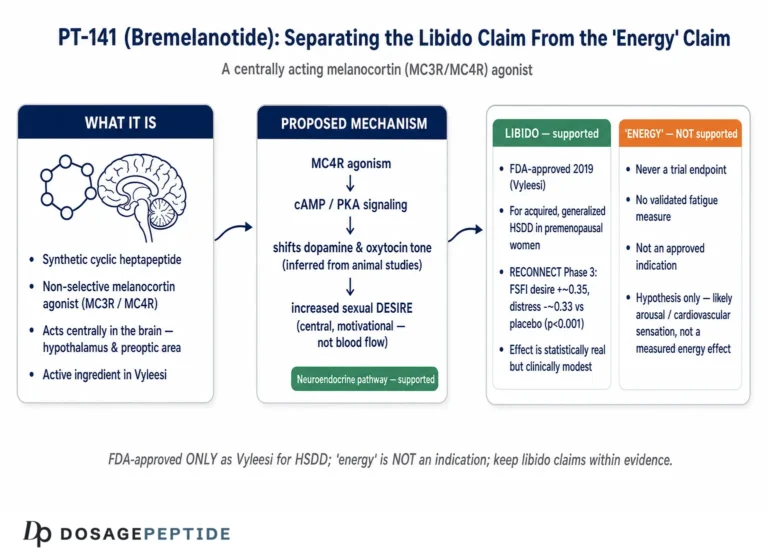
The pivotal evidence for bremelanotide is strong for what it covers and silent on what it does not. Two identical Phase 3, randomized, double-blind, placebo-controlled, 24-week trials — collectively the RECONNECT program — enrolled roughly 1,200 premenopausal women with acquired, generalized HSDD, who self-administered 1.75 mg subcutaneous bremelanotide or placebo on demand via auto-injector.1 Both trials met their co-primary endpoints: bremelanotide produced statistically significant improvements in sexual desire (measured by the Female Sexual Function Index desire domain) and statistically significant reductions in the distress associated with low desire (measured by a validated distress scale).1 A 52-week open-label extension supported durability of effect and characterized longer-term safety.2 This is a legitimate, regulator-grade evidence base, and it earns bremelanotide its measured claim to efficacy in its approved indication.
But the magnitude and the boundaries both demand honesty. The effect sizes in RECONNECT were statistically robust yet clinically modest — changes in desire scores and distress that separate reliably from placebo but that many commentators, and the FDA’s own reviewers, characterized as small in absolute terms. Bremelanotide is not a switch that restores desire; it is a modest, on-demand nudge in a carefully selected population. And that population was selected to be the mirror image of this article’s premise.
The prescribing information could hardly be more explicit. Vyleesi is indicated for acquired, generalized HSDD in premenopausal women, defined as low desire causing marked distress that is not due to a co-existing medical or psychiatric condition, problems within the relationship, or the effects of a medication or drug substance.3 In other words, before a clinician is even meant to consider Vyleesi, depression and antidepressant effects must have been ruled out as the cause of the low desire. The drug’s own label instructs prescribers to exclude precisely the etiologies this article’s title invokes.
| Question | What the approved evidence actually establishes |
|---|---|
| Approved population | Premenopausal women with acquired, generalized HSDD13 |
| Explicitly excluded causes | Co-existing medical or psychiatric condition; relationship problems; effects of a medication or drug substance3 |
| Depression as a cause | A psychiatric condition — outside the indication3 |
| Antidepressant-induced dysfunction | An effect of a medication — outside the indication3 |
| Men | Not indicated (nasal ED program halted for blood pressure)57 |
| Postmenopausal women | Not indicated3 |
| Endpoints measured | Desire (FSFI desire domain) and desire-related distress1 |
| Endpoints NOT measured | Depression severity; antidepressant-induced dysfunction; orgasmic recovery in SSRI users |
The reasonable reading is that RECONNECT tells us bremelanotide can modestly raise desire in women whose low desire has no identified psychiatric or pharmacologic cause. It does not tell us what the drug does in someone whose low desire is a symptom of depression or a side effect of an SSRI — because those people were, by design, screened out of the trials.
Does the Evidence Touch Depression-Related Sexual Dysfunction At All?
This is the section the title most demands, and candor requires that it be brief. There is no dedicated, adequately powered clinical trial of bremelanotide for sexual dysfunction caused by depression, and none for sexual dysfunction caused by antidepressants. The compound has not been tested as a treatment for SSRI-induced sexual dysfunction, has not been studied as an add-on in patients with active major depressive disorder, and has not been evaluated with depression severity or antidepressant-dysfunction recovery as an endpoint. On the specific question asked, the direct evidence level is effectively zero.
Three nuances make the picture slightly richer than a flat “no data,” and each must be stated carefully so it is not mistaken for support.
Subgroup analyses within HSDD. Prespecified and integrated subgroup analyses of the RECONNECT data examined whether bremelanotide’s effect held across demographic and clinical subgroups of the enrolled HSDD population.8 These are useful for showing the effect was reasonably consistent within the studied population, but they cannot answer the depression question, because the studied population had already excluded depression and medication-induced dysfunction as causes. A subgroup analysis cannot recover a population that was never enrolled.
Concomitant antidepressant users. Because HSDD and treated depression co-occur, some RECONNECT participants may have been on stable antidepressant therapy for adequately treated, stable depression — trials of this kind typically permit stable psychotropic use while excluding those whose low desire is attributed to the drug or an active mood disorder. Even where such participants existed, the trials were neither designed nor powered to isolate whether bremelanotide reversed antidepressant-induced dysfunction; any signal would be incidental, unadjusted, and hypothesis-generating at most. It would be a serious overreach to cite the mere presence of some antidepressant users as evidence of efficacy for antidepressant-induced dysfunction.
The male ED heritage. The early intranasal PT-141 studies showed the molecule can drive genital sexual response through a central route in men.5 That establishes biological activity on sexual circuitry but says nothing about depression-related dysfunction specifically, and the route that worked (nasal) is not the approved one, for safety reasons.7
It is also worth correcting a specific piece of misinformation that circulates in wellness marketing: the claim that because bremelanotide “works on the brain” it therefore treats the “mental” component of low libido, including the kind depression causes. This conflates two different meanings of “central.” Bremelanotide is central in the anatomical sense — it acts on brain receptors rather than genital vasculature — but that says nothing about whether it corrects a mood disorder or a serotonergic drug effect. A drug can act in the brain and still be entirely the wrong tool for a given brain problem. Antibiotics and antidepressants both act “in the body,” yet no one would treat pneumonia with an SSRI on that basis. The anatomical location of a drug’s action is not evidence that it addresses a particular disorder rooted in that location, and readers should be alert whenever “acts centrally” is quietly upgraded to “treats the psychological cause.”
The upshot is that any use of PT-141 for depression- or antidepressant-related sexual dysfunction is off-label and investigational. The correct scientific posture is not optimism or dismissal but agnosticism disciplined by mechanism — which is what the next section supplies. Readers comparing how the parent-class melanocortin compound has been discussed for desire disorders may find the analysis of whether melanotan II might play a role in hypoactive sexual desire disorder a useful comparison of exactly how thin the desire-disorder evidence base is across this whole chemical family.
Mechanistic Plausibility: Could a Melanocortin Agonist Help Where Depression Blunts Desire?
If there is a legitimate reason to keep an open mind, it lives here — and it is worth spelling out precisely because a plausible mechanism is so easily mistaken for a demonstrated one.
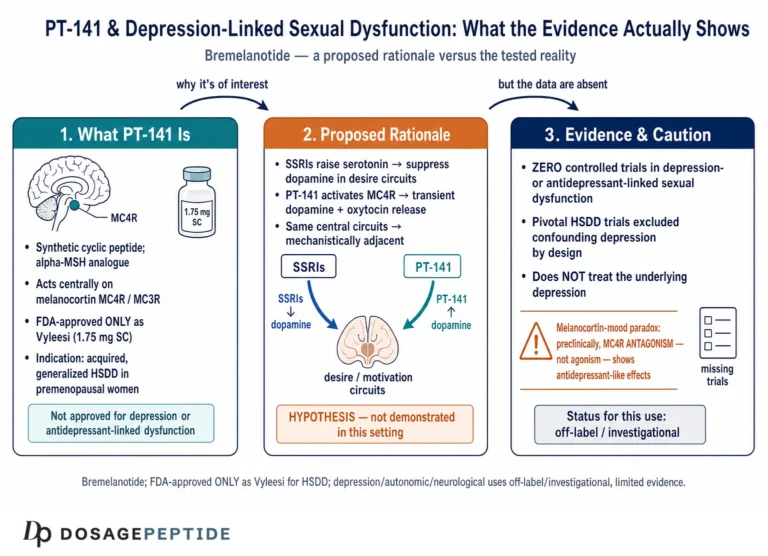
The core of the argument is a convergence on dopamine. Depression-related loss of desire and SSRI-induced loss of desire share a final common theme: suppressed dopaminergic drive in the mesolimbic reward circuitry that generates “wanting.”11 In depression, anhedonia reflects blunted reward signaling; with SSRIs, elevated serotonin actively brakes dopaminergic and downstream pro-sexual signaling. Bremelanotide’s proposed mechanism is that MC4R activation in hypothalamic and limbic nodes enhances dopaminergic neurotransmission in that same incentive circuitry.46 On paper, then, a melanocortin agonist engages a pathway positioned to partially offset the dopaminergic deficit that both depression and SSRIs impose. That is a coherent, non-trivial hypothesis, and it is the reason the question is worth asking rather than dismissing outright.
But the counter-arguments are equally real and, on current evidence, weightier. First, plausibility is not efficacy; the history of sexual medicine is full of mechanistically elegant candidates that failed in trials, and bremelanotide’s own effect size in its approved use is modest, so its capacity to overcome an active pharmacologic brake or an untreated mood disorder should not be assumed to be larger. Second, if the low desire is driven by an untreated or under-treated depression, the mechanistically correct intervention is to treat the depression; layering an on-demand desire peptide over an inadequately managed mood disorder addresses a symptom while leaving the disease, and risks masking a signal that should prompt better psychiatric care. Third, in SSRI-induced dysfunction specifically, the dominant, evidence-based strategies work by adjusting the serotonergic insult itself — dose reduction, switching to a less serotonergic agent, or adding a dopaminergic/noradrenergic drug — rather than by pushing a separate accelerator against a serotonergic brake, and there is no head-to-head evidence that a melanocortin agonist would match those approaches.11
There is also a pharmacodynamic subtlety worth flagging. Bremelanotide is used on demand, timed before anticipated activity, and produces a modest, transient effect. SSRI-induced dysfunction and depressive anhedonia are chronic, tonic states. Whether an intermittent, short-acting nudge to desire could meaningfully counter a persistent, treatment-maintained suppression is entirely unstudied, and the mismatch in temporal profiles is a reason for caution rather than confidence. The honest mechanistic verdict is therefore: biologically plausible, directionally sensible with respect to dopamine, but untested against the specific pathophysiology of depression-related dysfunction and facing an evidence-based standard of care built on different principles.
It is worth being explicit about how a plausible mechanism can mislead, because this compound is a textbook case. The reasoning “depression lowers dopamine-linked desire → bremelanotide raises dopamine-linked desire → therefore bremelanotide fixes depression-related low desire” is a syllogism that feels airtight and is not. Each arrow hides an assumption. The first assumes the patient’s low desire is primarily dopaminergic rather than driven by fatigue, sleep disruption, relationship strain, body-image change, or the illness’s global anhedonia — factors a desire peptide does not touch. The second assumes bremelanotide’s dopaminergic effect is large enough to matter against an active serotonergic brake, when its effect in a population with no such brake was already modest. The third assumes that raising desire in isolation is therapeutically meaningful when desire, arousal, and orgasm are dissociable and depression can impair them unevenly. A mechanism that survives all three assumptions is possible; one that has been demonstrated to survive them is what a clinical trial would show, and none exists.
There is one more asymmetry that deserves emphasis. In the illness-driven case, the desire problem is often a barometer of the depression itself, and it tends to lift as the mood episode remits. Using an on-demand peptide to lift the barometer without treating the weather it measures is not just unproven — it is conceptually backwards, because it risks obscuring a signal (worsening or under-treated depression) that clinicians actively rely on. This is a rare instance where a symptomatic fix, even if it worked, could carry a downside beyond its own side effects: it could make the underlying disease harder to track. That consideration has no analogue in the approved HSDD population, where by definition no such underlying disease is driving the symptom, and it is a further reason the extrapolation from HSDD to depression-related dysfunction is not benign.
How PT-141 Compares With Options Actually Used for Depression-Linked Sexual Dysfunction
The clearest way to locate PT-141 honestly is to set it beside the strategies clinicians actually use when depression or its treatment damages sexual function. The contrast is not that PT-141 loses a competition — it has never entered the trials that would let it compete — but that it sits outside a fairly well-developed, if imperfect, management framework.
| Strategy | How it addresses depression-related sexual dysfunction | Evidence status for this use |
|---|---|---|
| Treating the depression to remission | Removes illness-driven anhedonia/low desire at the source | Standard of care; sexual function often improves with mood recovery |
| Switch to bupropion (or add it) | Dopaminergic/noradrenergic, low sexual-side-effect burden; augmentation counters SSRI effect | Most evidence-supported pharmacologic strategy for antidepressant-induced dysfunction11 |
| SSRI dose reduction / drug holiday | Lessens the serotonergic insult | Used clinically; relapse risk must be weighed11 |
| Switch to less serotonergic agent (e.g., mirtazapine, vortioxetine, agomelatine) | Lower intrinsic sexual dysfunction | Supported for select patients11 |
| PDE5 inhibitor add-on | Improves the arousal/erectile mechanics, chiefly in men | Evidence mainly for the arousal phase, not desire11 |
| Buspirone augmentation | 5-HT1A partial agonism; may relieve SSRI dysfunction | Mixed/modest evidence11 |
| Flibanserin (Addyi) | Daily serotonergic/dopaminergic modulator for HSDD | Approved for HSDD; not for depression-caused dysfunction; alcohol/interaction cautions |
| Bremelanotide (PT-141 / Vyleesi) | On-demand central MC4R agonist raising desire | Approved only for HSDD not due to psychiatric/medication cause; no trials for depression-related dysfunction3 |
Two lessons fall out of this table. The first is that the management of depression-related sexual dysfunction is, appropriately, organized around the depression and its treatment — either optimizing the mood disorder’s care or modifying the offending drug — because the dysfunction is downstream of those things. PT-141 does neither; it acts on a parallel pathway without touching the cause. The second is that even the agents with the best evidence here, such as bupropion augmentation, produce imperfect results, which sets a sobering bar: a compound with no trials in this population is not a shortcut past a hard problem. It is an untested option that a responsible clinician would place well behind the evidence-based steps, if considered at all.
None of this makes PT-141 uninteresting. As a centrally acting desire drug with a genuinely novel mechanism, it remains a compelling research tool for dissecting how the brain constructs sexual motivation, and the site’s coverage of what clinical trials show about PT-141 and sexual desire catalogs the trial-level detail behind its approved use. But its place in the specific problem of depression-caused dysfunction is, for now, hypothetical.
Safety, Tolerability, and Special Concerns in a Population With Depression
Bremelanotide’s safety profile in its approved use is reasonably well characterized, and several features of that profile are more, not less, relevant in people with depression — which is one reason the off-label leap is not merely unproven but potentially ill-advised.
The most common adverse reaction is nausea, reported by roughly 40% of women in the trials, prompting anti-emetic use in around 13% and discontinuation in about 8%; flushing (around 20%) and headache (around 11%) were also markedly more common than with placebo.3 Injection-site reactions and vomiting round out the frequent events. Most events were mild-to-moderate and transient, and nausea tended to lessen with subsequent doses, but this is not a side-effect-free compound.3
The cardiovascular signal is the one that shaped the whole development history. Melanocortin agonism transiently raises blood pressure and slightly lowers heart rate; formal ambulatory blood pressure monitoring showed small mean increases in daytime systolic and diastolic pressure after dosing, peaking a few hours post-injection and resolving within the day.7 These increases are modest at the approved subcutaneous dose, which is why the drug reached market where the higher-exposure nasal ED formulation did not.57 Still, the label cautions against use in people with uncontrolled hypertension or known cardiovascular disease, and limits dosing frequency.3
| Adverse reaction | Reported frequency (approved use) | Note |
|---|---|---|
| Nausea | ~40% | Anti-emetic in ~13%; discontinuation in ~8%; improves with later doses3 |
| Flushing | ~20% | vs <1% placebo3 |
| Headache | ~11% | vs ~2% placebo3 |
| Injection-site reactions / vomiting | >4% | Common but usually mild3 |
| Transient blood-pressure increase | Small mean rise, peaks hours post-dose | Basis for cardiovascular cautions and dose limits7 |
| Focal hyperpigmentation | Reported with repeated dosing | Melanocortin effect on melanocytes310 |
Several considerations sharpen specifically for a depressed population. People with depression have elevated rates of cardiometabolic disease and are frequently on multiple medications, so the transient pressor effect and the potential for interactions warrant more caution, not less. Certain antidepressants and other drugs may interact with bremelanotide’s handling or additive effects, and the compound can slow gastric emptying, which is relevant for orally administered co-medications.3 There is a documented risk of focal hyperpigmentation with repeated dosing, a direct consequence of melanocortin action on pigment cells.310 And a broader clinical concern applies: using an on-demand desire drug to paper over sexual symptoms of an untreated or under-treated mood disorder could delay appropriate psychiatric care, which in depression — a condition carrying real morbidity and mortality — is not a trivial harm.
Finally, the sourcing hazard. Bremelanotide sold through research-chemical channels as “PT-141” carries no assurance of identity, purity, sterility, or dose accuracy; the reassuring trial safety data apply to the manufactured, dose-controlled product, not to an unregulated vial. For a population already managing a serious illness, that gap between the studied product and the material actually obtained is a safety issue in its own right.
Research Models, Endpoints, and the Methodological Gap
Understanding how bremelanotide has — and has not — been studied clarifies exactly what would be needed to answer this article’s question honestly.
Preclinical. The behavioral neuroscience is genuinely strong for the desire question in general: rodent paradigms measuring appetitive (solicitational) versus consummatory sexual behavior, combined with site-specific brain infusions and markers of neural activation, established that bremelanotide acts on discrete hypothalamic and limbic nodes to raise sexual motivation.6 But these are healthy-animal models of desire. There is no established, validated animal model of “depression-induced” or “SSRI-induced” sexual dysfunction in which bremelanotide has been tested as a reversal agent — the kind of chronic-serotonergic or chronic-stress model with sexual-behavior endpoints that would be the logical preclinical starting point.
Clinical. The human program was built to the appropriate standard for an HSDD drug: dose-ranging Phase 2b responder analyses, two identical Phase 3 randomized double-blind placebo-controlled trials with validated desire and distress endpoints, a long-term open-label extension, dedicated cardiovascular monitoring, and integrated safety and subgroup analyses.1278912 That architecture answers the HSDD question well. It does not answer the depression question at all, because the enrolled population was defined to exclude psychiatric and medication-induced causes, and because the endpoints measured desire and distress rather than antidepressant-dysfunction recovery or depression severity.
To actually establish efficacy for sexual dysfunction caused by depression, one would need purpose-built trials: for the antidepressant-induced form, a randomized controlled trial enrolling patients with well-characterized, stable depression on a stable SSRI who developed treatment-emergent sexual dysfunction, randomized to bremelanotide or placebo (ideally with an active comparator such as bupropion augmentation), using validated sexual-function instruments and depression-severity monitoring to ensure the mood disorder stays controlled. For the illness-driven form, the design is even harder, because the ethical and scientifically correct move is to treat the depression first, which tends to improve the sexual symptom and confound the question. None of this work has been done. Until it is, statements about PT-141 and depression-related dysfunction are hypotheses, not findings — a distinction the site’s broader reference materials, including the peptide research glossary, are organized to help readers keep straight.
Regulatory and Practical Status
The regulatory picture is unusually clean for a peptide, and it points firmly away from the use this title implies.
Approved, but narrowly. Bremelanotide (Vyleesi) is FDA-approved, as of June 2019, solely for acquired, generalized HSDD in premenopausal women, by subcutaneous auto-injector, on demand.13 It is a real, regulated medicine — not a research chemical — within that lane. Outside that lane, including for depression-related or antidepressant-induced sexual dysfunction, for men, and for postmenopausal women, its use is off-label and unsupported by adequate evidence.3
The indication itself excludes the premise. This bears repeating because it is the crux of the whole article: the approved indication requires that low desire not be due to a co-existing psychiatric condition or the effects of a medication.3 A clinician following the label is instructed to exclude depression and antidepressant effects before prescribing. There is no regulatory recognition anywhere of bremelanotide as a treatment for sexual dysfunction caused by depression.
Safety-related labeling. Vyleesi carries cardiovascular cautions, a dosing-frequency limit (no more than one dose in 24 hours, and no more than eight per month), warnings about transient blood-pressure elevation, focal hyperpigmentation, and reduced efficacy or tolerability concerns with certain uses; the drug’s hepatic profile is summarized in standard drug-safety references.310 These constraints reflect the melanocortin mechanism’s systemic reach and reinforce that this is not a benign lifestyle supplement.
The practical synthesis for anyone weighing the title’s question: PT-141 is an approved, modestly effective, on-demand desire drug for a specific female HSDD population defined to exclude depression and medication effects, and it is entirely untested for the depression-caused dysfunction the title asks about. The evidence-based path for sexual dysfunction driven by depression or its treatment runs through optimizing depression care and modifying antidepressant therapy — not through an off-label peptide. Any legitimate investigation of bremelanotide in this space belongs in properly designed clinical trials, under appropriate oversight, with psychiatric care held to standard.
Frequently Asked Questions
Is PT-141 approved to treat sexual dysfunction caused by depression?
No. Bremelanotide (Vyleesi) is FDA-approved only for acquired, generalized HSDD in premenopausal women, and the approved indication explicitly requires that the low desire not be due to a co-existing psychiatric condition or the effects of a medication.3 Depression is a psychiatric condition and antidepressants are medications, so sexual dysfunction caused by either falls outside the indication. Using PT-141 for that purpose is off-label and investigational, with no supporting clinical trials.
Has PT-141 been tested for antidepressant (SSRI)-induced sexual dysfunction?
Not in any dedicated, adequately powered trial. There is no randomized controlled study of bremelanotide as a treatment for SSRI-induced sexual dysfunction. Some participants in the HSDD trials may have been on stable antidepressants, but those studies were not designed or powered to isolate whether the drug reverses medication-induced dysfunction, so no efficacy conclusion for that use can be drawn.18
Could it work anyway, given its mechanism?
It is mechanistically plausible but unproven. Depression and SSRIs both blunt sexual desire in part by suppressing dopaminergic reward signaling, and bremelanotide’s central MC4R action is thought to enhance that same dopaminergic circuitry.4611 That makes the hypothesis reasonable to study. But plausibility is not efficacy, the drug’s effect size even in its approved use is modest, and it has never been tested against the specific pathophysiology of depression-related dysfunction.
What is the actual evidence-based treatment for sexual dysfunction from depression or antidepressants?
For dysfunction driven by the depressive illness, treating the depression to remission is the priority, and sexual function often improves as mood recovers. For antidepressant-induced dysfunction, the best-supported strategies modify the drug itself — switching to or augmenting with bupropion, reducing the dose, or switching to a less serotonergic agent — rather than adding a separate desire drug.11 These should be pursued with the prescribing clinician.
How does PT-141 differ from Viagra-type drugs in this context?
Fundamentally. PDE5 inhibitors like sildenafil act peripherally on genital blood flow and address the mechanics of arousal, not desire. Bremelanotide acts centrally, on hypothalamic and limbic circuits that generate sexual motivation.4 Since depression-related dysfunction frequently involves low desire, a central agent is conceptually closer to the problem — but, again, that conceptual fit has not been validated in trials for this population.
Is PT-141 safe for someone who has depression?
Its trial safety data come from women without excluded psychiatric causes, so they do not transfer automatically. Common effects include nausea (~40%), flushing, and headache, plus a transient rise in blood pressure that underlies cardiovascular cautions.37 People with depression often have higher cardiometabolic risk and take multiple medications, raising interaction and pressor concerns, and using the drug to mask symptoms of under-treated depression could delay appropriate care. Any use should involve a clinician managing the underlying mood disorder.
Why were people with depression excluded from the approval trials?
Because HSDD is defined as low desire that is not explained by another cause. If low desire stems from depression, an antidepressant, or relationship distress, it is considered secondary to that cause rather than primary HSDD.314 Regulators require that the drug be studied in the primary condition it claims to treat, so the trials screened out participants whose low desire was attributable to psychiatric or medication causes — exactly the groups this article’s title asks about.
Is “PT-141” bought online the same as Vyleesi?
Chemically it is the same peptide, bremelanotide, but the products are not equivalent. Vyleesi is a manufactured, dose-controlled, sterile subcutaneous product with regulatory oversight; material sold as research-grade “PT-141” carries no assurance of identity, purity, sterility, or dose, and the reassuring trial data do not apply to it.3 That distinction is a safety issue, especially for someone already managing a serious illness.
Could PT-141 ever become a treatment for depression-related sexual dysfunction?
It cannot be ruled out, but it would require purpose-built randomized trials in well-characterized patients — ideally against an active comparator like bupropion augmentation, with depression severity monitored throughout — and it would still have to clear the bar set by existing, imperfect strategies. Given its modest effect size in its approved use and the absence of any data in this population, it is, realistically, a research question rather than a near-term option.111
References
- Kingsberg SA, Clayton AH, Portman D, et al. Bremelanotide for the Treatment of Hypoactive Sexual Desire Disorder: Two Randomized Phase 3 Trials. Obstet Gynecol. 2019;134(5):899-908. PMID: 31599840. https://pubmed.ncbi.nlm.nih.gov/31599840/
- Simon JA, Kingsberg SA, Portman D, et al. Long-Term Safety and Efficacy of Bremelanotide for Hypoactive Sexual Desire Disorder. Obstet Gynecol. 2019;134(5):909-917. PMID: 31599847. https://pubmed.ncbi.nlm.nih.gov/31599847/
- VYLEESI (bremelanotide injection), for subcutaneous use: US Prescribing Information. Palatin Technologies / AMAG Pharmaceuticals; initial U.S. approval 2019. DailyMed. https://dailymed.nlm.nih.gov/dailymed/drugInfo.cfm?setid=8c9607a2-5b57-4a59-b159-cf196deebdd9
- Molinoff PB, Shadiack AM, Earle D, Diamond LE, Quon CY. PT-141: a melanocortin agonist for the treatment of sexual dysfunction. Ann N Y Acad Sci. 2003;994:96-102. PMID: 12851303. https://pubmed.ncbi.nlm.nih.gov/12851303/
- Diamond LE, Earle DC, Rosen RC, Willett MS, Molinoff PB. Double-blind, placebo-controlled evaluation of the safety, pharmacokinetic properties and pharmacodynamic effects of intranasal PT-141, a melanocortin receptor agonist, in healthy males and patients with mild-to-moderate erectile dysfunction. Int J Impot Res. 2004;16(1):51-59. PMID: 14963471. https://pubmed.ncbi.nlm.nih.gov/14963471/
- Pfaus J, Giuliano F, Gelez H. Bremelanotide: an overview of preclinical CNS effects on female sexual function. J Sex Med. 2007;4(Suppl 4):269-279. PMID: 17958619. https://pubmed.ncbi.nlm.nih.gov/17958619/
- White WB, Myers MG, Jordan R, Lucas J. Usefulness of ambulatory blood pressure monitoring to assess the melanocortin receptor agonist bremelanotide. J Hypertens. 2017;35(4):761-768. PMID: 27977473. PMCID: PMC5338879. https://pubmed.ncbi.nlm.nih.gov/27977473/
- Kingsberg SA, Clayton AH, Portman D, et al. Prespecified and Integrated Subgroup Analyses from the RECONNECT Phase 3 Studies of Bremelanotide. J Womens Health (Larchmt). 2022;31(3):391-400. PMID: 35230162. https://pubmed.ncbi.nlm.nih.gov/35230162/
- Althof S, Derogatis LR, Greenberg S, et al. Responder Analyses from a Phase 2b Dose-Ranging Study of Bremelanotide. J Sex Med. 2019;16(8):1226-1235. PMID: 31277966. https://pubmed.ncbi.nlm.nih.gov/31277966/
- LiverTox: Clinical and Research Information on Drug-Induced Liver Injury — Bremelanotide. Bethesda (MD): National Institute of Diabetes and Digestive and Kidney Diseases; 2021. Bookshelf ID: NBK573221. https://www.ncbi.nlm.nih.gov/books/NBK573221/
- Atmaca M. Selective Serotonin Reuptake Inhibitor-Induced Sexual Dysfunction: Current Management Perspectives. Neuropsychiatr Dis Treat. 2019;15:1529-1539. https://www.tandfonline.com/doi/full/10.2147/NDT.S185757
- Clayton AH, Kingsberg SA, Portman D, et al. Safety Profile of Bremelanotide Across the Clinical Development Program. J Womens Health (Larchmt). 2022;31(2):171-182. https://journals.sagepub.com/doi/full/10.1089/jwh.2021.0191
- Goldstein I, Kim NN, Clayton AH, et al. Hypoactive Sexual Desire Disorder: International Society for the Study of Women’s Sexual Health (ISSWSH) Expert Consensus Panel Review. Mayo Clin Proc. 2017;92(1):114-128. PMID: 27916394. https://www.sciencedirect.com/science/article/pii/S0025619616305961
- Pettigrew JA, Novick AM. An Overview of Hypoactive Sexual Desire Disorder: Physiology, Assessment, Diagnosis, and Treatment. J Midwifery Womens Health. 2021;66(6):740-748. PMCID: PMC8673442. https://pmc.ncbi.nlm.nih.gov/articles/PMC8673442/
Educational and research-use disclaimer: This article is provided solely for scientific and educational purposes. PT-141 (bremelanotide, Vyleesi) is approved by the FDA only for acquired, generalized hypoactive sexual desire disorder in premenopausal women, and its approved indication explicitly excludes low desire due to a co-existing psychiatric condition (such as depression) or the effects of a medication (such as an antidepressant). It is not approved, and has not been shown in clinical trials, to treat, cure, or prevent sexual dysfunction caused by depression or by antidepressant therapy; any such use is off-label and investigational. Nothing here is medical advice or a recommendation for use. Sexual dysfunction related to depression or its treatment should be managed by a qualified clinician, with optimization of depression care as the priority. Readers should consult appropriate professionals and applicable regulations before making any decisions.