The question in this article’s title carries a quiet assumption that deserves to be examined before we accept it. To ask how PT-141 addresses sexual dysfunction linked to depressive disorders is to presuppose that it does — that somewhere in the literature there is a demonstrated therapeutic effect of this peptide on the specific, tangled problem of low desire, impaired arousal, and anorgasmia that arises in the context of depression and its treatment. That presupposition does not survive contact with the evidence. PT-141, known generically as bremelanotide and marketed as Vyleesi, is approved by the United States Food and Drug Administration for exactly one thing: acquired, generalized hypoactive sexual desire disorder (HSDD) in premenopausal women.23 It is not approved for sexual dysfunction caused by depression, nor for the sexual side effects of antidepressants, nor for any use in men, postmenopausal women, or people with a current major depressive episode.
So this piece treats the title as an open research question rather than a settled clinical fact. The honest framing is this: depression and its pharmacological treatment are among the most common causes of sexual dysfunction in the population, and PT-141 has a genuinely novel, centrally acting mechanism that is at least mechanistically adjacent to the neurochemistry disrupted in that setting. That adjacency has generated real scientific interest and a certain amount of clinical speculation. But interest and speculation are not evidence of efficacy, and—as we will see—the melanocortin system’s relationship with mood is complicated enough that the same receptor PT-141 activates has been proposed as a target to antagonize for antidepressant effect. The premise, in other words, is not merely unproven; it sits on top of a genuine mechanistic tension.
This article is written for researchers and educated readers who want a candid map of what is known, what is plausible, and what is simply absent. We will cover what PT-141 actually is and what it is approved for, its central melanocortin mechanism, why depression and sexual dysfunction are so tightly linked, the specific problem of antidepressant-induced dysfunction, what the pivotal human trials did and did not study, the melanocortin–mood paradox, the direct evidence gap for depression-linked dysfunction, how PT-141 compares with other approaches, safety, laboratory handling, and regulatory status. The guiding principle throughout is restraint: nothing here should be read as suggesting PT-141 treats, cures, or prevents depression or any depression-linked condition.
What PT-141 Is and What It Is Actually Approved For
PT-141 is a synthetic cyclic heptapeptide, an analogue of the endogenous hormone α-melanocyte-stimulating hormone (α-MSH). It is a metabolite of an earlier compound, melanotan II, and was developed specifically to retain the pro-sexual central activity of that molecule while being administered as a discrete pharmaceutical.1 Chemically, its cyclic, constrained structure gives it high affinity for melanocortin receptors—particularly the melanocortin-3 and melanocortin-4 receptors (MC3R and MC4R)—and confers resistance to the rapid enzymatic degradation that limits many linear peptides.1
The regulatory reality is narrow and worth stating precisely. In June 2019 the FDA approved bremelanotide, under the brand name Vyleesi, as a 1.75 mg subcutaneous injection for the treatment of acquired, generalized HSDD in premenopausal women.23 Every word of that indication is load-bearing. “Acquired” means the woman previously had normal desire and then lost it, as opposed to lifelong low desire. “Generalized” means the loss is not limited to a specific partner or situation. “Premenopausal” excludes postmenopausal women, in whom it was not adequately studied for approval. And “HSDD” is a specific diagnosis of distressing low sexual desire, not a catch-all for any sexual complaint.6 The approved label directs a single 1.75 mg dose at least 45 minutes before anticipated sexual activity, no more than one dose in 24 hours, and no more than eight doses per month.3
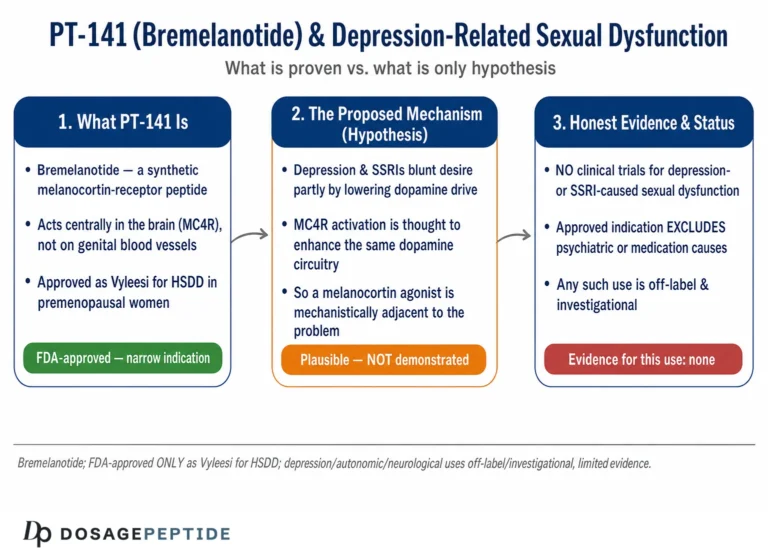
Critically for the subject of this article, the FDA-approved indication says nothing about depression. In fact, the drug’s labeling and development explicitly treated significant psychiatric illness as a confounder to be controlled for, not an indication to be pursued. HSDD as defined for the trials required that the low desire not be better accounted for by a co-existing medical or psychiatric condition, including depression, or by the effects of a medication such as an antidepressant.6 This is the opposite of what the title’s premise implies: rather than being developed to treat depression-linked sexual dysfunction, PT-141 was studied in a population from which the most obvious depression-linked cases were, by diagnostic design, largely screened out.
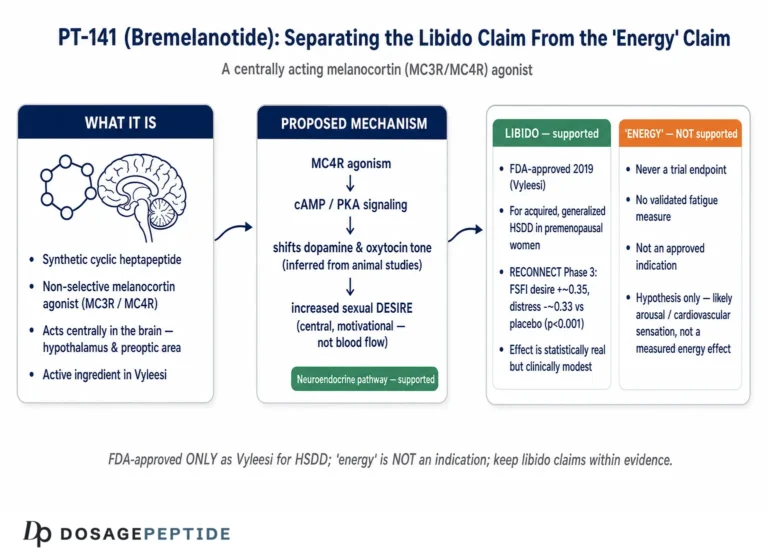
PT-141 also has a long pre-history in male sexual dysfunction. In the early 2000s it was investigated—initially as an intranasal formulation—for erectile dysfunction, including in men who had not responded adequately to sildenafil.1 Those male programs did not lead to approval, in part because of blood-pressure effects at the doses studied. That history matters here because it establishes that the compound’s pro-sexual action is not sex-specific or tied to any particular hormonal milieu—it is a central effect on the brain’s sexual-motivation circuitry. Readers interested in how that central mechanism has been examined across different physiological states can compare this article with the site’s discussion of whether PT-141 influences neuroendocrine pathways to enhance libido and energy, which explores the upstream signaling in more depth.
The Central Mechanism: Melanocortin Receptors, Not Blood Flow
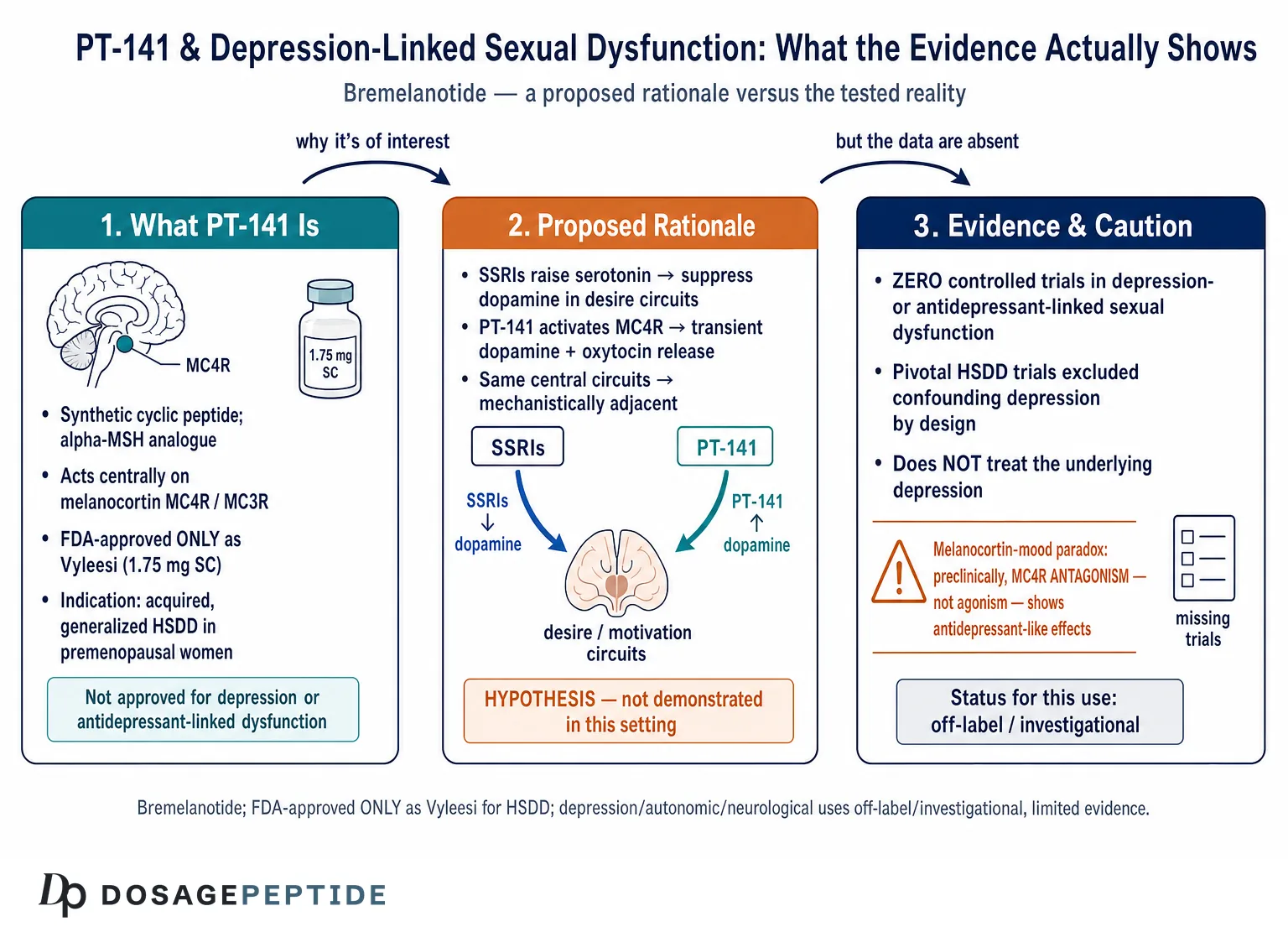
The single most important thing to understand about PT-141—and the reason it attracts interest in any discussion of desire, mood, and motivation—is that it does not work like the phosphodiesterase-5 inhibitors (sildenafil, tadalafil) that dominate the sexual-dysfunction landscape. Those drugs act peripherally on vascular smooth muscle to enhance genital blood flow; they facilitate a physical response to arousal that is already present. PT-141 acts centrally, in the brain, on the circuits that generate desire and arousal in the first place.1
The mechanism, as best characterized, runs through MC4R (and to a lesser extent MC3R) expressed in hypothalamic and limbic structures. MC4R is densely expressed in regions including the paraventricular nucleus and the medial preoptic area of the hypothalamus, structures that serve as central integrators of sexual motivation.1 When PT-141 activates MC4R in these areas, it engages a downstream cascade that increases the release of dopamine in circuits linked to reward and motivation and modulates oxytocinergic signaling—two neurochemical systems that are core substrates of sexual desire.1 Preclinical microdialysis work in rodents has shown that MC4R activation in the medial preoptic area increases extracellular dopamine and that this dopaminergic response appears necessary for the behavioral pro-sexual effect; blocking dopamine receptors attenuates it.1 The genetic importance of the receptor is underscored by MC4R-knockout animals, which show impaired sexual function.
A point of pharmacological nuance deserves mention here, because it bears directly on how confidently the mechanism can be extrapolated. PT-141 is not a selective MC4R ligand. As an α-MSH analogue it activates multiple melanocortin receptor subtypes, with meaningful activity at both MC3R and MC4R and lesser interactions across the wider receptor family.1 This lack of selectivity matters for the present question in two ways. First, it means the compound’s central effects cannot be attributed cleanly to a single receptor, which complicates any tidy mechanistic narrative about desire, dopamine, and mood; the behavioral output is the sum of activity across several receptors whose individual contributions are not fully separated. Second, the same non-selectivity underlies several of the off-target physiological effects discussed later—the transient rise in blood pressure and the darkening of skin and gums—because melanocortin receptors elsewhere in the body also govern cardiovascular tone and melanogenesis.13 A drug that engages a whole receptor family, rather than one narrowly chosen target, is inherently harder to repurpose with confidence into a new indication, because the additional receptors it touches may carry consequences that a desire-focused rationale quietly overlooks.
Human evidence that this central mechanism translates to measurable brain activity is unusually strong for a peptide of this kind. In a randomized, double-blind, placebo-controlled crossover study, 31 premenopausal women with HSDD underwent functional magnetic resonance imaging after receiving an MC4R agonist (bremelanotide) or placebo. The active drug significantly increased self-reported sexual desire for up to 24 hours and, on imaging, altered brain responses to erotic stimuli in regions implicated in sexual processing.4 This is one of the more direct demonstrations that the compound does what its mechanism predicts—it changes central sexual processing rather than peripheral physiology.
It is worth being careful about the limits of even this human evidence, because it is easy to over-read. The fMRI study measured changes in brain activation and self-reported desire in non-depressed women with HSDD; it did not measure behavioral outcomes in a depressed population, and it does not license the inference that the same central engagement would occur, or would be beneficial, when the desire deficit is caused by an SSRI or by depression itself.4 A drug can visibly modulate a brain region on imaging without that modulation translating into a clinically meaningful improvement in the target condition—a gap between biomarker and benefit that recurs throughout neuropsychopharmacology. The imaging data are best read as confirmation that PT-141 does what its mechanism predicts in the approved population, not as evidence for a new indication.
Why does this matter for depression-linked dysfunction specifically? Because the sexual dysfunction of depression, and especially of serotonergic antidepressants, is substantially a central problem—a blunting of desire, motivation, and the capacity for reward, driven in part by suppression of dopaminergic transmission in the same motivational circuits PT-141 engages.7 On paper, a centrally acting agent that increases dopamine release in the medial preoptic area is more mechanistically aligned with the deficit of antidepressant-associated dysfunction than a peripheral vasodilator would be. That alignment is the strongest honest argument for interest in PT-141 in this setting. It is a hypothesis-generating observation, not a demonstrated effect, and the rest of this article is largely about the distance between the two. The distinction between central desire and peripheral performance is explored further in the site’s companion discussion of whether PT-141 can improve fatigue and libido dysregulation in chronic illnesses.
Why Depression and Sexual Dysfunction Travel Together
To evaluate whether PT-141 could plausibly help, one has to be precise about what “sexual dysfunction linked to depressive disorders” actually means, because it is not one problem but at least three overlapping ones.
First, depression itself causes sexual dysfunction. Loss of libido and anhedonia—the inability to experience pleasure—are core symptoms of a major depressive episode. Depression flattens the reward system, reduces motivation, and disrupts the dopaminergic and neuroendocrine signaling that underpins desire. In this sense, low desire in depression is not a side problem; it is part of the illness. Estimates vary widely, but sexual dysfunction is common in untreated depression, with a substantial fraction of patients reporting reduced desire or arousal before any medication is started.7
Second, the treatments cause sexual dysfunction. This is the largest and best-documented piece of the puzzle, and it is the subject of its own section below. Serotonergic antidepressants, particularly selective serotonin reuptake inhibitors (SSRIs), are strongly associated with treatment-emergent sexual dysfunction across all phases of the sexual response.7
Third, the relationship is bidirectional. Sexual dysfunction is not merely a downstream consequence of depression; it can precede, precipitate, and perpetuate depressive symptoms. Loss of intimacy strains relationships and self-esteem, which feeds low mood, which further suppresses desire. Expert reviews of HSDD emphasize screening for depression precisely because the two conditions are so entangled that treating one without acknowledging the other tends to fail.6 Over a third of women with HSDD report comorbid depression or anxiety, and psychotropic medication use is one of the recognized associated factors.6
A fourth complication cuts across all three: it is often clinically impossible to disentangle how much of a given patient’s low desire comes from the illness, how much from the drug, and how much from the relational and psychological fallout of both. A woman who is depressed, taking an SSRI, and experiencing strain in her relationship has three overlapping contributors to low desire, and no blood test separates them. This diagnostic ambiguity is one reason the HSDD trials went to such lengths to define a “clean” population—and one reason the messier, real-world depression-linked cases are so much harder to study and remain unstudied for PT-141.6
This three-part structure is essential for honest reasoning about PT-141 because the compound’s mechanism speaks to only part of it. PT-141 acts on the desire-and-arousal circuitry. It does nothing to treat the underlying depressive illness—it is not an antidepressant, has no demonstrated effect on mood in humans, and (as we will see) engages a receptor system whose relationship to mood is, if anything, in the opposite direction to what one would want. So even in the most optimistic reading, PT-141 could at best address the sexual symptom while leaving the depression untouched, and only in a population where the sexual problem is genuinely a desire deficit rather than a manifestation of active, untreated illness that itself needs treatment. That is a narrow lane, and no trial has yet driven down it.
It is also worth naming a conceptual trap that recurs in popular writing on this topic. Because desire, mood, energy, and motivation all feel like facets of a single “drive,” it is tempting to assume that a drug improving one must lift the others. But these are dissociable systems with overlapping but distinct neural substrates. A person can have restored sexual desire and remain profoundly depressed; conversely, mood can lift while libido stays flat. The intuition that PT-141 “boosts drive” in some global sense is exactly the kind of category blur that overstates what a melanocortin agonist can do. The site maintains a broader discussion of how these overlapping systems are distinguished in its coverage of whether PT-141 modulates inflammatory responses in autoimmune disorders, another proposed off-label direction that illustrates the same tendency to extrapolate from a narrow approved effect.
The Antidepressant Problem: SSRI-Induced Sexual Dysfunction
If there is one place where the clinical need is real, urgent, and mechanistically legible, it is antidepressant-induced sexual dysfunction. This is worth dwelling on, because it is the most concrete version of “sexual dysfunction linked to depressive disorders” and the place where PT-141’s mechanism looks most relevant on paper.
The prevalence is high. Systematic review and meta-analysis of SSRI-treated adults with depression find treatment-emergent sexual dysfunction affecting a large share of patients—estimates commonly range from roughly a quarter to well over half, with some analyses reaching as high as 80% depending on the drug, the definition, and how actively symptoms are solicited.7 SSRIs are significantly associated with increased risk of orgasmic dysfunction in particular, and the effect spans desire, arousal, and orgasm.7 Because patients frequently do not volunteer these symptoms and clinicians do not always ask, the true burden is probably underestimated.
The mechanism is instructive because it is almost a mirror image of PT-141’s. Increased serotonergic tone—the intended therapeutic action of an SSRI—tends to suppress dopaminergic neurotransmission in regions such as the nucleus accumbens and hypothalamus that are central to sexual motivation and arousal.7 Stimulation of postsynaptic 5-HT2A receptors is thought to contribute significantly, and there are additional effects via prolactin, nitric oxide, and cholinergic pathways.7 The net result is a serotonergically driven brake on the very dopaminergic desire circuitry that PT-141, through MC4R-mediated dopamine release, is capable of pushing on.
This is the crux of the mechanistic argument for interest in PT-141 here. If SSRI-induced dysfunction is, in part, a dopamine-suppressed state in central motivational circuits, then a centrally acting agent that transiently increases dopamine release in those circuits is a rational thing to be curious about—more rational, arguably, than a peripheral vasodilator, which does nothing for the desire deficit that is the dominant complaint. It is the same logic that underlies the established practice of managing SSRI sexual dysfunction by switching to or augmenting with bupropion, a dopaminergic and noradrenergic agent, rather than reaching for a PDE-5 inhibitor.7
But—and this is the honest hinge of the whole article—this rational curiosity has not been converted into evidence. There is no published randomized controlled trial testing PT-141 or bremelanotide for the treatment of SSRI-induced or other antidepressant-induced sexual dysfunction. The pivotal HSDD program, as detailed below, was not designed to answer this question and in important respects screened against the population that would answer it. The mechanistic story is attractive; the trial that would validate it has not been run. Anyone stating that PT-141 “treats antidepressant-induced sexual dysfunction” is describing a hypothesis, not a finding.
It is also worth resisting a subtler slippage that the mechanistic story invites: the move from “acts on the same neurotransmitter” to “corrects the same deficit.” SSRIs suppress tonic dopaminergic signaling across sustained treatment; PT-141 produces a transient, phasic burst of dopamine release tied to a single on-demand dose. These are not the same intervention in reverse. A brief pulse of dopamine 45 minutes before intercourse does not restore the baseline dopaminergic tone that an SSRI has chronically dampened, any more than a stimulant taken once undoes a chronic deficit state. Whether an intermittent, pre-planned dose can meaningfully improve a persistent, treatment-linked sexual complaint is precisely the empirical question that would have to be answered by a trial—and the mismatch in temporal dynamics is one more reason not to assume the answer is yes.
What the Human Evidence Actually Covers — and What It Excludes
The strongest evidence for PT-141 lives in the RECONNECT program: two identical Phase 3, randomized, double-blind, placebo-controlled, multicenter trials that together enrolled 1,267 premenopausal women with HSDD, published by Kingsberg and colleagues in Obstetrics & Gynecology in 2019.2 Women self-administered 1.75 mg of subcutaneous bremelanotide on demand over 24 weeks. On the co-primary endpoints, bremelanotide produced statistically significant improvements versus placebo in a validated measure of sexual desire and in a measure of distress related to low desire (both P < 0.001 in the integrated analysis).2 These results were the basis for FDA approval, and a later prespecified subgroup analysis explored consistency of effect across demographic and clinical subgroups.11
It is important to be fair about what this shows: in the approved population, bremelanotide has genuine, replicated, placebo-controlled evidence of a modest but real effect on desire and associated distress. That is more than can be said for most compounds discussed on educational peptide sites. But it is equally important to be precise about the boundaries of that evidence, because the title of this article asks about a population and an indication that these trials were not built to address.
Several boundaries are decisive:
- The diagnosis excluded confounding depression by design. HSDD, as operationalized for these trials, required that the low desire not be attributable to a co-existing psychiatric condition or to medication effects.6 Women whose low desire was a manifestation of active major depression, or a side effect of their antidepressant, were the kind of case the diagnostic criteria were meant to exclude or set aside. The trials therefore cannot tell us what bremelanotide does in exactly the population the title is about.
- The effect size was modest and the endpoints were desire and distress, not mood. The improvements, while statistically significant, were incremental; the trials measured sexual desire and the distress it caused, not depressive symptoms, and reported no antidepressant effect because none was sought.2
- The population was premenopausal women only. Nothing in RECONNECT speaks to men, postmenopausal women, or any specific psychiatric population.
- Earlier signals in other female populations were mixed. A single-dose intranasal study in premenopausal women with sexual arousal disorder found improvements in subjective arousal and desire but no statistically significant change in an objective physiological measure (vaginal pulse amplitude) versus placebo, illustrating how subjective and objective endpoints can diverge.5
The reasonable synthesis is that PT-141 has real, if modest, evidence for one carefully defined indication—and essentially no direct human evidence for the depression-linked, antidepressant-associated dysfunction that this article’s title implies it addresses. To extrapolate from “improved desire in non-depressed premenopausal women with HSDD” to “treats sexual dysfunction caused by depression or its treatment” is to cross a line the data do not support.
The Melanocortin–Mood Paradox: Could an MC4R Agonist Cut Both Ways?
Here the story takes a turn that is rarely acknowledged in casual discussions of PT-141 and depression, and it is the reason the title’s premise is not just unproven but mechanistically contested. The melanocortin system that PT-141 activates is itself implicated in the neurobiology of depression and anxiety—but the direction of that involvement points, if anything, the wrong way for an agonist.
A substantial preclinical literature suggests that central MC4R signaling participates in the stress response and in depressive- and anxiety-like behavior. Activation of MC4R stimulates the hypothalamic-pituitary-adrenal (HPA) axis, the body’s central stress-hormone system that is chronically dysregulated in depression. In rodent models, MC4R antagonists—drugs that block the receptor—have shown antidepressant- and anxiolytic-like effects, while agonist activity has been reported to exacerbate stress-induced depressive- and anxiety-like behavior.910 One representative study found that intranasal infusion of an MC4R antagonist in rats ameliorated the development of depression- and anxiety-related symptoms induced by severe stress, with effects observed in classic behavioral despair paradigms.9 On the strength of such findings, MC4R antagonism—not agonism—has been explicitly proposed as a strategy for treating depression and anxiety.10
The picture is not entirely one-sided. Broader reviews of the melanocortin system note that melanocortins exert anti-inflammatory effects, can influence neurotrophic factors and hippocampal neurogenesis, and modulate HPA activity in complex, context-dependent ways, leading some authors to describe the system as a promising if double-edged target for antidepressant development.8 The system is clearly involved in mood regulation; what is contested is whether pushing MC4R up or down is the helpful direction, and the weight of the preclinical behavioral literature leans toward antagonism being anxiolytic and antidepressant.8910
| Direction of MC4R modulation | Reported behavioral / physiological effect (preclinical) | Relevance to depression-linked dysfunction |
|---|---|---|
| MC4R agonism (PT-141’s action) | Pro-sexual (dopamine/oxytocin release); stimulates HPA axis; reported to exacerbate stress-induced anxiety/despair behaviors110 | May help the sexual symptom while potentially engaging stress circuitry unfavorable for mood |
| MC4R antagonism | Antidepressant- and anxiolytic-like effects in rodent stress and despair models910 | Proposed as a mood-directed strategy—opposite pharmacology to PT-141 |
| Broad melanocortin modulation | Anti-inflammatory, neurotrophic, HPA-modulating effects; context-dependent8 | System is mood-relevant but the therapeutic direction is unresolved |
The implication is sobering for the title’s premise. PT-141 is an MC4R agonist. If the preclinical behavioral literature is even partly right, chronic or repeated agonism of this receptor is not obviously mood-neutral, and could in principle engage stress circuitry in a direction unfavorable for depressive symptoms—precisely the opposite of an antidepressant action. This does not mean PT-141 worsens depression in humans; the on-demand, intermittent dosing approved for HSDD is pharmacologically very different from the sustained receptor modulation studied in these mood models, and no human signal of mood worsening has been established from its approved use. But it does mean that the intuitive story—“melanocortin agonist boosts desire, therefore it must help depression-linked sexual problems”—collides with a body of evidence suggesting the mood-relevant lever on this receptor may run the other way. An honest account of PT-141 and depression cannot ignore that its own mechanism carries a plausible caution flag.
Direct Evidence in Depression-Linked Dysfunction: The Gap
This section is short because the honest answer is short. There is no published clinical trial—and no controlled study of any kind—testing PT-141 or bremelanotide as a treatment for sexual dysfunction caused by depression or by antidepressant medication. A search of the primary literature returns no randomized trial in patients with major depressive disorder, no trial in patients experiencing SSRI- or SNRI-induced sexual dysfunction, and no study using bremelanotide with depressive symptoms or antidepressant response as an endpoint.
What exists instead is a chain of adjacent findings from which the depression claim is extrapolated: the approved HSDD efficacy in non-depressed premenopausal women;2 the central, dopamine-linked mechanism that overlaps with the circuitry SSRIs suppress;17 the fMRI demonstration that the drug alters central sexual processing;4 and the general observation that depression and sexual dysfunction are comorbid.6 Each link is real. But a chain of plausible adjacencies is not a demonstration of efficacy in the target condition, and the melanocortin–mood paradox described above means the chain does not even point unambiguously in the hoped-for direction.910
It is worth being explicit about what a real evidence base would require, because the contrast makes the current gap vivid. To support a claim that PT-141 addresses depression-linked sexual dysfunction, one would want, at minimum: randomized, placebo-controlled trials enrolling patients with clinically diagnosed depression and documented sexual dysfunction (ideally stratified by whether the dysfunction is illness-driven or medication-driven); validated sexual-function endpoints alongside validated depression-severity scales to confirm the sexual benefit is not merely a proxy for mood improvement; adequate duration to assess whether on-demand dosing helps a chronic problem; and safety monitoring specifically attentive to mood and anxiety given the melanocortin–mood literature. None of this has been done. Until it is, statements about how PT-141 “addresses” this condition are, at the level of the target indication, at evidence level zero.
It is also telling to consider the direction of the compound’s own development history. Over roughly two decades of clinical life, the molecule’s sponsors pursued erectile dysfunction in men and then hypoactive desire in women, and it was the latter, narrow indication that eventually reached approval.12 At no point did an approved-drug developer mount a dedicated program targeting depression-linked or antidepressant-induced sexual dysfunction—despite that population being far larger than the tightly defined HSDD indication ultimately obtained. Pharmaceutical developers are not typically shy about chasing large markets when a mechanistic case and early signals justify the cost of a trial. The absence of any such program is, admittedly, an argument from silence and should be weighted lightly; but it is at least consistent with the possibility that those closest to the molecule did not see a compelling, fundable path in the depression-linked setting—whether because of the temporal mismatch between on-demand dosing and a chronic deficit, the melanocortin–mood concerns, the diagnostic messiness of the target population, or some combination of all three. Nothing about that history supports the title’s premise.
The absence is not a minor caveat to be waved away with mechanism talk. It is the central fact. Where a compound has not been studied for an indication, the scientifically correct posture is agnosticism—especially when, as here, the underlying receptor pharmacology raises its own questions about mood direction.
How PT-141 Compares With Options Actually Studied for This Problem
One way to see where PT-141 stands is to place it beside the strategies that clinicians actually use—and that have actually been studied—for sexual dysfunction in the setting of depression and its treatment. The contrast is not a competition, because PT-141 has never entered this arena; it simply shows what an evidence-supported approach looks like.
| Approach | Mechanism relevant to depression-linked dysfunction | Level of evidence in this setting |
|---|---|---|
| Antidepressant switch (e.g., to bupropion, mirtazapine, vortioxetine) | Choose an agent with lower serotonergic burden / more dopaminergic tone | Established clinical practice, supported by comparative and switch studies7 |
| Bupropion augmentation | Dopaminergic/noradrenergic reuptake inhibition to counter serotonergic suppression | Studied for SSRI-induced dysfunction; commonly used7 |
| Dose reduction / drug holiday | Reduce serotonergic exposure | Clinically used; limited controlled evidence; risks relapse |
| PDE-5 inhibitors (sildenafil, tadalafil) | Peripheral vasodilation; aids arousal/erection, not desire | Evidence mainly for the arousal/erectile component, chiefly in men7 |
| Flibanserin (for HSDD) | Serotonin 1A agonist / 2A antagonist; daily central agent | Approved for HSDD in premenopausal women; not for depression-linked dysfunction |
| PT-141 / bremelanotide | Central MC4R agonism → dopamine/oxytocin release in motivational circuits1 | Approved only for HSDD; no studies in depression- or antidepressant-linked dysfunction |
Two observations follow. First, the interventions with actual evidence for antidepressant-associated sexual dysfunction act on the serotonin–dopamine imbalance at its source—by changing the offending drug, augmenting with a dopaminergic agent, or reducing exposure.7 PT-141’s central dopaminergic mechanism is conceptually in the same family, which is exactly why it is interesting; but conceptual kinship is not the same as tested efficacy, and the studied options have decades of clinical use behind them.
Second, PT-141’s nearest approved cousin is flibanserin, another central agent for HSDD—and notably, flibanserin is also not approved or established for depression-linked dysfunction, and carries its own cautions. Even within the narrow world of centrally acting desire drugs, the depression-linked indication remains unclaimed territory. For readers comparing melanocortin approaches to desire more broadly, the site’s analysis of whether melanotan II could play a role in treating hypoactive sexual desire disorder examines the parent-class compound from which PT-141 was derived, with the same evidentiary caution.
Safety and Tolerability
PT-141’s safety profile is reasonably well characterized for its approved use and population, and that qualifier matters enormously when contemplating a hypothetical depression-linked application in a different, often medically complex group.
In the HSDD trials, the most common adverse reactions were nausea, flushing, injection-site reactions, headache, and vomiting.3 Nausea was notably frequent: it was reported by a large proportion of patients, required anti-emetic therapy in a subset, and led some patients to discontinue, although it tended to be mild to moderate and to improve with subsequent doses.3 Other reactions occurring in more than a few percent of patients included cough, fatigue, hot flush, paresthesia, dizziness, and nasal congestion.3
Two safety issues deserve specific emphasis in the context of this article:
- Blood pressure. Bremelanotide causes a transient increase in blood pressure and a compensatory decrease in heart rate after each dose. In monitoring studies the mean increases were small—on the order of a few mmHg—and transient, peaking hours after dosing.3 Because of this, the label contraindicates use in people with uncontrolled hypertension or known cardiovascular disease.3 This is directly relevant to a depression-linked population, which frequently includes people on multiple medications and with cardiovascular or metabolic comorbidity.
- Focal hyperpigmentation. Because it is a melanocortin agonist, bremelanotide can cause darkening of the skin and gums, particularly with more frequent dosing and in people with darker skin; the label limits dosing frequency partly for this reason.3 This is a mechanistic consequence of activating melanocortin receptors involved in pigmentation and is shared, more prominently, with the parent-class compound melanotan II.
Post-approval safety surveillance and hepatotoxicity review have not identified bremelanotide as a notable cause of liver injury, consistent with its peptide nature and intermittent dosing.12 Nonetheless, several caveats temper any extrapolation to a depression-linked use:
- Population mismatch. Safety was established in premenopausal women without significant cardiovascular disease and, by trial design, largely without active major psychiatric illness. It does not automatically transfer to depressed patients, older patients, men, or people on complex psychotropic regimens.
- Drug interactions. Bremelanotide can slow gastric emptying and thereby affect the absorption of orally administered drugs—a non-trivial concern in patients taking daily oral antidepressants, where altered absorption could affect either drug’s levels.3
- Mood monitoring. Given the preclinical melanocortin–mood literature, any serious investigation in a depressed population would need to monitor mood and anxiety specifically, which existing HSDD safety data were not designed to capture.910
The reasonable reading is that PT-141 has an acceptable, well-mapped short-term safety profile in its approved population, with clear cardiovascular and pigmentation cautions—and that this profile provides no assurance, and no efficacy evidence, for use in the more complex depression-linked populations the title contemplates.
Handling and Reconstitution in a Research Context
Because PT-141 is frequently encountered outside its approved single-dose autoinjector form—as a lyophilized (freeze-dried) powder in a sealed vial intended for laboratory use—a brief, strictly educational note on handling is warranted, with the emphasis that this is standard research-peptide practice and not a usage recommendation, and that PT-141 is not an approved therapeutic for depression-linked sexual dysfunction.
Lyophilized peptides are generally reconstituted with sterile or bacteriostatic water for laboratory purposes. The diluent is directed slowly against the inside wall of the vial rather than sprayed directly onto the powder, and the vial is swirled gently rather than shaken, because vigorous agitation can shear peptide bonds and denature the material. The chosen diluent volume simply sets the concentration: a fixed mass of peptide dissolved in a larger volume yields a lower concentration per unit volume, which is the arithmetic behind any reconstitution chart. General principles of this process—and the syringe math involved—are covered in the site’s peptide reconstitution guide, which is provided for educational reference rather than as guidance for human use.
| Parameter | Typical research-context practice |
|---|---|
| Lyophilized storage | Cool, dark conditions; long-term stability favored by freezing |
| After reconstitution | Refrigerated; used within a limited window |
| Light and heat | Minimize exposure; both degrade peptides |
| Agitation | Swirl gently; avoid shaking or foaming |
| Freeze-thaw | Repeated cycles degrade peptides; avoid |
| Sterility | Aseptic technique; bacteriostatic water for multi-use practice |
It bears repeating that meticulous handling changes nothing about the evidence question. A perfectly reconstituted, high-purity vial of PT-141 is still a compound with no controlled data in depression-linked sexual dysfunction. Good technique preserves whatever biological activity the molecule has; it does not create efficacy where none has been demonstrated. Terminology used across this literature—melanocortin receptor, HPA axis, HSDD, and related terms—is defined in the site’s peptide glossary for readers who want precise definitions, and the broader dosage index catalogs how compounds like this are organized for educational reference.
Regulatory Status and the Honest Bottom Line
PT-141’s regulatory picture is straightforward when stated precisely, and it is frequently misrepresented online.
One approved use, one population. Bremelanotide (Vyleesi) is approved by the FDA solely for acquired, generalized HSDD in premenopausal women.23 It is not approved for sexual dysfunction due to depression, for antidepressant-induced sexual dysfunction, for HSDD in postmenopausal women, or for any use in men. It is not approved anywhere as a treatment for depression or any mood disorder.
Off-label and investigational for everything else. Any use of PT-141 for depression-linked sexual dysfunction is, at best, off-label and, more accurately for the purpose of this article, investigational—meaning it has not been established by adequate and well-controlled trials in that population. The compound circulating in the research-chemical market for such uses is not the approved product, is not subject to the same quality controls, and carries the added risks of variable purity and mislabeling.
The honest bottom line. Pulling the threads together: PT-141 has a genuinely novel central mechanism that is mechanistically adjacent to the dopaminergic deficit underlying much antidepressant-associated sexual dysfunction; it has real, replicated evidence for a modest effect on desire and distress in a narrowly defined, largely non-depressed HSDD population; and it has fMRI evidence that it changes central sexual processing.124 Against that, it has no controlled evidence in depression- or antidepressant-linked sexual dysfunction, was studied in a population from which such cases were largely excluded, does nothing to treat the underlying depressive illness, and activates a receptor whose preclinical relationship with mood points, if anything, toward antagonism—not agonism—as the antidepressant direction.6910 So the honest answer to “how does PT-141 address sexual dysfunction linked to depressive disorders?” is that, on present evidence, it does not address it in any demonstrated sense; it is a plausible, untested hypothesis with a genuine mechanistic caution attached. The responsible path forward is formal clinical investigation in the relevant populations under regulatory oversight—not off-label use guided by mechanism and hope. Readers tracking how this evidence base evolves can follow the site’s ongoing coverage of central nervous system peptides, including its discussion of how Selank regulates behavior via central nervous system pathways, which examines a different class of CNS-active peptide with its own evidentiary limits.
Frequently Asked Questions
Is PT-141 approved to treat sexual dysfunction caused by depression or antidepressants?
No. PT-141 (bremelanotide, brand name Vyleesi) is FDA-approved only for acquired, generalized hypoactive sexual desire disorder (HSDD) in premenopausal women.23 It has no approval, and no controlled clinical trials, for sexual dysfunction caused by depression or by antidepressant medications such as SSRIs. Any such use is off-label and investigational.
Does PT-141 treat depression itself?
No. PT-141 is not an antidepressant and has no demonstrated effect on mood in humans. It acts on the brain’s sexual-motivation circuitry via melanocortin-4 receptor agonism, increasing dopamine and oxytocin signaling linked to desire.1 Even in the most optimistic interpretation it could only address a sexual symptom, not the underlying depressive illness, and the depression would still require its own evidence-based treatment.
Why might PT-141’s mechanism be relevant to antidepressant-induced sexual dysfunction?
SSRI-induced sexual dysfunction is driven partly by increased serotonergic tone suppressing dopamine in central motivational circuits.7 PT-141 acts centrally to increase dopamine release in those same circuits, which is why it is mechanistically interesting in this setting—more so than a peripheral blood-flow drug.1 But this is a hypothesis; no trial has tested PT-141 for antidepressant-induced dysfunction.
Could activating the melanocortin system actually affect mood?
Possibly, and not necessarily favorably. Preclinical studies suggest MC4R antagonists have antidepressant- and anxiolytic-like effects, while MC4R agonism (PT-141’s action) stimulates the stress (HPA) axis and has been reported to exacerbate stress-induced anxiety- and depression-like behavior in rodents.8910 The intermittent human dosing approved for HSDD differs from these models, and no human mood-worsening signal has been established—but the mechanism warrants caution rather than optimism about mood benefit.
What does the strongest human evidence for PT-141 actually show?
The RECONNECT program—two Phase 3 randomized, placebo-controlled trials in 1,267 premenopausal women with HSDD—showed statistically significant but modest improvements in sexual desire and in distress related to low desire versus placebo over 24 weeks.2 A separate fMRI study demonstrated that the drug alters central brain responses to erotic stimuli.4 None of this evidence involved depressed patients or antidepressant users.
Were depressed women included in the pivotal trials?
Largely no. The HSDD diagnosis used in the trials required that low desire not be better explained by a co-existing psychiatric condition such as depression or by medication effects.6 The trials were therefore designed to study desire in the absence of confounding active depression, which is precisely why they cannot answer the depression-linked question.
Is PT-141 safe for someone taking antidepressants?
This has not been established. PT-141 can transiently raise blood pressure and is contraindicated in uncontrolled hypertension or cardiovascular disease, and it slows gastric emptying, which could affect the absorption of oral medications including daily antidepressants.3 Safety was studied in premenopausal women largely without active psychiatric illness, so it does not transfer automatically to depressed patients on psychotropic regimens.3 Decisions of this kind require a qualified clinician.
What are the most common side effects?
In the approved population, the most common adverse reactions were nausea (frequently), flushing, injection-site reactions, headache, and vomiting; focal darkening of skin and gums can occur because it is a melanocortin agonist.3 Nausea was the leading reason for discontinuation but usually improved with later doses.3
What research would be needed to answer the title’s question properly?
Randomized, placebo-controlled trials enrolling patients with diagnosed depression and documented sexual dysfunction—stratified by whether the dysfunction is illness-driven or medication-driven—using validated sexual-function and depression-severity scales, adequate duration, and mood-specific safety monitoring. Until such trials exist, claims that PT-141 “addresses” depression-linked sexual dysfunction are hypotheses, not findings.
References
- Molinoff PB, Shadiack AM, Earle D, Diamond LE, Quon CY. PT-141: a melanocortin agonist for the treatment of sexual dysfunction. Ann N Y Acad Sci. 2003;994:96-102. PubMed PMID: 12851303. https://pubmed.ncbi.nlm.nih.gov/12851303/
- Kingsberg SA, Clayton AH, Portman D, et al. Bremelanotide for the Treatment of Hypoactive Sexual Desire Disorder: Two Randomized Phase 3 Trials. Obstet Gynecol. 2019;134(5):899-908. PubMed PMID: 31599840. PMCID: PMC6819021. https://pubmed.ncbi.nlm.nih.gov/31599840/
- U.S. Food and Drug Administration. VYLEESI (bremelanotide injection) Full Prescribing Information. Initial U.S. Approval 2019. https://www.accessdata.fda.gov/drugsatfda_docs/label/2019/210557s000lbl.pdf
- Thurston L, Hunjan T, Ertl N, et al. Melanocortin 4 receptor agonism enhances sexual brain processing in women with hypoactive sexual desire disorder. J Clin Invest. 2022;132(19):e152341. PubMed PMID: 36189794. PMCID: PMC9525110. https://pubmed.ncbi.nlm.nih.gov/36189794/
- Diamond LE, Earle DC, Heiman JR, Rosen RC, Perelman MA, Harning R. An effect on the subjective sexual response in premenopausal women with sexual arousal disorder by bremelanotide (PT-141), a melanocortin receptor agonist. J Sex Med. 2006;3(4):628-638. PubMed PMID: 16839319. https://pubmed.ncbi.nlm.nih.gov/16839319/
- Goldstein I, Kim NN, Clayton AH, et al. Hypoactive Sexual Desire Disorder: International Society for the Study of Women’s Sexual Health (ISSWSH) Expert Consensus Panel Review. Mayo Clin Proc. 2017;92(1):114-128. PubMed PMID: 27916394. https://pubmed.ncbi.nlm.nih.gov/27916394/
- Sexual dysfunction associated with selective serotonin reuptake inhibitors in adults with depression: a systematic review and meta-analysis. Eur J Clin Pharmacol. 2026. PMCID: PMC12923408. https://pmc.ncbi.nlm.nih.gov/articles/PMC12923408/
- Kokare DM, et al. The Melanocortin System: A Promising Target for the Development of New Antidepressant Drugs. Int J Mol Sci. 2023;24(7):6664. PMCID: PMC10094937. doi:10.3390/ijms24076664. https://pmc.ncbi.nlm.nih.gov/articles/PMC10094937/
- Serova LI, Laukova M, Alaluf LG, Sabban EL. Intranasal infusion of melanocortin receptor four (MC4R) antagonist to rats ameliorates development of depression and anxiety related symptoms induced by single prolonged stress. Behav Brain Res. 2013;250:139-147. PubMed PMID: 23680165. https://pubmed.ncbi.nlm.nih.gov/23680165/
- Chaki S, Okuyama S. Melanocortin-4 receptor antagonists for the treatment of depression and anxiety disorders. Curr Top Med Chem. 2007;7(11):1145-1151. PubMed PMID: 17584135. https://pubmed.ncbi.nlm.nih.gov/17584135/
- Simon JA, Kingsberg SA, Portman D, et al. Prespecified and Integrated Subgroup Analyses from the RECONNECT Phase 3 Studies of Bremelanotide. J Womens Health (Larchmt). 2022. PubMed PMID: 35230162. https://pubmed.ncbi.nlm.nih.gov/35230162/
- LiverTox: Clinical and Research Information on Drug-Induced Liver Injury. Bremelanotide. Bethesda (MD): National Institute of Diabetes and Digestive and Kidney Diseases. Bookshelf ID: NBK573221. https://www.ncbi.nlm.nih.gov/books/NBK573221/
Educational and research-use disclaimer: This article is provided solely for scientific and educational purposes. PT-141 (bremelanotide) is approved by the FDA only as Vyleesi for acquired, generalized hypoactive sexual desire disorder in premenopausal women. It is NOT approved by the FDA, EMA, or any comparable regulator for the treatment, cure, or prevention of depression, depression-linked sexual dysfunction, antidepressant-induced sexual dysfunction, or any related condition, and no human efficacy for these uses has been demonstrated in controlled trials. Preclinical evidence suggests the melanocortin-4 receptor pathway’s relationship to mood is complex and may not favor agonism. Nothing here is medical advice or a recommendation for human use. Any decision involving PT-141, antidepressants, or the management of depression or sexual dysfunction should be made with a qualified healthcare professional, and any legitimate investigation of this compound should occur within properly authorized clinical research under appropriate oversight.