Mixing two peptides? First read: Can I combine peptides in the same syringe?
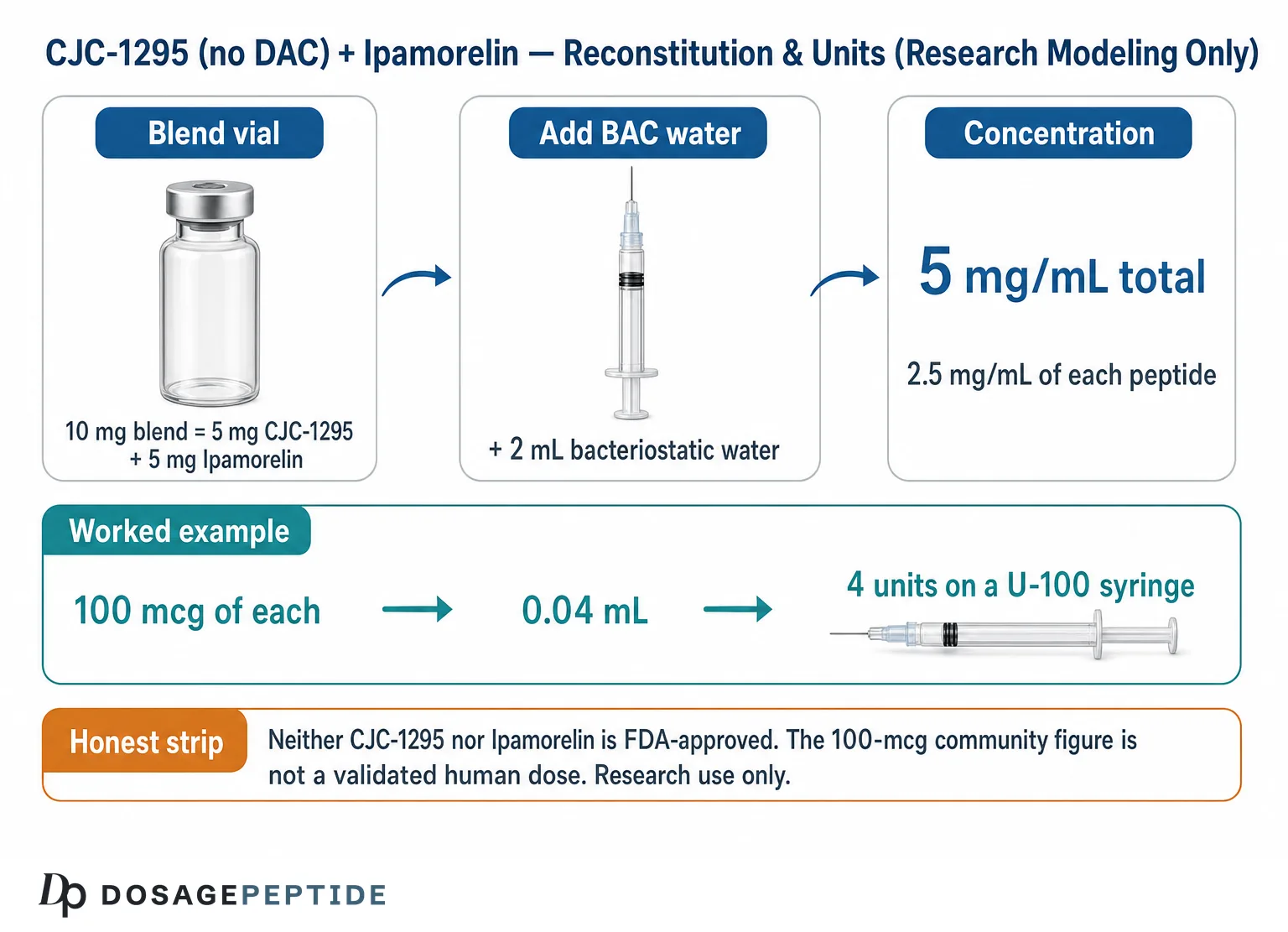
On a 10 mg blend vial reconstituted with 2 mL of bacteriostatic water, 4 units on a U-100 syringe deliver 100 mcg of CJC-1295 and 100 mcg of Ipamorelin. That is the number most people arrive here for, and it follows from one line of arithmetic: 10 mg ÷ 2 mL = 5 mg/mL total peptide, so each unit of volume carries 50 mcg of total peptide — 25 mcg of each molecule in a 5 mg + 5 mg blend.
The wrinkle that breaks most blend calculations is exactly there: one diluent volume dissolves two peptides, so whatever concentration you compute for “total peptide”, each individual peptide sits at half of it. Below are the full reconstitution tables for common water volumes, the mg → mcg → unit chain worked step by step, an honest separation of what the controlled human studies of each agent measured from what circulates as a community convention, and the storage and stability figures. Everything here is a measurement and modeling exercise for laboratory reference only, never guidance for a person.
Looking for the per-vial dosing tables? See the CJC-1295 (DAC) 5 mg + Ipamorelin 5 mg stack protocol and the CJC-1295 (no DAC) 5 mg vial protocol.
What Research Question Does A CJC-1295 + Ipamorelin Blend Actually Pose?
A blended vial that co-formulates CJC-1295 (in the “no DAC” form) with Ipamorelin exists because researchers modeling growth-hormone (GH) physiology have long been interested in a specific idea: that two secretagogues acting on two different pituitary receptors produce a larger, cleaner GH pulse than either compound alone.[4] The blend packages that hypothesis into a single vial. That convenience, however, creates the exact problem this article addresses — when two peptides share one vial and one diluent volume, the reconstitution math governs the concentration of both simultaneously, and a single mistake in diluent volume mis-states every downstream figure for both molecules at once.
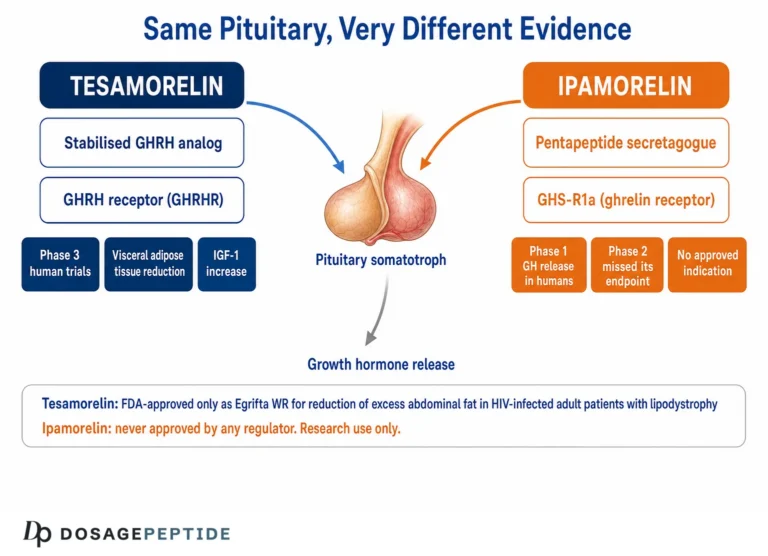
It is worth stating the regulatory posture plainly before any number appears. Neither CJC-1295 nor Ipamorelin is an FDA-approved drug. CJC-1295 was never approved for any indication in any form. Ipamorelin was investigated in industry-sponsored trials and did not complete successful development; its Phase II program for postoperative ileus did not meet its primary endpoint, and clinical development was discontinued.[6] Both are, in current US regulatory terms, unapproved research chemicals; both are explicitly named on the World Anti-Doping Agency (WADA) prohibited list under section S2.[11] Every concentration and unit figure below is therefore presented for in-vitro and research-modeling contexts only. The arithmetic is real and useful for laboratory handling; the dose figures are not endorsements, and a mathematically derivable “unit” number is not a recommendation that any amount be administered to a living subject.
For readers who want the specific product-format context behind these numbers, the companion CJC-1295 (no DAC) + Ipamorelin 10 mg blend vial dosage protocol reference page walks through the same vial size that most of this article’s worked examples assume.
What Are CJC-1295 (No DAC) And Ipamorelin, And Why Are They Paired?
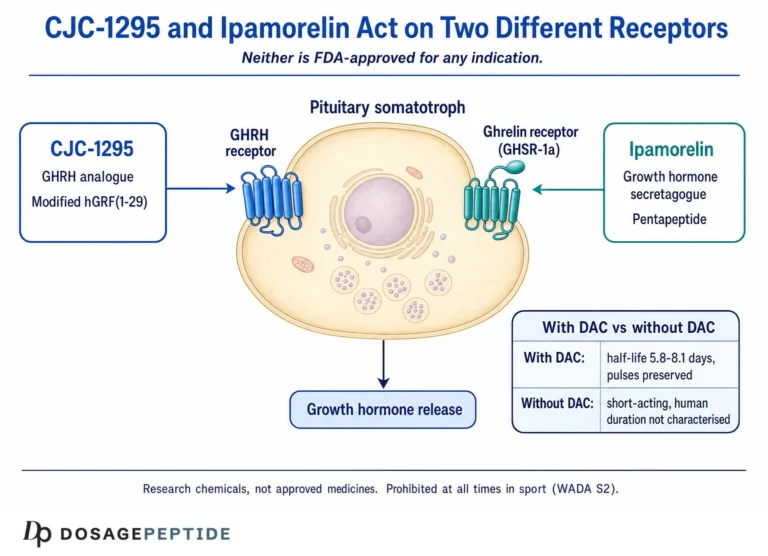
Understanding the blend starts with understanding that its two components are pharmacologically unrelated except for a shared downstream output — GH release from the anterior pituitary. They reach that output by different routes, and that difference is the entire rationale for combining them. One mimics the hypothalamic hormone that tells the pituitary to make and release GH; the other mimics the stomach-derived hormone that tells the pituitary to release GH now and eases the brake that would otherwise hold it back.
CJC-1295 (No DAC): A Short-Acting GHRH Analog
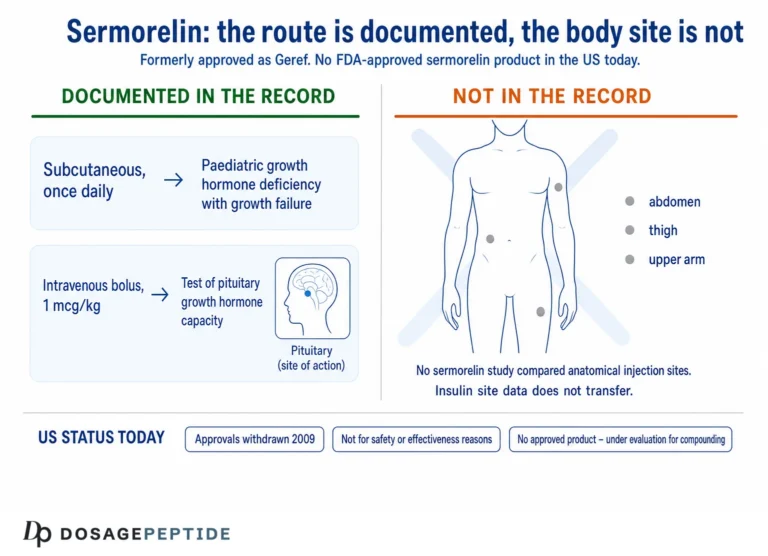
CJC-1295 in the “no DAC” configuration is a tetrasubstituted analog of the first 29 amino acids of human GHRH — the fragment historically called modified GRF(1-29) or, in older literature, CJC-1295 without Drug Affinity Complex. Native GHRH(1-29), sometimes marketed as sermorelin, is the shortest fragment that retains the full GH-releasing activity of the 44-amino-acid parent hormone, but it is degraded rapidly in plasma. The four amino-acid substitutions relative to native GHRH(1-29) are engineered to resist that enzymatic degradation — particularly cleavage by dipeptidyl peptidase-4 (DPP-4) at the N-terminus — which extends the peptide’s functional plasma half-life modestly relative to unmodified sermorelin-type fragments.
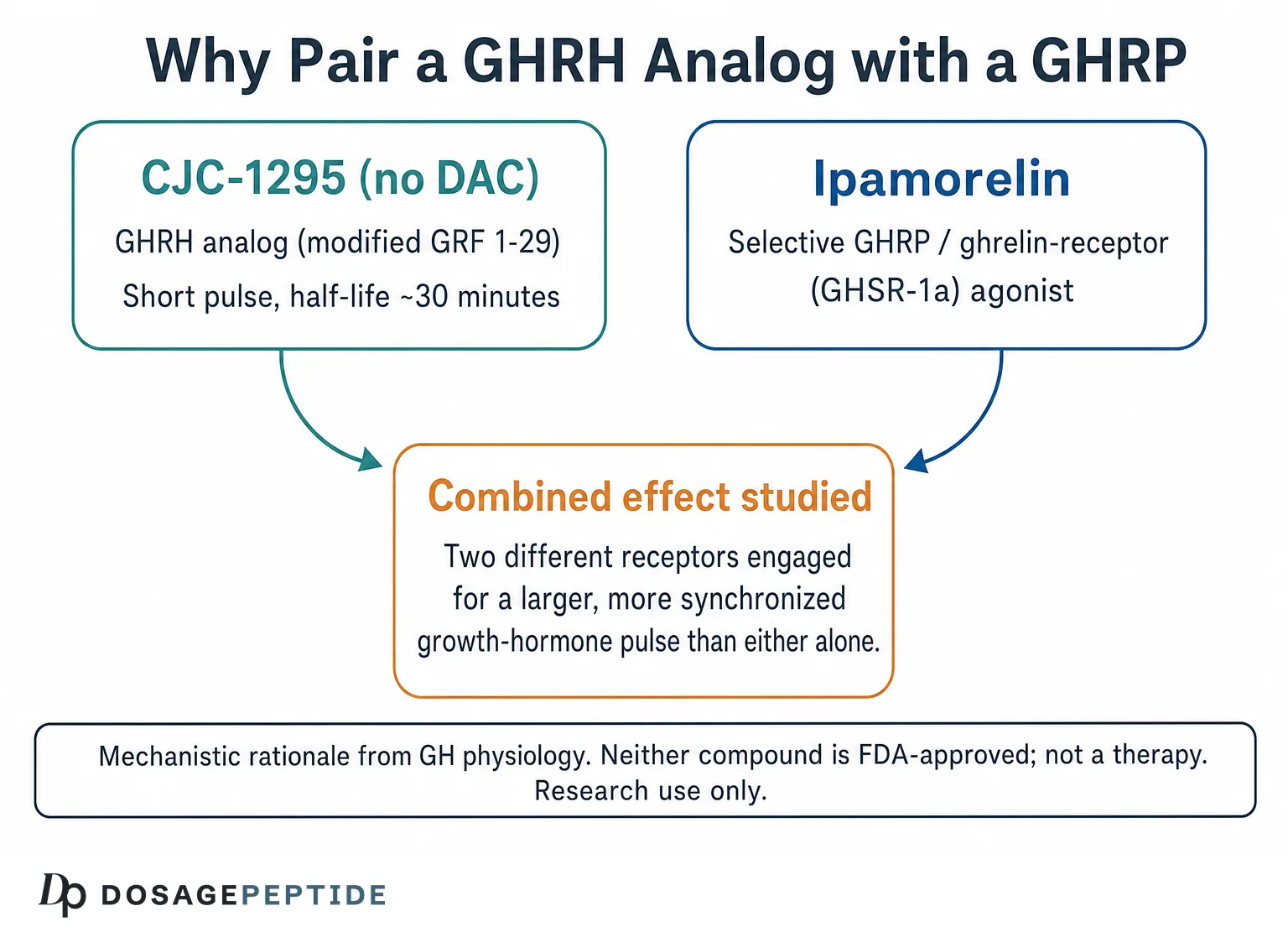
In the no-DAC form, that half-life is still short — commonly reported on the order of roughly 30 minutes — because there is no albumin-binding maleimide group to anchor the molecule in circulation. Functionally, no-DAC CJC-1295 acts like a somewhat longer-lasting GHRH signal: it binds the pituitary GHRH receptor, a G-protein-coupled receptor that raises intracellular cyclic AMP in somatotroph cells, and pushes those cells to synthesize and release GH — but only for a window measured in minutes to a couple of hours, not days. This short window is not an incidental property; as later sections explain, it is precisely the property that makes the no-DAC form the version selected for a blend intended to reinforce discrete natural pulses.
This distinction between the DAC and no-DAC forms is central and is covered in depth in the dedicated CJC-1295 DAC vs no-DAC dosage protocol reference.
Ipamorelin: A Selective Pentapeptide GHRP
Ipamorelin is a synthetic pentapeptide (Aib-His-D-2-Nal-D-Phe-Lys-NH₂) first described in 1998 as the first selective GH secretagogue.[3] It is a ghrelin-receptor agonist — it activates the growth hormone secretagogue receptor type 1a (GHSR-1a), the same receptor that endogenous ghrelin, the stomach-derived “hunger hormone,” binds.[8] The word “selective” in the original characterization is precise and important: in the Raun et al. work, Ipamorelin released GH with potency comparable to the older peptide GHRP-6 but, unlike GHRP-6 and GHRP-2, did not meaningfully elevate adrenocorticotropic hormone (ACTH), cortisol, or prolactin even at doses well above the GH-releasing threshold.[3]
That clean receptor profile is the reason Ipamorelin, rather than an older GHRP, is the ghrelin-mimetic component most often paired with a GHRH analog in research blends. Older GH secretagogues tended to drag the hypothalamic-pituitary-adrenal axis along with the GH axis, raising stress hormones as an off-target consequence; Ipamorelin’s comparatively narrow action on the GH axis is what made it attractive both to the pharmaceutical program that originally developed it and, later, to community researchers modeling GH pulses. The full pharmacology and protocol-format detail are laid out in the Ipamorelin dosage protocol guide.
Why Combine Them At All?
The pairing logic is a textbook GH-physiology principle, not a marketing claim: a GHRH signal and a ghrelin-receptor signal act through separate receptors and separate intracellular pathways, and when delivered together they produce GH release that exceeds the simple sum of each given alone.[4] A GHRH analog raises the amplitude of the somatotroph’s releasable GH; a GHRP both stimulates release and suppresses somatostatin tone (the physiological brake on GH). Combined, the two produce a more synchronized, larger pulse. That is the mechanistic reason the two peptides are co-formulated — and, as the next section explains, it is also why the short no-DAC form of CJC-1295 is the version chosen for the blend. It should be stressed that this synergy is a documented property of GHRH + GHRP generally, established in controlled endocrine studies of the individual agents; it is not a validated finding about this specific co-formulated blend, which has not been studied as a product.
How Does The GHRH + GHRP Receptor Pathway Produce A Synchronized GH Pulse?
The mechanism behind a cjc-1295 ipamorelin blend dosage model rests on three parallel control inputs onto the pituitary somatotroph. Understanding all three explains why researchers treat the blend as a “pulse amplifier” rather than a continuous GH source, and why the timing logic later in this article follows so directly from the pharmacology.
The Three Inputs Onto The Somatotroph
GH secretion from the anterior pituitary is governed by three principal signals: (1) GHRH, which stimulates GH synthesis and release via a cyclic-AMP–dependent pathway; (2) somatostatin, which inhibits release and shapes the trough between pulses; and (3) ghrelin acting at GHSR-1a, which both stimulates GH and functionally opposes somatostatin.[9] These three inputs interact continuously, and the pulsatile pattern of GH release across a day is the emergent product of GHRH and ghrelin pushing while somatostatin periodically pulls.
CJC-1295 (no DAC) supplies input (1). Ipamorelin supplies input (3). The blend therefore acts on two of the three levers at once — pushing the accelerator (GHRH receptor) while simultaneously easing the brake (via the ghrelin pathway’s functional antagonism of somatostatin tone). What it does not do is touch the somatostatin lever directly; instead it works around it. That distinction matters, because it means the size of the resulting pulse still depends on where the endogenous somatostatin rhythm happens to be at the moment of stimulation — a source of variability no reconstitution calculation can capture.
Why The Effect Is Synergistic, Not Additive
Because GHRH and GHRP act on distinct receptors that converge on GH release through partly independent second-messenger systems, their combined effect is larger than additive. Bowers and colleagues demonstrated in normal men that a GH-releasing peptide given with GHRH produced GH responses substantially greater than the sum of either agent alone, and inferred from that supra-additivity that the two act through independent mechanisms.[4] Mechanistically, the GHRH component recruits and primes the releasable pool of GH inside the somatotroph, while the ghrelin-receptor component triggers release and blunts the somatostatin brake that would otherwise cap the pulse.
This is the single strongest piece of physiology behind the blend concept — and, importantly, it is established GH physiology from controlled endocrine studies of the individual agents, not a validated finding about the specific CJC-1295 + Ipamorelin co-formulation. A great deal of vendor and forum content silently upgrades “GHRH and GHRP are synergistic in principle” into “this blend, at this dose, produces a synergistic result in humans.” The first statement is supported; the second is not.
Pulsatility Is Preserved — And That Matters
An important nuance from the CJC-1295 literature is that even a longer-acting GHRH stimulus does not flatten GH into a continuous plateau. Ionescu and Frohman showed that pulsatile GH secretion persists during continuous stimulation by CJC-1295, with elevated trough and mean GH and increased IGF-I, while the underlying pulsatile architecture was maintained.[2] In other words, the pituitary continues to fire in bursts even when the GHRH signal is sustained, because somatostatin continues to impose its rhythm on top of that signal.
Pulsatility is thought to matter for the downstream physiological effects of GH, which is part of why research models favor a short GHRH signal (no-DAC) that reinforces natural pulses over a multi-day DAC signal that raises the baseline more persistently. A pulse that rises and falls resembles the endogenous pattern more closely than a chronically elevated plateau; whether that theoretical advantage translates into any measurable difference for the blend has not been established, and should not be assumed.
Why Does The “No DAC” Form Matter For This Blend?
The choice of no-DAC over DAC in a blend is not arbitrary, and it directly shapes the timing logic that later governs how the reconstituted solution is modeled in research protocols. The entire rationale collapses into a single word: timescale.
DAC vs No-DAC: The Half-Life Divide
The Drug Affinity Complex (DAC) is a maleimide-containing moiety that lets the CJC-1295 molecule covalently bind circulating albumin after injection, dramatically extending its half-life to a multi-day range. In the original healthy-adult study of albumin-binding CJC-1295, single subcutaneous doses raised mean plasma GH 2- to 10-fold for six days or more and mean IGF-I 1.5- to 3-fold for nine to eleven days, with an estimated elimination half-life on the order of roughly six to eight days — a pharmacokinetic profile measured in days, not minutes.[1] The no-DAC form lacks that albumin anchor, so its action is measured in minutes to a couple of hours — a difference of roughly two to three orders of magnitude in duration between two molecules that share the same GHRH-analog backbone.
This is the most consequential single fact a researcher can carry into any dosing discussion about “CJC-1295,” because the unqualified name is genuinely ambiguous: it can refer to either a compound that acts for half an hour or one that acts for a week and a half. When human study doses are quoted — as they are later in this article — they are almost always doses of the DAC form, and mapping them onto the no-DAC blend is a mistake.
Matching Short To Short
Ipamorelin’s GH-releasing action is also short-lived — a transient pulse rather than a sustained elevation. Pairing it with the short no-DAC GHRH analog means both components rise and fall over a similar, brief window, producing a discrete co-timed pulse that researchers can model against the body’s natural pulse rhythm (for example, the nocturnal GH surge). The two signals overlap in time, which is the condition under which their synergy can express itself; a co-timed accelerator-plus-brake-release produces a single reinforced burst.
Pairing Ipamorelin with the multi-day DAC form would mismatch the timescales: a transient ghrelin-receptor pulse riding on top of a persistently elevated GHRH baseline that sits high for days, so the intended pulse-on-pulse synergy is lost. That mismatch, plus safety history, is why research blends overwhelmingly use no-DAC. The comparative reasoning is expanded in the DAC vs no-DAC protocol comparison.
A Note On The DAC Safety History
The long-acting DAC version carries a well-known safety episode: a Phase II study of an albumin-binding CJC-1295 formulation in HIV-associated lipodystrophy, conducted by ConjuChem, was halted following a participant death.[12] Contemporary reporting described the death as a myocardial infarction occurring in a participant who had received the eleventh weekly dose, and the trial’s attending physician considered the most likely explanation to be pre-existing asymptomatic coronary artery disease rather than the study drug. In other words, a definitive causal relationship to CJC-1295 was not established.
The honest way to hold this fact is in two hands at once: the causal link was not proven, and the episode is nonetheless a real part of why the DAC form never advanced and why the compound class is treated with caution. It should not be overstated into “CJC-1295 kills” — that claim is unsupported — nor waved away, because a halted trial with a death is a meaningful signal about how little is known. It is a reminder that neither form has an established human safety profile.
How Do Researchers Reconstitute A 10 mg CJC-1295 + Ipamorelin Blend Vial?
This is the legitimately useful, objective core of the article: the arithmetic that converts a dry vial into a known concentration. The math is identical in structure to any peptide reconstitution — mass divided by volume equals concentration — but the blend adds one wrinkle worth stating up front, and getting that wrinkle wrong is the most common way researchers mis-state every number that follows.
The Blend Wrinkle: One Volume, Two Peptides
A “10 mg blend” vial most commonly contains 5 mg of CJC-1295 (no DAC) plus 5 mg of Ipamorelin, for 10 mg of total peptide mass. When you add bacteriostatic water (BAC), that single diluent volume dissolves both peptides at once. So the concentration you calculate for “total peptide” must be split between the two molecules. If the vial is a 5 mg + 5 mg split, then whatever total mg/mL you compute, each individual peptide is present at half that figure.
This is the single most common source of error in blend math — researchers compute the total concentration correctly, then forget that a given volume delivers only half of that in CJC-1295 and half in Ipamorelin. The error is insidious because it produces numbers that look plausible: someone who believes a draw contains 100 mcg of CJC-1295 when it actually contains 50 mcg has made a two-fold error that no single figure on the page will flag. The only defense is to state the split explicitly at the top of every calculation and carry the per-component number all the way through, rather than reasoning about “the peptide” as if the vial held one substance.
The Core Formula
The governing equation is:
Concentration (mg/mL) = Total peptide mass (mg) ÷ BAC water volume (mL)
And to move from concentration to a syringe volume for a target amount:
Draw volume (mL) = Target amount (mg) ÷ Concentration (mg/mL)
On a U-100 insulin syringe, 1 mL = 100 units (often printed as “IU” on the barrel), so units = mL × 100. Every figure below is derived purely from these relationships; none of them constitutes a recommended dose. It is worth committing the three-line chain to memory, because almost every handling error is a slip somewhere along it: fix the concentration from mass and volume, convert a target mass to a volume, then convert that volume to units.
A Concrete Worked Example (10 mg Total + 2 mL BAC)
Take the most commonly modeled setup: a 10 mg blend vial (5 mg CJC-1295 + 5 mg Ipamorelin) reconstituted with 2 mL of bacteriostatic water.
- Total concentration: 10 mg ÷ 2 mL = 5 mg/mL total peptide.
- Per-component concentration: because the mass is split evenly, each peptide is at 2.5 mg/mL — i.e., 2.5 mg/mL CJC-1295 and 2.5 mg/mL Ipamorelin.
- Per-unit content: 5 mg/mL total ÷ 100 units/mL = 0.05 mg (50 mcg) of total peptide per insulin unit — which is 25 mcg CJC-1295 + 25 mcg Ipamorelin per unit.
So a frequently cited research-modeling amount of “100 mcg of each peptide” corresponds, in this vial, to 200 mcg of total peptide. Draw volume = 0.200 mg ÷ 5 mg/mL = 0.04 mL = 4 units on a U-100 syringe. Those 4 units deliver 100 mcg CJC-1295 and 100 mcg Ipamorelin simultaneously. This is arithmetic, not advice — the “100 mcg of each” figure is discussed critically in the dosing section below, where it is shown to be a community convention rather than a validated dose.
A Second Worked Example (10 mg Total + 1 mL BAC)
Now reconstitute the same vial with only 1 mL of BAC to see how the numbers move:
- Total concentration: 10 mg ÷ 1 mL = 10 mg/mL total peptide.
- Per-component concentration: 5 mg/mL each.
- Per-unit content: 10 mg/mL ÷ 100 units/mL = 0.1 mg (100 mcg) total per unit — 50 mcg of each peptide per unit.
The same “100 mcg of each” modeled amount (200 mcg total) now lands at 0.2 mg ÷ 10 mg/mL = 0.02 mL = 2 units. Halving the diluent doubled the concentration and halved the unit count for the identical modeled mass. This is the fundamental trade-off of reconstitution, and it is worth internalizing directly: the diluent volume is a free parameter chosen by the researcher, and it changes only the measurement resolution — how many syringe marks a given mass spreads across — never the total mass in the vial.
A Third Worked Example (Uneven Split)
Not every “10 mg blend” is a 5 + 5 split. Suppose a product states 6 mg CJC-1295 + 4 mg Ipamorelin, still 10 mg total, reconstituted in 2 mL. The total concentration is unchanged at 5 mg/mL, and total peptide per unit is still 50 mcg — but the split is now 60/40, so each unit carries 30 mcg CJC-1295 and 20 mcg Ipamorelin. A researcher who assumed a 5 + 5 split would mis-state both components. The lesson is procedural: never infer the split from the total. Read the stated ratio off the specific product, and if it is not stated, the per-component figures cannot be derived at all — only the total can. This is why the very first step of any blend calculation is to confirm the mass of each component, not just the combined mass on the label.
Reconstitution Reference Table
The table below shows how BAC volume changes the concentration and the units-per-common-modeled-amount for a 10 mg total (5 + 5) blend vial. It exists so that a stated volume can be checked against the intended concentration — not to endorse any row.
| BAC water added | Total conc. (mg/mL) | Per-component conc. (each) | Total peptide per unit (U-100) | Units for 100 mcg of each (200 mcg total) |
|---|---|---|---|---|
| 1 mL | 10 mg/mL | 5 mg/mL | 100 mcg | 2 units |
| 2 mL | 5 mg/mL | 2.5 mg/mL | 50 mcg | 4 units |
| 2.5 mL | 4 mg/mL | 2 mg/mL | 40 mcg | 5 units |
| 3 mL | 3.33 mg/mL | 1.67 mg/mL | 33.3 mcg | 6 units |
| 5 mL | 2 mg/mL | 1 mg/mL | 20 mcg | 10 units |
The pattern to internalize: more diluent lowers the concentration and raises the unit count for the same modeled amount, which makes small amounts easier to measure accurately on the syringe. A larger BAC volume trades a lower concentration for finer measurement resolution — a genuine laboratory-handling consideration independent of any dose question. To run these numbers for a custom vial size or split, the interactive peptide dosage calculator automates the division, and the peptide reconstitution guide covers diluent handling.
Handling, Diluent Choice, And Storage Considerations
Two handling points sit alongside the arithmetic and materially affect whether the calculated concentration is the concentration actually in the vial. First, the diluent itself. Bacteriostatic water contains roughly 0.9% benzyl alcohol as a preservative, which is why it is the conventional choice for multi-draw vials that will be entered repeatedly over days; sterile water lacks the preservative and is generally modeled for single-use scenarios. The choice of diluent does not change the concentration math — volume is volume — but it does bear on how long a reconstituted vial can be modeled as stable before microbial or chemical degradation makes the labeled mass a poor description of the contents.
Second, technique. Bacteriostatic water is directed down the inner wall of the vial rather than sprayed onto the lyophilized powder, because peptides are shear-sensitive; the vial is swirled, not shaken, and the reconstituted solution is typically modeled as refrigerated and protected from light. A peptide that has partly degraded no longer matches its label, and once again the arithmetic silently over-states what is present. None of this is a dosing instruction; it is the set of conditions under which the concentration calculation remains an honest description of the vial. The primer on how much bacteriostatic water to use covers diluent selection in more depth.
Converting Milligrams To Insulin Units: The Arithmetic In Detail
Because the unit conversion is where most handling errors occur, it deserves its own worked walk-through. The goal is to make the mg → mcg → unit chain fully transparent so that any figure can be independently checked, and so that a single arithmetic slip becomes visible rather than propagating silently into every downstream number.
Step 1: Fix Your Units Vocabulary
Three units of measure appear constantly and are easy to conflate. Milligrams (mg) describe the peptide mass in the vial. Micrograms (mcg) describe the small modeled amounts — 1 mg = 1000 mcg. Insulin units (IU) are volume marks on a U-100 syringe, where 100 units = 1 mL, so 1 unit = 0.01 mL. The critical conceptual point is that units measure volume, not mass — the same “4 units” delivers a completely different mass at every concentration. A researcher who thinks in “units of peptide” rather than “units of volume” has already made the error that most blend miscalculations trace back to.
Step 2: Establish The Concentration
Using the 10 mg + 2 mL example: 10 mg ÷ 2 mL = 5 mg/mL total = 5000 mcg/mL total. Divide by 100 units/mL and you get 50 mcg of total peptide per unit. Split evenly, that is 25 mcg of each peptide per unit. Anchoring on the “per-unit” figure early is useful because it turns every subsequent question into a one-step multiplication or division rather than a fresh calculation from raw mass.
Step 3: Solve For The Volume Of A Modeled Amount
Suppose a protocol models 100 mcg of each peptide (200 mcg total). Total peptide per unit is 50 mcg, so 200 mcg ÷ 50 mcg/unit = 4 units. Equivalently, 0.2 mg ÷ 5 mg/mL = 0.04 mL = 4 units. Both paths agree, which is the built-in check: compute the volume two independent ways — once from the per-unit figure and once from the concentration formula — and confirm they match. When they disagree, one of the two contains the error, and the disagreement itself is the alarm.
Step 4: Sanity-Check Against The Vial’s Total Yield
A 10 mg vial contains 10,000 mcg of total peptide. At 200 mcg total per modeled draw, that is 50 draws per vial. Sanity-checking total yield against per-draw amount catches gross errors — if your arithmetic implies only three or four draws from a 10 mg vial, you have almost certainly mislabeled mg as mcg somewhere, a thousand-fold error that the per-unit figure alone would not reveal. This “does the whole vial divide into a sensible number of draws?” check is the cheapest and most powerful guard against order-of-magnitude mistakes.
The table below summarizes the mg → unit mapping for the two most common concentrations.
| Modeled amount (each peptide) | Total peptide | Units at 5 mg/mL (2 mL BAC) | Units at 10 mg/mL (1 mL BAC) |
|---|---|---|---|
| 50 mcg each | 100 mcg | 2 units | 1 unit |
| 100 mcg each | 200 mcg | 4 units | 2 units |
| 150 mcg each | 300 mcg | 6 units | 3 units |
| 200 mcg each | 400 mcg | 8 units | 4 units |
Notice that at the higher 10 mg/mL concentration, a 50 mcg-each amount lands on a single unit — a mark that is hard to measure precisely on a standard syringe, where any error of half a unit is now a 50% error in delivered mass. This is exactly why researchers modeling smaller amounts often choose more diluent: it spreads the same mass across more units and improves measurement resolution. The general principles of this conversion, applicable to any peptide, are detailed further in the peptide reconstitution guide.
Measurement Resolution And Syringe Choice
A practical extension concerns syringe selection. Because a “unit” is a fixed volume (0.01 mL), the smallest reliably measurable mass is set jointly by the concentration and the finest graduation on the barrel. At 10 mg/mL, one unit is 100 mcg of total peptide, so even a half-unit mark is 50 mcg — coarse for small modeled amounts. At 2 mg/mL (5 mL BAC), one unit is 20 mcg total and a half-unit is 10 mcg, giving far finer control, at the cost of a larger injection volume and a faster-exhausted vial. This is a pure handling optimization, entirely separate from the question of whether any amount should be modeled at all.
Dosing Figures Reported In The Literature vs Circulated In Research Communities
This is the section where honesty matters most. There is a sharp line between what controlled human studies of the individual agents measured and the specific dose numbers that circulate in research communities for the blend. Conflating the two is the central error in most online content on this topic, and it is the error this article exists to prevent.
What The Controlled Literature Actually Used
The human data that exist are for the compounds individually, in specific formulations, at doses chosen for those studies — not for the co-formulated no-DAC blend. The albumin-binding CJC-1295 (DAC) healthy-adult study used weight-based subcutaneous dosing, with roughly 30 to 60 mcg/kg reported as the doses that were safe and relatively well tolerated in ascending single and multiple-dose trials of the DAC form — a completely different pharmacokinetic entity from no-DAC.[1] For Ipamorelin, the Phase II postoperative-ileus program used an intravenous regimen of 0.03 mg/kg twice daily — again, an IV hospital protocol for a gastrointestinal endpoint, not a subcutaneous GH-modeling amount.[6] Neither of these maps onto the “100 mcg subcutaneously” figures that dominate community protocols.
The mismatch runs along three axes at once: formulation (DAC versus no-DAC for CJC-1295), route (intravenous versus subcutaneous for Ipamorelin), and endpoint (GH/IGF-I pharmacodynamics or gastrointestinal recovery, versus GH-pulse modeling). A dose is only meaningful relative to a formulation, a route, and an endpoint; changing all three and keeping the number is not extrapolation, it is coincidence.
The Community “100 mcg Of Each” Convention
The most widely circulated research-modeling figure is “100 mcg of each peptide, one to three times per day.” It is essential to be explicit: this figure is a community and anecdotal research-modeling convention, not a clinically validated human dose. No controlled trial established 100 mcg of no-DAC CJC-1295 plus 100 mcg of Ipamorelin as a safe or effective subcutaneous amount in humans. The number appears to derive partly from the “saturation dose” concept discussed next, and partly from convention propagated across forums and vendor literature until repetition lent it a false air of authority.
It is presented here only because it is the figure researchers most often model, and because the reconstitution math above needs a concrete number to work against — not because it carries evidentiary weight. Treat “100 mcg of each” the way one would treat a placeholder variable in an equation: a value plugged in to make the arithmetic concrete, carrying no implicit claim that it is correct for any purpose.
The ~1 mcg/kg “Saturation Dose” Idea
A related community concept is that a GHRP reaches a “saturation dose” near roughly 1 mcg/kg — the notion being that beyond this amount the ghrelin receptor is maximally engaged and additional peptide yields diminishing GH return. For a 100 kg subject this back-calculates to about 100 mcg, which is likely why 100 mcg became the default modeling figure. The idea is not baseless: dose-response curves for GH secretagogues do plateau, and the Bowers work explored GHRP across a 0.1 to 1.0 mcg/kg range, so a saturation region in that neighborhood is a reasonable-sounding extrapolation.[4]
But a plateau observed for one GHRP under acute intravenous testing is not a validated clinical parameter for Ipamorelin specifically, delivered subcutaneously, in a blend. The precise saturation point for Ipamorelin in humans was never established in an approval-grade trial, and applying a single per-kilogram number across subjects ignores substantial inter-individual variability in GH responsiveness. The saturation heuristic is best understood as a plausibility argument for why a figure near 100 mcg is not obviously absurd, not as evidence that it is correct.
Frequency And “1–3x Per Day”
The “one to three times per day” frequency in community protocols follows directly from the short half-life of both blend components: because a no-DAC GHRH signal and an Ipamorelin pulse each last on the order of a couple of hours, a once-daily model produces one reinforced pulse, while a multiple-times-daily model attempts to reinforce several natural pulses across the day. This is internally consistent pharmacological reasoning about pulse timing — the frequency is genuinely a consequence of the pharmacokinetics rather than an arbitrary choice.
It remains, however, a modeling rationale, not evidence that any particular frequency is safe or produces any particular outcome in a living subject. And there is a countervailing consideration the frequency logic tends to omit: more frequent stimulation of the ghrelin receptor raises the theoretical prospect of desensitization over time, so “more pulses per day” is not straightforwardly “more effect,” even on the model’s own terms.
Honesty Summary Table
| Figure commonly seen | What it actually is | Evidence status |
|---|---|---|
| 100 mcg of each, 1–3x/day | Community/anecdotal modeling convention | Not clinically validated for this blend |
| ~1 mcg/kg GHRP “saturation dose” | Extrapolated dose-response heuristic | Not an approval-grade human parameter |
| ~30–60 mcg/kg CJC-1295 | Doses from the DAC (albumin-binding) study | Real, but for the DAC form, not no-DAC |
| 0.03 mg/kg IV twice daily Ipamorelin | Phase II postoperative-ileus IV regimen | Real, but IV/GI endpoint; trial did not succeed |
The honest bottom line: the reconstitution arithmetic is solid and the modeling frequency has a coherent pharmacological rationale, but the actual dose magnitudes circulating for this blend are conventions, not validated human doses. A reader who remembers only one sentence from this article should remember that one.
How Is Timing Modeled In Community Research Protocols?
Timing is the part of blend protocols with the clearest mechanistic logic, precisely because it follows from the short-half-life pharmacology rather than from any dose claim. Three timing ideas recur, all traceable to GH physiology, and all better supported in principle than any specific dose figure — though still, it must be said, not validated for this blend in humans.
Empty-Stomach / Nutrient-Timing Logic
Community protocols consistently model administration away from food, particularly avoiding carbohydrate and fat in the surrounding window. The rationale is physiological: elevated blood glucose and circulating somatostatin blunt GH release, and a nutrient load — especially fat — can attenuate the GH pulse a secretagogue is trying to amplify. Researchers therefore model a fasted window around administration to avoid working against the very pulse the blend is meant to reinforce.
This is a real GH-physiology consideration; the suppressive effect of an oral glucose load on GH is well enough established that it underpins a standard clinical GH-suppression test. What that does not establish is any quantitative claim about how much the fasted-versus-fed difference matters for this blend at any modeled amount — only that the direction of the effect is real and the timing logic is not arbitrary.
Before-Sleep Timing And The Nocturnal Pulse
The largest natural GH pulse in humans occurs in the first phase of slow-wave sleep. Community protocols frequently model a before-sleep administration on the logic that reinforcing the endogenous nocturnal pulse aligns the exogenous signal with the body’s own rhythm rather than fighting it. Because both blend components are short-acting, a before-sleep model produces a co-timed pulse that rises and falls within the early-sleep window — consistent with the preserved-pulsatility findings from the CJC-1295 literature, in which stimulation raised GH output while the underlying pulsatile pattern was maintained.[2]
There is also a converse consideration that responsible modeling should note: a ghrelin-receptor agonist is, among other things, an appetite signal, and GHSR-1a activation has been associated with increased food intake in human work on related peptides.[14] Whether Ipamorelin’s comparatively selective profile shares that appetite effect to any meaningful degree is not well characterized, but the possibility is one more reason the before-sleep timing model cannot be treated as a settled, consequence-free choice.
Multiple Daily Pulses
Protocols that model two or three administrations per day extend the same logic across the waking period, attempting to reinforce additional natural pulses. The trade-off researchers weigh is that more frequent stimulation of the ghrelin receptor could, in principle, blunt responsiveness over time — a receptor-desensitization concern that is plausible but not well characterized for Ipamorelin specifically. As with everything in this section, the timing logic is coherent; it does not establish that any schedule is safe or effective in a living subject, and none of it should be read as a protocol to follow.
What Is The Current Evidence Level For This Blend?
Stating the evidence tier precisely is a compliance and honesty requirement, and it is where this article most sharply diverges from typical vendor content. The tiers below apply to the components; the blend as a co-formulated product has essentially no direct clinical evidence of its own, and no amount of component data changes that.
Regulatory Status: Unapproved For Both
Neither CJC-1295 nor Ipamorelin is FDA-approved for any indication, in any formulation. There is no approved-drug tier to point to here. Both are named on the WADA prohibited list under S2 (peptide hormones, growth factors, related substances and mimetics), which prohibits GHRH analogs and GH secretagogues in sport at all times.[11] In US regulatory terms, both are unapproved research chemicals, not therapeutics, and neither carries the safety, efficacy, or manufacturing assurances that approval would represent.
CJC-1295: Human Pharmacokinetic Data For The DAC Form
The strongest human evidence for CJC-1295 is pharmacokinetic and pharmacodynamic, not clinical-outcome data, and it is largely for the DAC form: the Teichman et al. healthy-adult study established that the albumin-binding version produces sustained, dose-dependent GH and IGF-I elevation, with a multi-day half-life.[1] The Ionescu–Frohman work then characterized the important finding that pulsatility is preserved under sustained stimulation.[2] Supporting preclinical work showed that once-daily CJC-1295 normalized growth in a GHRH-knockout mouse model, evidence at the animal tier that the molecule engages the GH axis productively in vivo.[5]
These studies demonstrate that the molecule raises GH and IGF-I; they do not establish any therapeutic benefit for any condition, and — critically — they are not studies of the no-DAC form used in blends. The correct summary is a pharmacodynamic one: DAC CJC-1295 measurably moves a biomarker in humans. Everything beyond that biomarker movement, including any clinical outcome and any statement about the no-DAC form, is extrapolation.
Ipamorelin: Investigational, Development Discontinued
Ipamorelin’s evidence is characterization plus a failed clinical program. Its selective GH-releasing profile was well established preclinically,[3] and rodent work supported gastrointestinal-motility effects, showing accelerated gastric emptying via a ghrelin-receptor-mediated mechanism in a model of postoperative ileus.[7] That preclinical promise carried the compound into a human Phase II program for postoperative ileus — but the randomized, placebo-controlled trial in bowel-resection patients did not meet its primary efficacy endpoint, and clinical development was subsequently discontinued.[6][10]
The correct tier is therefore “investigational, development halted for lack of demonstrated efficacy” — not approved, and emphatically not a compound that succeeded in trials. Vendor copy routinely inverts this, presenting the existence of a Phase II trial as evidence that Ipamorelin “works,” when the trial’s actual result was that it failed to demonstrate benefit on its endpoint. A trial that runs and misses is evidence against, not for.
The Blend Itself: No Direct Clinical Evidence
Critically, the co-formulated CJC-1295 (no DAC) + Ipamorelin blend has not been studied as a product in controlled human trials. Everything asserted about the blend is inference from (a) the synergy principle demonstrated for GHRH + GHRP generally,[4] and (b) the individual-agent data above. That is a legitimate mechanistic rationale, but it is not the same as evidence that this specific blend, at any modeled dose, is safe or produces any outcome in humans.
The evidentiary structure is a chain of inferences, only as strong as its weakest link: synergy shown for other GHRP+GHRH pairs, extrapolated to this pair; PK shown for the DAC form, extrapolated to no-DAC; a failed GI trial for Ipamorelin, extrapolated to a GH-modeling context. Each link is individually defensible as a hypothesis and individually unproven as a conclusion about the blend. The peptide research glossary defines the broader class of GH secretagogues and related terms.
What Are The Limitations, Unknowns, And Safety Signals?
Responsible modeling requires naming what is not known and what warning signs exist. These limitations are not hedging — they are the substance of an honest assessment, and in a domain this thin on validated human data they are arguably the most important content on the page.
Product And Purity Limitations
Research-chemical peptides are not manufactured to pharmaceutical standards. Actual peptide content can differ from the label, and a “10 mg” vial may not contain exactly 5 mg + 5 mg, which would invalidate the per-component split assumed throughout the arithmetic above. Reconstitution math is only as accurate as the labeled mass, and without an independent assay — for example, high-performance liquid chromatography (HPLC) for purity and mass spectrometry for identity — that mass is an assumption, not a fact.
Beyond the total mass, several quality variables sit outside the arithmetic: actual peptide purity (residual by-products, truncated sequences, counterion and water content that inflate apparent mass) and endotoxin or bioburden a sterility claim may not cover. This is a fundamental limitation of the enterprise: the arithmetic is exact, but its inputs are uncertain, so an exact calculation on an uncertain input yields an uncertain result dressed up in false precision. The four-decimal-place draw volume is no more trustworthy than the two-significant-figure label it came from.
Physiological Unknowns
Several mechanistic questions relevant to the blend are unresolved. The degree and time course of ghrelin-receptor desensitization with repeated Ipamorelin exposure is not well characterized. Sustained IGF-I elevation from any GH secretagogue raises theoretical concerns — IGF-I is a mitogen, and chronic elevation is a variable of interest in tissue-growth contexts — that have not been evaluated for this blend over time. And the interaction between a repeated exogenous GHRH+GHRP signal and the body’s own feedback (somatostatin tone, receptor expression, IGF-I negative feedback) is not mapped for chronic use. None of these has been studied in humans for the co-formulation, so the honest answer to “what happens with sustained use?” is simply: not established.
Documented Safety History And Metabolic Effects
The most concrete safety signal in the compound family is the halted DAC study associated with a participant death, discussed earlier — an event that, while it involved the long-acting DAC form and carried no established causal link, remains the clearest reason the compound class is treated cautiously.[12] Beyond that specific episode, GH secretagogues generally can affect glucose metabolism and insulin sensitivity: raising GH tends to oppose insulin action, and studies of oral ghrelin-mimetic secretagogues in older adults have documented measurable effects on glucose handling alongside their GH and IGF-I elevation.[13]
The relevance to the blend is indirect but real: whatever glucose-metabolic footprint the GH axis carries when stimulated by an oral secretagogue is a reasonable prior for what a GHRH+GHRP stimulus might do, and long-term data that would actually characterize such risks for this blend simply do not exist.
The Interpretive Limitation
Finally, the deepest limitation is interpretive: it is tempting to read the solid reconstitution arithmetic as if it validated the doses it computes. It does not. The math tells you exactly how many units contain 100 mcg of each peptide; it tells you nothing about whether 100 mcg is a meaningful, safe, or effective amount for anything. Keeping those two questions separate is the single most important discipline for anyone working with this compound. The reconstitution table is a measurement tool, not a dosing recommendation, and the confidence its precision inspires should attach only to the arithmetic, never to the numbers plugged into it.
Frequently Asked Questions
What does a 10 mg CJC-1295 + Ipamorelin blend vial actually contain?
Most commonly, a 10 mg blend vial holds 5 mg of CJC-1295 (no DAC) plus 5 mg of Ipamorelin, for 10 mg of total peptide mass. That even split is why any total concentration you calculate must be halved to get each individual peptide’s concentration. Always confirm the split on the specific product, because a different ratio (for example 6 + 4) changes every per-component figure derived from the reconstitution math, even though the total concentration is unchanged.
How many units is 100 mcg of each peptide?
It depends entirely on how much bacteriostatic water you add. With a 10 mg vial reconstituted in 2 mL (5 mg/mL total), 100 mcg of each peptide equals 200 mcg total, which is 4 units on a U-100 syringe. With 1 mL of water (10 mg/mL), the same 200 mcg is only 2 units. This figure is arithmetic for research modeling, not a recommended dose — the “100 mcg of each” amount itself is a community convention, not a validated human dose.
What is the difference between CJC-1295 with DAC and without DAC?
The DAC (Drug Affinity Complex) form binds albumin and has a multi-day half-life (roughly six to eight days in the original human study), producing sustained GH and IGF-I elevation for many days. The no-DAC form (modified GRF 1-29) lacks that albumin anchor and acts for only minutes to a couple of hours. Blends use the no-DAC form so its short signal pairs cleanly with the equally short Ipamorelin pulse, producing a discrete co-timed burst rather than a chronic elevation.
Why is the “100 mcg of each” figure not a validated dose?
Because no controlled human trial ever established it. The number is a convention circulated in research communities, likely back-derived from the ~1 mcg/kg GHRP “saturation dose” heuristic. The real human studies used different formulations (DAC CJC-1295), different routes (IV Ipamorelin), and different endpoints (GH/IGF-I pharmacodynamics or gastrointestinal recovery). Treat 100 mcg as a modeling placeholder that makes the arithmetic concrete, not as evidence-based guidance.
Are CJC-1295 and Ipamorelin FDA-approved?
No. Neither compound is approved by the FDA for any indication in any formulation. CJC-1295 was never approved; Ipamorelin was investigated in a Phase II trial for postoperative ileus but did not meet its primary endpoint, and development was discontinued. Both are unapproved research chemicals, and both appear on the WADA prohibited list under S2, so they carry no approved-therapeutic status of any kind.
Why do researchers pair a GHRH analog with a GHRP?
Because they act on two different pituitary receptors that converge on GH release. A GHRH analog raises the releasable GH pool, while a GHRP triggers release and eases the somatostatin brake. Given together, they produce GH output greater than the sum of each alone — an established synergy in controlled endocrine studies of the individual agents, though not studied for this specific co-formulated blend.
Does more bacteriostatic water change the total peptide amount?
No. The peptide mass in the vial is fixed; adding more water only lowers the concentration and spreads the same mass across more syringe units. That can improve measurement precision for small modeled amounts, but the total peptide available is unchanged. Diluent volume is a handling and resolution choice, not a way to alter how much peptide the vial contains — a 10 mg vial yields 10 mg regardless of whether it is dissolved in 1 mL or 5 mL.
What are the main safety unknowns for this blend?
Chief among them: no controlled human safety data exist for the co-formulated blend, ghrelin-receptor desensitization over time is poorly characterized, sustained IGF-I elevation is a theoretical concern that has not been evaluated for this product, and GH secretagogues can affect glucose and insulin sensitivity. The compound class also carries the historical DAC-form study that was halted after a participant death. These are reasons the blend is treated as a research chemical, not a therapy, and is unsuitable for human use.
Why does the blend use short-acting components instead of the long-acting DAC?
To keep both signals on the same short timescale and preserve natural GH pulsatility. Ipamorelin’s action is transient; pairing it with the short no-DAC GHRH analog produces a discrete, co-timed pulse that reinforces the body’s own rhythm. Combining Ipamorelin with the multi-day DAC form would mismatch the timescales — a minutes-long pulse riding on a days-long baseline — and the DAC form additionally carries the noted safety history.
References
- Teichman SL, Neale A, Lawrence B, Gagnon C, Castaigne JP, Frohman LA. Prolonged stimulation of growth hormone (GH) and insulin-like growth factor I secretion by CJC-1295, a long-acting analog of GH-releasing hormone, in healthy adults. J Clin Endocrinol Metab. 2006;91(3):799–805. https://academic.oup.com/jcem/article-abstract/91/3/799/2843281
- Ionescu M, Frohman LA. Pulsatile secretion of growth hormone (GH) persists during continuous stimulation by CJC-1295, a long-acting GH-releasing hormone analog. J Clin Endocrinol Metab. 2006;91(12):4792–4797. https://pubmed.ncbi.nlm.nih.gov/17018654/
- Raun K, Hansen BS, Johansen NL, et al. Ipamorelin, the first selective growth hormone secretagogue. Eur J Endocrinol. 1998;139(5):552–561. https://academic.oup.com/ejendo/article-abstract/139/5/552/6748390
- Bowers CY, Reynolds GA, Durham D, Barrera CM, Pezzoli SS, Thorner MO. Growth hormone (GH)-releasing peptide stimulates GH release in normal men and acts synergistically with GH-releasing hormone. J Clin Endocrinol Metab. 1990;70(4):975–982. https://academic.oup.com/jcem/article-abstract/70/4/975/2652594
- Alba M, Fintini D, Sagazio A, et al. Once-daily administration of CJC-1295, a long-acting GHRH analog, normalizes growth in the GHRH knockout mouse. Am J Physiol Endocrinol Metab. 2006;291(6):E1290–E1294. https://journals.physiology.org/doi/full/10.1152/ajpendo.00201.2006
- Beck DE, Sweeney WB, McCarter MD; Ipamorelin 201 Study Group. Prospective, randomized, controlled, proof-of-concept study of the ghrelin mimetic ipamorelin for the management of postoperative ileus in bowel resection patients. Int J Colorectal Dis. 2014;29(12):1527–1534. https://link.springer.com/article/10.1007/s00384-014-2030-8
- Greenwood-Van Meerveld B, Tyler K, Mohammadi E, Pietra C. Efficacy of ipamorelin, a ghrelin mimetic, on gastric dysmotility in a rodent model of postoperative ileus. J Exp Pharmacol. 2012;4:159–167. https://pmc.ncbi.nlm.nih.gov/articles/PMC4863553/
- Kojima M, Hosoda H, Date Y, Nakazato M, Matsuo H, Kangawa K. Ghrelin is a growth-hormone-releasing acylated peptide from stomach. Nature. 1999;402(6762):656–660. https://pubmed.ncbi.nlm.nih.gov/10604470/
- Howard AD, Feighner SD, Cully DF, et al. A receptor in pituitary and hypothalamus that functions in growth hormone release. Science. 1996;273(5277):974–977. https://pubmed.ncbi.nlm.nih.gov/8688086/
- ClinicalTrials.gov. Safety and efficacy of ipamorelin for the management of post-operative ileus (NCT00672074). U.S. National Library of Medicine. https://clinicaltrials.gov/study/NCT00672074
- World Anti-Doping Agency. The Prohibited List — Section S2: Peptide Hormones, Growth Factors, Related Substances and Mimetics. WADA. https://www.wada-ama.org/en/prohibited-list
- aidsmap (NAM). Lipodystrophy study halted after patient death (CJC-1295 DAC Phase II, ConjuChem). July 2006. https://www.aidsmap.com/news/jul-2006/lipodystrophy-study-halted-after-patient-death
- Nass R, Pezzoli SS, Oliveri MC, et al. Effects of an oral ghrelin mimetic on body composition and clinical outcomes in healthy older adults: a randomized trial. Ann Intern Med. 2008;149(9):601–611. https://pubmed.ncbi.nlm.nih.gov/18981485/
- Laferrère B, Abraham C, Russell CD, Bowers CY. Growth hormone releasing peptide-2 (GHRP-2), like ghrelin, increases food intake in healthy men. J Clin Endocrinol Metab. 2005;90(2):611–614. https://pubmed.ncbi.nlm.nih.gov/15699539/
Research-use-only disclaimer: This article is an educational reference for laboratory and research-modeling contexts only. It is not medical advice, not a protocol for human or veterinary use, and not an endorsement of any dose. CJC-1295 and Ipamorelin are unapproved research chemicals; neither is approved by the FDA for any indication, and both are prohibited in sport. Every concentration, unit, and timing figure above is presented solely to illustrate reconstitution arithmetic and the reasoning found in published literature and research communities — not as guidance that any substance be administered to any living subject. Nothing here should be interpreted as a claim that this blend treats, cures, prevents, or improves any condition.