The phrasing “critical handling protocols for retatrutide research studies” carries an implicit assumption worth unpacking before anything else: that retatrutide is an established laboratory reagent with a settled, validated handling standard the way, say, a decades-old buffer salt might be. It is not. Retatrutide (development code LY3437943) is an investigational triple-hormone-receptor agonist developed by Eli Lilly that, as of August 2026, has completed its pivotal Phase 3 TRIUMPH trials but has not received marketing authorization from the U.S. Food and Drug Administration (FDA) or any comparable regulator.17 There is no pharmacopeial monograph, no official cold-chain specification for third-party material, and no regulatory body that certifies a “correct” handling protocol for the powders sold to laboratories under a research-use label. Any handling guidance therefore rests on general peptide-formulation science and on the physicochemical properties disclosed in the primary literature, not on an approved product insert.
That distinction matters because handling errors are one of the most under-appreciated sources of variability in preclinical peptide work. A peptide that has been through even a few unnecessary freeze-thaw cycles, or that has been reconstituted with the wrong diluent, can degrade or aggregate to a degree that quietly corrupts every downstream measurement while looking, to the naked eye, perfectly fine. This article is written for that reality. It reviews what retatrutide is, what its molecular architecture implies for stability, the honest state of the evidence around it, and the handling, reconstitution, storage, and documentation practices that the general peptide-science literature supports in a controlled research setting.
Throughout, the framing is deliberately narrow and research-only. Nothing here is dosing guidance, a protocol for human or veterinary use, or a claim that retatrutide treats, prevents, or cures any condition. It is an educational synthesis for people who study peptides in vitro or in validated animal models under appropriate oversight, and who need to understand how a molecule with retatrutide’s properties behaves in a vial.
What Retatrutide Is and Where It Came From
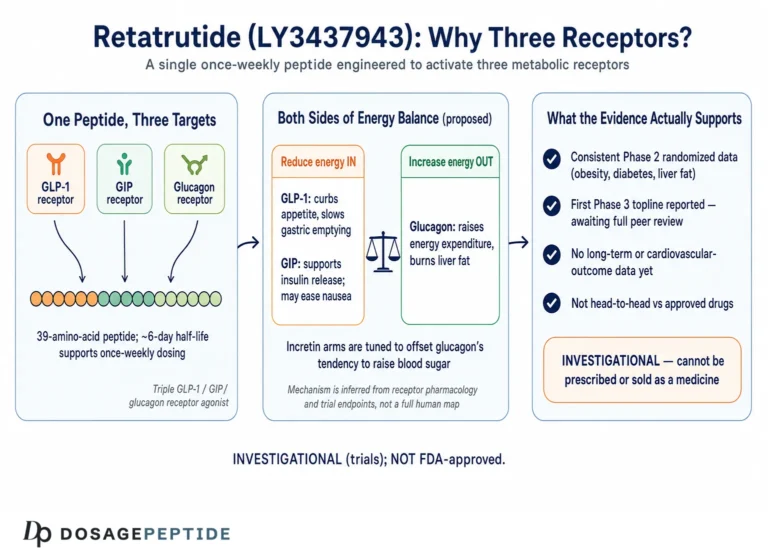
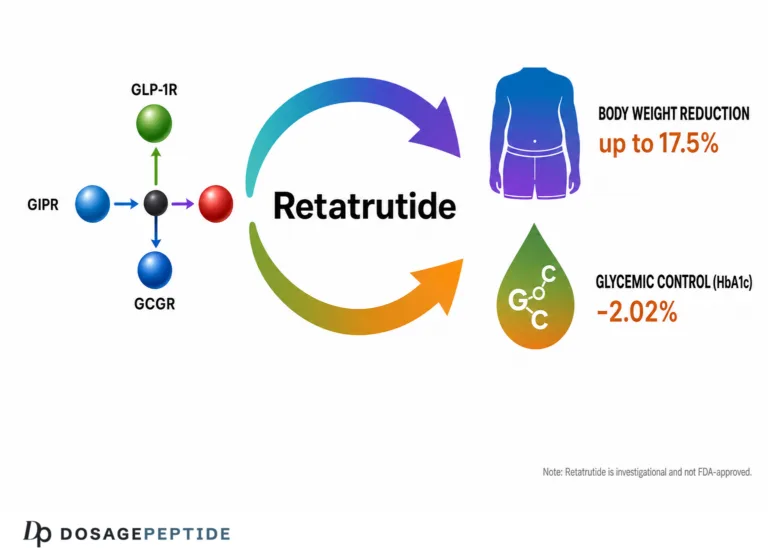
Retatrutide is a synthetic, single-chain peptide agonist that simultaneously activates three metabolic hormone receptors: the glucose-dependent insulinotropic polypeptide receptor (GIPR), the glucagon-like peptide-1 receptor (GLP-1R), and the glucagon receptor (GCGR).2 Because it engages all three, it is frequently described as a “triple agonist” or “triple-hormone-receptor agonist,” distinguishing it from single-incretin agonists such as semaglutide (GLP-1R only) and dual agonists such as tirzepatide (GIPR and GLP-1R). It emerged from Eli Lilly’s incretin peptide-engineering program and was first characterized in a 2022 discovery-to-proof-of-concept paper by Coskun and colleagues, which described both its in vitro receptor pharmacology and its earliest human data.2
The design lineage is important for understanding why retatrutide exists at all. Glucagon receptor agonism, on its own, raises hepatic glucose output and would be counterproductive in a metabolic context; but paired with strong incretin (GLP-1 and GIP) activity, glucagon agonism is hypothesized to increase energy expenditure and support hepatic lipid handling while the incretin arms suppress appetite and support glycemic control. Retatrutide was engineered to balance these three activities in a single molecule with a pharmacokinetic profile suitable for once-weekly subcutaneous administration in trials.23 Notably, its receptor-activity profile is not evenly weighted: in the disclosed pharmacology it is relatively more potent at the human GIP receptor and comparatively less potent at the human glucagon and GLP-1 receptors than native ligands, an intentional tuning of the three signals.2
From a research-reagent standpoint, the practical takeaway is that retatrutide is not a naturally occurring hormone or a simple fragment. It is a heavily engineered, lipidated 39-residue peptide, and the same structural features that give it a long circulating half-life also govern how it must be handled in the vial. The molecule that laboratories purchase as a lyophilized (freeze-dried) powder is chemically identical in intent to the trial material, but material sourced from research-chemical suppliers is not manufactured under pharmaceutical current Good Manufacturing Practice (cGMP), is not subject to FDA premarket review, and carries no guarantee of identity, purity, or endotoxin content.8 Independent characterization — mass spectrometry and reversed-phase HPLC for identity and purity at minimum — is therefore a reasonable first step before any research material is trusted, because handling can only preserve the quality that was present at the start. For a broader library of compound-specific reference pages, DosagePeptide maintains an index of peptide dosage protocols that catalogs how various vial sizes are described in the research literature.
It is also worth being precise about naming. “Retatrutide” refers to the specific Lilly molecule LY3437943. Products sold online under that name are, in the FDA’s characterization, unapproved drugs when they are furnished for human use, regardless of a “not for human consumption” or “research use only” label.89 The name on a label is not a certificate of what is in the vial, which is one more reason analytical verification is a legitimate part of any serious handling workflow.
Molecular Structure and the Basis for Its Handling Requirements
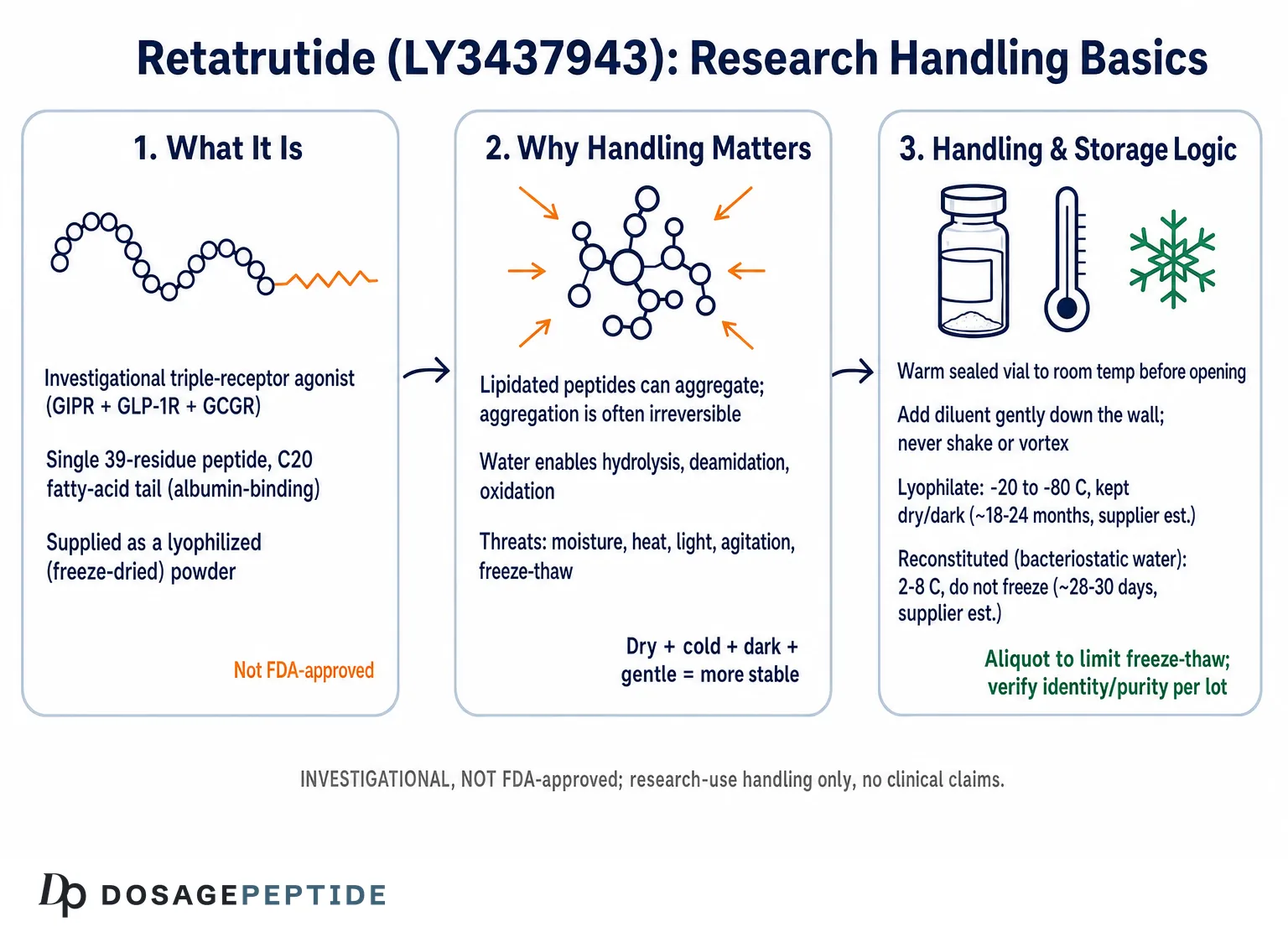
Retatrutide is built on a single 39-amino-acid peptide backbone. Its defining structural feature — and the one most relevant to handling — is a C20 fatty diacid (eicosanedioic acid) moiety conjugated to a lysine residue through a chemical linker (a spacer of the AEEA and gamma-glutamate type common to this class).2 This lipidation is the molecular basis for the compound’s pharmacokinetics: the fatty-acid chain binds reversibly to serum albumin in circulation, and by “hitching” to that abundant plasma protein the peptide is protected from rapid renal clearance and enzymatic degradation. The result is an elimination half-life on the order of six days, which is what makes once-weekly subcutaneous dosing feasible in the trial setting.23
The presence of a hydrophobic fatty-acid tail on an otherwise water-interacting peptide has direct consequences in the vial. Amphipathic, lipidated peptides are more prone to self-association and aggregation than simple hydrophilic sequences, because the lipid tails preferentially cluster away from water. This is a general property of the acylated-incretin class and is one reason such peptides are formulated and stored with care. Aggregation is not merely cosmetic: soluble oligomers and visible particulates represent peptide that is no longer in its intended monomeric, active state, and once aggregation has occurred it is frequently irreversible.1112 A handling protocol that minimizes conditions favoring aggregation — extreme concentrations, vigorous agitation, air-water interfaces, and repeated phase transitions — is therefore protecting the very thing the experiment intends to measure.
The peptide’s chemical composition also dictates which degradation chemistries matter most. Peptides in general are susceptible to hydrolysis of the amide backbone, deamidation of asparagine and glutamine residues, and oxidation of susceptible side chains such as methionine, tryptophan, tyrosine, and histidine.1112 Oxidation in particular is accelerated by light, dissolved oxygen, and trace metal contamination, which is why amber vials, minimized headspace, and clean technique are standard defensive measures for reactive peptides. Deamidation and hydrolysis are strongly pH- and temperature-dependent, which is the underlying reason the freeze-dried solid state is so much more stable than any solution: removing water removes the medium in which most of these reactions proceed.
This is the through-line of every handling recommendation that follows. Retatrutide’s structure is optimized for a long life in the bloodstream, where it is bound to albumin and diluted enormously. That optimization says nothing about its stability as a concentrated powder or a benchtop solution, where the relevant threats are hydrolysis, oxidation, aggregation, adsorption to surfaces, and microbial contamination. Understanding the structure lets a researcher predict, rather than merely follow, the storage and reconstitution rules: keep it dry and cold to suppress backbone and side-chain chemistry, keep it dark and low-oxygen to suppress oxidation, and keep it gently handled and appropriately concentrated to suppress aggregation. The molecule-specific numbers that appear on supplier stability sheets — 18 to 24 months for the lyophilate, weeks for a refrigerated solution — are downstream of these principles rather than independent facts.10
How Retatrutide Works: The Triple-Receptor Mechanism
The pharmacological rationale for retatrutide is the simultaneous, coordinated activation of three class B G-protein-coupled receptors. Each contributes a distinct physiological signal, and the central hypothesis of the triple-agonist strategy is that combining them produces metabolic effects that no single receptor could deliver alone.23
The GLP-1 receptor arm is the best-characterized incretin pathway. GLP-1 receptor agonism enhances glucose-dependent insulin secretion from pancreatic beta cells, suppresses glucagon secretion when glucose is elevated, slows gastric emptying, and acts on central appetite circuits to reduce food intake. The GIP receptor arm adds a second incretin signal; GIP biology is more complex and its net metabolic role has been debated, but in the context of these engineered co-agonists GIPR activation appears to complement GLP-1 signaling on both glycemic control and, in this class, on tolerability and weight effects.2 The glucagon receptor arm is the genuinely differentiating feature. Isolated glucagon agonism raises blood glucose, but the hypothesized benefit in a balanced triple agonist is increased energy expenditure and enhanced hepatic fat mobilization, with the incretin arms present to offset glucagon’s glycemic effect.23
What makes retatrutide distinct within this design space is the specific tuning of the three activities. As disclosed in the discovery pharmacology, retatrutide is more potent at the human GIP receptor than the native peptide and less potent at the human glucagon and GLP-1 receptors relative to their native ligands.2 This is not an accident of synthesis; it reflects deliberate sequence engineering to achieve a particular signaling balance. For a researcher, this is a reminder that “triple agonist” is a category, not a fixed ratio, and that the behavior observed in any receptor or cell-based assay will depend on which receptor is being interrogated and at what concentration.
Mechanistic study of retatrutide in a laboratory context typically proceeds through in vitro receptor-activation assays. Standard approaches include measuring cyclic AMP (cAMP) accumulation in cells engineered to express human GIPR, GLP-1R, or GCGR, since all three receptors signal predominantly through Gs and adenylyl cyclase; beta-arrestin recruitment assays add information about receptor internalization and biased signaling. These systems allow potency (EC50) and efficacy (maximal response) to be quantified for each receptor independently and are the foundation on which the reported potency ratios rest.2 The reliability of every one of these measurements, however, depends on the peptide actually being intact and correctly concentrated at the moment of the assay — which is precisely why handling is not a peripheral concern but a prerequisite for mechanistic validity.
It bears emphasizing that mechanism is not efficacy. That retatrutide activates three receptors in a dish, and that this activation produces measurable metabolic effects in trials, does not translate into any claim that a research-sourced powder produces a defined effect in any individual. The mechanism explains why the molecule was designed and what it does at the receptor level; it is a description, not an endorsement.
The Current State of the Evidence: An Honest Accounting
The evidence base for retatrutide is, for an investigational compound, unusually substantial — but it is a clinical-development evidence base, generated under rigorous trial conditions with pharmaceutical-grade material, and it should not be read as validating any research-chemical product. The most-cited single study is the Phase 2 obesity trial published in the New England Journal of Medicine in 2023 by Jastreboff and colleagues. This double-blind, randomized, placebo-controlled trial enrolled 338 adults with obesity (BMI 30 or higher, or 27 to less than 30 with a weight-related condition), assigning them to subcutaneous retatrutide at several dose levels or placebo once weekly for 48 weeks. At the highest dose evaluated, the trial reported a mean weight reduction of roughly 24% versus about 2% for placebo.1
Retatrutide has also been studied in type 2 diabetes. A Phase 2 trial reported in The Lancet in 2023 by Rosenstock and colleagues evaluated the compound in people with type 2 diabetes, examining glycemic and body-weight endpoints against placebo and an active comparator.4 A separate Phase 2a randomized trial, published in Nature Medicine, examined retatrutide in metabolic dysfunction-associated steatotic liver disease (MASLD), reporting reductions in liver fat content as measured by imaging.5 Earlier still, the Phase 1b multiple-ascending-dose study by Urva, Coskun, and colleagues, also in The Lancet, established the safety, tolerability, and pharmacokinetic feasibility of once-weekly dosing in people with type 2 diabetes.3
More recently, Eli Lilly’s Phase 3 TRIUMPH program has reported topline results. The company disclosed that TRIUMPH-1, a large pivotal obesity trial, met its primary and key secondary endpoints, with substantial mean weight reductions at the higher doses over the trial period.6 These are the results that move a compound toward a regulatory filing. As of August 2026, retatrutide remains investigational and is not approved for any use. Eli Lilly announced on 23 July 2026 that it intends to file for FDA approval in the first quarter of 2027; FDA review of such a filing typically takes about a year, so no approval decision is expected before late 2027 at the earliest.7
The honest characterization of this evidence, then, is as follows. Retatrutide has moved through a coherent, well-conducted clinical development program and has generated positive, peer-reviewed and company-reported efficacy signals in obesity, type 2 diabetes, and steatotic liver disease. That is a genuinely strong preclinical-to-clinical trajectory. But three caveats are non-negotiable. First, every one of these results was generated with pharmaceutical-grade, cGMP-manufactured material under medical supervision — not with research-chemical powder of unverified identity. Second, positive trial efficacy is a finding about a supervised intervention, not a statement about what a laboratory reagent will do outside that setting. Third, until a regulator completes its review, the full risk-benefit picture, including long-term safety, remains formally undetermined. The evidence is promising and real; it is also strictly investigational.
How Retatrutide Compares to Related Investigational and Approved Peptides
Retatrutide is most usefully understood against the incretin-based peptides that preceded it, because the comparison clarifies both its design logic and its distinct handling profile. The relevant reference points are semaglutide, a GLP-1 receptor agonist; tirzepatide, a dual GIP/GLP-1 receptor agonist; and native glucagon-family peptides. The following table summarizes the pharmacological positioning as described in the primary literature.
| Compound | Receptor targets | Class | Approval status (August 2026) |
|---|---|---|---|
| Semaglutide | GLP-1R | Single incretin agonist | Approved (multiple indications) |
| Tirzepatide | GIPR + GLP-1R | Dual agonist | Approved (multiple indications) |
| Retatrutide (LY3437943) | GIPR + GLP-1R + GCGR | Triple agonist | Investigational, not approved7 |
The addition of the glucagon-receptor arm is the conceptual leap from tirzepatide to retatrutide. Where tirzepatide combines two incretin signals, retatrutide adds a third, catabolic signal intended to raise energy expenditure and support hepatic lipid handling, while relying on the incretin arms to counter glucagon’s tendency to raise glucose.23 This is why retatrutide is described as first-in-class within the triple-agonist category rather than simply as a more potent version of an existing drug.
The structural comparison is equally instructive for handling. Both tirzepatide and retatrutide are acylated with a C20 (eicosanedioic) fatty diacid, and both use it to achieve albumin-mediated half-life extension. What distinguishes them is not the length of the fatty-acid chain but the rest of the molecule: retatrutide is a distinct 39-residue backbone attaching its C20 diacid through its own linker chemistry at a different lysine residue, and — more importantly — it engages a third receptor (the glucagon receptor) that tirzepatide does not.2 These differences in backbone sequence, attachment site, and receptor pharmacology influence self-association behavior and formulation characteristics in ways the shared chain length does not capture. The practical implication is that handling knowledge is not perfectly transferable between these molecules; a diluent or concentration that suits one lipidated peptide is a reasonable starting hypothesis for another, not a guarantee. Researchers comparing compound-specific reference material, such as the retatrutide 30mg dosage chart in units versus tirzepatide equivalents, will find the reconstitution arithmetic differs with the labeled mass in the vial.
One further comparison deserves honesty rather than hype. In the crowded and increasingly competitive incretin field, retatrutide’s Phase 2 and Phase 3 weight-reduction figures have attracted attention because they are numerically large. But those numbers come from controlled trials of the pharmaceutical product; they are not a property that a vial of research powder inherits. Comparative efficacy claims are appropriate only as descriptions of what the trials found, and they carry no implication about outcomes with unapproved material used outside a trial. The comparison is scientifically interesting; it is not a marketing endorsement.
Research Models and Study Methodology
Understanding how retatrutide is studied clarifies where handling errors do the most damage. Preclinical and clinical investigation of the compound has proceeded through a conventional, layered methodology, each layer with its own material-integrity demands.
At the most basic level are the in vitro receptor and cell-based assays already described: cAMP-accumulation and beta-arrestin-recruitment assays in cells expressing human GIPR, GLP-1R, or GCGR, used to quantify potency and efficacy at each receptor.2 These experiments generate the potency ratios that define retatrutide’s signaling balance. They are also acutely sensitive to peptide quality: because potency is expressed as a concentration (EC50), any error in the true concentration of active peptide — whether from imprecise reconstitution, adsorptive loss to plasticware, or partial aggregation — propagates directly into a wrong potency value. Cell-based work also demands sterile, endotoxin-controlled material, since bacterial contaminants can independently perturb cellular readouts.
The next layer is in vivo pharmacology in animal models. The discovery literature describes characterization in rodent models to establish glycemic, body-weight, and energy-expenditure effects and to define pharmacokinetics before human studies.2 Animal work adds requirements around dose accuracy, vehicle compatibility, and sterility that in vitro work may not, and it is typically conducted under institutional animal-care oversight with defined protocols. Here again, a peptide that has degraded in storage will produce a blunted or absent effect that can be misread as a biological result rather than a handling artifact.
The clinical layers follow the standard phased structure. The first-in-human and Phase 1b work established single- and multiple-ascending-dose safety and pharmacokinetics, confirming the roughly six-day half-life and the feasibility of once-weekly subcutaneous administration.3 Phase 2 trials in obesity, type 2 diabetes, and MASLD established dose-ranging efficacy and safety signals.145 Phase 3 trials in the TRIUMPH program tested pre-specified endpoints in large populations to support a potential regulatory filing.6 Across all of these, the material was pharmaceutical-grade and the study designs were randomized and, at Phase 2 and beyond, placebo-controlled and blinded — methodological features that a benchtop researcher cannot replicate but should keep in mind when interpreting trial numbers.
For a laboratory replicating or extending mechanistic work, methodology and handling are inseparable. Good practice includes independent confirmation of identity and purity (mass spectrometry and HPLC) on each lot, verification of the actual peptide content rather than trusting the label, preparation of accurately quantified stock solutions, and the use of appropriate positive and negative controls in every assay so that a null result can be distinguished from a degraded-reagent result. Documentation — lot numbers, reconstitution date and diluent, storage history, and freeze-thaw count for each aliquot — is part of methodology, not clerical overhead, because reproducibility depends on being able to reconstruct exactly what condition the peptide was in when it was used.
Safety and Tolerability Signals from the Trial Record
Safety information for retatrutide comes from its clinical trials and describes the pharmaceutical product administered under medical supervision. It is summarized here strictly as a description of the trial record, not as a safety profile for any research-sourced material, and certainly not as a reassurance about non-clinical use, for which no adequate data exist.
The most consistent finding across the retatrutide trials is that its adverse-event profile is dominated by gastrointestinal effects, consistent with the broader incretin (GLP-1 receptor agonist) class. In the Phase 2 obesity trial, the most common adverse events were nausea, vomiting, diarrhea, and constipation, and these were generally reported as dose-related and most prominent during dose escalation.1 This pattern — GI symptoms concentrated early and mitigated by gradual titration — recurs throughout the incretin literature and was a design rationale for the stepwise dose-escalation schedules used in the trials.13
Because retatrutide includes glucagon-receptor agonism, its trials paid particular attention to signals that could be linked to that mechanism, including heart rate and, given glucagon’s glycemic effect, glucose handling. Dose-dependent increases in heart rate have been observed within the incretin/glucagon class and were monitored in the retatrutide program; the trial reports and subsequent analyses characterize these and other parameters in detail, and any researcher citing safety should go to those primary sources rather than to secondary summaries.14 The Phase 3 TRIUMPH topline disclosures described an overall safety profile that the sponsor characterized as consistent with the incretin class, but the full, peer-reviewed safety datasets are what ultimately matter and were still being published and reviewed as of August 2026.67
Two points must be stated plainly. First, these safety data were generated with monitored dosing of a cGMP product in enrolled trial participants who met eligibility criteria and were screened for contraindications. They say nothing about the safety of unverified research-chemical material, which may differ in purity, may contain contaminants or endotoxin, and carries none of the identity guarantees of trial material.8 Second, the FDA has explicitly warned about the risks of unapproved GLP-1-class drugs, including retatrutide, sold outside the regulated supply chain, precisely because the safety established in trials does not transfer to unregulated products.89
The correct reading of the safety record is therefore twofold: the trials suggest a class-typical, largely gastrointestinal tolerability profile for the supervised pharmaceutical product, and that record provides no basis whatsoever for non-clinical use of research material. From a handling perspective, the most relevant safety consideration for a laboratory worker is occupational: unverified peptide powders should be handled as biologically active substances of unknown potency, using appropriate personal protective equipment and avoiding inhalation of powder or skin contact, consistent with general good laboratory practice.
Critical Handling and Reconstitution Protocols in a Research Context
This is the operational core of the article. The practices below reflect general peptide-formulation science and the physicochemical logic established earlier; they are not a regulatory standard, and they assume qualified personnel working with material intended solely for in vitro or validated preclinical research under appropriate oversight.
Equilibrate before opening. Lyophilized retatrutide is typically supplied and stored frozen or refrigerated. A cold, sealed vial opened directly will draw atmospheric moisture and condensation onto the powder, and moisture is the enemy of a dry peptide’s stability. The standard practice is to allow the sealed vial to warm to room temperature before breaking the seal, so that no condensation forms on or in the vial.1013 This single step is frequently skipped and quietly undermines subsequent stability.
Choose the diluent deliberately. The reconstitution solvent determines both immediate solubility and how long the resulting solution remains usable. Bacteriostatic water — sterile water containing roughly 0.9% benzyl alcohol — is the commonly described diluent for lipidated research peptides because the preservative suppresses microbial growth and thereby supports multi-day refrigerated storage of a multi-use vial.1013 Preservative-free sterile water is acceptable for a single-use, immediately consumed preparation but does not support storage. The choice is not cosmetic: a preservative-free solution left at 2 to 8 degrees Celsius for days is a microbial-growth risk as much as a chemical-stability risk.
Add solvent to peptide, gently, down the wall. A cardinal rule of peptide reconstitution is to add the diluent to the peptide rather than the reverse, and to direct the stream down the inner wall of the vial rather than squirting it directly onto the powder.1314 Adding peptide to solvent, or blasting solvent onto a concentrated powder, creates transient zones of very high local concentration that can trigger immediate, sometimes irreversible aggregation. After the diluent is in, the vial should be allowed to sit and the powder allowed to dissolve on its own, with slow swirling or gentle rolling if needed. It should never be vortexed or shaken vigorously: mechanical agitation and the resulting air-water interfaces and foaming are classic drivers of peptide aggregation and denaturation.111214
Reconstitution arithmetic. The concentration of the resulting solution is simply the labeled peptide mass divided by the diluent volume. Because vials are sold in a range of labeled masses, the same volume of diluent yields different concentrations depending on the vial. Compound-specific reference pages — for example the 12 mg vial protocol, the 10 mg vial reconstitution guide, and the 6 mg vial protocol — illustrate how the same diluent volume produces different working concentrations by vial size. In a research setting, the actual concentration should be verified analytically rather than assumed from the label, since the labeled mass on a non-cGMP product is not guaranteed. The table below shows the arithmetic relationship, using illustrative values only.
| Labeled vial mass | Diluent added | Resulting nominal concentration |
|---|---|---|
| 6 mg | 2 mL | 3 mg/mL (3000 mcg/mL) |
| 10 mg | 2 mL | 5 mg/mL (5000 mcg/mL) |
| 12 mg | 2 mL | 6 mg/mL (6000 mcg/mL) |
| 30 mg | 3 mL | 10 mg/mL (10000 mcg/mL) |
Inspect and, where appropriate, filter. After reconstitution the solution should be inspected visually: a properly reconstituted preparation is clear and free of visible particulates, haze, or persistent foam. Cloudiness or particles indicate aggregation or contamination and mean the preparation should not be trusted. For cell-culture or other sterility-critical applications, passage through a 0.22-micron low-protein-binding sterile filter removes particulates and microbial contaminants; low-binding membranes are specified to minimize peptide loss to the filter itself.13 Filtration should be used when sterility genuinely requires it, not as a routine substitute for clean technique, because every additional manipulation is an opportunity for loss and contamination.
Minimize surfaces and headspace. Lipidated peptides adsorb readily to glass and plastic surfaces, especially at low concentrations, and are oxidized by dissolved and headspace oxygen. Working reasonably promptly, minimizing the number of transfers, and keeping vials capped and headspace small all reduce loss and oxidation.1112 Where a protocol demands a very dilute working solution, carrier proteins or surfactants are sometimes added to reduce adsorptive loss, but only when they are compatible with the downstream assay.
Storage, Stability, and Documentation Across a Study Timeline
Handling does not end at reconstitution; the way material is stored between uses often determines whether a multi-week study yields consistent data. The governing principle is the one established from the molecule’s chemistry: the dry, lyophilized solid is dramatically more stable than any solution, and cold, dark, dry conditions suppress the degradation chemistries that threaten the peptide.
Storing the lyophilate. As a freeze-dried powder, kept sealed, dry, dark, and frozen, retatrutide is described in supplier stability documentation as stable for roughly 18 to 24 months.10 A temperature of −20 degrees Celsius is generally adequate for short-to-medium-term storage, while −80 degrees Celsius is the preferred standard for long-term preservation because it further slows any residual chemistry and, importantly, provides a more stable temperature than a domestic-grade freezer subject to frequent door-opening and defrost cycles.1011 Temperature cycling — repeated warming and re-cooling — is itself a stressor, so a dedicated, monitored laboratory freezer is preferable to a general-purpose one.
Storing the reconstituted solution. Once in solution, the stability window shortens by orders of magnitude. A solution reconstituted with bacteriostatic water is typically stored refrigerated at 2 to 8 degrees Celsius and used within a matter of weeks — supplier guidance commonly cites roughly 28 to 30 days — while a preservative-free preparation should be used within a day or two.1013 A widely repeated practical instruction is not to freeze the reconstituted multi-use solution: freezing and thawing a lipidated-peptide solution promotes aggregation at the ice-water boundary and can leave the material visibly or invisibly compromised.1012
Aliquoting and the freeze-thaw problem. When a peptide solution genuinely must be frozen for long-term storage, the standard defense against freeze-thaw damage is aliquoting: dividing the solution into single-use portions immediately after preparation, freezing each portion, and thawing only one at a time so that no aliquot is ever refrozen.1114 The formulation literature documents that aggregation increases progressively with each freeze-thaw cycle, and a common conservative recommendation is to keep any given aliquot to a small number of cycles at most.1112 Aliquoting trades a little extra up-front labor for the elimination of one of the most common and most invisible sources of experimental variability.
The stability hierarchy, summarized. The following table consolidates the general storage logic; the exact numbers are illustrative of supplier guidance rather than a regulatory specification.
| State | Typical storage | Approximate usable window | Primary threats |
|---|---|---|---|
| Lyophilized powder | −20 to −80 °C, sealed, dark | ~18 to 24 months10 | Moisture, temperature cycling |
| Reconstituted, bacteriostatic water | 2 to 8 °C, do not freeze | ~28 to 30 days10 | Hydrolysis, oxidation, microbial growth |
| Reconstituted, preservative-free | 2 to 8 °C, single use | ~24 to 48 hours | Microbial growth, aggregation |
| Frozen aliquots (if unavoidable) | −20 to −80 °C, single-use | Per aliquot, minimize thaw cycles | Freeze-thaw aggregation |
Documentation as part of stability. None of the above is auditable without records. A defensible handling log captures, at minimum, the supplier lot number, results of any identity/purity verification, the date and diluent of reconstitution, the storage temperature history, and a freeze-thaw count for each aliquot. When an assay produces an anomalous result, this log is what allows a researcher to distinguish a real biological finding from a degraded-reagent artifact. Reproducibility, in other words, is downstream of documentation. Additional compound-specific reconstitution references, such as the 24 mg vial protocol, can serve as templates for the parameters worth recording per lot.
Limitations and the Human-Evidence Gap
Honesty about what is not known is as important as any handling instruction. Several distinct limitations bound what can responsibly be claimed about retatrutide, and they should temper any enthusiasm generated by the trial figures.
Approval status is the central limitation. Retatrutide is investigational. As of August 2026 it has completed its pivotal Phase 3 trials and a regulatory filing is planned for early 2027, but it has not been approved by the FDA or any comparable regulator, meaning that no regulatory body has completed a full, independent risk-benefit assessment of the compound.7 Positive topline results and even published Phase 3 data are not the same as approval; regulators routinely scrutinize datasets that looked favorable in press releases, and long-term safety in real-world populations is established only after approval and post-marketing surveillance.
The material gap. Every efficacy and safety figure cited in this article was generated with pharmaceutical-grade, cGMP-manufactured retatrutide administered under medical supervision.16 Research-chemical material sold under the retatrutide name is a different thing: it is not cGMP-manufactured, is not subject to FDA premarket review, and carries no guarantee of identity, purity, potency, or freedom from contaminants or endotoxin.8 The trial data therefore cannot be read across to research powder, and no legitimate inference about what such powder will do in any living subject can be drawn from the clinical literature.
Durability and long-term outcomes. The pivotal trials, while long by trial standards, still measure endpoints over months to a couple of years. The durability of effects, the consequences of stopping, rare adverse events that only appear in very large post-approval populations, and interactions with other conditions and medications are precisely the questions that trials of this length and size cannot fully answer. The glucagon-receptor arm, which differentiates retatrutide, is also the newest of the three mechanisms in this therapeutic context, and its long-term implications warrant the caution that comes with less accumulated human experience.24
Handling knowledge itself is inferential. The storage and reconstitution numbers repeated across supplier documentation are not derived from a peer-reviewed, retatrutide-specific stability study in the public literature; they are extrapolations from general peptide-formulation principles and from analogous lipidated peptides.1011 They are reasonable working assumptions, but a rigorous laboratory would confirm the stability of its own material under its own conditions rather than treating a supplier’s “28 to 30 days” as an established fact. The absence of a pharmacopeial monograph means there is no authoritative specification to defer to.
Taken together, these limitations define the honest posture: retatrutide is a scientifically interesting, well-studied investigational molecule with a strong clinical-trial trajectory and a real, mechanism-based rationale — and simultaneously a compound about which important safety, durability, and material-quality questions remain open, and whose trial results provide no license for non-clinical use.
Regulatory Status and Compliance Considerations
The regulatory picture is the final and least negotiable piece of context for anyone handling retatrutide. As of August 2026, retatrutide is an investigational drug that has not been approved by the FDA for any use.7 It is not a controlled substance under the U.S. Controlled Substances Act, so it is not DEA-scheduled; but the absence of scheduling should not be mistaken for regulatory endorsement. An unapproved drug is unapproved regardless of whether it is also controlled.8
The FDA has been unusually explicit about retatrutide specifically and about the unapproved GLP-1-class more broadly. The agency has published consumer- and provider-facing communications warning about the risks of unapproved GLP-1 drugs used for weight loss, and it has issued warning letters to firms selling products labeled as retatrutide.89 A central legal point from those communications is that a “research use only” or “not for human consumption” label does not transform an unapproved drug into a lawful product once it is administered to, or furnished for use in, a person. Selling or using such material as a medication is, in the FDA’s characterization, unlawful.8
For legitimate laboratory research, the compliance framework is the ordinary one that governs any potent, biologically active research chemical. Material should be purchased, stored, and used strictly as a research reagent; it should never be diverted to human or veterinary use; and its handling should conform to institutional biosafety, chemical-hygiene, and — where animals are involved — animal-care oversight requirements. Records of acquisition, use, and disposal are part of that compliance, not merely of good scientific practice. Where an institution has a defined policy for investigational or research-use-only substances, that policy governs.
It is also worth situating the enforcement trend. The FDA’s issuance of multiple rounds of warning letters to retatrutide sellers, together with parallel communications from state pharmacy boards and professional bodies, signals an active regulatory environment rather than a settled one.89 This has two implications for a researcher. First, the legal and supply landscape around research-sourced retatrutide can change quickly, so compliance decisions should be based on current agency guidance rather than on assumptions carried over from an earlier period. Second, the very existence of this enforcement activity underscores why the honest framing throughout this article is not merely rhetorical caution: regulators are treating unapproved retatrutide as a genuine public-health concern, and the gap between “studied in trials” and “safe to use outside them” is one they are actively policing.
The bottom line on status is simple and should be stated without hedging. Retatrutide is investigational, not approved, and its promising trial data confer no legal or scientific authorization for use outside a properly regulated clinical trial or an appropriately overseen laboratory research setting. Everything in this article is written within, and only within, that research-education boundary.
Frequently Asked Questions
Is retatrutide FDA-approved?
No. As of August 2026, retatrutide (LY3437943) is an investigational compound that has completed pivotal Phase 3 trials but has not received marketing authorization from the FDA or any comparable regulator.7 It is not a controlled substance, but being unscheduled is not the same as being approved. The FDA has issued warnings and warning letters concerning unapproved retatrutide products sold outside the regulated supply chain.89
What diluent is typically described for reconstituting research-grade retatrutide?
Bacteriostatic water — sterile water with roughly 0.9% benzyl alcohol — is the commonly described diluent because the preservative supports multi-day refrigerated storage of a multi-use vial.1013 Preservative-free sterile water is described as acceptable for immediate single-use preparation only. The diluent should always be added gently to the peptide, directed down the vial wall, never the reverse, and the solution should never be shaken or vortexed.1314
Why does the lyophilized powder last so much longer than the reconstituted solution?
Most peptide degradation chemistries — hydrolysis of the backbone, deamidation, and much oxidation — proceed in water. Freeze-drying removes water and thereby suppresses those reactions, which is why a dry, cold, dark lyophilate is described as stable for roughly 18 to 24 months while a refrigerated solution is typically used within weeks.1011 Reconstitution reintroduces the medium in which the peptide degrades.
Can reconstituted retatrutide solution be frozen to extend its life?
The widely repeated practical guidance is not to freeze a reconstituted multi-use solution, because freezing and thawing a lipidated peptide promotes aggregation at the ice-water interface and can compromise the material.1012 When long-term frozen storage of a solution is genuinely required, the standard approach is to aliquot into single-use portions before freezing and thaw each only once, minimizing freeze-thaw cycles.1114
How is retatrutide different from tirzepatide and semaglutide?
Semaglutide activates one receptor (GLP-1R), tirzepatide activates two (GIPR and GLP-1R), and retatrutide activates three (GIPR, GLP-1R, and GCGR), making it a first-in-class triple agonist.2 Structurally, retatrutide and tirzepatide are both acylated with a C20 fatty diacid for albumin binding; they differ not in fatty-acid chain length but in their peptide backbones, the lysine attachment site and linker chemistry, and — most consequentially — their receptor profile, since retatrutide adds glucagon-receptor activity. Handling knowledge is therefore related but not perfectly transferable.2
Do the trial weight-loss figures apply to research-chemical retatrutide?
No. The efficacy figures from the Phase 2 and Phase 3 trials were generated with pharmaceutical-grade, cGMP-manufactured retatrutide administered under medical supervision.16 Those results are findings about a supervised intervention and cannot be read across to unverified research-chemical material, which carries no guarantee of identity, purity, or potency.8 No efficacy claim about research powder can be inferred from the clinical data.
What analytical checks make sense before trusting a research lot?
Because research-chemical material is not cGMP-manufactured and the label is not a guarantee, independent verification is prudent: mass spectrometry to confirm identity and molecular mass, and reversed-phase HPLC to assess purity, at minimum. Verifying the actual peptide content (rather than trusting the labeled mass) is what allows accurate stock-concentration calculations, and endotoxin testing matters for any cell-culture application.813
Where can I find compound-specific reconstitution references?
DosagePeptide maintains vial-size-specific reference pages, including protocols for the 20 mg vial and other sizes, plus a general dosage index. These illustrate how reconstitution arithmetic changes with the labeled mass in the vial. They are research-education references; the actual concentration of any given lot should still be verified analytically.
References
- Jastreboff AM, Kaplan LM, Frias JP, et al. Triple-Hormone-Receptor Agonist Retatrutide for Obesity — A Phase 2 Trial. New England Journal of Medicine. 2023;389(6):514-526. doi:10.1056/NEJMoa2301972. PubMed PMID: 37366315.
- Coskun T, Urva S, Roell WC, et al. LY3437943, a novel triple glucagon, GIP, and GLP-1 receptor agonist for glycemic control and weight loss: From discovery to clinical proof of concept. Cell Metabolism. 2022;34(9):1234-1247.e9.
- Urva S, Coskun T, Loh MT, et al. LY3437943, a novel triple GIP, GLP-1, and glucagon receptor agonist in people with type 2 diabetes: a phase 1b, multicentre, double-blind, placebo-controlled, randomised, multiple-ascending dose trial. The Lancet. 2022;400(10366):1869-1881.
- Rosenstock J, Frias J, Jastreboff AM, et al. Retatrutide, a GIP, GLP-1 and glucagon receptor agonist, for people with type 2 diabetes: a randomised, double-blind, placebo- and active-controlled, parallel-group, phase 2 trial. The Lancet. 2023;402(10401):529-544.
- Sanyal AJ, Kaplan LM, Frias JP, et al. Triple hormone receptor agonist retatrutide for metabolic dysfunction-associated steatotic liver disease: a randomized phase 2a trial. Nature Medicine. 2024. PubMed Central PMCID: PMC11271400.
- Eli Lilly and Company. Lilly’s triple agonist, retatrutide, delivered powerful weight loss in pivotal Phase 3 obesity trial (TRIUMPH-1). Investor news release. 2025. https://investor.lilly.com/news-releases/news-release-details/lillys-triple-agonist-retatrutide-delivered-powerful-weight-loss
- Eli Lilly and Company. Pipeline (retatrutide listed as an investigational asset). https://www.lilly.com/discovery/pipeline (accessed July 2026).
- U.S. Food and Drug Administration. FDA’s Concerns with Unapproved GLP-1 Drugs Used for Weight Loss. Drug Alerts and Statements. https://www.fda.gov/drugs/postmarket-drug-safety-information-patients-and-providers/fdas-concerns-unapproved-glp-1-drugs-used-weight-loss (accessed July 2026).
- U.S. Food and Drug Administration. Warning Letters to firms marketing unapproved retatrutide/GLP-1 products (e.g., GLP-1 Solution, 09/09/2025; Gram Peptides, 03/31/2026). Inspections, Compliance, Enforcement, and Criminal Investigations. https://www.fda.gov/inspections-compliance-enforcement-and-criminal-investigations/warning-letters
- Supplier stability and storage documentation for research-grade retatrutide (lyophilized shelf life ~18-24 months; reconstituted refrigerated use ~28-30 days). Representative example: Alpha Carbon Labs, Retatrutide Stability & Storage Guide. https://alphacarbonlabs.com/ (accessed July 2026).
- Manning MC, Chou DK, Murphy BM, Payne RW, Katayama DS. Stability of protein pharmaceuticals: an update. Pharmaceutical Research. 2010;27(4):544-575.
- Wang W. Instability, stabilization, and formulation of liquid protein pharmaceuticals. International Journal of Pharmaceutics. 1999;185(2):129-188.
- General peptide reconstitution best-practice guidance (add solvent to peptide; 0.22-micron low-binding sterile filtration for cell culture; avoid agitation). Representative compilation: Verified Peptides Knowledge Hub, How to Reconstitute Lyophilized Peptides. https://verifiedpeptides.com/ (accessed July 2026).
- General laboratory peptide storage and handling best practices (aliquoting, freeze-thaw minimization, adsorption and oxidation control). Representative compilation: Omnix Peptides, Peptide Storage and Handling. https://omnixpeptides.com/peptide-storage-and-handling/ (accessed July 2026).
Educational and research-use disclaimer: This article is provided solely for scientific education and laboratory research reference. Retatrutide (LY3437943) is an investigational compound that is not approved by the FDA or any comparable regulator for any use. Nothing herein is medical, veterinary, dosing, or treatment advice, and nothing should be interpreted as encouraging or authorizing the use of retatrutide in humans or animals outside of a properly regulated clinical trial. Statements about clinical-trial efficacy and safety describe findings obtained with pharmaceutical-grade material under medical supervision and do not apply to research-chemical products of unverified quality. Handling, storage, and reconstitution practices described here reflect general peptide-formulation science, not a regulatory or pharmacopeial standard, and must be adapted to, and validated within, each laboratory’s own oversight, biosafety, and compliance framework. Always consult qualified professionals and current regulatory guidance.