Vitamin B12 improves cognitive performance in one situation and one only: when the person taking it is genuinely deficient. Correcting a real deficiency can reverse or halt measurable memory and neurological impairment.12 In people whose B12 status is already adequate, more than two decades of randomized trials have failed to move memory, attention or processing speed at all — even when the supplement lowered homocysteine exactly as intended.679
The genuinely unsettled ground sits in the middle: older adults with borderline status, elevated homocysteine, or subtle deficiency. There the results are mixed, and the positive signals show up only in specific subgroups. That middle ground is the real substance of the question, and it is where this article spends most of its time — including how “cognitive performance” is actually measured, because the choice of test drives the conclusion more than most readers realize.
What Vitamin B12 Does in the Nervous System
Vitamin B12 is a water-soluble B-vitamin built around a cobalt-centered corrin ring — the largest and most structurally complex of all the vitamins. Humans cannot synthesize it; it originates in microbial synthesis and reaches us almost entirely through animal-source foods. In the body it serves as an essential cofactor for exactly two enzymatic reactions, and both are directly relevant to how the brain works.1
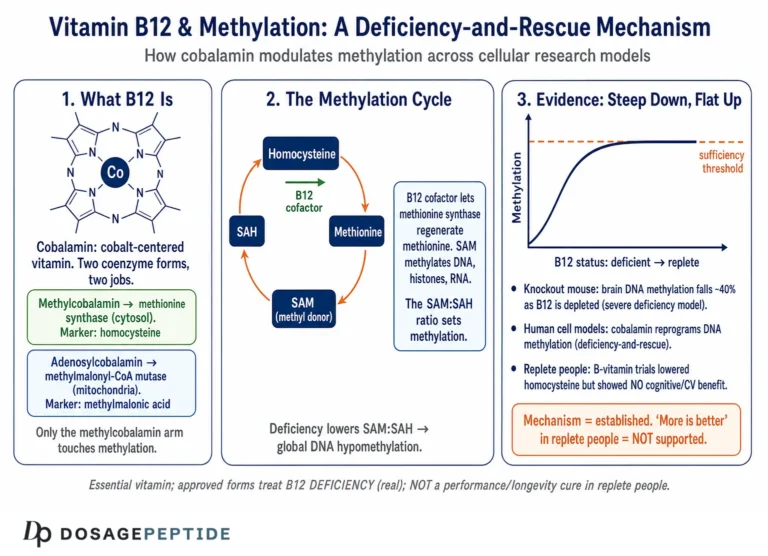
The first reaction is the methionine synthase step. In the cytoplasm, the methylcobalamin form of B12 acts as the cofactor that lets methionine synthase transfer a methyl group from 5-methyltetrahydrofolate to homocysteine, regenerating methionine and, in the process, freeing tetrahydrofolate to re-enter the folate cycle.2 Methionine is then activated to S-adenosylmethionine (SAM), the universal methyl donor for well over a hundred methylation reactions — including the methylation of DNA, of myelin basic protein, of phospholipids, and of neurotransmitters. When B12 is scarce, this reaction slows, homocysteine accumulates, SAM-dependent methylation falters, and folate becomes trapped in its methyl form (the “methyl-folate trap”). The downstream consequences for the nervous system — impaired myelin maintenance and disturbed methylation of neural substrates — are a central part of why deficiency injures the brain and spinal cord.2
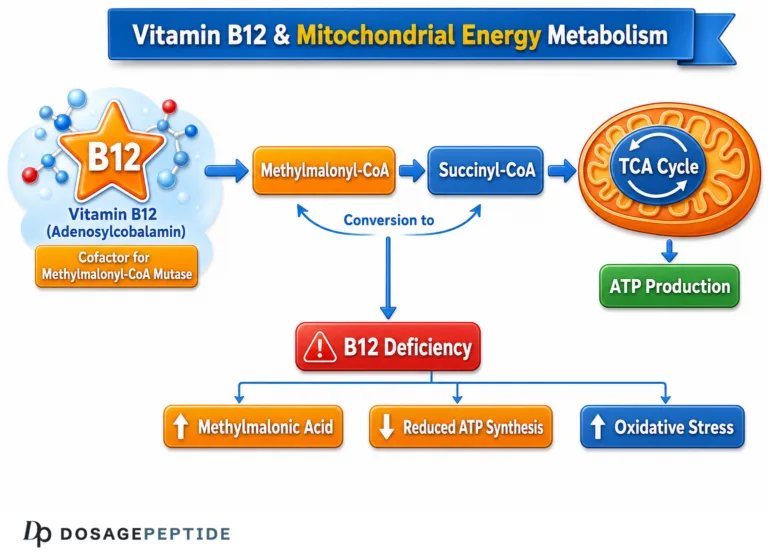
The second reaction is the methylmalonyl-CoA mutase step, which occurs in mitochondria and uses the adenosylcobalamin form of B12. This enzyme converts L-methylmalonyl-CoA to succinyl-CoA, a node feeding into the citric-acid cycle. When B12 is deficient, methylmalonyl-CoA accumulates and is measured clinically as elevated methylmalonic acid (MMA), now regarded as one of the more specific functional markers of cellular B12 status.1 Accumulating MMA and the resulting disruption of mitochondrial energy production and fatty-acid handling are thought to contribute to the neuropathology of deficiency, particularly the abnormal myelin seen in severe cases.4
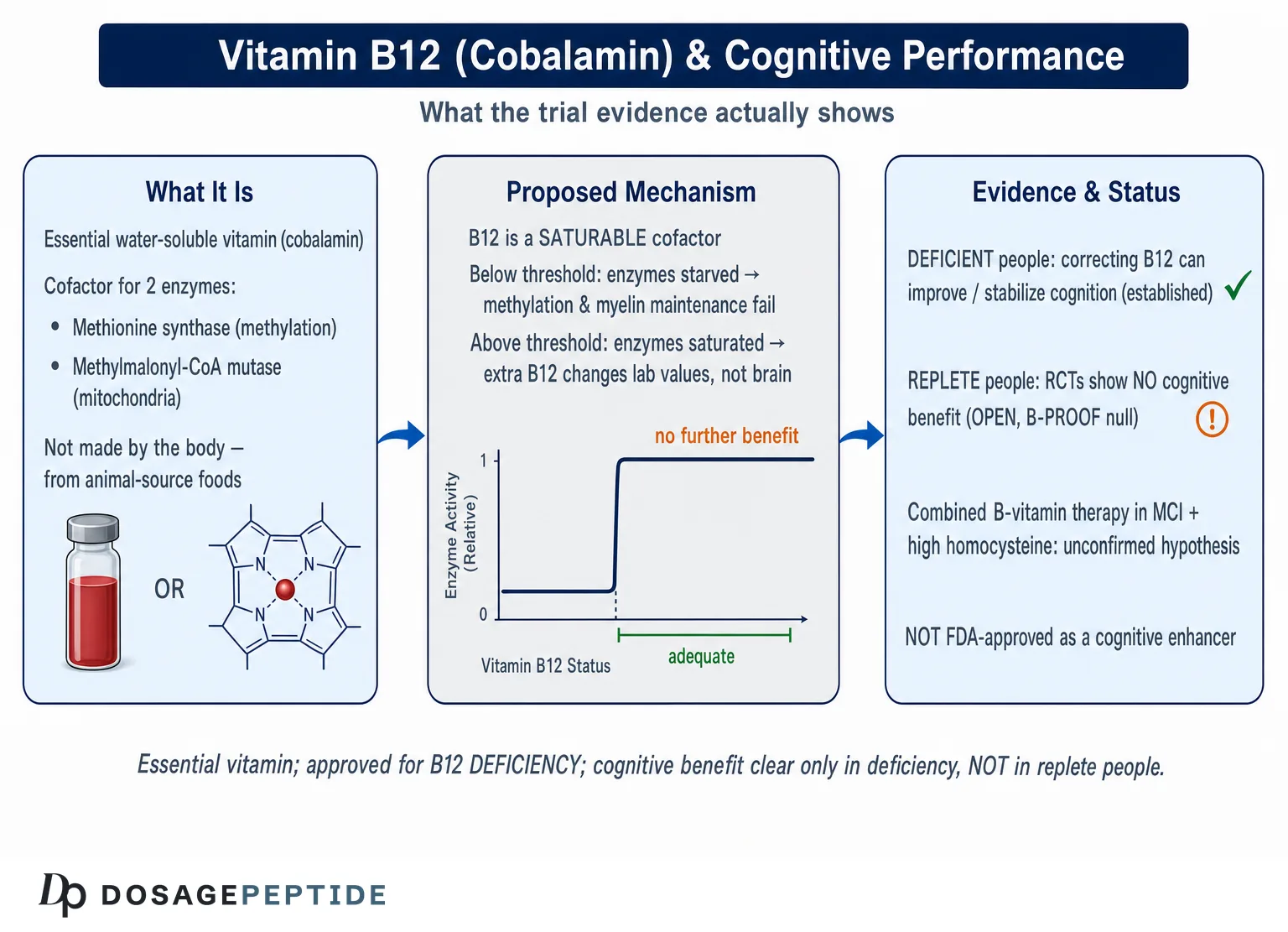
Two features of this biochemistry matter enormously for the cognitive-performance question. First, both reactions are cofactor reactions: B12 functions catalytically, meaning a molecule of it is used and regenerated rather than consumed stoichiometrically. Enzymes that depend on a cofactor are typically saturated once a modest amount is present; beyond saturation, adding more cofactor does nothing, because the rate-limiting step is no longer cofactor availability. This is the biochemical reason to expect a threshold rather than a linear dose-response — a point we will return to repeatedly. Second, the body maintains substantial hepatic stores of B12 (on the order of a few milligrams, enough to last years), and daily requirements are measured in micrograms. The system is built for scarcity tolerance, which is precisely why deficiency develops slowly and why, once corrected, there is no physiological reason for extra vitamin to keep helping.1 For a compact orientation to these terms — cofactor, homocysteine, MMA, holotranscobalamin — the site’s peptide and biochemistry glossary is a useful reference.
The clinical corollary is that B12 has a legitimate, evidence-based neurological role: it is required for normal function of the central and peripheral nervous system, and its absence causes disease. The temptation this creates — and the one the trial literature has spent twenty years testing — is to reason from “required for normal function” to “supplementation enhances function.” The two are not the same, and conflating them is the single most common error in popular writing about B12 and the brain.5
How Cognitive Performance Is Actually Measured in Trials
Before evaluating whether B12 “affects cognitive performance,” it is essential to understand what that phrase means operationally, because the answer depends heavily on which instrument you use and which cognitive domain you probe. “Cognition” is not one thing; it is a family of dissociable capacities — memory, executive function, processing speed, attention, language, visuospatial ability — each measured by different tests with different sensitivities.
At the coarsest level, trials use global screening instruments such as the Mini-Mental State Examination (MMSE) or the Montreal Cognitive Assessment (MoCA). These are quick, widely used, and good at flagging clinically meaningful impairment, but they are relatively insensitive to subtle change in cognitively healthy people because they suffer from ceiling effects: a well-functioning older adult scores near the maximum, leaving little room to detect improvement. A trial that relies only on the MMSE in a healthy population is poorly positioned to find a small effect even if one exists.
More sensitive trials assemble a battery of domain-specific tests. Episodic memory might be assessed with the Hopkins Verbal Learning Test or a word-list recall task; executive function with tasks such as the CLOX clock-drawing test, Trail Making Test part B, or verbal fluency; processing speed with digit-symbol substitution or simple reaction-time tasks; and semantic memory with category-fluency measures. Composite “global cognition” z-scores are often computed by standardizing and averaging across the battery. The choice matters: B12 and homocysteine-related effects, when they appear at all, have tended to show up in executive function and memory rather than uniformly across every domain.8
The table below summarizes the main instruments and what they capture, because interpreting the trials requires knowing what was actually measured.
| Domain / instrument | What it measures | Sensitivity considerations |
|---|---|---|
| MMSE / MoCA (global screens) | Overall cognitive status; orientation, recall, attention | Ceiling effects in healthy adults; blunt for subtle change |
| Hopkins Verbal Learning Test | Episodic verbal memory (learning and delayed recall) | Sensitive to memory decline; practice effects on repeat testing |
| CLOX / clock drawing | Executive function, planning, visuoconstruction | Sensitive to executive change; where some B-vitamin signals appeared |
| Trail Making Test B; verbal fluency | Executive function, mental flexibility, processing speed | Affected by education and motor speed |
| Digit-symbol / reaction time | Processing speed, sustained attention | Useful for detecting slowing; noisy across sessions |
| Global composite z-score | Standardized average across a battery | Improves power but can dilute a domain-specific effect |
Three methodological realities follow from this. First, a “null” trial and a “positive” trial can both be honest if they used different instruments in different populations — a study probing executive function in people with elevated homocysteine may detect something a global-screen study in replete adults cannot. Second, practice effects (people improve on cognitive tests simply by taking them repeatedly) can mask a treatment effect or, if unbalanced, create a spurious one; good trials control for this with placebo arms and appropriate statistics. Third, statistical power is a recurring problem: cognitive change in older adults over one to two years is slow and variable, so a trial needs large numbers and sensitive endpoints to detect a modest effect, and many earlier trials were underpowered. Keeping these measurement issues in mind prevents the most common misreading of this literature — treating a null result from an insensitive instrument as proof of no effect, or a subgroup finding from a sensitive one as proof of a general benefit.
There is also the separate question of what counts as a meaningful change even when a trial detects a statistically significant one. Cognitive test scores can shift by amounts that clear a p-value threshold in a large sample yet fall well below what a person, a clinician, or a caregiver would notice in daily life. A one- or two-point movement on a fluency task or a fraction of a standard deviation on a composite z-score is not the same as preserving the ability to manage finances, navigate a familiar route, or hold the thread of a conversation. The most valuable trials therefore try to anchor their endpoints to something clinically interpretable — a validated measure of everyday function, a diagnostic transition (for instance, conversion from mild cognitive impairment to dementia), or a structural outcome such as brain-atrophy rate that has an established relationship to future decline. When a study reports a significant effect on a narrow test but no effect on any functional or diagnostic endpoint, the honest description is that a biomarker of cognition moved, not that the person’s cognition improved in a way that matters. This distinction — statistical significance versus clinical meaningfulness — recurs throughout the B12 literature and is one more reason to read positive headlines carefully.
Observational Evidence: Association Without Proof of Benefit
The starting point for the whole field was epidemiological. Cross-sectional and prospective cohort studies repeatedly reported that older adults with lower B12 status tended to have poorer cognition or a higher risk of cognitive decline and dementia. On its face this looks like support for the hypothesis. But the observational evidence is considerably more equivocal than headlines suggest, and understanding why is instructive.
The most rigorous synthesis is a systematic review of 35 prospective cohort studies involving more than 14,000 participants, which found that serum or plasma B12 concentration was not associated with cognitive decline or incident dementia.6 That is a striking negative result for the simplest version of the hypothesis. The same review, however, identified a more nuanced pattern: the handful of studies that used newer, more specific functional markers of B12 status — methylmalonic acid and holotranscobalamin (the metabolically active fraction of circulating B12) — did tend to show associations between poor B12 status and increased risk of cognitive decline.6 In other words, how you measure B12 status changes what you find: total serum B12 is a noisy marker (much of it is bound to haptocorrin and metabolically inert), whereas MMA and holotranscobalamin better reflect what is happening inside cells.
Even where associations exist, the interpretive caution is severe. Observational associations cannot establish that low B12 causes cognitive decline. Reverse causation is plausible: people developing dementia may eat worse, absorb nutrients less well, or lose weight, lowering B12 as a consequence rather than a cause. Confounding is rampant: B12 status tracks with overall diet quality, socioeconomic status, gastrointestinal health, alcohol use, and general frailty, any of which independently affects cognition. And the marker problem compounds these: a study using total serum B12 may miss a real effect, while one using MMA may capture a signal that is partly a marker of age-related renal decline rather than brain-relevant deficiency. The honest reading of the observational literature is that poor functional B12 status is plausibly associated with worse cognitive trajectories in older adults, but that association is neither uniform across studies nor sufficient to prove that supplementation will help.56
This is exactly the situation randomized controlled trials exist to resolve. When observational data suggest a link but cannot prove causation, the field runs experiments: give some people B12 (or B-vitamins) and others placebo, measure cognitive performance over time, and see whether the intervention changes the trajectory. The results of those experiments, taken together, are the heart of the answer to the title question — and they are more sobering than the epidemiology implied.
Randomized Trials in Replete and Borderline Populations
The cleanest test of “does giving B12 improve cognition” comes from randomized, placebo-controlled trials that supplement B12 (alone or with folate) and track cognitive performance. Across a range of such trials, the dominant finding in people who are not clearly deficient is null: supplementation reliably raises B12 markers and lowers homocysteine, but does not translate into measurable cognitive improvement.
A particularly instructive example is the OPEN study (Older People and Enhanced Neurological function), a double-blind, placebo-controlled trial in adults aged 75 and over who had moderate B12 deficiency — serum concentrations in the 107–210 pmol/L range — but crucially without anemia and without existing neurological or cognitive signs. Participants received 1 mg of oral crystalline B12 daily or placebo for 12 months. The result was clearly negative: correcting this moderate, asymptomatic deficiency produced no beneficial effect on any cognitive-function outcome, nor on peripheral-nerve or central-motor measures.7 This is a well-designed trial delivering an important message: raising B12 in older people who have low-normal levels but no clinical deficiency syndrome does not improve how they perform on cognitive tests.
The broader trial literature agrees. A Cochrane systematic review of folic acid with or without vitamin B12 concluded that there was no evidence that the intervention improved cognitive function in unselected elderly people, whether cognitively healthy or already demented.10 The review noted the theoretical caveat that long-term supplementation might benefit cognition in healthy older people with elevated homocysteine — a hypothesis, not a demonstrated effect — and flagged a genuine safety concern that runs through this whole area: giving folic acid to someone with undiagnosed B12 deficiency can correct the anemia while allowing the neurological damage to progress unchecked, which is one reason B12 status must be assessed before folate is given.10
The reasonable synthesis of the replete-and-borderline trial evidence is that B12 supplementation behaves exactly as the cofactor-saturation biochemistry predicts. It corrects the biomarker (B12 up, homocysteine and MMA down) without corresponding cognitive benefit, because in people whose enzymes are already adequately supplied, adding more cofactor changes a lab value but not brain performance. A null cognitive result alongside a “successful” biochemical result is not a paradox; it is the expected outcome when the limiting factor was never B12 availability in the first place.
The Homocysteine Hypothesis and the Combination-Vitamin Trials
If the simple story were the whole story, the field would have closed years ago. What kept it alive — and what generates most of the genuine scientific interest — is the homocysteine hypothesis. The reasoning goes like this: elevated plasma total homocysteine is a consistent, dose-related risk marker for cognitive decline, brain atrophy, white-matter damage, and dementia; B-vitamins (folate, B12, B6) are the most effective way to lower homocysteine; therefore lowering homocysteine with B-vitamins might slow cognitive decline, particularly in people whose homocysteine is elevated. This is a coherent, testable hypothesis, and it moved the trials away from “supplement everyone” toward “supplement people with elevated homocysteine and measure carefully.”
The most influential trial in this vein is VITACOG, a single-center, double-blind, placebo-controlled trial in 271 older adults (aged 70+) with mild cognitive impairment. Participants received a combination of high-dose folic acid (0.8 mg), vitamin B12 (0.5 mg), and vitamin B6 (20 mg) daily, or placebo, for two years. The headline neuroimaging result was substantial: B-vitamin treatment lowered homocysteine and was associated with roughly a 30% reduction in the rate of whole-brain atrophy compared with placebo, with the effect concentrated in participants whose baseline homocysteine was in the upper range.8 This is a real, peer-reviewed finding and the strongest single piece of evidence that B-vitamins can affect a brain-structural outcome in the right population.
The cognitive-performance results from VITACOG, reported separately, are where the nuance lives. B-vitamin treatment stabilized executive function (measured by the CLOX test) relative to placebo across the whole sample, and — importantly — among the subgroup with baseline homocysteine above the median (about 11.3 µmol/L), treatment produced significant benefits on global cognition (MMSE), episodic memory (delayed recall), and semantic memory (category fluency).11 In other words, the cognitive benefit was real but conditional: it depended on having elevated homocysteine to begin with. In participants with low or normal homocysteine, the treatment did little. This subgroup dependence is the crux of the entire B12-and-cognition debate, and it is why blanket statements in either direction are wrong.
Set against VITACOG’s encouraging subgroup findings is the sobering result of the much larger B-PROOF trial. In a multicenter, double-blind, randomized study of 2,919 older adults (65+) with elevated homocysteine (12–50 µmol/L), participants received 400 µg folic acid plus 500 µg B12 daily or placebo for two years. Despite targeting exactly the elevated-homocysteine population the hypothesis predicts should benefit, B-PROOF found no beneficial effect on performance across four cognitive domains. There was a hint of a marginally slower decline in global cognition, but the authors judged the difference small enough to be attributable to chance, and the trial was rated as providing Class I evidence against a beneficial cognitive effect in this population.9 B-PROOF is larger and arguably more definitive than VITACOG, and it did not replicate the cognitive benefit.
How to reconcile them honestly? Several differences plausibly matter: VITACOG enrolled people with mild cognitive impairment (an at-risk, declining group) while B-PROOF enrolled generally healthier older adults; VITACOG used higher doses (notably 20 mg B6 and 0.8 mg folate) and included B6, whereas B-PROOF used lower doses and no B6; and VITACOG’s strongest effects were themselves confined to a high-homocysteine subgroup. The most defensible interpretation is that homocysteine-lowering with B-vitamins may slow cognitive and structural decline in a specific niche — older people who are simultaneously cognitively impaired and have elevated homocysteine — but that this benefit does not generalize to older adults at large, and has not been consistently replicated even within the targeted population. The table below lays the key trials side by side.
| Trial | Population | Intervention | Cognitive-performance result |
|---|---|---|---|
| OPEN (Dangour 2015) | Age 75+, moderate B12 deficiency, no anemia/symptoms | 1 mg oral B12 daily, 12 mo | No benefit on any cognitive outcome7 |
| Cochrane review (Malouf 2008) | Unselected elderly, healthy or demented | Folic acid ± B12 | No evidence of cognitive improvement10 |
| VITACOG — imaging (Smith 2010) | Age 70+, mild cognitive impairment | Folate 0.8 mg + B12 0.5 mg + B6 20 mg, 24 mo | ~30% slower brain atrophy; largest in high-homocysteine subgroup8 |
| VITACOG — cognition (de Jager 2012) | Same MCI cohort | Same B-vitamin combination | Stabilized executive function; memory/global benefit in high-homocysteine subgroup11 |
| B-PROOF (van der Zwaluw 2014) | Age 65+, elevated homocysteine (12–50 µmol/L) | Folate 0.4 mg + B12 0.5 mg, 24 mo | No benefit across 4 cognitive domains (Class I evidence)9 |
One further caution deserves emphasis: most of the “positive” combination trials used folate, B12, and B6 together, which makes it impossible to attribute any benefit specifically to B12. The homocysteine-lowering effect of these regimens is driven substantially by folate; B12 is included partly because folate alone can mask B12 deficiency. So even in the best-case reading, the evidence supports a possible role for combined B-vitamin, homocysteine-lowering therapy in a narrow population — not a specific cognitive benefit of B12 as a standalone agent in people who have enough of it. Readers interested in how other interventions have fared against the hard endpoint of age-related cognitive change may find the site’s discussion of sermorelin and cognitive function in age-related neurodegeneration a useful comparison in how carefully such claims must be qualified.
The Decisive Variable: Deficient Versus Replete
If there is one organizing principle that makes sense of the entire literature, it is baseline B12 status. The trials are not really in conflict; they are answering the same question in different populations, and the answers line up once you sort them by whether the participants were truly deficient, borderline, or replete.
The biochemical logic, laid out earlier, predicts this precisely. Because B12 works as a cofactor for two saturable enzymes, there should be a threshold below which supply limits enzyme activity and above which it does not. Below the threshold — genuine deficiency — methionine synthase and methylmalonyl-CoA mutase are running short of cofactor, methylation and mitochondrial metabolism suffer, myelin maintenance degrades, and cognition can measurably decline; restoring B12 relieves the constraint and function can recover. Above the threshold — repletion — the enzymes are already saturated, and adding B12 raises the serum number while changing nothing that limits neural function. The dose-response is a step, not a ramp.
This is why the OPEN study found nothing (its participants had low-normal levels but no true deficiency syndrome), why B-PROOF found nothing (its participants had elevated homocysteine but were largely B12-replete, with homocysteine driven more by folate and other factors), and why the clearest cognitive benefits in the literature come from correcting frank, symptomatic deficiency rather than from topping up the already-adequate.57 It is also why the observational marker matters: studies using MMA and holotranscobalamin — which actually detect cellular deficiency — find associations that studies using total serum B12 miss.6
The practical and scientific implication is that the phrase “B12 affects cognitive performance” is incomplete without specifying in whom. For a person with pernicious anemia or malabsorption whose cognition is slipping because their cells are starved of B12, the effect can be large and clinically meaningful. For a well-nourished person with normal status seeking a cognitive edge, the expected effect on test performance is, based on the randomized evidence, essentially zero. Treating these as the same question — which the nootropic framing implicitly does — is the core error. The table below makes the contrast explicit.
| Context | Expected effect on cognitive performance | Evidence basis |
|---|---|---|
| Frank, symptomatic B12 deficiency (e.g., pernicious anemia) | Meaningful improvement or arrest of decline; some deficits reversible if treated early | Clinical/mechanistic; deficiency neurology24 |
| Moderate, asymptomatic low-normal B12 (no anemia/symptoms) | No detectable benefit | OPEN RCT7 |
| Elevated homocysteine, largely B12-replete | No consistent benefit (some structural signal in MCI subgroups) | B-PROOF; VITACOG subgroup89 |
| MCI + elevated homocysteine, B-vitamin combination | Possible slowing of decline; not consistently replicated | VITACOG811 |
| Healthy, B12-replete adult seeking enhancement | No expected benefit | RCTs + cofactor saturation biochemistry110 |
The Neurology of Real Deficiency: Why Correction Clearly Helps
To keep the honesty symmetrical, it is worth spelling out the situation in which B12 unambiguously affects cognition and neurological function: genuine deficiency. This is not a hypothesis; it is established clinical medicine, and it is the reason B12 is a recognized essential nutrient rather than an optional supplement.
Severe or prolonged B12 deficiency produces a spectrum of neurological disease. The classic entity is subacute combined degeneration of the spinal cord, in which demyelination of the dorsal and lateral columns produces progressive sensory loss, impaired proprioception and vibration sense, gait disturbance, weakness, and, if untreated, permanent damage.4 Beyond the cord, deficiency can cause peripheral neuropathy and a range of neuropsychiatric manifestations: cognitive slowing, memory impairment, irritability, depression, and in severe cases a dementia-like picture sometimes labeled “megaloblastic madness.” Critically, some of these cognitive and neurological deficits are reversible with timely B12 repletion — which is why B12 deficiency is on the short list of “reversible” or “treatable” causes of cognitive impairment that clinicians screen for when evaluating new dementia.25
The mechanism connects directly to the biochemistry described earlier. Impaired methionine synthase activity reduces SAM-dependent methylation needed for myelin maintenance, while accumulating methylmalonic acid disrupts mitochondrial energy metabolism and normal fatty-acid incorporation into myelin; the combined result is the abnormal, poorly maintained myelin that underlies the demyelinating lesions of deficiency.4 When B12 is restored, methylation and mitochondrial handling normalize, and provided permanent axonal damage has not yet occurred, function can recover — though recovery is often incomplete if treatment is delayed, underscoring the importance of early detection.
An important nuance for the cognitive-performance question is that recovery in deficiency is about restoring lost function, not enhancing normal function. The person whose cognition improves after B12 treatment was performing below their own baseline because of a treatable metabolic lesion; correction returns them toward that baseline. Nothing about this mechanism predicts that pushing B12 above the level needed to saturate the enzymes would push cognition above a person’s healthy baseline. This is the clean conceptual boundary between treating deficiency and enhancing performance — and it is exactly the boundary the replete-population trials confirmed. The interplay between micronutrient supply, cellular energetics, and neuronal resilience is an active research area more broadly; parallels appear in work on NAD+ deficiency and neuronal vulnerability, where, similarly, correcting a deficiency state is a very different proposition from supra-physiological “boosting.”
Who Is Actually at Risk of Deficiency
Because the cognitive stakes hinge on deficiency, it is worth being specific about who develops it, since these are the people in whom a cognitive effect of B12 is plausible. Deficiency is not rare, particularly with age: estimates place it in the range of roughly 10–20% of older adults depending on the population and the marker used, with figures around 17% reported in some older cohorts using a serum threshold below 148 pmol/L.5
The main mechanisms of deficiency are worth distinguishing because they determine both risk and the appropriate correction. Malabsorption is the dominant cause in older adults: pernicious anemia (autoimmune destruction of the gastric parietal cells that make intrinsic factor, the protein required to absorb dietary B12), atrophic gastritis, and prior gastric or ileal surgery all impair the elaborate absorption pathway.3 Food-cobalamin malabsorption, in which the vitamin cannot be liberated from food protein because of low stomach acid, is especially common with age and with chronic use of acid-suppressing medications (proton-pump inhibitors, H2 blockers) and the diabetes drug metformin. Inadequate intake is the primary risk for strict vegans and vegetarians, since B12 comes essentially only from animal-source foods; and pregnancy and lactation raise requirements.1
The reason this matters for cognition is that these at-risk groups are precisely where screening for and correcting deficiency has a defensible rationale, whereas the general, well-nourished population is where supplementation for cognitive purposes lacks support. It also explains a subtle point about biomarkers: because malabsorption impairs the uptake of dietary and low-dose oral B12, the classic treatment for pernicious anemia has historically been intramuscular injection — though high-dose oral B12 can work even in malabsorption via passive diffusion, which accounts for absorption of roughly 1–2% of large oral doses independent of intrinsic factor.3 The clinical goal in all these cases is repletion to a normal level, confirmed by resolution of elevated MMA and homocysteine, not indefinite escalation.
Forms, Dosing, and How B12 Is Used in Research and Practice
Vitamin B12 exists in several forms, and the distinctions occasionally matter. The two biologically active coenzyme forms in humans are methylcobalamin (cofactor for methionine synthase) and adenosylcobalamin (cofactor for methylmalonyl-CoA mutase). The two most common supplemental and pharmaceutical forms are cyanocobalamin (a stable synthetic form that the body converts to the active coenzymes) and hydroxocobalamin (a natural form with a longer retention time, often preferred for injection). For the treatment of deficiency, cyanocobalamin and hydroxocobalamin are considered essentially equivalent in efficacy and both are well tolerated.3
Dosing in deficiency is a genuine, evidence-based clinical matter — and this is the one context in which B12 has formal regulatory standing. Injectable cyanocobalamin is an FDA-approved treatment for B12 deficiency arising from pernicious anemia, malabsorption, atrophic gastritis, gastrectomy, and related conditions.3 Typical regimens for correcting deficiency involve an initial series of intramuscular injections (commonly 1000 µg) followed by maintenance dosing, or high-dose daily oral therapy (often 1000–2000 µg) that leverages passive diffusion. The important framing is that these doses and schedules are validated for treating deficiency and its hematologic and neurological consequences — not for enhancing cognition in people who are replete. There is no established cognitive-enhancement dose of B12, because there is no established cognitive-enhancement effect in replete people.
For those working with lyophilized or injectable B12 in a research or laboratory context, standard handling parameters apply: B12 is notably light-sensitive (solutions are characteristically deep red and degrade with light exposure), so it is stored protected from light; reconstituted or liquid preparations are kept cool; and, as with any injectable, sterility and accurate concentration calculations govern responsible handling. General principles for reconstitution arithmetic and storage are covered in the site’s reconstitution guide, and the broader catalog of compound handling references is organized in the central dosages index. None of this handling detail, it should be stressed, converts B12 into a cognitive enhancer; good technique preserves the vitamin’s activity but does not create an effect the trials have not found.
A final practical note on safety informs why the “more is fine” instinct persists: B12 has remarkably low toxicity, with no established upper intake limit, because excess is largely excreted renally. This benign safety profile is often cited as a reason to supplement liberally. But low toxicity is an argument about harm, not about benefit — a substance can be both harmless and ineffective for a given purpose, and for cognitive enhancement in replete people, that is precisely the situation. The absence of a downside is not evidence of an upside.
Limitations, Open Questions, and the Honest Bottom Line
Several limitations constrain how confidently anyone can answer the title question, and naming them is part of an honest account.
Measurement heterogeneity. Trials used different cognitive batteries, different B12 markers, different doses, and different populations, which makes direct comparison and meta-analysis difficult and partly explains the apparent inconsistency across studies. A field that cannot agree on endpoints will produce a literature that looks messier than the underlying biology may be.6
The combination-therapy confound. The trials with positive signals (VITACOG) used folate + B12 + B6 together, so any benefit cannot be attributed to B12 specifically, and the homocysteine-lowering that drives the hypothesis is substantially a folate effect. Isolating B12’s independent contribution to cognition in humans remains largely unresolved.811
Subgroup dependence and replication. The most encouraging cognitive results were confined to subgroups (elevated homocysteine, mild cognitive impairment), and the largest trial targeting the relevant population (B-PROOF) did not replicate a cognitive benefit. Subgroup findings that fail to replicate in larger trials are a well-known source of false positives in nutrition science, and appropriate skepticism is warranted.9
Timing and duration. It remains possible that intervening earlier, for longer, or at a specific window in the trajectory from healthy aging to dementia would yield different results; most trials ran one to two years, which may be too short to detect effects on a decades-long process, and by the time impairment is established, damage may be beyond the reach of a nutritional intervention.6
The reverse-causation and confounding problem. Because low B12 status travels with poor diet, frailty, and gastrointestinal disease, disentangling B12’s specific causal role from the company it keeps is genuinely hard, and observational associations will always overstate the case relative to randomized evidence.5
The honest bottom line, then, is layered rather than simple. Vitamin B12 is essential to the nervous system, and correcting a genuine deficiency can produce clear, sometimes reversible, improvements in cognitive and neurological function — this is settled, evidence-based, and the basis for B12’s approved therapeutic use.23 In people who are already B12-replete, supplementation has repeatedly failed to improve cognitive-performance measures in randomized trials, exactly as the cofactor-saturation biochemistry predicts.7910 A narrow, biologically interesting exception may exist for combined B-vitamin, homocysteine-lowering therapy in older adults who are both cognitively impaired and have elevated homocysteine — but that benefit is inconsistent across trials, is not specific to B12, and should be treated as a promising open research question rather than an established therapy.811 What the evidence does not support, at any level, is the framing of B12 as a cognitive enhancer or “nootropic” for healthy, well-nourished people, nor its use to treat, prevent, or slow dementia or Alzheimer’s disease in the absence of deficiency — claims for which regulatory approval does not exist and randomized evidence is negative. The most defensible practical posture is therefore to screen for and correct genuine deficiency where it is plausible, and to remain appropriately skeptical of enhancement claims where B12 status is already adequate.
Frequently Asked Questions
Does vitamin B12 improve cognitive performance in healthy people who are not deficient?
No. Randomized controlled trials in people who are already B12-replete have consistently failed to show improvement in cognitive-performance measures, even though supplementation reliably raises B12 levels and lowers homocysteine.7910 This fits the biochemistry: B12 acts as a cofactor for saturable enzymes, so once you have enough, adding more changes a lab value but not brain function. B12 is essential, but “essential when lacking” is not the same as “enhancing when sufficient.” There is no established cognitive-enhancement effect of B12 in healthy, well-nourished people.
Can correcting a B12 deficiency actually reverse cognitive problems?
In many cases, yes — particularly if the deficiency is caught early. Genuine B12 deficiency can cause cognitive slowing, memory problems, neuropsychiatric symptoms, and subacute combined degeneration of the spinal cord, and some of these deficits are reversible with timely repletion.24 B12 deficiency is one of the recognized “treatable” causes of cognitive impairment that clinicians screen for. However, recovery restores lost function toward a person’s own baseline; it does not push cognition above normal, and it may be incomplete if treatment is delayed and permanent nerve damage has occurred.
What did the VITACOG trial really show about B12 and cognition?
VITACOG tested a combination of folic acid, B12, and B6 in older adults with mild cognitive impairment. It found about a 30% slowing of brain atrophy and some cognitive benefit — but the cognitive benefit was concentrated in participants who had elevated homocysteine at baseline, and appeared mainly in executive function and memory.811 Two caveats matter: the study used three B-vitamins together, so the effect cannot be attributed to B12 alone, and the much larger B-PROOF trial did not replicate a cognitive benefit in a similar elevated-homocysteine population.9 It is best read as a promising but unconfirmed finding in a narrow subgroup.
Why do observational studies link low B12 to dementia if trials don’t show benefit?
Observational studies show associations, not causation. A large systematic review of prospective cohorts found no association between total serum B12 and cognitive decline, though studies using more specific markers (methylmalonic acid, holotranscobalamin) did find associations.6 Even where associations exist, they may reflect reverse causation (developing dementia worsens nutrition) or confounding (low B12 tracks with poor diet and frailty). Randomized trials exist precisely to test whether the association is causal, and for cognitive enhancement in replete people, they have generally said no.
Is the form of B12 (methylcobalamin vs. cyanocobalamin) important for the brain?
For correcting deficiency, cyanocobalamin and hydroxocobalamin are considered essentially equivalent and both are effective and well tolerated; the body converts cyanocobalamin into the active coenzyme forms (methylcobalamin and adenosylcobalamin).3 Marketing often promotes methylcobalamin as superior for the brain, but there is no strong randomized evidence that the choice of form meaningfully changes cognitive outcomes. The decisive variable is whether a person is deficient in the first place, not which form is used to correct it.
Is vitamin B12 approved by the FDA for cognitive enhancement?
No. Injectable cyanocobalamin is FDA-approved for treating vitamin B12 deficiency due to pernicious anemia, malabsorption, atrophic gastritis, gastrectomy, and related conditions — that is, for correcting deficiency and its consequences.3 It is not approved as a cognitive enhancer or as a treatment or preventive for dementia or Alzheimer’s disease in people who are not deficient, and the randomized evidence does not support such a use.
Who should consider getting their B12 status checked?
People at higher risk of deficiency have the clearest rationale: older adults (deficiency prevalence is roughly 10–20%), strict vegans and vegetarians, people with pernicious anemia or other malabsorption, those who have had gastric or intestinal surgery, and long-term users of acid-suppressing drugs or metformin.135 Functional markers such as methylmalonic acid and holotranscobalamin can detect cellular deficiency that a normal-looking total serum B12 might miss.6 This is a clinical assessment to be discussed with a qualified professional, not a do-it-yourself cognitive-enhancement strategy.
Does taking extra B12 carry any risk if it doesn’t help cognition?
B12 has very low toxicity and no established upper intake limit, since excess is largely excreted by the kidneys. But low toxicity is not evidence of benefit — a substance can be both harmless and ineffective for a given purpose. One genuine caveat: taking high-dose folic acid can mask the anemia of an undiagnosed B12 deficiency while allowing neurological damage to progress, which is why B12 status should be assessed rather than assumed when supplementing B-vitamins.10
References
- Green R, Allen LH, Bjørke-Monsen AL, et al. Vitamin B12 deficiency. Nat Rev Dis Primers. 2017;3:17040. PMID: 28660890. https://pubmed.ncbi.nlm.nih.gov/28660890/
- Reynolds E. Vitamin B12, folic acid, and the nervous system. Lancet Neurol. 2006;5(11):949-960. PMID: 17052662. https://www.thelancet.com/journals/laneur/article/PIIS1474-4422(06)70598-1/abstract
- Ankar A, Kumar A. Vitamin B12 Deficiency (Cyanocobalamin). StatPearls [Internet]. Treasure Island (FL): StatPearls Publishing. NBK441923/ & Cyanocobalamin, NBK555964. https://www.ncbi.nlm.nih.gov/books/NBK555964/
- Kumar N, et al. Subacute Combined Degeneration of the Spinal Cord. StatPearls [Internet]. Treasure Island (FL): StatPearls Publishing. NBK559316. https://www.ncbi.nlm.nih.gov/books/NBK559316/
- Gröber U, Kisters K, Schmidt J. Neuroenhancement with vitamin B12—underestimated neurological significance. Nutrients. 2013;5(12):5031-5045. PMID: 24352086. PMCID: PMC3875920. https://www.ncbi.nlm.nih.gov/pmc/articles/PMC3875920/
- O’Leary F, Allman-Farinelli M, Samman S. Vitamin B12 status, cognitive decline and dementia: a systematic review of prospective cohort studies. Br J Nutr. 2012;108(11):1948-1961. PMID: 23084026. https://pubmed.ncbi.nlm.nih.gov/23084026/
- Dangour AD, Allen E, Clarke R, et al. Effects of vitamin B-12 supplementation on neurologic and cognitive function in older people: a randomized controlled trial. Am J Clin Nutr. 2015;102(3):639-647. PMID: 26135351. PMCID: PMC4548176. https://www.ncbi.nlm.nih.gov/pmc/articles/PMC4548176/
- Smith AD, Smith SM, de Jager CA, et al. Homocysteine-lowering by B vitamins slows the rate of accelerated brain atrophy in mild cognitive impairment: a randomized controlled trial. PLoS One. 2010;5(9):e12244. PMID: 20838622. PMCID: PMC2935890. https://journals.plos.org/plosone/article?id=10.1371/journal.pone.0012244
- van der Zwaluw NL, Dhonukshe-Rutten RA, van Wijngaarden JP, et al. Results of 2-year vitamin B treatment on cognitive performance: secondary data from an RCT. Neurology. 2014;83(23):2158-2166. PMID: 25391305. https://pubmed.ncbi.nlm.nih.gov/25391305/
- Malouf R, Grimley Evans J. Folic acid with or without vitamin B12 for the prevention and treatment of healthy elderly and demented people. Cochrane Database Syst Rev. 2008;(4):CD004514. PMID: 18843658. https://www.cochranelibrary.com/cdsr/doi/10.1002/14651858.CD004514.pub2/full
- de Jager CA, Oulhaj A, Jacoby R, Refsum H, Smith AD. Cognitive and clinical outcomes of homocysteine-lowering B-vitamin treatment in mild cognitive impairment: a randomized controlled trial. Int J Geriatr Psychiatry. 2012;27(6):592-600. PMID: 21780182. https://pubmed.ncbi.nlm.nih.gov/21780182/
Educational and research-use disclaimer: This article is provided solely for scientific and educational purposes. Vitamin B12 (cobalamin) is an essential nutrient, and injectable cyanocobalamin is FDA-approved for treating B12 deficiency due to pernicious anemia, malabsorption, and related conditions; it is not approved as a cognitive enhancer or as a treatment or preventive for dementia, Alzheimer’s disease, or age-related cognitive decline in people who are not deficient, and randomized trials do not support such use. Nothing here is medical advice or a recommendation for self-treatment. Suspected deficiency, and any decision to supplement or to interpret B12-related biomarkers, should be assessed and managed by a qualified healthcare professional. Readers should consult appropriate professionals and applicable regulations before making any health decisions.