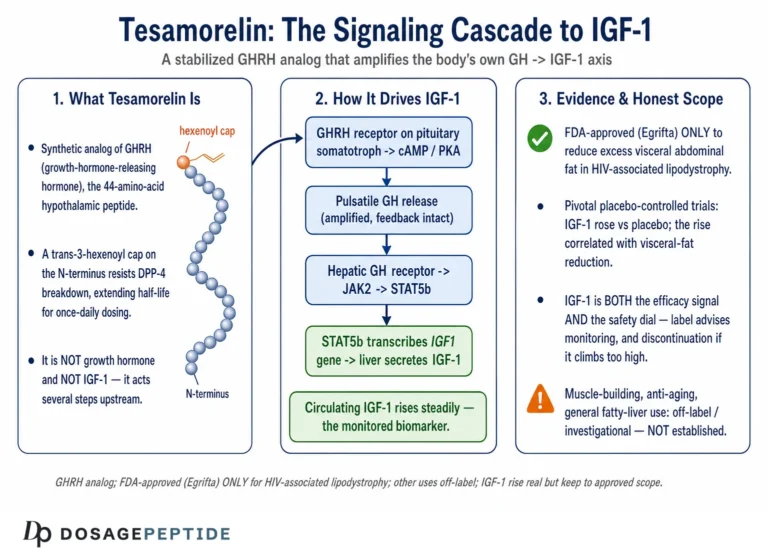
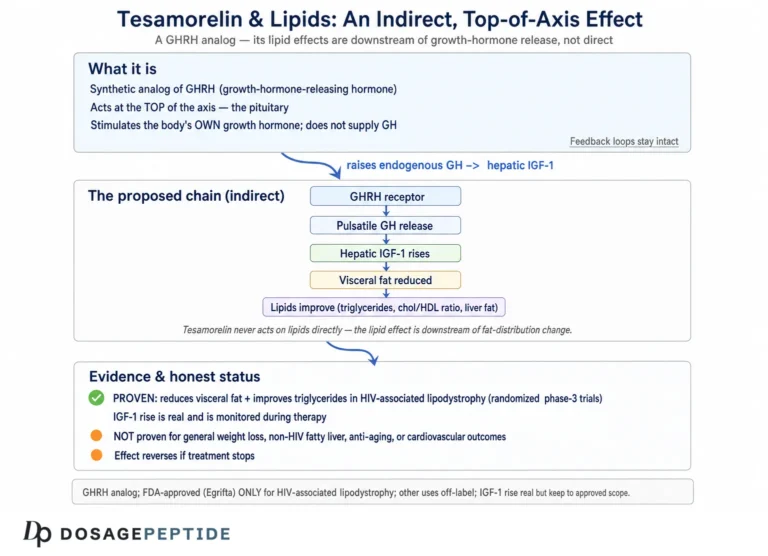
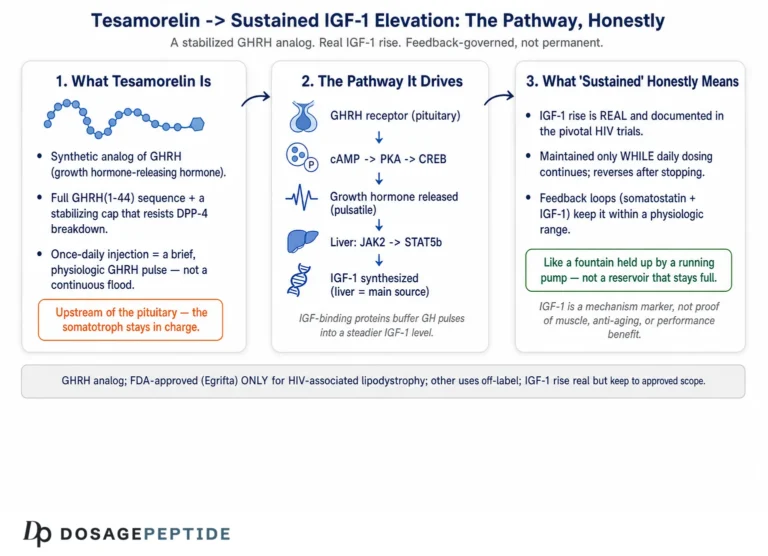
Search for tesamorelin vs CJC-1295 and you will find the two compounds discussed side by side as if they were interchangeable options on the same menu — two injectable peptides that both raise growth hormone (GH) by acting on the same receptor. At the level of mechanism, that framing is fair: both are synthetic analogs of growth hormone-releasing hormone (GHRH), and both work by prompting the pituitary to release the body’s own GH rather than by supplying GH directly. But at the level of evidence, the two are not peers, and pretending they are is the single biggest mistake a reader can make about this pair.
Here is the honesty up front, before any table or mechanism diagram. Tesamorelin is an FDA-approved prescription drug (brand name Egrifta), cleared in 2010 on the strength of multiple Phase 3 double-blind, placebo-controlled randomized trials for a specific, narrow indication: reducing excess abdominal fat in people with HIV-associated lipodystrophy.[1] CJC-1295 is not approved by the FDA or any other regulator, anywhere; its clinical development was discontinued, and it exists today only as a research chemical sold for laboratory use. Its entire published human evidence base is two small early-phase pharmacokinetic studies from the mid-2000s that measured GH and IGF-1 as surrogate markers — not a single controlled efficacy trial with a disease endpoint.[6] This article is educational reference material for reading that literature accurately. It is not medical advice, not a therapeutic recommendation, and not instructions for human use.
Two further honesty points frame everything below. First, no head-to-head trial comparing tesamorelin and CJC-1295 has ever been published — the two have never been tested under a common protocol against a common endpoint, so any “X is stronger than Y” claim is cross-study inference, not data. Second, “CJC-1295” is not even one thing: it exists as two pharmacologically distinct forms — a long-acting version with DAC (a Drug Affinity Complex that binds it to blood albumin for days) and a short-acting version without DAC (often sold as “mod GRF 1-29”). Conflating them, or applying data from the DAC form to a no-DAC product, misrepresents both the dosing and the evidence. Keeping those distinctions straight is most of what it takes to read this comparison honestly.
What Tesamorelin and CJC-1295 Actually Are
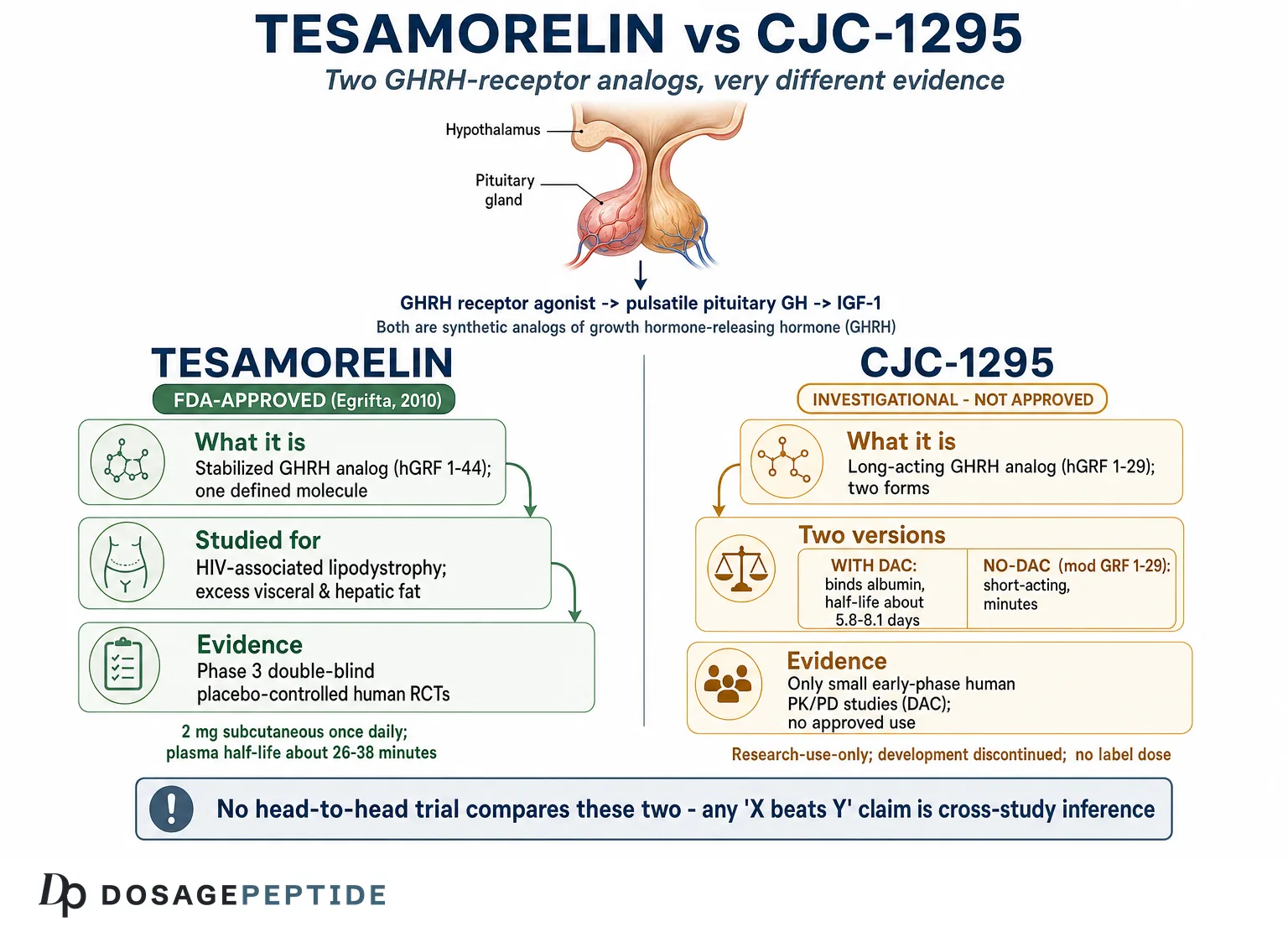
Both molecules belong to the same pharmacological family: GHRH-receptor agonists, sometimes called GH secretagogues of the GHRH class. GHRH is the hypothalamic hormone that normally travels to the anterior pituitary and tells specialized cells (somatotrophs) to secrete GH in pulses. GH in turn drives the liver to make insulin-like growth factor 1 (IGF-1), which mediates many of GH’s downstream effects. Because both tesamorelin and CJC-1295 act at the top of this axis — the GHRH receptor — they raise GH in a way that is still shaped by the body’s own feedback loops, at least in principle, rather than flooding the system with exogenous GH. That shared mechanism is the reason the two names get grouped together. Everything else about them diverges.
Tesamorelin: one defined molecule with a regulatory dossier
Tesamorelin is a stabilized synthetic analog of human GHRH. Structurally it is based on the full 44-amino-acid growth-hormone-releasing factor sequence (hGRF 1-44) with a modification that protects it from rapid enzymatic breakdown, extending its usefulness compared with native GHRH. Functionally it is a straightforward GHRH-receptor agonist: it binds the receptor on pituitary somatotrophs and stimulates endogenous, pulsatile GH release, which secondarily raises IGF-1.[5] The important point for this comparison is that tesamorelin is one well-defined molecule with a single, regulator-reviewed identity. When a study or a label says “tesamorelin,” it refers to a specific, characterized drug substance manufactured to pharmaceutical standards — the same entity the FDA reviewed.
Its approved use is narrow and specific. Tesamorelin (Egrifta, and the later reformulations Egrifta SV and Egrifta WR) is indicated to reduce excess visceral (abdominal) adipose tissue in patients with HIV-associated lipodystrophy — a condition in which antiretroviral therapy and HIV itself drive an abnormal accumulation of deep abdominal fat.[1] It has also been studied, in NIH-funded research, for HIV-associated fatty liver disease (NAFLD/MASLD), and earlier in its development program it was investigated for indications as varied as wasting, sleep, and mild cognitive impairment — most of which did not advance.[5] The laboratory handling parameters for the research-grade material are summarized in our tesamorelin 10 mg vial research dosage reference and the companion 5 mg and 20 mg references — none of which is a recommendation for human administration.
CJC-1295: one name, two molecules, no approval
CJC-1295 is a synthetic long-acting analog of GHRH built on the shorter, biologically active 29-amino-acid fragment (hGRF 1-29 — the same active core as sermorelin). Like tesamorelin, it is a GHRH-receptor agonist. Unlike tesamorelin, the name covers two distinct chemical entities that behave completely differently in the body:
- CJC-1295 with DAC. This is the version that gave the compound its identity. It carries a Drug Affinity Complex — a maleimidopropionyl-lysine group that covalently binds to the free thiol on cysteine-34 of circulating serum albumin after injection.[8] Tethering the peptide to a long-lived plasma protein dramatically slows its clearance, extending its action from minutes to days. This is the form studied in the two published human trials.
- CJC-1295 without DAC (“mod GRF 1-29”). This is the same GHRH(1-29) analog without the albumin-binding complex. It is short-acting — pharmacologically much closer to sermorelin than to the DAC version — and clears within minutes. Crucially, it has no published controlled human trials at all; it exists in the literature only as a research reagent.
Neither form is approved for any indication by the FDA or any regulator. The original clinical development, by the Canadian biotech ConjuChem, was discontinued, and there is no validated disease endpoint for either version. On this site, therefore, CJC-1295 is framed strictly as research-use-only material, described in references such as our CJC-1295 DAC 2 mg and CJC-1295 DAC 5 mg vial references and the separate CJC-1295 no-DAC 5 mg reference — kept deliberately distinct because the DAC and no-DAC forms are not the same compound.
| Attribute | Tesamorelin | CJC-1295 (research-market) |
|---|---|---|
| Molecular class | Stabilized GHRH analog (hGRF 1-44); GHRH-receptor agonist | Long-acting GHRH analog (hGRF 1-29); GHRH-receptor agonist |
| How many molecules the name covers | One defined, characterized drug substance | Two: with DAC (albumin-binding, long-acting) and no-DAC (“mod GRF 1-29,” short-acting) |
| Primary research use | Reduction of excess visceral fat in HIV-associated lipodystrophy (approved indication) | Investigational GH secretagogue; no validated disease endpoint |
| Regulatory status | FDA-approved (Egrifta, 2010); prescription drug | Not approved by any regulator; development discontinued; research-use only |
| Human evidence tier | Multiple Phase 3 RCTs + regulatory approval | Two small early-phase human PK/PD studies (DAC only); none for no-DAC |
How the GHRH-Receptor Mechanism Works — and Where the Two Diverge
To compare these compounds fairly, it helps to be precise about the mechanism they share and the one variable that separates them: how long each keeps that mechanism switched on.
The shared core: stimulating the body’s own pulsatile GH
Native GHRH is released from the hypothalamus in bursts and binds the GHRH receptor on pituitary somatotrophs, triggering GH secretion. GH then acts on the liver and peripheral tissues, and stimulates IGF-1 production, which carries out much of GH’s anabolic and metabolic signaling. Both tesamorelin and CJC-1295 plug into this system at the receptor. This is mechanistically different from injecting recombinant GH itself: a GHRH agonist raises GH indirectly, through the pituitary, so the output remains at least partly subject to the axis’s normal regulation — including negative feedback from IGF-1 and somatostatin. In the CJC-1295 DAC human studies, GH secretion rose but retained its pulsatile pattern, with the frequency and size of secretory pulses essentially unchanged; what increased most was the trough (basal) GH level between pulses.[7]
The dividing line: half-life and duration of action
The single most important difference between these compounds — and between the two forms of CJC-1295 — is pharmacokinetic. It determines how the mechanism is experienced by the body over time:
- Tesamorelin has a short plasma half-life, on the order of roughly 26–38 minutes. It works by triggering a wave of the body’s own pulsatile GH release and is then rapidly cleared, rather than persisting in circulation. This short exposure profile is consistent with its once-daily subcutaneous dosing in the clinical program.
- CJC-1295 with DAC has a half-life measured in days — an estimated 5.8 to 8.1 days in the pivotal human study, because it is anchored to albumin.[6] The albumin-conjugation chemistry that produces this was first demonstrated in rats, where the compound remained in plasma beyond 72 hours.[8] A single injection raised IGF-1 for a week or more.
- CJC-1295 without DAC has a short half-life — on the order of minutes, comparable to native GHRH or sermorelin — because it lacks the albumin anchor. This is why the no-DAC form is pharmacologically a different proposition from the DAC form, despite sharing a name.
That contrast is the entire point of the DAC modification. It also frames the honest comparison: tesamorelin’s short half-life pairs with a defined once-daily regimen validated in trials, whereas the CJC-1295 DAC half-life of several days was the novel feature that its developers were testing — a feature that never reached a proven clinical use.
How the Field Got Here: Two GHRH Programs That Ended Very Differently
The reason these two compounds sit at opposite ends of the evidence ladder is largely a story of development history. Both emerged from the same scientific goal — make GHRH useful as a therapeutic by overcoming its impractically short duration of action — but they took different routes and reached different destinations.
Native GHRH is biologically active but clinically awkward: its half-life of only a few minutes makes sustained stimulation of the GH axis difficult. Researchers pursued two broad strategies to fix this. One was to stabilize the molecule against enzymatic degradation while keeping a short, physiological pattern of action — the tesamorelin approach. The other was to dramatically extend the half-life by binding the peptide to a long-lived carrier protein — the CJC-1295-with-DAC approach.
Tesamorelin’s program was carried through a disciplined clinical development path by Theratechnologies, culminating in Phase 3 trials in HIV-associated lipodystrophy and FDA approval in November 2010.[1] That is the archetype of translational success: a defined molecule, a defined indication, a measurable endpoint (visceral fat), and confirmatory randomized trials.
CJC-1295’s story is the opposite. The albumin-binding chemistry was elegant and was validated at the bench: the identifying study showed that the maleimide-modified GHRH(1-29) conjugate activated the receptor and persisted in plasma for days in animals.[8] Early-phase human studies in 2005–2006 confirmed prolonged GH and IGF-1 stimulation.[6] But the program did not advance to pivotal efficacy trials; ConjuChem’s clinical development of the compound was discontinued, and it never earned an approved indication. What happened next is the crux of the modern confusion: the compound did not disappear, it migrated into the research-chemical and performance-enhancement markets, where it is discussed as though the early surrogate-marker data were equivalent to proof of a clinical benefit. They are not.
The Regulatory Reality: FDA Approval vs. Discontinued Development
Regulatory status is a hard fact, independent of any mechanistic promise, and it is the cleanest way to separate these two compounds.
Tesamorelin is FDA-approved. It was first approved as Egrifta in November 2010 for the reduction of excess abdominal fat in HIV-infected patients with lipodystrophy, and it remains a prescription drug with a regulator-reviewed label, including a defined dose, defined contraindications, and required safety monitoring.[1] Approval means an independent agency reviewed the efficacy and safety data and judged the benefit-risk balance acceptable for that specific indication and population. It does not mean tesamorelin is validated for bodybuilding, anti-aging, general “GH optimization,” or fat loss in healthy adults — none of which are approved uses.
CJC-1295 is approved by no one. Neither the DAC nor the no-DAC form has marketing approval from the FDA or any other regulator, anywhere. Its clinical development was halted, so there is no completed pivotal trial, no approved label, no reviewed dose, and no regulatory safety determination. Material sold as “CJC-1295” is research-grade, labeled for laboratory use, and is not a medicine.
On the sport side, both compounds fall within the scope of anti-doping prohibition. The World Anti-Doping Agency (WADA) prohibits growth hormone secretagogues and GHRH and its analogs and mimetics within its hormone-and-metabolic-modulator category, and GHRH-receptor agonists such as tesamorelin and CJC-1295 are treated as prohibited substances. Athletes subject to anti-doping rules should treat both as banned and consult the current WADA Prohibited List directly, since it is updated annually and category wording changes over time.
Tesamorelin: What the Human Evidence Actually Shows
This is the section where the two compounds separate most sharply, because tesamorelin has a genuine, replicated human efficacy record — within its narrow indication.
The Phase 3 lipodystrophy trials
Tesamorelin’s approval rests on two Phase 3 double-blind, placebo-controlled randomized trials (plus their pooled analyses) in patients with HIV-associated lipodystrophy. Across these trials, tesamorelin at 2 mg subcutaneously once daily produced a statistically significant reduction in visceral adipose tissue and waist circumference over 26 weeks, with 26-week extension phases showing that the visceral-fat improvement was maintained on continued treatment — and, importantly, without adverse effects on blood glucose or lipid parameters in those analyses.[2] This is the highest tier of evidence in this entire comparison: randomized, blinded, placebo-controlled, with a hard imaging endpoint (visceral fat measured by CT), replicated across two trials, and reviewed by a regulator.
More recent randomized data: fatty liver and modern regimens
Tesamorelin’s human evidence did not stop at approval. NIH-funded work extended it to HIV-associated fatty liver disease. In a randomized, double-blind, placebo-controlled trial, tesamorelin reduced liver fat and was associated with less fibrosis progression, and a targeted proteomic and transcriptomic analysis of that trial showed the drug lowered fibro-inflammatory mediators including VEGFA, TGF-β1, and CSF1.[4] A separate 2024 randomized double-blind trial in people with HIV taking modern integrase-inhibitor regimens found that tesamorelin 2 mg daily significantly reduced both visceral and hepatic fat versus placebo, again without worsening glycemic control in that analysis.[3] The consistency of the visceral- and hepatic-fat signal across multiple randomized trials, and across a decade of changing HIV therapy, is what genuine replicated human evidence looks like.
What that evidence does and does not license
The precise reading matters. Tesamorelin’s proven human endpoints are visceral fat and hepatic fat in people with HIV. That is the population studied and the outcome measured. It is not evidence that tesamorelin is a general fat-loss drug for healthy people, a muscle-building or anti-aging agent, or a cosmetic body-recomposition tool. Extrapolating an approved HIV-lipodystrophy indication to those uses is exactly the kind of tier-inflation this reference is written to prevent. The trials show what they show, in whom they show it.
CJC-1295: The Thin, DAC-Only Human Evidence
CJC-1295’s human record is a different universe: two small, early-phase studies of the DAC form, measuring hormone surrogates rather than clinical outcomes, and nothing at all for the no-DAC form.
The two published human studies (both DAC)
The pivotal human data come from a randomized, double-blind, placebo-controlled ascending-dose study by Teichman and colleagues in healthy adults. A single subcutaneous injection of CJC-1295 (DAC) produced dose-dependent increases in mean plasma GH by roughly 2- to 10-fold for six days or more, and increased IGF-1 by about 1.5- to 3-fold for nine to eleven days; after multiple doses, IGF-1 remained above baseline for up to 28 days, and the estimated half-life was 5.8–8.1 days.[6] A second study by Ionescu and Frohman gave a single injection to healthy men and showed that GH secretion rose — driven mostly by a marked increase in trough GH — while preserving the normal pulsatile pattern, with a corresponding rise in IGF-1.[7]
These are real, well-conducted studies, and they establish something specific and limited: in healthy volunteers, CJC-1295 with DAC raises GH and IGF-1 for an extended period and was reported as generally well tolerated over the short term. But notice what these endpoints are. GH and IGF-1 are surrogate biomarkers — they tell you the drug engages its axis, not that it produces any clinical benefit or is safe over the long term. There is no published trial in which CJC-1295 improved a disease outcome, body composition endpoint, or functional measure. The evidence stops at “it does raise the hormones,” which is a molecular-pharmacology result, not proof of efficacy.
The animal foundation
Beneath the two human studies sits the preclinical work. The albumin-conjugation approach was defined in rats, where CJC-1295 activated the pituitary GHRH receptor and persisted in plasma beyond 72 hours.[8] In a GHRH-knockout mouse model — animals that cannot make their own GHRH and therefore grow abnormally — once-daily CJC-1295 normalized growth and body composition, while less frequent dosing was less effective.[9] These are legitimate, informative animal studies about the compound’s mechanism and pharmacology. They are also, without exception, animal studies — a rescue-of-deficiency model in mice is not evidence of benefit in healthy humans.
The no-DAC blind spot
One more point deserves emphasis because it is routinely ignored in marketing copy: every piece of the human evidence above is for CJC-1295 with DAC. The no-DAC form (“mod GRF 1-29”) has no published controlled human trials of its own. So when a product sold as “CJC-1295 no-DAC” is described using the Teichman half-life or IGF-1 numbers, it is borrowing data from a different molecule with a fundamentally different pharmacokinetic profile. That is a category error, and it is exactly the sort of thing our peptide research glossary exists to help readers catch.
Head-to-Head vs. Cross-Trial: The Only Fair Comparisons
This is the honesty centerpiece of the article. It is tempting to line up tesamorelin’s trial results against CJC-1295’s trial results and declare a winner. But the two were studied in different people, for different purposes, with different endpoints, over different time frames — so a direct numeric comparison is not valid. The only intellectually honest comparisons are the ones the evidence actually supports.
| Comparison | Study design available | Evidence strength | What can honestly be said |
|---|---|---|---|
| Tesamorelin vs. placebo (visceral/hepatic fat, HIV lipodystrophy) | Multiple Phase 3 double-blind RCTs + later RCTs | Strong (direct, replicated) | Tesamorelin significantly reduces visceral and hepatic fat vs. placebo in this population[2] |
| CJC-1295 (DAC) vs. placebo (GH/IGF-1 surrogates, healthy adults) | Two small early-phase RCT/controlled studies | Weak (surrogate endpoints, no clinical outcome) | CJC-1295 with DAC raises GH and IGF-1 for days after a single dose[6] |
| CJC-1295 (no-DAC) — any human outcome | None published | No direct data; not established | No controlled human evidence exists for the no-DAC form |
| Tesamorelin vs. CJC-1295 (head-to-head) | None — no shared-protocol trial exists | No direct data; cross-trial inference only | The two have never been compared under a common protocol or endpoint |
Read that table top to bottom and the honest hierarchy is unmistakable. Tesamorelin has direct, replicated, placebo-controlled human efficacy data for a defined endpoint. CJC-1295 (DAC) has weak, surrogate-only human data. CJC-1295 (no-DAC) has no controlled human data. And the specific claim people most want — that one of these is “better” than the other — has no supporting head-to-head trial. Any comparison of their magnitudes is inference across unlike studies, which cannot establish superiority.
Reading the Numbers Honestly
With the fair-comparison logic established, the full dimension-by-dimension picture can be laid out. The table below is a reference map, not a scoreboard: several cells are deliberately marked “not established” because that is the accurate entry.
| Dimension | Tesamorelin | CJC-1295 |
|---|---|---|
| Class / mechanism | Stabilized GHRH analog (hGRF 1-44); GHRH-receptor agonist stimulating endogenous pulsatile GH, secondarily raising IGF-1 | Long-acting GHRH analog (hGRF 1-29); GHRH-receptor agonist. Exists as DAC (albumin-binding) and no-DAC forms |
| Half-life | Short — roughly 26–38 minutes; acts by triggering the body’s own pulsatile GH release | DAC: ~5.8–8.1 days (albumin-bound)[6]; no-DAC: ~minutes |
| Typical route | Subcutaneous injection, once daily | Subcutaneous injection; DAC dosed weekly/biweekly in the early human studies; no-DAC would need frequent dosing |
| Pivotal data | Phase 3 RCTs: significant visceral-fat and waist-circumference reduction; later RCTs add hepatic-fat reduction[2][3] | Two early-phase human studies (DAC) measuring GH/IGF-1 surrogates; no pivotal efficacy trial[6] |
| Dosing convention | Clinical label dose: 2 mg SC once daily (Egrifta) — a regulator-reviewed regimen | Research-use only — no approved or label dose; circulating “protocols” are anecdotal/vendor-derived |
| Approval status | FDA-approved (Egrifta, 2010) for HIV-associated lipodystrophy[1] | Not approved anywhere; development discontinued; research-use only |
| Head-to-head evidence | None — no published trial directly compares the two | |
The “dosing convention” row carries a compliance-critical distinction. Tesamorelin’s 2 mg once-daily figure is a regulator-reviewed clinical dose, cited here as a fact about the approved drug — not as personal medical advice, and not a suggestion that anyone self-administer it. CJC-1295 has no approved or label dose at all; any numeric “protocol” circulating for it is anecdotal and vendor-derived, and on this site it is framed strictly as research-use-only, with no human dosing recommendation. Researchers handling either compound in a laboratory setting can consult our peptide reconstitution guide and reconstitution dosage calculator for the arithmetic of preparing a solution — tools that describe laboratory technique, not therapeutic use.
Safety and Tolerability
Safety is where the asymmetry in evidence has the most direct consequences, because you can only characterize the risks of a compound that has actually been studied in enough people, for long enough, to detect them.
| Safety dimension | Tesamorelin | CJC-1295 |
|---|---|---|
| Depth of human safety data | Documented across Phase 3 RCTs and later trials | Very limited; short early-phase DAC studies only. No long-term human data (essentially none for no-DAC) |
| Commonly reported effects | Injection-site reactions; arthralgia/myalgia; peripheral edema[2] | Early DAC trials reported no serious adverse events, but were small and short[6] |
| Glucose / metabolic signal | A recognized glucose-intolerance / hyperglycemia signal (GH-IGF-1 mediated) — monitored in trials | Not characterized in humans; sustained non-pulsatile GH elevation (DAC) raises theoretical insulin-resistance concern |
| Labeled contraindications | Active malignancy; disruption of the pituitary/HPA axis; pregnancy | None defined (no approved label exists) |
| Product-identity risk | Pharmaceutical-grade, characterized drug substance | Research-chemical supply adds purity/identity uncertainty — trial data are not product data |
Two entries in that table are worth stating in plain language. First, tesamorelin carries a real, trial-documented glucose signal: because it works through GH and IGF-1, it can affect glucose handling, and its labeling reflects contraindications such as active malignancy, disruption of the pituitary/HPA axis, and pregnancy. This is not a reason to treat CJC-1295 as “safer” — and this is the crucial point — because CJC-1295’s apparent lack of documented adverse effects reflects the absence of long-term study, not a demonstration of safety. Both compounds elevate IGF-1 and therefore share the GH axis’s theoretical risks (fluid retention, insulin resistance, and the general caution around chronically elevated IGF-1). The difference is that tesamorelin’s risks are characterized; CJC-1295’s are largely unknown, and for the no-DAC form, essentially unstudied in humans.
Beyond the Primary Endpoint: Cardiometabolic and Body-Composition Signals
Both compounds act on a hormonal axis with wide-ranging metabolic effects, so it is reasonable to ask what happens beyond the headline endpoint. Here, too, the evidence is lopsided.
For tesamorelin, the deeper story is in the liver. The reduction in hepatic fat in HIV-associated fatty liver disease, alongside the primary visceral-fat effect, has been characterized in randomized trials, and the mechanistic follow-up identified reductions in fibro-inflammatory mediators (VEGFA, TGF-β1, CSF1) that track with improvements in liver-injury scores.[4] That is a genuine, mechanism-anchored secondary story built on randomized data. Even so, it lives inside the same population — people with HIV — and does not automatically generalize to non-HIV fatty liver disease.
For CJC-1295, there is no comparable body of secondary-endpoint data, because the program never ran the trials that would generate it. The most one can say is mechanistic: raising GH and IGF-1 could, in principle, influence body composition and metabolism, and the animal models show effects on growth and body composition in a deficiency setting.[9] But “could in principle” and “shown in GHRH-knockout mice” are not the same as demonstrated cardiometabolic benefit in humans, and it would be dishonest to present them as if they were.
What the Evidence Does NOT Show
Being explicit about the boundaries of the evidence is the most important compliance function of this comparison. The following are not established:
- That either compound is a proven fat-loss or physique drug for healthy people. Tesamorelin’s human efficacy is specific to visceral and hepatic fat in HIV-associated lipodystrophy; CJC-1295 has no human efficacy outcome at all.
- That CJC-1295 produces any clinical benefit. Its human data stop at GH/IGF-1 surrogate markers. No trial shows it improves a disease outcome, body composition, strength, recovery, or longevity in humans.
- That the no-DAC form does what the DAC form does. They differ in half-life by orders of magnitude, and only the DAC form has any human data. Applying DAC study numbers to a no-DAC product is unsupported.
- That either compound is “stronger” than the other. With no head-to-head trial, superiority claims in either direction are not evidence-based.
- That tesamorelin’s HIV-population liver data generalize to the general population. The randomized fatty-liver evidence is in people with HIV; extension to non-HIV NAFLD is not established.
- That a lack of reported side effects for CJC-1295 means it is safe. Absence of long-term study is not evidence of safety.
Limitations of This Comparison
Several structural limitations constrain any honest reading of the tesamorelin–CJC-1295 literature:
- Asymmetric evidence base. One compound has multiple Phase 3 RCTs and regulatory review; the other has two small early-phase studies and discontinued development. They cannot be weighed on the same scale.
- Surrogate vs. outcome endpoints. CJC-1295’s human data are entirely GH/IGF-1 surrogates; tesamorelin’s are hard imaging endpoints. Surrogate improvement does not guarantee clinical benefit.
- Population specificity. Tesamorelin’s trials are in people with HIV; effects and safety may differ in other populations, and CJC-1295’s tiny studies were in healthy volunteers.
- The DAC / no-DAC ambiguity. “CJC-1295” is not one molecule, and much popular discussion blurs the two forms.
- Research-chemical identity gap. Material sold outside trials is of unverified identity and purity; even a perfectly designed study using such material would be studying an undefined input. Trial data are not product data.
- No head-to-head trial. The most-wanted comparison simply has not been run.
Research-Use Context: Handling, Reconstitution, and Framing
Because this is reference material rather than usage guidance, the practical section addresses how these compounds are characterized in research settings — not how a person should administer anything. Both are supplied as lyophilized (freeze-dried) powder that is reconstituted with bacteriostatic water before use in the laboratory. The arithmetic of that step — how much diluent to add to reach a target concentration, and how that maps to volume marks on a syringe — is generic to injectable research peptides and is covered in our peptide reconstitution guide, with an interactive dosage calculator for the calculation itself. The terminology used throughout this article — GHRH receptor, secretagogue, pulsatile secretion, IGF-1, half-life, DAC — is defined in the research glossary.
A note on framing that applies to both compounds but especially to CJC-1295: any dosing figure discussed in the research literature or on vendor materials describes laboratory research settings only. Tesamorelin’s 2 mg once-daily figure is the FDA-approved clinical regimen and is stated as a fact about the approved drug, not as advice to any individual. CJC-1295 has no approved dose to state. Researchers sourcing reference-grade material for laboratory work can compare third-party-tested options through vendors such as this research-supplier listing; identity and purity documentation (for example, a certificate of analysis) is exactly the kind of characterization that distinguishes usable research material from an unknown input, and nothing about sourcing changes the research-use-only status of these compounds.
How to Read a GH-Secretagogue Study
Because so much of the confusion around these compounds comes from misreading the literature, a few practical habits help:
- Identify the exact molecule. Is it tesamorelin, CJC-1295 with DAC, or CJC-1295 no-DAC? Conclusions apply only to what was actually tested; DAC and no-DAC are not interchangeable.
- Identify the endpoint tier. Is the outcome a hormone surrogate (GH, IGF-1) or a clinical/imaging endpoint (visceral fat, liver fat)? A surrogate result is weaker evidence than an outcome result.
- Identify the population. Healthy volunteers, people with HIV, or animals? Findings in one do not automatically transfer to another.
- Check the study design. Randomized, double-blind, placebo-controlled, and replicated is strong; single-arm or single-dose is weak.
- Separate mechanism from benefit. “It raises GH and IGF-1” is a mechanism. “It improves a clinical outcome” is a benefit. The two require separate evidence.
Apply those five checks to the popular claim “CJC-1295 is a proven GH booster” and it resolves quickly: the human data are single-dose or short surrogate-marker studies of the DAC form in healthy adults — a genuine mechanism result, but not proof of any clinical benefit.
Common Misconceptions
“Tesamorelin and CJC-1295 are basically the same kind of thing”
Mechanistically they are cousins — both GHRH-receptor agonists. But as evidence propositions they are worlds apart: one is an FDA-approved drug with replicated Phase 3 trials, the other is an unapproved research chemical with two small surrogate-marker studies and discontinued development. Shared mechanism does not equal shared evidence.
“CJC-1295 has fewer side effects than tesamorelin”
This inverts what the data actually mean. Tesamorelin’s side effects (including a glucose signal) are documented because it was studied in enough people for long enough to find them. CJC-1295’s thin adverse-event record reflects the near-absence of long-term human study, not a proven safety advantage. Unknown is not the same as safe.
“The CJC-1295 half-life is about a week”
Only for the DAC form. The ~5.8–8.1-day half-life comes from the DAC version, which binds albumin.[6] The no-DAC form (“mod GRF 1-29”) clears in minutes. Quoting the week-long half-life for a no-DAC product mixes up two different molecules.
“Tesamorelin is an approved fat-loss or anti-aging drug”
Tesamorelin is approved for one thing: reducing excess visceral fat in HIV-associated lipodystrophy. It is not approved for cosmetic fat loss, bodybuilding, or anti-aging, and its trials were not conducted in those populations. Its approval is real but narrow.
“Because both work through the body’s own GH, they must be safe”
Acting through the pituitary rather than injecting GH directly is a meaningful pharmacological difference, but it does not make a compound automatically safe. Both raise IGF-1, both carry the GH axis’s theoretical risks, and only tesamorelin’s risk profile has actually been characterized in trials.
Key Takeaways
- Same receptor, different worlds of evidence. Tesamorelin and CJC-1295 are both GHRH-receptor agonists, but tesamorelin is an FDA-approved drug with replicated Phase 3 trials while CJC-1295 is an unapproved research chemical with two small surrogate-marker studies.
- Tesamorelin’s proof is narrow and real. Its human efficacy is for visceral and hepatic fat in people with HIV-associated lipodystrophy — not general fat loss, physique, or anti-aging.
- CJC-1295 is two molecules. The DAC form (albumin-bound, ~5.8–8.1-day half-life) has the only human data; the no-DAC form has none, and the two are not interchangeable.
- Surrogates are not outcomes. CJC-1295’s human evidence stops at raising GH and IGF-1 — a mechanism result, not a demonstrated clinical benefit.
- No head-to-head trial exists. Any “A beats B” claim is cross-study inference, not data.
- Safety asymmetry cuts against complacency. Tesamorelin’s risks (including a glucose signal) are characterized; CJC-1295’s are largely unknown, and research-chemical supply adds identity and purity uncertainty on top.
Frequently Asked Questions
Is tesamorelin or CJC-1295 better?
There is no valid evidence-based answer, because no head-to-head trial has ever compared them. What can be said is that they sit on very different evidence tiers: tesamorelin is FDA-approved with multiple Phase 3 randomized trials for reducing visceral fat in HIV-associated lipodystrophy, while CJC-1295 is unapproved, with only two small early-phase human studies measuring GH and IGF-1 surrogates. “Better” also depends entirely on the goal, and neither is validated for general fat loss or anti-aging.
Are tesamorelin and CJC-1295 the same type of peptide?
Both are synthetic analogs of growth hormone-releasing hormone (GHRH) and both act as GHRH-receptor agonists, stimulating the pituitary to release the body’s own GH. In that mechanistic sense they are the same class. But they differ in structure (tesamorelin is based on hGRF 1-44; CJC-1295 on hGRF 1-29), in half-life, and above all in regulatory and evidence status.
Is CJC-1295 FDA-approved?
No. Neither the DAC nor the no-DAC form of CJC-1295 is approved by the FDA or any other regulator, anywhere. Its clinical development was discontinued, and it is sold only as a research chemical labeled for laboratory use. There is no approved indication, no reviewed label, and no regulator-sanctioned dose.
Is tesamorelin FDA-approved?
Yes. Tesamorelin was approved by the FDA in November 2010 under the brand name Egrifta for the reduction of excess abdominal fat in people with HIV-associated lipodystrophy. It is a prescription drug with a defined dose (2 mg subcutaneously once daily), labeled contraindications, and required safety monitoring. Its approval is specific to that indication and does not cover cosmetic or anti-aging use.
What is the difference between CJC-1295 with DAC and without DAC?
DAC stands for Drug Affinity Complex — a chemical group that covalently binds the peptide to serum albumin after injection, extending its half-life to an estimated 5.8–8.1 days. The no-DAC form (often called “mod GRF 1-29”) lacks this complex and is short-acting, clearing in minutes like native GHRH. They are pharmacologically different molecules, and only the DAC form has published human data.
What is the half-life of tesamorelin compared with CJC-1295?
Tesamorelin has a short plasma half-life of roughly 26–38 minutes; it works by triggering a burst of the body’s own pulsatile GH and is then cleared. CJC-1295 with DAC has a half-life of about 5.8–8.1 days because it is anchored to albumin, while CJC-1295 without DAC clears in minutes. The long DAC half-life was the entire purpose of that modification.
Does CJC-1295 have human trials showing it works?
Only in a limited, surrogate-marker sense. Two early-phase human studies of the DAC form showed it raises GH and IGF-1 for days after injection while preserving pulsatile GH secretion. Those are pharmacology results, not proof of a clinical benefit — there is no controlled human trial showing CJC-1295 improves body composition, a disease outcome, or any functional measure, and the no-DAC form has no controlled human trials at all.
What was tesamorelin actually studied and approved for?
Tesamorelin’s pivotal trials tested reduction of excess visceral (abdominal) fat in people with HIV-associated lipodystrophy, and that is its FDA-approved indication. Later randomized trials extended the human evidence to reduction of liver fat in HIV-associated fatty liver disease. Its proven endpoints are visceral and hepatic fat in that specific population — not weight loss, muscle gain, or anti-aging in healthy adults.
Are tesamorelin and CJC-1295 banned in sport?
Yes. GHRH and its analogs and GH secretagogues fall within the World Anti-Doping Agency’s prohibited hormone-and-metabolic-modulator category, and GHRH-receptor agonists such as tesamorelin and CJC-1295 are treated as prohibited. Athletes under anti-doping rules should treat both as banned and consult the current WADA Prohibited List, which is updated annually.
References
- Grunfeld C, Dritselis A, Kirkpatrick P. Tesamorelin. Nat Rev Drug Discov. 2011 Feb;10(2):95-6. doi:10.1038/nrd3362.
- Spooner LM, Olin JL. Tesamorelin: a growth hormone-releasing factor analogue for HIV-associated lipodystrophy. Ann Pharmacother. 2012 Feb;46(2):240-7. doi:10.1345/aph.1Q629.
- Russo SC, Ockene MW, Arpante AK, et al. Efficacy and safety of tesamorelin in people with HIV on integrase inhibitors. AIDS. 2024 Oct 1;38(12):1758-1764. doi:10.1097/QAD.0000000000003965.
- Fourman LT, Stanley TL, Billingsley JM, et al. Delineating tesamorelin response pathways in HIV-associated NAFLD using a targeted proteomic and transcriptomic approach. Sci Rep. 2021 May 18;11(1):10485. doi:10.1038/s41598-021-89966-y.
- Tomlinson B. Drug evaluation: tesamorelin, a synthetic human growth hormone releasing factor. Curr Opin Investig Drugs. 2006 Oct;7(10):936-45. PMID 17086939.
- Teichman SL, Neale A, Lawrence B, et al. Prolonged stimulation of GH and IGF-I secretion by CJC-1295, a long-acting analog of GHRH, in healthy adults. J Clin Endocrinol Metab. 2006;91(3):799-805. doi:10.1210/jc.2005-1536.
- Ionescu M, Frohman LA. Pulsatile secretion of GH persists during continuous stimulation by CJC-1295, a long-acting GHRH analog. J Clin Endocrinol Metab. 2006 Dec;91(12):4792-7. doi:10.1210/jc.2006-1702.
- Jette L, Leger R, Thibaudeau K, et al. Human GRF(1-29)-albumin bioconjugates activate the GRF receptor on the anterior pituitary in rats: identification of CJC-1295 as a long-lasting GRF analog. Endocrinology. 2005 Jul;146(7):3052-8. doi:10.1210/en.2004-1286.
- Alba M, Fintini D, Sagazio A, et al. Once-daily administration of CJC-1295, a long-acting GHRH analog, normalizes growth in the GHRH knockout mouse. Am J Physiol Endocrinol Metab. 2006 Dec;291(6):E1290-4. doi:10.1152/ajpendo.00201.2006.
Research-use disclaimer: This article is educational reference material summarizing published research and regulatory context. It is not medical advice, not a therapeutic recommendation, and not instructions for human use. Tesamorelin is an FDA-approved prescription drug for a specific indication (HIV-associated lipodystrophy); its approved dosing is a regulator-reviewed clinical regimen, not personal advice. CJC-1295 is not approved by any regulator and is described here strictly as research-use-only material; nothing here is a human dosing recommendation. Both are prohibited in sport by WADA. Always verify current clinical-trial and regulatory status through primary sources such as PubMed, ClinicalTrials.gov, and the FDA.