The short version: they do the same thing at the same receptor, but they are not on the same evidence footing. Sermorelin and CJC-1295 are both analogs of growth-hormone-releasing hormone (GHRH), and both prompt the pituitary to release the body’s own growth hormone rather than injecting GH itself. Sermorelin is short-acting, has genuine human clinical trials behind it, and was once an FDA-approved drug (Geref).[4] CJC-1295 was engineered to last far longer, was tested in a single published Phase 1/2 trial, then had its clinical development discontinued — it has never been approved anywhere, for anything.[1]
Three things you should know before reading any comparison of these two, including this one:
- No head-to-head trial exists. Every comparison on this page — and on every other page you will find — is drawn from separate studies in different populations at different times. That is cross-trial inference, and it cannot establish that one is “better” than the other.
- “CJC-1295” means two different molecules. The DAC and no-DAC versions are chemically different, with half-lives measured in days versus minutes, and their pharmacology is not interchangeable. Half the confusion in this comparison comes from that one word being used for both.
- The duration difference is real; the outcome difference is not established. A longer half-life is a measured chemical property. Whether a steady GH signal produces better results than a pulsatile one is a hypothesis that no trial has tested against the other compound.
This is educational reference material that summarizes published research and regulatory status. It is not medical advice, not a therapeutic recommendation, and not instructions for human use. Neither peptide is approved for anti-aging, body composition, athletic performance, or wellness; any dosing figures cited describe laboratory research settings and historical clinical protocols only.
Sermorelin vs. CJC-1295: The Honest Bottom Line
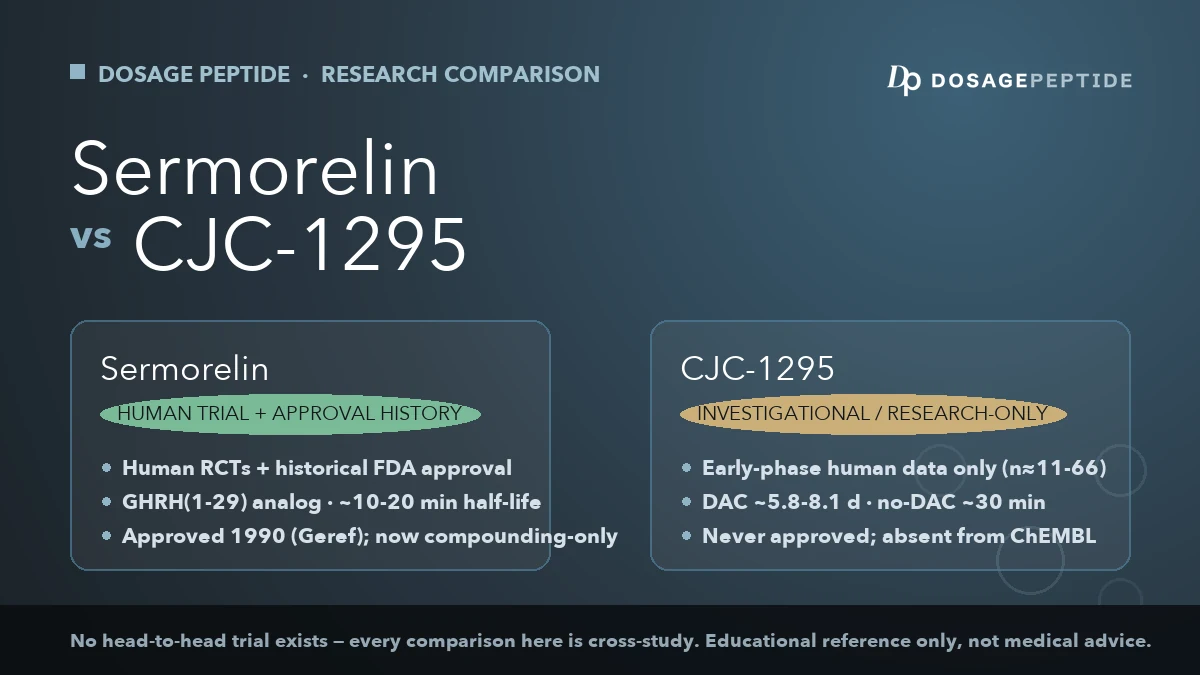
If you read only one section, read this one. Sermorelin and CJC-1295 share a mechanism — both are agonists at the pituitary GHRH receptor that prompt the somatotropes to release the body’s own GH in a feedback-limited way. Where they diverge is duration and, far more importantly, the weight of evidence behind each. Sermorelin is the shortest fully active fragment of human GHRH, has a very short half-life, and was an FDA-approved drug (Geref) with published pediatric and aging-adult trials.[4][9] CJC-1295 was engineered for a much longer duration and was tested in a single published Phase 1/2 trial — then its clinical development was discontinued, and it never reached approval.[1]
| Attribute | Sermorelin | CJC-1295 |
|---|---|---|
| Class / mechanism | GHRH(1-29)NH2 analog — the shortest fully active fragment of human GHRH; agonist at pituitary GHRH receptors, stimulates the body’s own pulsatile GH with feedback intact | Long-acting GHRH(1-29) analog; same GHRH-receptor mechanism, engineered for greatly extended duration (in the DAC form) |
| Molecular identity | Single defined 29-amino-acid sequence | Two distinct molecules under one name: “DAC” (albumin-binding) and “no-DAC” / mod-GRF(1-29) (short-acting) — not interchangeable |
| Half-life | Very short: ~10–20 minutes; GH-releasing effect persists ~2–3 hours despite rapid clearance[5] | DAC: ~5.8–8.1 days (albumin-bound)[1]; no-DAC / mod-GRF(1-29): ~30 minutes — the multi-day figure does not apply to the no-DAC product |
| Typical route | Subcutaneous injection; historically intravenous for GH-secretion diagnostic testing | Subcutaneous injection |
| Human evidence tier | Human RCTs + historical FDA approval. Multicenter pediatric GHD trial (n=110), aging-adult RCT, GHRH(1-29) dose-response RCTs[4][5][6] | Early-phase human data only. One Phase 1/2 randomized double-blind dose-escalation trial (n=66) plus small pharmacodynamic studies (n≈11)[1][2][3] |
| Approval status | FDA-approved historically as sermorelin acetate (Geref/Groliberin; ChEMBL max_phase 4, first approval 1990). Branded product discontinued (~2008, commercial reasons); now compounding-pharmacy supply only[9] | Never approved anywhere, for any indication. Absent from the ChEMBL drug registry (zero records). Investigational / research-only; development not continued |
| Anti-aging / performance use | Not approved; experimental. Aging-adult evidence is a single small 5-month RCT with modest, sex-dependent effects[5] | Not approved; experimental. No trials in anti-aging, body-composition, or performance endpoints |
What Is Sermorelin?
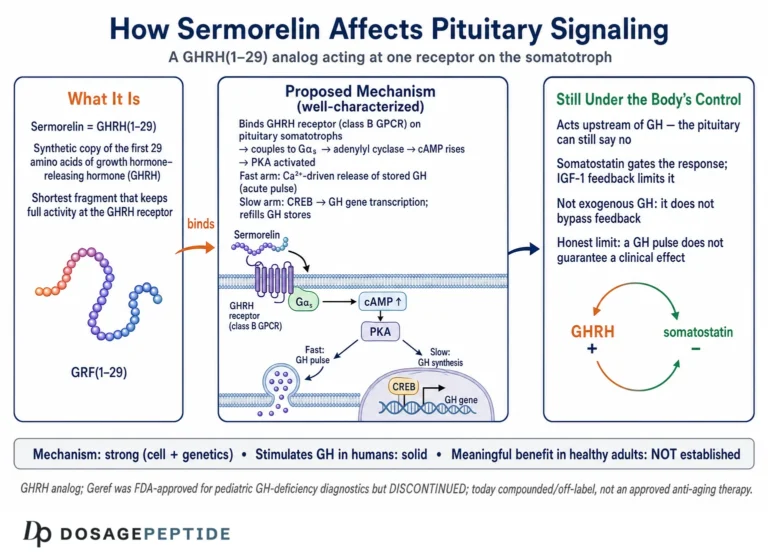
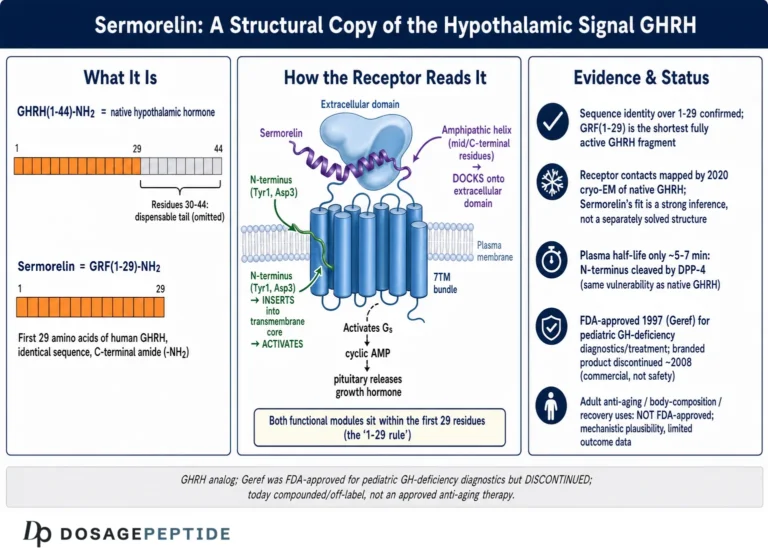
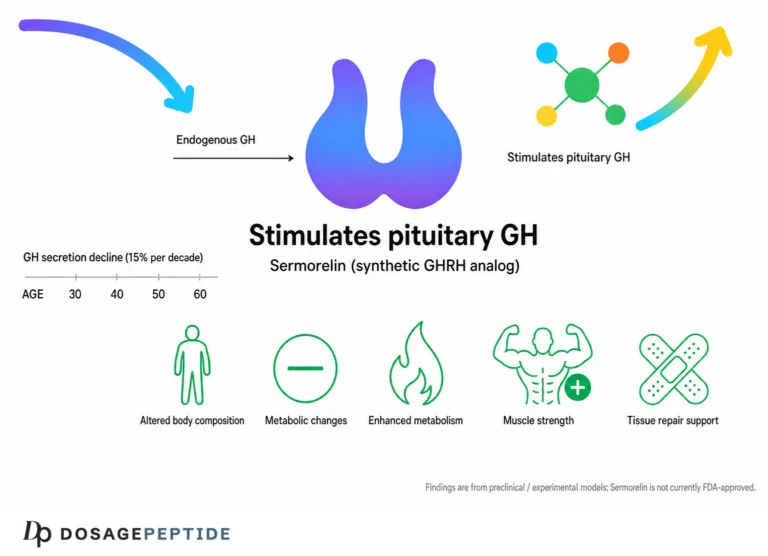
Sermorelin is a synthetic peptide corresponding to the first 29 amino acids of human GHRH — written GHRH(1-29)NH2 — which is the shortest fragment that retains the full GH-releasing activity of the 44-residue parent hormone. It works by binding GHRH receptors on the somatotrope cells of the anterior pituitary, prompting them to synthesize and release GH in the same pulsatile pattern the body uses naturally.[7] Because it acts one step upstream of GH — on the gland rather than replacing the hormone — the pituitary’s own negative-feedback loop (through somatostatin and IGF-1) stays intact, which imposes a physiological ceiling on how much GH can be released. That feedback-limited profile is frequently cited as a conceptual safety contrast with injecting recombinant human GH directly, though it is a mechanistic argument, not a substitute for long-term outcome data.
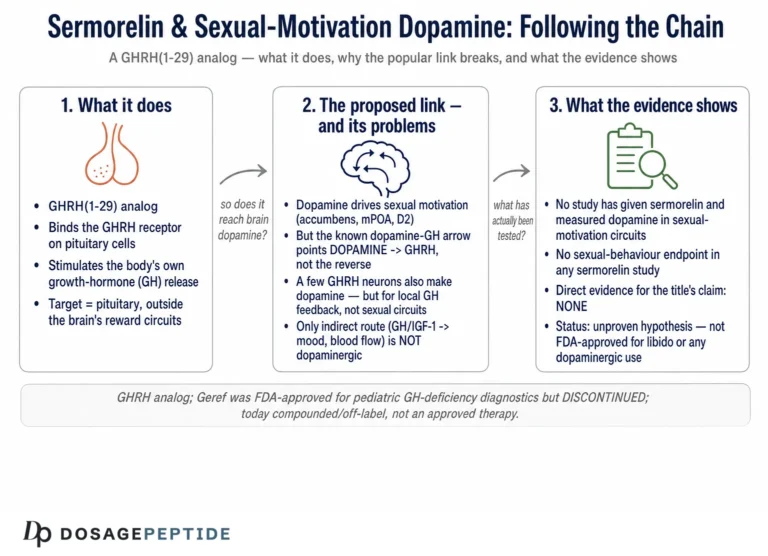
For readers who want the structural detail of why a 29-residue fragment can stand in for the native hormone, our reference on what structural features let Sermorelin mimic native hypothalamic peptides covers the receptor-binding motif, and the companion piece on how Sermorelin affects pituitary signaling in endocrine research walks through the downstream cascade.
What Is CJC-1295? (And Why the Name Is Ambiguous)
CJC-1295 is a modified GHRH(1-29) analog designed to last far longer in circulation than native GHRH. The critical thing most product listings gloss over is that “CJC-1295” names two different molecules:
- CJC-1295 with DAC (“Drug Affinity Complex”) carries a maleimido-lysine group that covalently binds to cysteine-34 of circulating serum albumin after injection. Tethered to albumin, it resists enzymatic breakdown and clears over days rather than minutes — this is the version with a multi-day half-life and the only version tested in a published human trial.[1]
- CJC-1295 without DAC is a different chemical entity — modified GRF(1-29), often called mod-GRF(1-29) — that lacks the albumin-binding complex and has a half-life on the order of ~30 minutes. It behaves much more like Sermorelin in duration, and the multi-day half-life and the Phase 1/2 trial data do not transfer to it.
This matters enormously for interpreting any claim about CJC-1295: a study result obtained with the DAC molecule says little about a vial of “no-DAC” material, and vice versa. We break the two apart in more depth in our explainer on CJC-1295 DAC vs no-DAC. The disambiguation table below summarizes the split.
| Property | CJC-1295 with DAC | CJC-1295 no-DAC (mod-GRF 1-29) |
|---|---|---|
| Key modification | Maleimido-lysine complex that covalently binds albumin (Cys34) | Sequence modifications for stability, but no albumin-binding complex |
| Half-life | ~5.8–8.1 days[1] | ~30 minutes |
| Duration of GH/IGF-1 effect | GH elevated for ~6 days; IGF-1 elevated ~9–11 days after a single dose[1] | Short, pulse-like (comparable in duration to Sermorelin) |
| Dedicated published human trial | Yes — Phase 1/2 dose-escalation (n=66)[1] | No dedicated published human PK/efficacy trial |
| What the “CJC-1295” data describe | This molecule | Frequently mislabeled with DAC-version data that do not apply |
Shared Mechanism: Both Are GHRH-Receptor Agonists
Despite the differences in duration, Sermorelin and both forms of CJC-1295 converge on the same target: the GHRH receptor on pituitary somatotropes. Native pulsatile GH release is governed by the interplay of GHRH (stimulatory) and somatostatin (inhibitory) tone from the hypothalamus; a GHRH analog amplifies the stimulatory side.[7] Notably, even the long-acting DAC form does not abolish pulsatility: in a controlled human study, GH continued to be secreted in pulses during continuous GHRH stimulation, with the main change being a large rise in trough (basal) GH levels that drove the increase in IGF-1.[2]
Because both act through the pituitary rather than bypassing it, both preserve the feedback architecture that a direct GH injection overrides. That shared “physiological ceiling” framing is real — but it is a statement about mechanism, not a guarantee about long-term safety, and it applies equally to a molecule (CJC-1295) whose long-term human data simply do not exist. For how these GHRH analogs sit relative to the ghrelin-mimetic secretagogues, see our overview of how research compares the growth-hormone peptides.
How We Got Here: Field History
Sermorelin’s history is that of a real pharmaceutical. It was approved as sermorelin acetate under the brand names Geref and Groliberin around 1990, used both as a diagnostic agent to test pituitary GH-secretory capacity and as a treatment for growth-hormone-deficient children.[9] The branded product was later discontinued around 2008 — for commercial rather than safety reasons — after which its availability shifted to compounding pharmacies. It has never been approved as an anti-aging drug.
CJC-1295’s history is that of a candidate that stalled. It was developed by ConjuChem as a long-acting GHRH analog, reached a published Phase 1/2 trial in the mid-2000s, and generated legitimate pharmacodynamic data — but its clinical development was not carried forward, and it never advanced to approval.[1] Everything sold today under the CJC-1295 name is research-market material that exists outside any completed drug-development pathway.
Regulatory and Approval Reality
Stated plainly: Sermorelin was an FDA-approved drug; CJC-1295 was not, and is not, approved anywhere. The ChEMBL drug registry records sermorelin acetate at max_phase 4 (approved), with a first approval in 1990; a parallel query for CJC-1295 returns zero records, consistent with a compound that never completed development.[9]
Two honest caveats sit on top of that. First, Sermorelin’s approval is historical and formulation-specific — the branded product is discontinued, and current compounded material is not the same as an on-market FDA-approved drug. Second, neither peptide is approved for the uses most people search for — anti-aging, fat loss, muscle gain, or recovery — and those applications remain experimental. Where GHRH-agonist therapy has been reviewed in the aging context, the class effect is described cautiously, with the strongest visceral-fat and pulsatility data belonging to tesamorelin rather than to either compound here.[8]
Sermorelin: What the Human Evidence Shows
Sermorelin’s human record is its distinguishing feature. In a multicenter, open-label study, 110 previously untreated prepubertal GH-deficient children received 30 mcg/kg/day of GHRH(1-29) subcutaneously at bedtime for up to a year; mean height velocity rose from about 4.1 cm/yr at baseline to roughly 8.0 cm/yr at six months, with GHRH well tolerated and no excessive IGF-1 generation.[4]
In the aging context, a placebo-controlled RCT gave a GHRH(1-29) analog at 10 mcg/kg nightly to 19 age-advanced men and women for five months. It significantly raised nocturnal GH and IGF-1 and increased skin thickness in both sexes, but the gains in lean body mass, insulin sensitivity, well-being, and libido appeared in men and not women — an anabolic effect that “favored men more than women.” The only adverse effect was transient hyperlipidemia that resolved by study end.[5] This is genuine human data — but it is one small, short study with modest, sex-dependent results, which is exactly how it should be represented. Our reference on whether Sermorelin supports growth hormone in aging adults discusses this trial in more depth.
Sermorelin’s dose-response has also been characterized in diagnostic and physiology studies. Controlled work using GHRH(1-29)NH2 at low-to-supramaximal bolus doses mapped the GH response and showed it is attenuated in patients with post-irradiation GH insufficiency, and clamp studies established GHRH’s role in generating and amplifying GH pulses.[6][7]
CJC-1295: What the Human Evidence Shows
CJC-1295’s human evidence is real but thin, and it belongs to the DAC molecule. In two randomized, placebo-controlled, double-blind ascending-dose trials in healthy adults (aged 21–61), a single subcutaneous injection of CJC-1295 with DAC produced dose-dependent increases in mean GH of roughly 2- to 10-fold for six days or more, and increases in IGF-1 of about 1.5- to 3-fold for nine to eleven days; the estimated half-life was 5.8–8.1 days, and no serious adverse reactions were reported, particularly at 30 or 60 mcg/kg.[1] A separate clinical study showed that this sustained stimulation preserved GH pulsatility while markedly raising trough GH,[2] and a small proteomics study (n=11) explored downstream serum-protein changes as candidate biomarkers of GH/IGF-1 action.[3]
The honest framing of that record: the effect is dose-dependent and reproducible in the short term, but the cohorts are tiny (n≈11–66), the follow-up is short, all of it comes from a single developer whose program was discontinued, and there are no efficacy trials for any real-world outcome (body composition, performance, aging). Long-term human safety is unestablished.
Head-to-Head vs. Cross-Trial: The Only Fair Comparisons
This is the section that keeps the rest honest. There is no study in which Sermorelin and CJC-1295 were administered to comparable subjects and measured against each other. When a source says CJC-1295 is “stronger” or “longer-lasting” than Sermorelin, it is stitching together numbers from separate trials run years apart in different people — a cross-trial inference. Cross-trial inference can motivate a hypothesis; it cannot establish superiority, because differences in population, assay, dose, and design confound any direct read.
What can be said fairly is narrow and mechanistic: the DAC form of CJC-1295 has a longer measured half-life than Sermorelin (days vs minutes), which is a pharmacokinetic fact from its own trial — not evidence that it produces better outcomes. On the evidence axis that matters for trust, the comparison is not close: Sermorelin has controlled human trials and an approval history; CJC-1295 has early-phase data and none. The evidence-tier table makes each reported role explicit.
| Reported research role | Strongest evidence tier | Honest interpretation |
|---|---|---|
| Sermorelin raises GH/IGF-1 in GH-deficient children | Multicenter human clinical trial (n=110)[4] | Well supported for that specific population and endpoint; the basis of its historical approval |
| Sermorelin improves body composition in aging adults | One small placebo-controlled RCT, 5 months (n=19)[5] | Modest, sex-dependent (favored men); hypothesis-level, not established therapy |
| CJC-1295 (DAC) raises GH/IGF-1 in healthy adults | Phase 1/2 dose-escalation RCT (n=66)[1] | Real short-term pharmacodynamic effect; hypothesis-generating, program discontinued |
| CJC-1295 preserves GH pulsatility | Human clinical study, healthy men[2] | Supported for the DAC molecule; does not imply clinical benefit |
| CJC-1295 (no-DAC / mod-GRF 1-29) efficacy | No dedicated published human trial | Not established; DAC-version data do not transfer |
| Either peptide for fat loss, muscle, or performance | No direct trials | Not established; experimental / off-label |
| Sermorelin “beats” CJC-1295 (or vice versa) | No head-to-head trial | Cannot be claimed from the evidence; cross-trial only |
Reading the Numbers Honestly: Half-Life and Duration
The single most-misused number in this comparison is half-life. Sermorelin clears in roughly 10–20 minutes, yet its downstream GH-releasing effect persists a few hours — the peptide is gone long before its biological effect is.[5] CJC-1295 with DAC clears over roughly 5.8–8.1 days because it is covalently anchored to albumin.[1] The trap is applying that multi-day figure to “CJC-1295 no-DAC,” which clears in about 30 minutes — closer to Sermorelin than to the DAC molecule. A longer half-life also is not automatically preferable: sustained, less-pulsatile GHRH stimulation is pharmacologically different from short pulses, and its long-term consequences in humans have not been studied.
Research-Use Dosing Conventions (Laboratory Settings Only)
The figures below are reported from published studies and historical clinical protocols. They are provided to help interpret the literature, not as a protocol for human use, and neither peptide has an approved dose for the applications commonly searched.
- Sermorelin — the pediatric GHD clinical precedent used 30 mcg/kg/day subcutaneously at bedtime (Geref); the aging-adult RCT used 10 mcg/kg nightly.[4][5] On dosagepeptide.com these are framed research-use-only. See the Sermorelin 5 mg vial research dosage reference and the Sermorelin 10 mg vial reference.
- CJC-1295 — the published trial administered single subcutaneous doses of 30–60 mcg/kg with weekly-to-biweekly cadence, justified by the long DAC half-life.[1] No approved clinical dose exists. See the CJC-1295 DAC 2 mg vial reference, the CJC-1295 DAC 5 mg reference, and the CJC-1295 no-DAC 5 mg reference — note the cadence assumptions differ between the DAC and no-DAC forms.
Safety and Tolerability
Both peptides were reasonably tolerated in the trials that exist, but the depth of the safety record is very different. Sermorelin was studied in children over a year and in aging adults over five months; CJC-1295’s safety data come from small, short trials in healthy volunteers.
| Safety dimension | Sermorelin | CJC-1295 |
|---|---|---|
| Reported adverse effects | Injection-site reactions, flushing, headache; transient hyperlipidemia in the 5-month aging RCT[5] | No serious adverse events in the published Phase 1/2 trial, but cohorts are tiny and short-term[1] |
| Feedback / physiological ceiling | Preserved — GH release remains feedback-limited | Preserved, but continuous (less-pulsatile) stimulation is a theoretical concern |
| Duration of human safety data | Up to ~1 year (pediatric); 5 months (aging adults) | Days to weeks only |
| Molecule-specific concerns | Established biochemistry; well-characterized | Covalent albumin binding (DAC) and sustained GH elevation are theoretical concerns; long-term data absent |
| Development status | Approved historically; discontinued for commercial reasons | Clinical development discontinued by the original developer |
Which Is Studied for What?
Mapping each peptide to its actual research context prevents the most common category error — treating them as interchangeable “GH boosters.” Sermorelin is studied where a short, physiological GHRH pulse is wanted: as a diagnostic probe of pituitary GH-secretory capacity, as a pediatric GH-deficiency treatment (its approved use), and, in a limited way, for age-related decline in the GH/IGF-1 axis. CJC-1295 (DAC) is studied for exactly one thing in humans: whether a single infrequent dose can produce sustained elevation of GH and IGF-1 — a pharmacodynamic question about prolonged GHRH-receptor stimulation, not a therapeutic outcome. CJC-1295 (no-DAC / mod-GRF 1-29) has no dedicated human efficacy literature at all and is best understood as a short-acting GHRH analog used in research settings. For the broader landscape of GH-axis peptides and how selective secretagogues differ, our overview of what research says about Sermorelin and natural GH adds context.
What the Evidence Does NOT Show
Being explicit about the gaps is part of reading this pair honestly. The published evidence does not show any of the following:
- That Sermorelin or CJC-1295 is superior to the other — no head-to-head trial exists.
- That either peptide causes fat loss, muscle gain, improved athletic performance, or anti-aging benefit — there are no trials with those endpoints for either compound.
- That “CJC-1295 no-DAC” behaves like the DAC molecule — the multi-day half-life and the Phase 1/2 data belong to the DAC version only.
- That CJC-1295 is safe long-term — the human safety window is days to weeks in small cohorts, and the program was discontinued.
- That current Sermorelin supply equals an FDA-approved drug — the approval is historical and the branded product is discontinued; today’s material is compounded.
- That a research vial’s label guarantees its contents — research-market identity and purity are unverified (see below).
Practical Research Context
A few practical points close the loop for anyone reading the science. Reconstitution math is identical in principle for both peptides — our peptide reconstitution guide and dosage calculator walk through converting a vial concentration into a measured volume, and the peptide research glossary defines terms like GHRH, somatostatin, half-life, and IGF-1 used throughout this article.
Because research-market material is sold outside any approved supply chain, its identity and purity are unverified: trial data describe a characterized study drug, not the contents of an arbitrary vial, so a batch certificate of analysis is the minimum a research setting should require. Reference vials of these GHRH analogs are catalogued by research-grade peptide suppliers such as Prime Lab; the dosing figures on this page nonetheless describe published laboratory studies and historical clinical protocols only, not a protocol for use.
Common Misconceptions
“CJC-1295 is just a stronger, longer Sermorelin.”
They share a mechanism, but this framing hides the evidence gap. Sermorelin has human trials and an approval history; CJC-1295 has early-phase data and no approval. “Longer” is true only for the DAC form and is a pharmacokinetic property, not proof of a better outcome.
“CJC-1295 no-DAC has the multi-day half-life.”
No. The ~5.8–8.1-day half-life belongs to CJC-1295 with DAC. The no-DAC molecule (mod-GRF 1-29) clears in roughly 30 minutes and has no dedicated published human trial.
“Sermorelin is FDA-approved, so it’s a safe anti-aging drug.”
Sermorelin’s approval was for GH-secretion testing and pediatric GH deficiency, the branded product is discontinued, and it was never approved for anti-aging. Historical approval of one formulation is not a safety endorsement of compounded material for a different use.
“Because both work through the pituitary, they’re inherently safe.”
Preserved feedback is a genuine mechanistic contrast with injected GH, but it is not the same as long-term safety evidence — which, for CJC-1295, does not exist.
Key Takeaways
- Sermorelin and CJC-1295 are both GHRH(1-29) analogs acting on the pituitary GHRH receptor, preserving the body’s GH feedback.
- The comparison is defined by asymmetric evidence: Sermorelin has human RCTs and a historical FDA approval; CJC-1295 has early-phase human data only and no approval anywhere.
- No head-to-head trial exists — every direct comparison is cross-trial inference.
- “CJC-1295” means two molecules: DAC (~5.8–8.1-day half-life, the trial molecule) and no-DAC / mod-GRF(1-29) (~30 minutes, no dedicated trial).
- Neither is approved for anti-aging, fat loss, muscle, or performance; those uses are experimental.
- Research-market vials have unverified identity and purity; trial data are not product data. Everything here is educational, not medical advice.
Frequently Asked Questions
Is Sermorelin or CJC-1295 better?
There is no head-to-head trial, so “better” cannot be established from evidence. On the strength of human data and regulatory history, Sermorelin is far better documented (human RCTs plus a historical FDA approval), while CJC-1295 has only early-phase human data and was never approved. Any claim that one outperforms the other is cross-trial inference, not a direct result.
What is the difference between CJC-1295 with DAC and without DAC?
CJC-1295 with DAC carries an albumin-binding complex that extends its half-life to roughly 5.8–8.1 days; the no-DAC version (mod-GRF 1-29) lacks that complex and clears in about 30 minutes. They are chemically different molecules, and the multi-day half-life and the published trial data apply only to the DAC form.
Is Sermorelin FDA-approved?
Historically yes — sermorelin acetate was approved around 1990 (Geref/Groliberin) for GH-secretion testing and pediatric GH deficiency. However, the branded product was discontinued around 2008 for commercial reasons, so current supply is from compounding pharmacies, and it has never been approved as an anti-aging drug.
Is CJC-1295 FDA-approved?
No. CJC-1295 has never been approved anywhere, for any indication. It is absent from the ChEMBL drug registry, consistent with a compound whose clinical development was discontinued after early-phase trials. It is investigational and research-use-only.
How long does each one last in the body?
Sermorelin has a half-life of about 10–20 minutes, though its GH-releasing effect lasts a few hours. CJC-1295 with DAC has a half-life of about 5.8–8.1 days; CJC-1295 no-DAC lasts about 30 minutes. Duration is not the same as benefit.
Do Sermorelin and CJC-1295 raise growth hormone the same way?
Both stimulate the same pituitary GHRH receptor and preserve pulsatile, feedback-limited GH release. The main pharmacological difference is duration: Sermorelin and no-DAC CJC-1295 give short pulses, while DAC CJC-1295 produces sustained elevation with markedly higher trough GH.
Are these peptides studied for fat loss or muscle gain?
No trials have tested either peptide for fat loss, muscle gain, or athletic performance. The aging-adult Sermorelin RCT reported modest, sex-dependent body-composition effects, but those endpoints are not established uses, and CJC-1295 has no such trials at all.
Is a research vial labeled “CJC-1295” guaranteed to contain what it says?
No. Research-market material is sold outside any approved supply chain, so its identity and purity are unverified. In particular, a vial labeled “CJC-1295” may be the DAC or the no-DAC molecule, and published trial data describe a characterized study drug, not arbitrary product. A batch certificate of analysis is the minimum a research setting should require.
Is any of this a recommendation for human use?
No. This article is educational reference material summarizing published research and regulatory status. It is not medical advice, not a therapeutic recommendation, and not instructions for human use; any doses cited describe laboratory research settings and historical clinical protocols only.
References
- Teichman SL, Neale A, Lawrence B, Gagnon C, Castaigne JP, Frohman LA. Prolonged stimulation of growth hormone (GH) and insulin-like growth factor I secretion by CJC-1295, a long-acting analog of GH-releasing hormone, in healthy adults. J Clin Endocrinol Metab. 2005;91(3):799-805. doi:10.1210/jc.2005-1536.
- Ionescu M, Frohman LA. Pulsatile secretion of growth hormone (GH) persists during continuous stimulation by CJC-1295, a long-acting GH-releasing hormone analog. J Clin Endocrinol Metab. 2006;91(12):4792-7. doi:10.1210/jc.2006-1702.
- Sackmann-Sala L, Ding J, Frohman LA, Kopchick JJ. Activation of the GH/IGF-1 axis by CJC-1295, a long-acting GHRH analog, results in serum protein profile changes in normal adult subjects. Growth Horm IGF Res. 2009;19(6):471-7. doi:10.1016/j.ghir.2009.03.001.
- Thorner M, Rochiccioli P, Colle M, Lanes R, Grunt J, Galazka A, et al. Once daily subcutaneous growth hormone-releasing hormone therapy accelerates growth in growth hormone-deficient children during the first year of therapy. Geref International Study Group. J Clin Endocrinol Metab. 1996;81(3):1189-96. doi:10.1210/jcem.81.3.8772599.
- Khorram O, Laughlin GA, Yen SS. Endocrine and metabolic effects of long-term administration of [Nle27]growth hormone-releasing hormone-(1-29)-NH2 in age-advanced men and women. J Clin Endocrinol Metab. 1997;82(5):1472-9. doi:10.1210/jcem.82.5.3943.
- Achermann JC, Brook CG, Hindmarsh PC. The GH response to low-dose bolus growth hormone-releasing hormone (GHRH(1-29)NH2) is attenuated in patients with longstanding post-irradiation GH insufficiency. Eur J Endocrinol. 2000;142(4):359-64. doi:10.1530/eje.0.1420359.
- Achermann JC, Hindmarsh PC, Robinson IC, Matthews DR, Brook CG. The relative roles of continuous growth hormone-releasing hormone (GHRH(1-29)NH2) and intermittent somatostatin(1-14) in growth hormone (GH) pulse generation. Clin Endocrinol (Oxf). 1999;51(5):575-85. doi:10.1046/j.1365-2265.1999.00839.x.
- Sattler FR. Growth hormone in the aging male. Best Pract Res Clin Endocrinol Metab. 2013;27(4):541-55. doi:10.1016/j.beem.2013.05.003.
- ChEMBL v34 compound record for SERMORELIN ACETATE (CHEMBL1201490): molecule_type Protein, max_phase 4 (approved), first_approval 1990, parenteral; synonyms Geref/Groliberin. CJC-1295 returns zero records in the same registry.
Research-use disclaimer: This article is educational reference material summarizing published research and regulatory context. It is not medical advice, not a therapeutic recommendation, and not instructions for human use. Neither Sermorelin nor CJC-1295 is an FDA-approved drug currently marketed for anti-aging, body composition, or performance, and CJC-1295 has never been approved for any indication. Descriptions of dosing refer to laboratory research settings and historical clinical protocols only. Always verify current clinical-trial and regulatory status through primary sources such as ClinicalTrials.gov, PubMed, and the FDA.