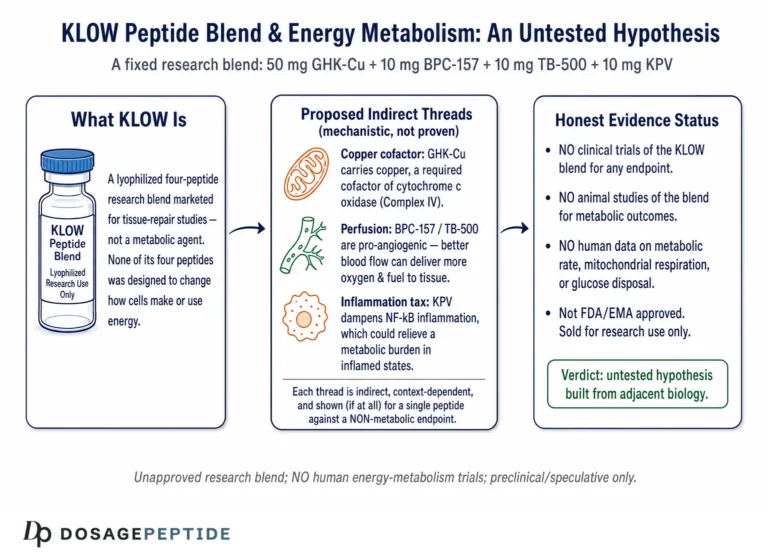
Short answer: no — and nobody has measured it. The KLOW blend has never been tested for energy or metabolic endpoints. Not in humans, not in animals, not even as a defined mixture for any endpoint at all. Every claim you will read about KLOW and “energy” is an extrapolation from its individual components.
KLOW is a lyophilized four-peptide research blend, typically an 80 mg vial: roughly 50 mg GHK-Cu, 10 mg BPC-157, 10 mg TB-500 and 10 mg KPV. Each of those four entered the scientific literature as a tissue-repair or anti-inflammatory molecule — none was characterized as an energy or metabolism compound. The one genuine thread linking the blend to metabolism is GHK-Cu’s documented ability to shift the expression of thousands of genes, some of them mitochondrial. That thread is real, but it is thin, indirect, and a long way from “supports energy and metabolic function” in a living organism.
This page is research-use-only reference information, not medical advice and not a human protocol. It covers: what is actually in KLOW, what evidence would be needed to claim a metabolic effect, the GHK-Cu gene-expression thread, the inflammation–metabolism route that is its most plausible indirect mechanism, how KLOW compares with peptides that have been studied for energy metabolism, the copper question, and where the evidence stops.
What KLOW Is and Why Energy Metabolism Was Never Its Design Brief
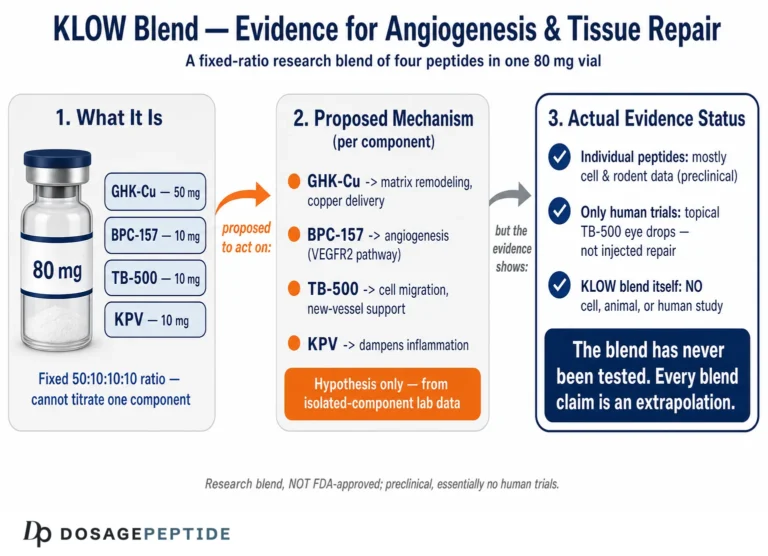
KLOW is a shorthand name for a lyophilized four-peptide research blend, typically supplied as a single vial containing roughly 80 mg of total peptide. The conventional split is 50 mg GHK-Cu, 10 mg BPC-157, 10 mg TB-500, and 10 mg KPV. The name is simply an acronym of the components, and the blend has no regulatory identity, no pharmacopoeial monograph, and no approved indication. It exists as a research-chemical product, and its rationale — where vendors articulate one at all — is regenerative: the idea that combining a copper-binding remodeling peptide, a cytoprotective gastric pentadecapeptide, an actin-regulating repair peptide, and an anti-inflammatory tripeptide might produce broad tissue-repair and anti-inflammatory effects.
To see why “energy and metabolic function” sits awkwardly on this blend, it helps to know where each component came from and what it was characterized to do.
GHK-Cu is the tripeptide glycyl-L-histidyl-L-lysine complexed with copper(II). It was first isolated from human plasma in 1973 and is present naturally in plasma, saliva, and urine, where its concentration declines with age — from roughly 200 ng/mL around age twenty to about 80 ng/mL by age sixty.1 Its documented biology is dominated by tissue remodeling and gene regulation: it stimulates collagen and glycosaminoglycan synthesis, modulates matrix metalloproteinases, attracts repair cells to injury sites, and, most strikingly, modulates the expression of a very large number of human genes.1 It is the only component of KLOW with any credible connection to mitochondrial or metabolic gene expression, and we will spend an entire section on it below.
BPC-157 is a synthetic pentadecapeptide (15 amino acids) derived from a partial sequence of a protein found in human gastric juice. Its research literature is overwhelmingly about cytoprotection and healing — of the gut, tendons, ligaments, muscle, and blood vessels — and its proposed mechanisms center on angiogenesis and nitric-oxide signaling rather than on energy metabolism.45 Much of its evidence base comes from a single research group, a caveat we return to later.
TB-500 is a synthetic fragment marketed as equivalent to thymosin β4, a 43-amino-acid actin-sequestering peptide present in most cells. Thymosin β4’s best-studied roles are in cell migration, wound healing, and cardiac repair after injury.67 It touches metabolism only at the margins — through survival-signaling pathways and, intriguingly, an interaction with cell-surface ATP synthase — but it was never developed as a metabolic agent.
KPV is the tripeptide lysine-proline-valine, corresponding to the C-terminal residues 11–13 of alpha-melanocyte-stimulating hormone (α-MSH). Its defining property is anti-inflammatory: it dampens NF-κB and MAPK signaling and has reduced inflammation in animal models of colitis.89 Anti-inflammatory action is where its relevance to metabolism, if any, must be sought — not in any direct effect on energy production.
Read together, the origins tell a consistent story. Not one of the four peptides was discovered, engineered, or clinically developed as an energy or metabolic compound. Their shared theme is repair and the resolution of inflammation. Any link to “energy and metabolic function” is therefore not a headline effect but a hypothesized downstream consequence — and a researcher should hold that distinction firmly in mind. For readers who want the companion piece that surveys the blend’s better-documented regenerative angle, the site’s article on KLOW peptides in angiogenesis and tissue repair covers the territory the components were actually built for.
What “Energy and Metabolic Function” Would Actually Require
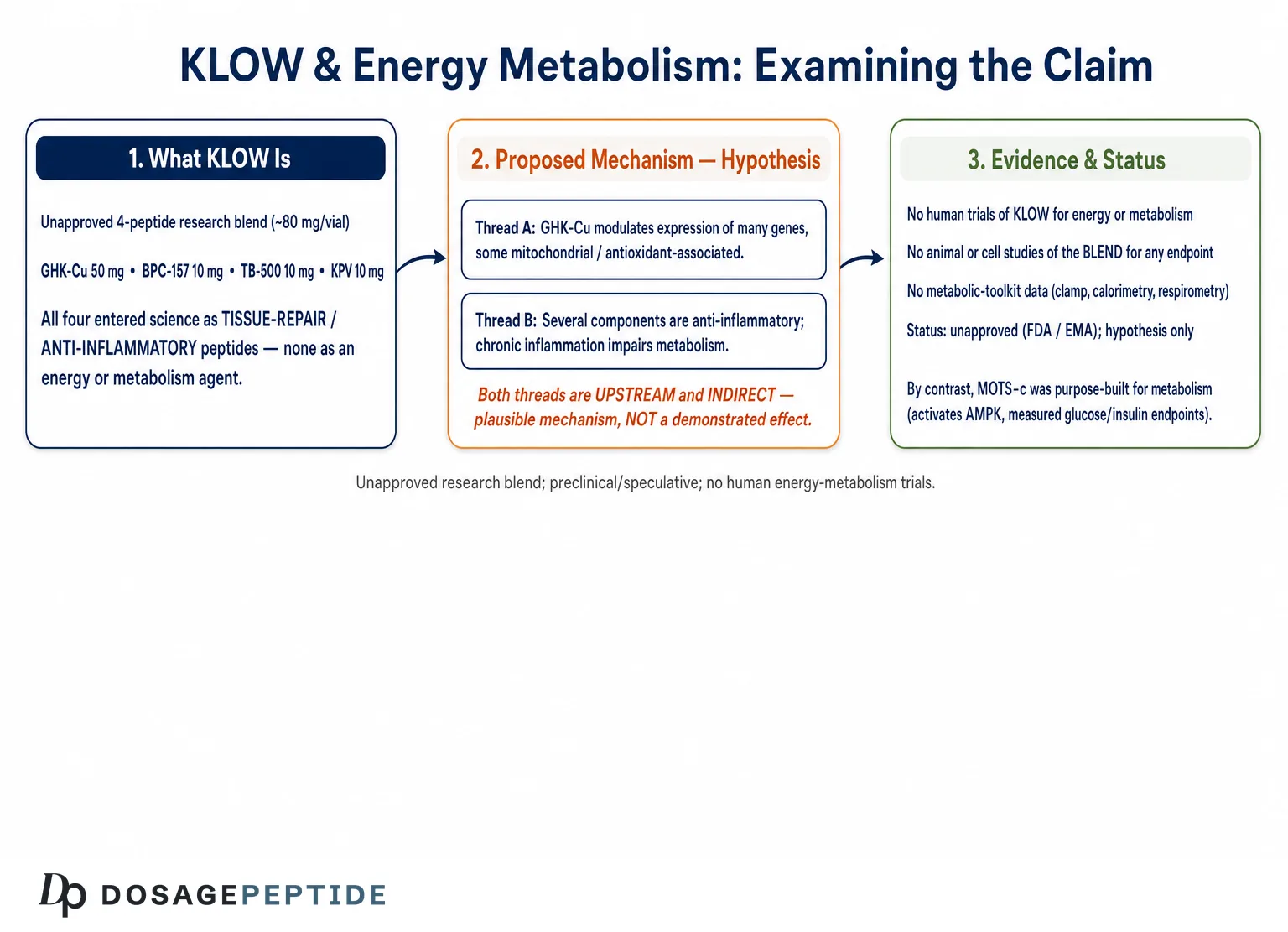
Before evaluating whether any evidence links KLOW to energy metabolism, we should be precise about what that phrase means, because it is often used loosely enough to mean almost anything. In physiology, “energy metabolism” refers to the biochemical machinery by which cells extract usable energy from fuel and manage its supply. That encompasses several distinct, measurable systems.
At the cellular level, it means mitochondrial function: oxidative phosphorylation, the assembly and activity of the electron-transport-chain complexes, ATP synthesis, mitochondrial biogenesis (the making of new mitochondria, governed by regulators such as PGC-1α), and the control of reactive oxygen species. At the tissue and whole-body level, it means substrate handling: glucose uptake and disposal, insulin sensitivity, fatty-acid oxidation, lipid storage and mobilization, and the hormonal and enzymatic control of all of these — AMP-activated protein kinase (AMPK), the master fuel sensor, being the archetypal node. And at the experiential level that most people mean by “energy,” it involves fatigue, exercise capacity, and the subjective sense of vitality, which are downstream of the cellular and systemic layers but influenced by many other things besides.
A compound that genuinely “supports energy and metabolic function” would need to move one or more of these needles in a demonstrable, reproducible way: increase ATP production or mitochondrial density, improve glucose disposal or insulin sensitivity, raise fat oxidation, activate AMPK or PGC-1α, or improve a validated functional measure such as exercise endurance or metabolic rate. Crucially, these are all measurable. The gold-standard tools exist and are well established: hyperinsulinemic-euglycemic clamps for insulin sensitivity, indirect calorimetry for substrate oxidation and energy expenditure, high-resolution respirometry (for example, Seahorse assays) for cellular oxygen-consumption rate, and mitochondrial-content and biogenesis markers at the molecular level.
This precision matters for one reason above all: none of these measurements has been reported for the KLOW blend. Not in humans, not in animals, not in a controlled cell model. So when we ask what research links KLOW to energy and metabolic function, we are not weighing strong evidence against weak; we are examining whether even an indirect, mechanistic rationale exists, and if so, how far it can honestly be stretched. The distinction between “plausible mechanism” and “demonstrated effect” is the single most important lens for the rest of this article.
GHK-Cu and Mitochondrial Gene Expression: The Strongest Thread
If there is any legitimate scientific reason to associate KLOW with metabolism, it runs almost entirely through GHK-Cu, and specifically through its gene-modulating activity. This is the thread most worth taking seriously, so it deserves careful, unembellished treatment.
The central finding is that GHK, at low (nanomolar) concentrations, alters the expression of a strikingly large fraction of the human genome. Analyses using the Broad Institute’s Connectivity Map and related datasets have reported that GHK induces a change of 50% or greater in the expression of roughly a third of assessed human genes, with the peptide capable of up- or down-regulating on the order of 4,000 genes.1 Within that vast signature, reviewers have specifically catalogued genes associated with DNA repair, antioxidant response, tissue remodeling, and — the detail relevant here — mitochondrial function, alongside a general tendency to down-regulate inflammatory and tumor-progression pathways.2 Cell studies have described fibroblasts exposed to GHK-Cu showing up-regulation of DNA-repair enzymes, normalization of oxidative-stress markers, and, in the language of the reviews, restoration of mitochondrial function.2
The most rigorous single piece of gene-expression work is the emphysema study. Using lung tissue from smokers with COPD, investigators identified a gene-expression signature that tracked with the severity of emphysematous tissue destruction, then screened for compounds that could reverse it. The tripeptide GHK emerged as able to reverse that aberrant signature and to induce expression patterns consistent with TGF-β pathway activation and tissue remodeling.3 A parallel body of work has examined GHK’s effect on genes relevant to nervous-system function and cognitive decline, again through the Connectivity Map approach.13 These are real, peer-reviewed findings from a serious research program.
Now the honest qualifications, which are substantial:
- Gene expression is not the same as metabolic outcome. That GHK modulates mitochondrial-associated genes in a transcriptomic screen tells us the peptide can influence the readout of those genes; it does not establish that it increases ATP production, mitochondrial density, or oxidative capacity in a functioning tissue, let alone that it improves whole-body energy metabolism. The gap between a Connectivity Map signature and a Seahorse respirometry result — or an insulin clamp — is enormous, and it has not been bridged for GHK on metabolic endpoints.
- The signature is nonspecific by nature. A molecule that moves a third of the genome is, almost by definition, hitting many systems at once. Highlighting the mitochondrial genes within a 4,000-gene response is legitimate, but it should not be mistaken for a targeted metabolic mechanism. It is one theme in a very broad chorus.
- The strongest disease-model evidence is in lung and skin, not metabolism. The emphysema reversal and the dermal-remodeling data are the program’s crown jewels, and neither is a metabolic study. There is no comparable GHK dataset showing reversal of a metabolic-disease signature in a validated metabolic model.
- Dose and delivery in a blend are unknown quantities. The gene-expression work uses defined GHK concentrations in controlled systems. What a fixed dose of GHK-Cu delivered subcutaneously as part of a four-peptide mixture does to gene expression in a target tissue in vivo is simply not characterized.
There is a further layer worth unpacking, because it is where the copper in GHK-Cu becomes genuinely relevant rather than merely decorative. Copper is not incidental to energy metabolism; it is a required cofactor for cytochrome c oxidase, complex IV of the mitochondrial electron transport chain, the terminal enzyme that reduces oxygen to water and permits the proton gradient that drives ATP synthesis. Copper biology in this sense is a legitimate node in cellular bioenergetics: adequate copper loading favors mitochondrial complex IV assembly and oxidative metabolism, whereas copper deficiency can shift cells toward glycolysis. On its face, this looks like a promising hook for an energy-metabolism story — a copper-delivering peptide feeding the copper-dependent machinery of oxidative phosphorylation. But the reasoning collapses under scrutiny. Copper status in a healthy organism is homeostatically defended within narrow limits; complex IV assembly is not generally copper-limited in copper-replete tissue, so delivering additional copper via a peptide does not straightforwardly “boost” mitochondrial output. Worse, unbound or excess copper is redox-active and pro-oxidant, capable of damaging the very mitochondria it is imagined to fuel. No study has shown that GHK-Cu administration raises mitochondrial complex IV activity or ATP output in a living tissue. The copper-mitochondria connection is real cell biology, but as a rationale for KLOW improving energy it is a hook without a fish on it.
The fair summary is that GHK-Cu gives KLOW a genuine but strictly upstream connection to metabolism: it can influence the expression of mitochondrial and antioxidant genes, which is mechanistically interesting and not nothing. But “can influence the transcription of mitochondrial-associated genes in a broad screen” is a long way from “supports energy and metabolic function,” and treating the former as evidence for the latter is precisely the kind of overreach a careful reader should resist. Those interested in how GHK-Cu’s gene-reversal biology has been explored in a disease context can see the site’s discussion of the evidence around GHK-Cu in COPD and pulmonary fibrosis, which is built on the same transcriptomic findings.
The Inflammation–Metabolism Axis: KLOW’s Most Plausible Indirect Route
The second, and arguably more coherent, mechanistic route by which a blend like KLOW could touch metabolism is indirect: through the resolution of chronic inflammation. This is worth developing carefully, because it is the argument most likely to be both scientifically defensible and quietly overstated.
The premise is well established in mainstream metabolic science. Chronic, low-grade inflammation — sometimes called metaflammation or meta-inflammation — is now understood as a driver of metabolic dysfunction. Landmark work showed that inflammatory signaling, beginning with the observation that TNF is elevated in the adipose tissue of obese animals, interferes with insulin action and contributes to insulin resistance and type 2 diabetes.10 In this model, pro-inflammatory cytokines and immune-cell reprogramming in metabolic tissues impair insulin signaling, promote ectopic fat accumulation, and degrade metabolic health. It follows, logically, that interventions which reduce chronic inflammation could, in principle, relieve some of the inflammatory burden on metabolic tissues.
Three of KLOW’s four components have anti-inflammatory activity. KPV suppresses NF-κB and MAPK signaling and reduced colonic inflammation in murine colitis models, with the added feature that inflamed tissue up-regulates the PepT1 transporter that carries the tripeptide into cells, concentrating its effect where inflammation is highest.89 BPC-157 has been described as cytoprotective and anti-inflammatory across many tissue models.4 Thymosin β4 modulates inflammatory mediators as part of its wound-healing repertoire.7 And GHK-Cu’s gene signature tilts away from inflammatory pathways.2 So the raw ingredients for an anti-inflammatory effect are present.
Here is where discipline is required. The chain of reasoning — KLOW’s components are anti-inflammatory → chronic inflammation impairs metabolism → therefore KLOW supports metabolic function — is a syllogism, not a finding. Every link in it is individually plausible and collectively unproven for this blend. The anti-inflammatory data are almost entirely in models of localized tissue injury (colitis, wounds, ischemic myocardium), not in models of metabolic inflammation such as diet-induced obesity, adipose-tissue macrophage infiltration, or insulin resistance. No study has administered KLOW, or even its individual components in a metabolic-inflammation model, and measured a metabolic endpoint like insulin sensitivity or glucose tolerance. The inflammation-metabolism axis is a real bridge, but no one has actually walked across it with this compound.
There is also a subtlety that cuts against glib extrapolation: inflammation is not uniformly bad for metabolism. Acute, transient inflammatory signaling is part of healthy adaptation to exercise and to feeding, and blunting it indiscriminately is not obviously beneficial. Immunometabolism research has increasingly emphasized that both excessive and insufficient inflammatory tone can be maladaptive. A blend that broadly dampens inflammation could, in theory, interfere with beneficial adaptive signaling as easily as it relieves pathological inflammation — and without data, we cannot say which would dominate. For readers exploring how localized gut and systemic inflammation intersect with peptide research, the site’s coverage of BPC-157’s effects on the gut and inflammation and of TB-500’s reported anti-inflammatory and recovery effects lays out the component-level anti-inflammatory literature that this hypothesis would rest on.
It is also worth naming why the fatigue-and-vitality version of the metabolic claim is so persistent and so hard to evaluate. Subjective “energy” is influenced by sleep, mood, pain, systemic inflammation, and recovery from tissue injury — several of which KLOW’s components might plausibly touch through their repair and anti-inflammatory actions. A person recovering from an injury or a period of high inflammatory burden may genuinely feel more energetic as that burden resolves, and if a repair-oriented blend contributes to that resolution, the felt improvement is real. But this is not the same as a metabolic effect in the physiological sense, and it is precisely the kind of experience that anecdote and marketing conflate with “improved metabolism.” Feeling less depleted because inflammation or an injury is resolving is a downstream, nonspecific consequence of tissue repair; it is not evidence that the blend acts on mitochondria, glucose handling, or fuel oxidation. Distinguishing “I feel more energetic” from “my energy metabolism improved” is essential to reading any report about this blend honestly, and the two are routinely merged in the very sources that promote it.
The honest conclusion on this route is that it is the best case KLOW has — a biologically coherent, mechanistically grounded hypothesis that reducing inflammatory burden could indirectly benefit metabolic tissues — and that it remains entirely untested for the blend. It should be described as such, never as an established effect.
The Other Three Components in the Energy Conversation
Having given GHK-Cu and the inflammation axis their due, it is worth being specific about what BPC-157, TB-500, and KPV do and do not contribute to any energy or metabolic narrative, because vendor copy frequently blurs their roles into a vague promise of “vitality.”
TB-500 / thymosin β4. Of the three, TB-500 has the most tantalizing brush with bioenergetics, and it is worth stating precisely so it is neither dismissed nor inflated. Thymosin β4’s core function is to sequester G-actin and regulate the cytoskeleton, which underlies its roles in cell migration and repair. In cardiac injury models it activates integrin-linked kinase and Akt signaling, promoting cardiomyocyte survival and functional recovery after myocardial infarction.6 Reviews of its biology also note that thymosin β4 can interact with cell-surface ATP synthase and influence purinergic signaling and endothelial migration.7 That ATP-synthase interaction is the closest any KLOW component comes to a direct energy-machinery touchpoint — but the context is angiogenesis and cell migration, not cellular energy provisioning, and it has not been developed into any demonstrated effect on tissue ATP status or whole-body energetics. It is a mechanistic curiosity, not a metabolic mechanism.
BPC-157. BPC-157’s proposed mechanisms are vascular and cytoprotective. It promotes angiogenesis and modulates the nitric-oxide system, with reported activation of the VEGFR2–Akt–eNOS axis and effects on vasomotor tone through a Src–caveolin-1–eNOS pathway.5 A generous reading might argue that improved microvascular perfusion could support the delivery of oxygen and substrate to tissues, which is loosely “metabolic.” But this is perfusion, not metabolism proper, and the inference is speculative. BPC-157 has no reported effect on glucose disposal, insulin sensitivity, mitochondrial function, or fat oxidation. Its literature is about healing, and it carries the important caveat that a large majority of its published studies originate from a single research group, which limits how confidently any of its mechanisms can be generalized.4
KPV. KPV’s contribution to any metabolic story is purely through the inflammation axis discussed above. It is an anti-inflammatory tripeptide with elegant, well-characterized signaling — NF-κB suppression, PepT1-mediated uptake into inflamed cells — but nothing in its literature describes a direct effect on energy metabolism, mitochondria, or glucose and lipid handling.89 Its relevance here is entirely as a possible contributor to reduced inflammatory burden, subject to all the caveats already noted.
The pattern across all three is the same one seen with GHK-Cu: each has genuine, sometimes sophisticated biology, and in each case that biology is anchored to repair, vascular function, or inflammation rather than to energy metabolism. The energy connection, where it exists at all, is peripheral and inferential.
How KLOW Compares With Peptides Actually Studied for Energy Metabolism
The clearest way to calibrate KLOW’s standing is to set it beside compounds that were genuinely investigated for energy metabolism. The contrast is not a competition — KLOW has never entered the metabolic arena — but it shows what a real energy-metabolism candidate looks like in mechanism and evidence, and how far KLOW sits from that standard.
The obvious reference point is MOTS-c, a 16-amino-acid mitochondrial-derived peptide encoded within the 12S rRNA region of the mitochondrial genome. MOTS-c is, unlike anything in KLOW, an actual metabolic regulator by design and discovery. It acts through the folate–AICAR–AMPK pathway to activate AMPK, the master fuel sensor; in the original characterization it promoted metabolic homeostasis and reduced diet-induced obesity and insulin resistance in mice, increasing glucose uptake into muscle and enhancing whole-body insulin sensitivity.11 It is frequently described as an “exercise mimetic” because its expression rises with exercise and it improves metabolic and physical-function measures, though reviewers appropriately note that the human evidence is still emerging and context-dependent.12 That is what a metabolic peptide’s evidence base looks like: a defined pathway (AMPK), measured metabolic endpoints (glucose disposal, insulin sensitivity by clamp), and validated disease models.
The incretin-based agents provide another useful yardstick from a different angle — large, rigorous human programs with hard metabolic endpoints — and the site’s discussion of how GLP-1 pathways regulate lipid metabolism illustrates the level of mechanistic and clinical detail that accompanies a genuine metabolic compound. Against either yardstick, KLOW’s position is defined by absence.
| Compound / class | Primary mechanism relevant to energy metabolism | Level of energy-metabolism evidence |
|---|---|---|
| MOTS-c (mitochondrial-derived peptide) | Activates AMPK via folate–AICAR pathway; increases glucose uptake and fat oxidation | Preclinical metabolic studies with clamp-measured insulin sensitivity; emerging human data1112 |
| GLP-1 receptor agonists (class) | Incretin signaling; improved glucose handling, weight, lipid metabolism | Large randomized human trials with hard metabolic endpoints |
| GHK-Cu (KLOW component) | Broad gene-expression modulation, including mitochondrial-associated genes | Transcriptomic/gene-expression signatures; no metabolic-endpoint studies12 |
| TB-500 / thymosin β4 (KLOW component) | Actin regulation, cell migration; cell-surface ATP-synthase interaction | Repair/cardiac studies; no energy-metabolism endpoints67 |
| BPC-157 (KLOW component) | Angiogenesis, NO/eNOS signaling (perfusion, not metabolism) | Repair/cytoprotection studies, single-group dominated; no metabolic endpoints45 |
| KPV (KLOW component) | Anti-inflammatory (NF-κB suppression); indirect only | Colitis/inflammation models; no metabolic endpoints89 |
| KLOW (the blend) | No defined metabolic mechanism; inferred from components | No studies of the blend for any energy or metabolic endpoint |
The table makes the point plainly. Real energy-metabolism agents converge on identifiable fuel-handling nodes — AMPK, incretin signaling — and are tested with metabolic endpoints in metabolic models or human trials. KLOW’s components converge on repair and inflammation, touch metabolism only at the transcriptomic or perfusion margins, and the blend itself has no metabolic evidence of any kind. A researcher comparing KLOW to MOTS-c on energy metabolism is not comparing a weaker candidate to a stronger one; they are comparing a compound with no metabolic data to one built for the purpose.
Research Models, the Blend Problem, and the Evidence Gap
Understanding how KLOW’s components have actually been studied — and how they have not — clarifies exactly where the energy-metabolism claim breaks down. There are two distinct problems: the absence of metabolic models, and the absence of any blend-level research at all.
The metabolic-model gap. A serious investigation of a compound’s effect on energy metabolism uses a recognizable toolkit. In cells, that means respirometry (oxygen-consumption and extracellular-acidification rates on platforms such as Seahorse), ATP-content assays, mitochondrial-membrane-potential measurements, and biogenesis markers like PGC-1α and mitochondrial DNA copy number. In animals, it means metabolic phenotyping: glucose- and insulin-tolerance tests, hyperinsulinemic-euglycemic clamps, indirect calorimetry for energy expenditure and substrate use, and disease models such as diet-induced obesity or genetic diabetes. In humans, it means clamps, calorimetry, DXA body composition, and functional measures like VO₂max or exercise time to exhaustion. Reviewing the KLOW components against this toolkit, one finds essentially none of it applied with a metabolic question in mind. GHK’s work is transcriptomic and dermatologic; BPC-157’s is cytoprotective and vascular; TB-500’s is repair- and cardiac-focused; KPV’s is inflammatory. The metabolic instruments were never pointed at these molecules.
The blend problem. Even setting aside the metabolic gap, there is a more basic issue: KLOW as a defined mixture has not been studied. All of the evidence discussed in this article is component-level, generated with individual peptides at defined concentrations, usually in isolation. A blend is not the arithmetic sum of its parts. Combining four peptides raises questions that only direct study can answer: Do they interact pharmacokinetically or chemically in solution? Does the copper in GHK-Cu affect the stability of the other three? Are there additive, synergistic, or antagonistic effects on shared pathways? What is the effective dose of each component when co-administered? None of these has been characterized for KLOW. The blend is an assembled product, not a studied entity, and inferring its behavior from four separate literatures is a leap that compounds the uncertainty of each.
A related trap is the temptation to treat the sheer volume of component-level publications as if it were evidence for the blend. GHK-Cu alone has a substantial literature, thymosin β4 has decades of study, and BPC-157 has hundreds of papers; summed together, the four peptides look impressively researched. But quantity of adjacent literature does not transfer to the specific claim at hand. None of those papers studied the mixture, none used the metabolic toolkit, and the BPC-157 volume in particular is inflated by single-group output rather than broad independent replication.4 A researcher assessing KLOW for energy metabolism should count only the studies that actually bear on the question — the blend, and metabolic endpoints — and by that honest accounting the tally is zero. The impression of a deep evidence base is an artifact of aggregating unrelated literatures, and it dissolves the moment the correct question is asked.
Put the two problems together and the evidence gap for the specific question of this article is total. There is no cell study, no animal study, and no human trial of KLOW — or, to the available literature, of these components in combination — measuring any energy or metabolic endpoint. On the precise question “what research links KLOW to energy and metabolic function,” the accurate answer is that direct research does not exist; what exists is an indirect, component-derived, mechanistic rationale of modest strength. That is a fundamentally different and more honest statement than the title’s framing implies, and it is the most important thing for a researcher to carry away. Those tracking the closely related question of the blend’s reported metabolic angle may also consult the companion article on what studies reveal about KLOW peptides and energy metabolism, which approaches the same evidence gap from a complementary direction.
Safety, Tolerability, and the Copper Question
Safety deserves its own treatment, with the caveat stated up front that safety and efficacy are independent questions: a compound can be reasonably tolerated in limited settings while having no demonstrated benefit, and that is the situation here. There is no long-term safety database for the KLOW blend, and what can be said is assembled from the individual components’ largely preclinical records.
The individual peptides have generally not thrown up dramatic acute toxicity signals in the animal and limited human work that exists, but several genuine considerations apply specifically to a blend and to the energy-metabolism context:
- The copper load. GHK-Cu delivers copper, and at 50 mg it is the dominant component by mass. Copper is an essential trace element but is tightly regulated in the body, and excess copper is pro-oxidant and can itself impair mitochondrial and cellular function. Copper homeostasis is directly relevant to energy metabolism — adequate copper supports mitochondrial complex IV (cytochrome c oxidase) assembly, while dysregulated copper is harmful. Repeated administration of a copper-bearing peptide without monitoring copper status is a real, if under-discussed, consideration, and it cuts against any simplistic “more is better” framing.
- Population and duration. The component data come from healthy or acutely injured animal models over short durations. Nothing characterizes repeated long-term administration of the combination in humans, and certainly not in anyone with metabolic disease, where organ function and drug handling differ.
- Single-source evidence for BPC-157. Because so much of BPC-157’s literature originates from one group, independent replication of its safety profile is thinner than the volume of publications suggests.4
- Product quality. KLOW is sold as a research chemical of variable purity. A four-peptide blend multiplies the opportunities for impurity, incorrect ratios, endotoxin, or degradation, and none of that has anything to do with the molecules’ intrinsic properties — it is a sourcing hazard.
The reasonable reading is that KLOW’s components have not shown major acute toxicity in the narrow settings studied, that the copper content warrants genuine caution in any metabolic framing, and that the absence of long-term, combination, and human safety data means safety in real use is simply not established. Absence of demonstrated harm is not evidence of safety, and it is certainly not evidence of benefit.
Handling and Reconstitution in a Research Context
Because KLOW is encountered as a lyophilized powder in a sealed multi-component vial, a brief, strictly educational note on laboratory handling is warranted — with the emphasis that this describes standard research-peptide practice, not a usage recommendation, and that KLOW is not an approved product for any human use.
Lyophilized peptide blends are generally reconstituted with sterile or bacteriostatic water for laboratory purposes. The diluent is directed slowly against the inside wall of the vial rather than sprayed onto the powder, and the vial is swirled gently rather than shaken, because vigorous agitation can shear peptide bonds and denature the material — a particular concern for a blend, since the four peptides differ in size and fragility. The volume of diluent simply sets the concentration of the total blend; because the four components are present in a fixed ratio, any reconstitution math applies to the mixture as a whole rather than to a single peptide, which is one more reason the blend behaves as an undivided product rather than four independently dosed molecules. General reconstitution and syringe-math principles are laid out on the site’s peptide reconstitution guide, which is illustrative of how these calculations are typically presented for research handling.
| Parameter | Typical research-context practice |
|---|---|
| Lyophilized storage | Cool, dark conditions; freezing favored for long-term stability |
| After reconstitution | Refrigerated; used within a limited window |
| Light and heat | Minimize exposure; both degrade peptides |
| Agitation | Swirl gently; avoid shaking or foaming |
| Freeze–thaw | Repeated cycles degrade peptides; avoid |
| Copper-bearing component | GHK-Cu is light- and oxidation-sensitive; protect accordingly |
| Sterility | Aseptic technique; bacteriostatic water for multi-use practice |
It bears repeating that meticulous handling changes nothing about the evidence question. A perfectly reconstituted, high-purity vial of KLOW is still a blend with zero energy-metabolism data. Good technique preserves whatever biological activity the peptides have; it does not create demonstrated efficacy where none exists.
Regulatory Status and the Human-Evidence Gap
The regulatory picture is unambiguous and worth stating plainly, because it is often obscured by the confident language of research-chemical marketing.
No approval, anywhere, for anything. KLOW is not approved as a drug by the U.S. Food and Drug Administration, the European Medicines Agency, or any comparable major regulator — not for energy, not for metabolism, not for tissue repair, not for any condition. It is a research-use blend with no recognized therapeutic indication. Its individual components occupy an unsettled regulatory space: several peptides in this general category have been the subject of FDA scrutiny regarding compounding, and none of the four has an approved therapeutic use as a standalone agent for a metabolic indication.
The human-evidence gap is the whole story. Pulling the threads together, the limitations bearing on the energy-metabolism question are severe and mutually reinforcing:
- No blend studies. KLOW as a defined mixture has never been studied for any endpoint, metabolic or otherwise.
- No metabolic-endpoint data. Not one component has been tested with the standard metabolic toolkit — clamps, calorimetry, respirometry — for an energy-metabolism question.
- Indirect mechanisms only. The two real threads — GHK-Cu’s gene-expression signature touching mitochondrial genes, and the components’ anti-inflammatory activity acting through the inflammation-metabolism axis — are upstream and inferential, not demonstrated metabolic effects.
- Single-source and preclinical limits. Much of the underlying literature is preclinical, and BPC-157’s in particular is dominated by one research group, constraining how far any mechanism can be generalized.4
- No human data at all. There are no human trials of KLOW for energy, fatigue, metabolic rate, insulin sensitivity, or any related outcome.
Responsible communication about KLOW and energy metabolism therefore means resisting the intuitive slide from “these peptides have interesting biology” to “this blend supports energy and metabolic function.” The former is defensible; the latter is not supported by data. The appropriate scientific posture is that the energy-metabolism hypothesis for KLOW is unproven, mechanistically modest, and untested at the level of the blend, and that any legitimate exploration would require purpose-built metabolic studies — respirometry and metabolic phenotyping in validated models, and eventually controlled human trials — conducted under proper oversight. Readers following how blend-format peptides are evaluated more broadly may find the site’s treatment of the related Glow peptide blend and collagen-synthesis pathways a useful parallel in how component evidence is honestly separated from blend-level claims.
Frequently Asked Questions
Does KLOW improve energy or metabolism in humans?
There is no evidence that it does. No human trial has tested the KLOW blend for energy, fatigue, metabolic rate, insulin sensitivity, or any related endpoint, and there are no controlled studies of the blend for any purpose. The association between KLOW and “energy and metabolic function” rests on indirect, component-level mechanisms — chiefly GHK-Cu’s gene-expression activity and the anti-inflammatory properties of several components — not on demonstrated metabolic effects. It should be treated as an untested hypothesis, not a finding.
What is KLOW actually made of?
KLOW is a research blend of four peptides, conventionally about 50 mg GHK-Cu, 10 mg BPC-157, 10 mg TB-500, and 10 mg KPV in a single lyophilized vial. All four originated as tissue-repair or anti-inflammatory molecules. None was discovered or developed as an energy or metabolic agent, which is why the metabolic framing is a downstream inference rather than a design feature.
Is there any real mechanism linking KLOW to metabolism?
Two threads are legitimate but modest. First, GHK-Cu modulates the expression of thousands of human genes, some associated with mitochondrial function and antioxidant response.12 Second, chronic inflammation impairs metabolic health, and several KLOW components are anti-inflammatory, so reducing inflammatory burden could in principle benefit metabolic tissues.10 Both are upstream, indirect rationales; neither has been shown to translate into a measured metabolic effect for KLOW.
How does KLOW compare with MOTS-c for energy metabolism?
They are not in the same category. MOTS-c is a mitochondrial-derived peptide that activates AMPK and improved glucose disposal and insulin sensitivity in metabolic studies, with metabolic endpoints measured directly.1112 KLOW has no defined metabolic mechanism and no metabolic-endpoint data of any kind. Comparing them is comparing a purpose-built metabolic peptide with a repair-and-inflammation blend that has never been tested metabolically.
Does the copper in GHK-Cu boost mitochondrial energy?
Copper is genuinely important for mitochondrial energy production — it is required for complex IV (cytochrome c oxidase) — but that does not mean administering a copper-bearing peptide “boosts” energy. Copper is tightly regulated, and excess is pro-oxidant and potentially harmful to mitochondria. There is no study showing that KLOW’s copper content improves mitochondrial function in a living organism, and the copper load is a reason for caution rather than a claimed benefit.
Has the KLOW blend itself ever been studied?
No. Every piece of evidence discussed for KLOW is drawn from research on the individual peptides, usually in isolation and at defined concentrations. The blend as a defined mixture — with its specific ratios, potential interactions, and combined pharmacokinetics — has not been characterized in any published study, for metabolic endpoints or otherwise. Inferring the blend’s behavior from four separate literatures adds substantial uncertainty.
Is KLOW approved or safe to use?
KLOW is not approved by the FDA, EMA, or any comparable regulator for any use. It is sold as a research chemical. Its components have not shown major acute toxicity in the limited settings studied, but there is no long-term, combination, or human safety database, the copper content warrants caution, and research-chemical purity is variable. Absence of demonstrated harm is not the same as established safety, and it is not evidence of benefit.
What would it take to actually prove KLOW affects energy metabolism?
Purpose-built research that does not currently exist: cellular respirometry and ATP/biogenesis assays; animal metabolic phenotyping with glucose- and insulin-tolerance tests, clamps, and indirect calorimetry in validated metabolic-disease models; and eventually controlled human trials measuring insulin sensitivity, energy expenditure, or exercise capacity. Critically, this work would have to be done on the blend as sold, not just its components, and under appropriate regulatory oversight.
References
- Pickart L, Vasquez-Soltero JM, Margolina A. GHK Peptide as a Natural Modulator of Multiple Cellular Pathways in Skin Regeneration. Biomed Res Int. 2015;2015:648108. PMID: 26236730. PMCID: PMC4508379. https://pmc.ncbi.nlm.nih.gov/articles/PMC4508379/
- Pickart L, Margolina A. Regenerative and Protective Actions of the GHK-Cu Peptide in the Light of the New Gene Data. Int J Mol Sci. 2018;19(7):1987. PMID: 29986520. PMCID: PMC6073405. https://pubmed.ncbi.nlm.nih.gov/29986520/
- Campbell JD, McDonough JE, Zeskind JE, et al. A gene expression signature of emphysema-related lung destruction and its reversal by the tripeptide GHK. Genome Med. 2012;4(8):67. PMID: 22937864. PMCID: PMC4064320. https://pubmed.ncbi.nlm.nih.gov/22937864/
- Sikiric P, Seiwerth S, Rucman R, et al. Stable gastric pentadecapeptide BPC 157: novel therapy in gastrointestinal tract. Curr Pharm Des. 2011;17(16):1612-1632. PMID: 21548867. https://pubmed.ncbi.nlm.nih.gov/21548867/
- Hsieh MJ, Liu HT, Wang CN, et al. Modulatory effects of BPC 157 on vasomotor tone and the activation of Src-Caveolin-1-endothelial nitric oxide synthase pathway. Sci Rep. 2020;10(1):17078. PMID: 33051481. PMCID: PMC7555539. https://www.nature.com/articles/s41598-020-74022-y
- Bock-Marquette I, Saxena A, White MD, et al. Thymosin beta4 activates integrin-linked kinase and promotes cardiac cell migration, survival and cardiac repair. Nature. 2004;432(7016):466-472. PMID: 15565145. https://pubmed.ncbi.nlm.nih.gov/15565145/
- Goldstein AL, Hannappel E, Kleinman HK. Thymosin beta4: actin-sequestering protein moonlights to repair injured tissues. Trends Mol Med. 2005;11(9):421-429. PMID: 16099219. https://pubmed.ncbi.nlm.nih.gov/16099219/
- Kannengiesser K, Maaser C, Heidemann J, et al. Melanocortin-derived tripeptide KPV has anti-inflammatory potential in murine models of inflammatory bowel disease. Inflamm Bowel Dis. 2008;14(3):324-331. PMID: 18092346. https://pubmed.ncbi.nlm.nih.gov/18092346/
- Dalmasso G, Charrier-Hisamuddin L, Nguyen HT, et al. PepT1-mediated tripeptide KPV uptake reduces intestinal inflammation. Gastroenterology. 2008;134(1):166-178. PMID: 18061177. https://pubmed.ncbi.nlm.nih.gov/18061177/
- Hotamisligil GS. Inflammation and metabolic disorders. Nature. 2006;444(7121):860-867. PMID: 17167474. https://pubmed.ncbi.nlm.nih.gov/17167474/
- Lee C, Zeng J, Drew BG, et al. The mitochondrial-derived peptide MOTS-c promotes metabolic homeostasis and reduces obesity and insulin resistance. Cell Metab. 2015;21(3):443-454. PMID: 25738959. PMCID: PMC4350682. https://pubmed.ncbi.nlm.nih.gov/25738959/
- Wan W, Zhang L, Lin Y, et al. Mitochondria-derived peptide MOTS-c: effects and mechanisms related to stress, metabolism and aging. J Transl Med. 2023;21(1):36. PMID: 36670507. PMCID: PMC9854231. https://pmc.ncbi.nlm.nih.gov/articles/PMC9854231/
- Pickart L, Vasquez-Soltero JM, Margolina A. The Effect of the Human Peptide GHK on Gene Expression Relevant to Nervous System Function and Cognitive Decline. Brain Sci. 2017;7(2):20. PMID: 28212278. PMCID: PMC5332963. https://pmc.ncbi.nlm.nih.gov/articles/PMC5332963/
Educational and research-use disclaimer: This article is provided solely for scientific and educational purposes. KLOW is an unapproved multi-component research peptide blend (GHK-Cu, BPC-157, TB-500, and KPV) and is not approved by the FDA, EMA, or any comparable regulator for the treatment, cure, or prevention of any disease, nor for improving energy, metabolism, or any physiological function. No human trials have evaluated the KLOW blend for energy or metabolic endpoints, and the mechanistic links discussed here are indirect, preclinical, and speculative. Nothing here is medical advice or a recommendation for human use. Any legitimate investigation of this blend should occur within properly authorized preclinical or clinical research under appropriate oversight. Readers should consult qualified professionals and applicable regulations before making any decisions.