Research-use-only notice: This article discusses 5-Amino-1MQ strictly as a research compound and describes laboratory and animal findings only. Nothing here is medical advice, and nothing here describes results you should expect in a person.
Search 5-Amino-1MQ and you will see confident “week-by-week results” timelines everywhere. Here is the uncomfortable part almost none of them mention: every one of those timelines is extrapolated from an 11-day mouse study, and there is not a single completed human clinical trial behind them. That does not make the compound uninteresting — it makes the honest question not “how fast will I lose fat” but “what does the actual research show, and what would a realistic, evidence-grounded expectation look like?” This article walks through exactly that: the real preclinical numbers, why the NNMT/NAD+ mechanism is genuinely intriguing, and where the marketing timelines quietly outrun the data.

The short version: what the research does and doesn’t show
Research stage: preclinical only. Three honest points anchor everything that follows:
- The mechanism is real and interesting. 5-Amino-1MQ inhibits an enzyme (NNMT) that sits at the crossroads of NAD+ metabolism and fat-cell energy handling. In animal and cell studies, blocking this enzyme is associated with metabolic changes.
- The efficacy data is entirely preclinical. The widely-cited figures come from rodent work — most prominently an 11-day study in obese mice. As of writing, there are no completed human efficacy trials.
- Any human “timeline” is extrapolation, not data. The week-by-week schedules circulating online are marketing constructions, not observations from a human study.
Bottom line up front: a genuinely interesting mechanism sitting on a genuinely thin human evidence base. Treat every “expected result” you read elsewhere as a hypothesis, not a finding.
What is 5-Amino-1MQ, briefly
5-Amino-1MQ is a small-molecule inhibitor of an enzyme called nicotinamide N-methyltransferase (NNMT). In preclinical research it is studied for how NNMT activity connects to fat-cell metabolism and cellular energy currency. For the full breakdown of how it is proposed to work, our full 5-Amino-1MQ mechanism guide covers mechanism, proposed benefits and research context in depth, and you can find plain-language definitions of NNMT and NAD+ in our peptide glossary.
One correction is worth making immediately, because it trips up nearly everyone: 5-Amino-1MQ is not technically a peptide. It is a small molecule — a methylquinolinium compound — not a chain of amino acids. It gets grouped with research peptides because it travels in the same research-compound circles and answers similar “metabolic research” questions, but chemically it belongs to a different family entirely. If you have been searching “is 5-amino-1mq a peptide,” the answer is no.
The mechanism that makes it interesting: NNMT, NAD+ and the SAM cycle
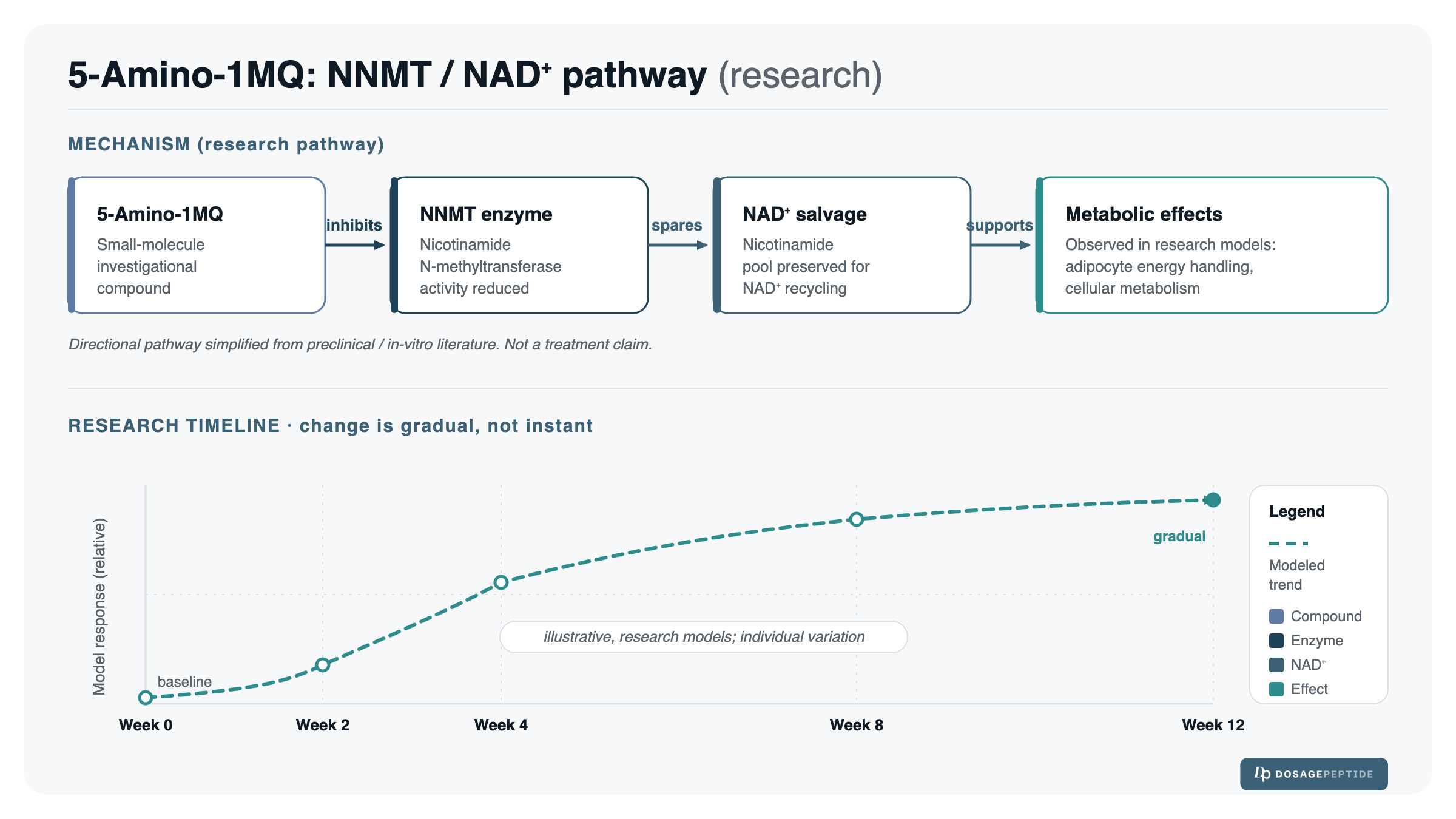
NNMT methylates nicotinamide — a form of vitamin B3 — using a methyl donor from the S-adenosylmethionine (SAM) methylation cycle. In simplified terms, high NNMT activity consumes both nicotinamide (a precursor in the NAD+ salvage pathway) and methyl groups. Preclinical researchers are interested in NNMT precisely because it sits at this metabolic crossroads.
Why inhibiting NNMT may raise cellular NAD+ and shift fat-cell metabolism
The working hypothesis in the research literature is that inhibiting NNMT preserves nicotinamide for NAD+ production and frees up methyl groups, which in turn may influence how fat cells handle energy. In preclinical work, NNMT inhibition has been associated with increased cellular NAD+, reduced lipogenesis (fat storage), increased oxygen consumption in fat cells, and preserved lean mass. To be precise: these are lab and animal observations, and the causal chain from “NAD+ goes up” to “a person changes body composition” has not been demonstrated in humans.
Why the effect appears fat-tissue-selective
Part of what makes NNMT an appealing target is that the enzyme is highly expressed in white adipose (fat) tissue. Because expression is concentrated there, researchers hypothesize that inhibiting it may act somewhat selectively on fat-tissue metabolism rather than broadly across the body. Again, this is a mechanistic rationale drawn from expression patterns and animal models — not a demonstrated selective effect in people.
The actual preclinical results: the numbers the timelines are built on
Almost every “results” claim about 5-Amino-1MQ traces back to a single, specific study. It is worth looking at exactly what that study measured, because the gap between what it found and what marketing implies is the whole point of this article.
The 2017 diet-induced-obesity mouse study
The anchor study is Neelakantan and colleagues, published in Biochemical Pharmacology in 2017. Researchers took diet-induced obese C57BL/6 mice and administered 5-Amino-1MQ subcutaneously — roughly 20 mg/kg per injection, three times daily, for 11 days. In these mice, the researchers observed:
- Approximately 5.1% loss of body weight from baseline;
- Approximately 35% decrease in epididymal (white adipose) fat-pad mass;
- A greater than 30% decrease in adipocyte (fat-cell) size;
- Approximately 30% lower plasma total cholesterol;
- Food intake unchanged between treated and control groups — suggesting the effect in mice was not simply the animals eating less.
Read that last point twice, because it is genuinely the interesting part of the study: in mice, the changes appeared without a drop in food intake. That is a mechanistically notable signal. But notice what it is not: it is not a human outcome, it is not a timeline for a person, and it is 11 days of an aggressive three-times-daily injection schedule in rodents. Every “you’ll see X by week 4” claim is being reverse-engineered out of this one dataset.
Muscle and regeneration signals from NNMT-knockdown work
The 2017 study did not appear from nowhere. Earlier work established NNMT as a metabolic target — notably a 2014 Nature study by Kraus and colleagues showing that knocking down NNMT (using antisense oligonucleotides) protected mice against diet-induced obesity. That is the genetic-knockdown precedent that made pharmacological inhibition worth pursuing. Separately, some NNMT research has explored signals related to muscle and tissue regeneration. These are consistent, mechanistically coherent threads — and they are all preclinical. None of them establishes a human result or a human timeline.
“Realistic timeline”: what the evidence can and cannot tell you
This is the section the competing “before and after” articles skip. Here is the honest reframe.
Why any human “week-by-week” timeline is extrapolation, not data
A timeline is a claim about when something happens in a person over weeks or months. The entire published efficacy dataset for 5-Amino-1MQ is an 11-day rodent experiment. You cannot honestly derive a human 12-week schedule from an 11-day mouse study — the species differ, the dosing route and frequency differ, and no one has run the human observation to check. So when a vendor page tells you “energy by week 2, body-composition change by weeks 4–6, peak effect by weeks 8–12,” what you are reading is a narrative, not a research finding. It may turn out to be roughly right; it may turn out to be entirely wrong. As of now, it is unvalidated.
How researchers frame observation windows in metabolic studies
There is also a biological reason to be skeptical of fast-timeline claims. In metabolic research, mechanistic changes — things happening inside cells, such as enzyme activity, NAD+ levels and gene expression — typically precede visible body-composition changes by a meaningful lag. A compound can be “doing something” at the molecular level long before any measurable change in mass or size would appear, and characterizing that lag is exactly what a proper human trial would need to do. Because that trial has not been run, no one can honestly tell you where the lag lands in people.
The table below is the honest comparison. It contrasts what marketed timelines claim against what the evidence base actually supports.
| Stage | What marketed timelines claim | What the evidence base actually supports |
|---|---|---|
| Weeks 1–2 | Increased energy, early “priming” | No human data. No study has measured this in people. |
| Weeks 4–6 | Visible body-composition change | No human data. The only body-composition figures come from 11-day mouse experiments. |
| Weeks 8–12 | “Peak” fat-loss results | No human data. No human study has run to 12 weeks — or to any efficacy endpoint. |
| Underlying dataset | Implied to be human experience | A single ~11-day preclinical mouse study, plus supporting NNMT-knockdown animal work. |
How 5-Amino-1MQ is studied vs. injectable peptides
One practical divergence is worth understanding: much of the published animal work on 5-Amino-1MQ used injected compound (subcutaneous, in mice), yet in research-market circles 5-Amino-1MQ is frequently discussed as an oral capsule. That is a real gap between how the anchor study delivered the compound and how it is commonly handled — and it is another reason the animal figures cannot be mapped cleanly onto an oral protocol. Absorption, distribution and effective exposure differ by route, and none of that has been characterized in humans for this compound. It also sets 5-Amino-1MQ apart from many research peptides, which are handled as a reconstituted vial drawn into a syringe.
Safety signals from preclinical work
In the mouse study, 5-Amino-1MQ was reported as generally well-tolerated over the short 11-day window, with the notable observation that treated animals did not simply stop eating. That is a preclinical tolerability signal — nothing more. Human safety is not established. There is no human safety dataset, no long-term data, no data on interactions, and no regulatory review of the compound for human use. “Well-tolerated in mice for 11 days” and “safe for a person” are separated by an enormous, unbridged gap. Treat the absence of human safety data as a hard limit on what can be claimed.
If you’re researching it: where the real numbers live
This article deliberately gives no dose. If you are looking at 5-Amino-1MQ in a research context and need the actual reconstitution and measurement details, those belong on the protocol pages, not in a “results” article. You can find the 5-Amino-1MQ dosage protocol in our single-peptide index, walk through how researchers prepare a vial with our peptide reconstitution guide, and work out concentration and volume with our reconstitution & dosage calculator. The numbers live there, framed appropriately as research-handling information.
Bottom line: an interesting mechanism, a thin human evidence base
5-Amino-1MQ is not vaporware and it is not a miracle. The NNMT/NAD+ mechanism is a legitimate, actively-researched metabolic target, and the preclinical numbers — a roughly 5% body-weight reduction and a roughly 35% drop in a fat pad in obese mice, without reduced food intake — are a real, specific finding worth taking seriously as animal data. What does not exist is any of the human evidence the marketing timelines quietly assume. The most useful posture for a researcher is to hold both facts at once: the mechanism is interesting, and the human timeline is unknown. Anyone selling you certainty about the second point is selling you a story.
FAQ
Is 5-Amino-1MQ FDA approved?
No. 5-Amino-1MQ is not an FDA-approved drug and is handled as a research-use-only compound. It has not been reviewed or authorized for human use.
Are there human studies on 5-Amino-1MQ?
There are no completed human efficacy trials. A search of the public clinical-trials registry does not turn up completed trials establishing human results — the efficacy evidence is entirely preclinical (rodent and cell studies). We flag that absence deliberately, because it is central to reading any “results” claim honestly.
Is 5-Amino-1MQ a peptide?
No. It is a small molecule — a methylquinolinium compound — not a peptide. Vendors and forums often group it with research peptides, but chemically it is a different class of compound.
How is 5-Amino-1MQ different from NMN or NR?
All three touch NAD+ metabolism, but by different routes. NMN and NR are NAD+ precursors — they are proposed to raise NAD+ by feeding into the pathway directly. 5-Amino-1MQ instead inhibits NNMT, an enzyme that consumes nicotinamide and methyl groups, which is a different mechanism for influencing NAD+ and fat-cell metabolism. They are not interchangeable, and comparing them requires more than assuming “they all raise NAD+.”
References
- Neelakantan H, Vance V, Wetzel MD, et al. “Selective and membrane-permeable small molecule inhibitors of nicotinamide N-methyltransferase reverse high fat diet-induced obesity in mice.” Biochemical Pharmacology. 2017;147:141–152 — the anchor preclinical study for the cited figures. (PubMed 29155147)
- Kraus D, Yang Q, Kong D, et al. “Nicotinamide N-methyltransferase knockdown protects against diet-induced obesity.” Nature. 2014 — the NNMT-knockdown precedent establishing NNMT as a metabolic target. (PubMed 24717514)
- Peer-reviewed review literature on NNMT biology, NAD+ metabolism, and the S-adenosylmethionine (SAM) / methylation cycle — for the mechanistic framing of NNMT at the crossroads of NAD+ and methyl-group handling.
- Public clinical-trials registry — a registry search does not return completed 5-Amino-1MQ efficacy trials, supporting the “no completed human data” statement.
Disclaimer: This article is for informational and research purposes only and is not medical advice. 5-Amino-1MQ is a research-use-only compound; it is not FDA-approved, has no completed human clinical trials, and its safety and efficacy in humans have not been established. Nothing here promises fat loss, increased energy, muscle gain, or any personal result, and nothing here should be interpreted as a recommendation to use any compound. All efficacy figures described are from animal or cell studies. Products discussed are intended for laboratory and research use only and not for human consumption. Consult a qualified professional before making any health-related decision.