PNC-27 is a synthetic 32-amino-acid peptide that, in cell-culture and mouse studies, appears to punch holes in the membranes of cancer cells while leaving normal cells intact. That mechanism is real and reasonably well characterised — and that is where the evidence stops. There are no published human clinical trials, no approved use anywhere, and the FDA has issued a warning about products sold under this name. Below: how the p53/HDM-2 membrane mechanism works, what the preclinical studies measured, and exactly where the science ends and the marketing begins.
This is a research-and-education reference, not medical advice. Nothing here should be read as a recommendation to obtain, self-administer, or use PNC-27 to prevent, treat, or cure any disease. If you or someone you know is facing cancer, the appropriate next step is a conversation with a licensed oncologist about approved, evidence-based options — not an unapproved peptide sold online.
What is PNC-27 and where did it come from?
PNC-27 belongs to a small family of peptides — the “PNC” series — developed by a research group centered at SUNY Downstate Medical Center and collaborating institutions, with names such as Kanovsky, Michl, Do, Bowne, Sarafraz-Yazdi, and Pincus recurring across the primary literature. The concept originates from the biology of the tumor-suppressor protein p53, often called “the guardian of the genome.” In healthy cells, p53 senses DNA damage and other stresses and can trigger cell-cycle arrest or programmed cell death. Its activity is held in check by a protein called HDM-2 (the human homolog of mouse MDM2), which binds the amino-terminal transactivation domain of p53 and marks it for degradation. Many cancers exploit this relationship, over-producing HDM-2 to suppress whatever functional p53 remains.
The founding idea, published by Kanovsky and colleagues in the Proceedings of the National Academy of Sciences in 2001, was to take the very piece of p53 that binds HDM-2 — a short stretch corresponding roughly to residues 12–26 — and turn it into a free-standing peptide that could interfere with the HDM-2/p53 interaction inside transformed cells.[1] That study reported that peptides built from the amino-terminal MDM-2-binding domain of p53, designed from conformational analysis, were selectively cytotoxic to transformed cells rather than to normal cells. Because a bare 15-residue fragment cannot easily cross the cell membrane on its own, the researchers fused it to a “leader” sequence — a cell-penetrating peptide derived from the Drosophila Antennapedia homeodomain protein, commonly known as penetratin. The resulting chimera is PNC-27.
Identity at a glance
| Property | Description (research context) |
|---|---|
| Compound class | Synthetic chimeric peptide (p53-derived domain + penetratin leader) |
| Length | 32 amino acids |
| Functional domains | p53 residues ~12–26 (HDM-2-binding) + membrane-penetrating leader sequence (penetratin/“membrane residency peptide”) |
| Reported published sequence | PPLSQETFSDLWKLLKKWKMRRNQFWVKVQRG (one-letter notation as reported in the primary literature) |
| Molecular character | Amphipathic; NMR studies describe a helix–loop–helix conformation characteristic of pore-forming, membrane-active polypeptides |
| Approximate molecular weight | ~3.9 kDa (varies slightly by salt form and terminal chemistry) |
| Molecular target | HDM-2 (MDM2) protein expressed at the cancer-cell plasma membrane |
| Sister compound | PNC-28 (uses p53 residues ~17–26); PNC-29 is a control peptide with a scrambled/non-binding sequence |
| Regulatory status | Not FDA-approved; no completed human clinical trials; subject of an FDA consumer safety alert |
Two points about the sequence deserve emphasis for accuracy. First, exact one-letter sequences reported for research peptides can differ subtly between publications and vendors depending on terminal modifications and how the penetratin leader is written; treat any single sequence string as approximate rather than canonical. Second, the “membrane residency peptide” (MRP) framing used in later papers refers to the same leader region and its documented tendency to insert into and reside within lipid membranes — a property that turns out to be central to the mechanism. If you are working through peptide nomenclature and abbreviations, the site’s peptide research glossary defines many of the terms used throughout this article.
What does each part of the peptide do?
PNC-27 is best understood as two functional modules stitched together, and the division of labor explains both its design and its behavior.
- The p53-derived recognition module (roughly residues 12–26 of p53). This is the “address label.” It corresponds to the segment of p53 that normally docks into HDM-2, so it gives the peptide its affinity for HDM-2. In the standard intracellular model of p53 biology, this is the region a drug would use to compete p53 away from HDM-2; in PNC-27’s membrane model, it is what steers the whole peptide toward HDM-2 displayed on the cancer-cell surface.
- The penetratin / membrane-residency leader. Penetratin is a well-studied cell-penetrating peptide derived from the Drosophila Antennapedia homeodomain. On its own it is used across cell biology to ferry cargo across membranes. In PNC-27 it does more than chaperone: its membrane-inserting, amphipathic character is proposed to be what actually builds the transmembrane pore once the peptide is anchored at membrane HDM-2. This is why later papers call it a “membrane residency peptide” — it takes up residence in the lipid bilayer rather than simply passing through.
The combination is what makes the compound interesting: the recognition module supplies selectivity (bind where HDM-2 is displayed) and the leader supplies the lethal action (disrupt the membrane there). Sibling peptide PNC-28 uses a slightly shorter p53 fragment (residues 17–26) with the same leader, and the non-binding PNC-29 serves as the control that ties the killing to the specific recognition sequence rather than to the leader alone.
Why target the p53–HDM-2 (MDM2) axis at all?
To evaluate PNC-27 fairly, it helps to understand why the p53–HDM-2 relationship is such a heavily pursued target in oncology. The TP53 gene is the single most frequently altered gene in human cancer; a large fraction of tumors carry mutations, deletions, or functional inactivation of p53. Wild-type p53 sits at the hub of the cell’s stress response. When DNA is damaged, when oncogenes are inappropriately activated, or when a cell is under metabolic or replicative stress, p53 accumulates and acts as a transcription factor, switching on genes that halt the cell cycle, drive DNA repair, or, if the damage is too severe, commit the cell to apoptosis. A cell with fully functional p53 is therefore hard to turn cancerous, which is why tumors so often disable it.
HDM-2 is p53’s principal brake. It is an E3 ubiquitin ligase that binds the amino-terminal transactivation domain of p53, blocks its transcriptional activity, and tags it with ubiquitin for destruction by the proteasome. The two proteins form a feedback loop: p53 switches on the HDM2 gene, and the resulting HDM-2 protein then degrades p53, keeping its levels low under normal conditions. In many cancers this loop is hijacked — tumors amplify or over-express HDM-2, which crushes any residual wild-type p53 and removes a key barrier to uncontrolled growth. This is the vulnerability that most p53-directed drug programs try to exploit: block HDM-2’s grip on p53, and functional p53 is freed to do its job.
PNC-27’s designers started from this same logic but arrived at a mechanism that, as the evidence matured, turned out to be quite different from the standard “free intracellular p53” playbook. Rather than acting inside the cell to reactivate p53, PNC-27 appears to weaponize a peculiar property of cancer cells: their tendency to display HDM-2 on the outside of the cell, at the plasma membrane. That distinction — membrane HDM-2 as a target rather than intracellular HDM-2 as an inhibitory partner — is what makes PNC-27 mechanistically distinctive, and it is the thread to follow through the sections below.
How does PNC-27 kill cancer cells? The proposed mechanism
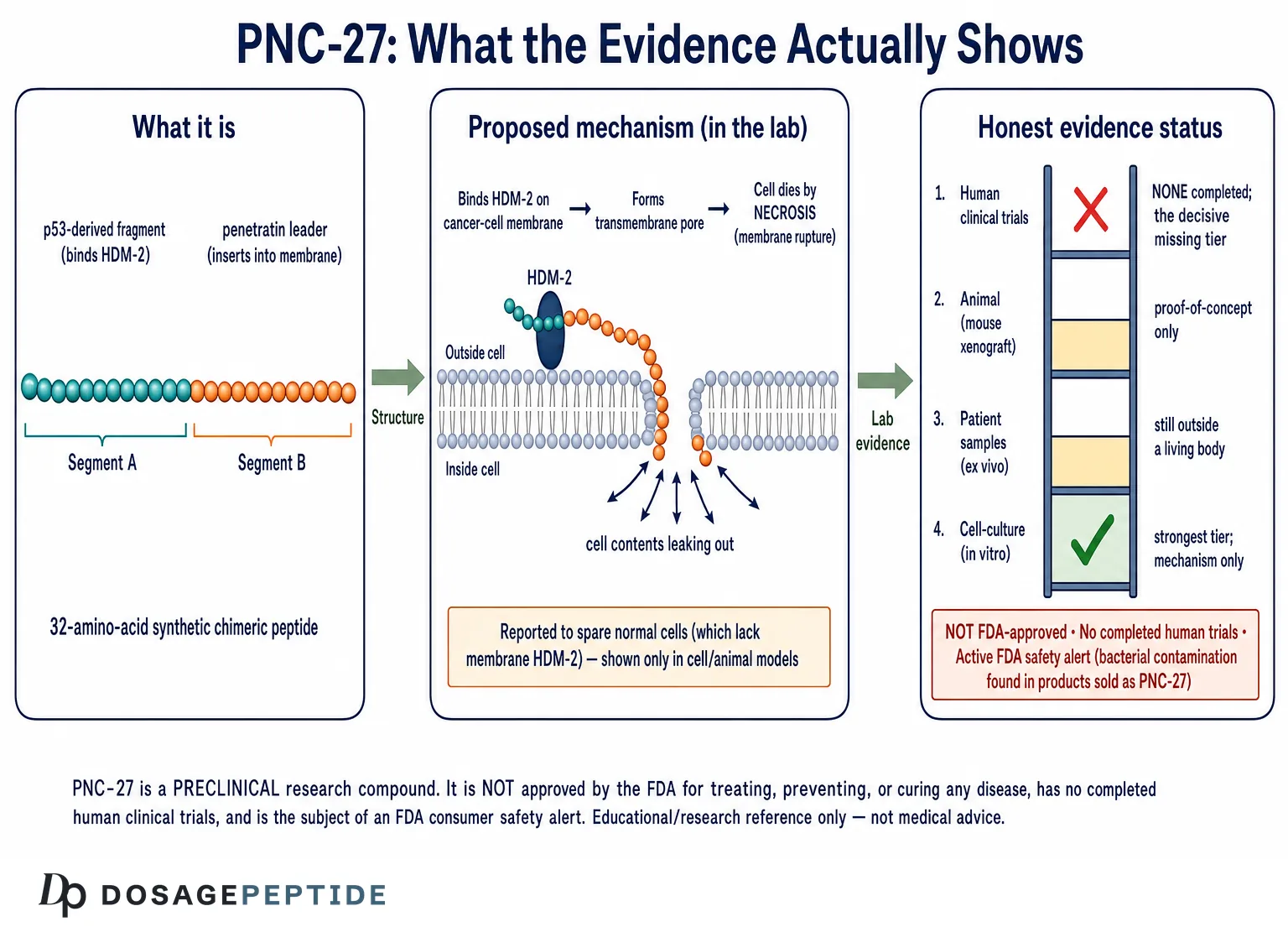
The mechanism of PNC-27 is genuinely unusual, and understanding it is the key to reading the evidence honestly. When the peptides were first designed, the working hypothesis was intracellular: the p53-derived fragment would slip inside the cell, bind HDM-2, free up p53, and thereby restore programmed cell death (apoptosis). Over the following two decades, the research group’s own experiments pushed them toward a different and more surprising model.
Step 1: HDM-2 at the cancer-cell membrane
A recurring finding across the PNC literature is that many cancer cells display HDM-2 not only inside the cell but at the plasma membrane — on the cell surface — whereas most normal cells do not. In a 2010 PNAS paper, Sarafraz-Yazdi and colleagues reported that PNC-27 adopts an HDM-2-binding conformation and kills cancer cells by binding to HDM-2 located in their membranes; untransformed human breast epithelial cells, which do not normally express membrane HDM-2, were not susceptible to PNC-27-induced lysis.[2] This membrane-localized HDM-2 is proposed to be the molecular “address” that gives PNC-27 its reported selectivity.
Step 2: Colocalization and transmembrane pore formation
Once at the membrane, PNC-27 is proposed to bind membrane HDM-2 in a 1:1 complex, with the penetratin leader oriented so that it inserts into the lipid bilayer. Conformational-energy calculations and structural work suggest the bound peptide arranges into the amphipathic helix–loop–helix motif shared by many pore-forming polypeptides. In a 2022 study in Biomedicines, the authors reported that PNC-27 binds HDM-2 in a p53 peptide-like structure and induces selective membrane-pore formation leading to cancer-cell lysis, with transmission electron microscopy revealing transmembrane pores in treated cancer cells.[3] The pores are large enough to allow intracellular contents to leak out, which is measured experimentally as release of the enzyme lactate dehydrogenase (LDH).
Step 3: Necrosis, not apoptosis — and a p53-independent effect
This is the mechanistic twist that most distinguishes PNC-27 from other p53/MDM2-targeting approaches. Rather than restoring orderly, programmed apoptosis, the membrane-pore mechanism causes the cell to spill its contents and die by necrosis — a faster, messier form of cell death. Crucially, because the killing depends on membrane HDM-2 rather than on rescuing intracellular p53 function, the effect has been reported even in cancer cell lines that lack functional p53. In a 2014 report in Annals of Clinical and Laboratory Science, PNC-27 induced necrosis of a poorly differentiated, p53-null human leukemia cell line, and that killing depended on expression of HDM-2 in the plasma membrane of those cells.[4] This p53-independence is mechanistically important: it means PNC-27’s reported activity does not require the tumor to have intact p53 signaling.
Step 4: A possible second hit at the mitochondria
More recent work suggests the story may not end at the plasma membrane. A 2024 paper in Annals of Clinical and Laboratory Science reported that, in addition to co-localizing with membrane-expressed HDM-2 and forming transmembrane pores, PNC-27 can enter cancer cells and bind mitochondrial membranes, causing mitochondrial disruption.[5] If confirmed and independently replicated, a dual plasma-membrane-plus-mitochondrial mechanism would help explain the rapid and extensive cell death observed in some assays. It is worth stressing that this is a recent finding from the originating research lineage and awaits broader independent confirmation.
The contrast between necrosis and apoptosis is not a trivial detail. Apoptosis-inducing drugs work by nudging a cell’s own suicide program; membrane-lytic necrosis is closer to physically punching holes in the cell. Understanding which pathway a compound uses shapes expectations about selectivity, off-target toxicity, and immune consequences — all of which are still open research questions for PNC-27.
Why the necrosis-versus-apoptosis distinction matters
In apoptosis, a cell dies quietly. Its membrane stays intact while internal machinery dismantles the cell into neat, membrane-wrapped packages that neighboring cells clear away with minimal inflammation. Most conventional chemotherapy and most p53-reactivating strategies aim for apoptosis precisely because it is orderly. Necrosis is the opposite: the membrane fails, the cell swells and bursts, and its contents — including molecules that act as danger signals — spill into the surrounding tissue. The membrane-pore mechanism attributed to PNC-27 is a form of lytic, necrotic death.
This has two research-relevant implications, both still unresolved for PNC-27. On the potentially favorable side, necrotic death releases “damage-associated molecular patterns” that can, in principle, alert and activate the immune system against a tumor — an effect that apoptosis tends to suppress. On the potentially unfavorable side, uncontrolled necrosis and the inflammation it triggers can damage surrounding healthy tissue if the killing is not perfectly confined to cancer cells. Which of these dominates cannot be answered by cell-culture experiments, because a dish has no immune system. It requires studies in immunocompetent animals and, ultimately, humans — neither of which has been done at the level needed to settle the question. This is a concrete example of why a plausible in-vitro mechanism does not equal a proven therapy.
A quick note on how “selectivity” is demonstrated
Whenever a study claims PNC-27 “spares normal cells,” it is worth asking exactly what the comparison was. In the primary literature, selectivity is typically shown by running the peptide against a cancer cell line and, in parallel, against a matched untransformed or normal cell population — for example untransformed breast epithelial cells, or normal rat mononuclear cells — and demonstrating membrane rupture (LDH release) in the former but not the latter. A non-binding control peptide, PNC-29, is usually included to confirm that killing tracks with the specific HDM-2-binding sequence and not with generic peptide toxicity. This is a reasonable experimental design, but it establishes selectivity under those specific culture conditions against those specific cells — not a guarantee of selectivity across the vast diversity of human tissues in a living body.
What is the actual evidence base? An honest, study-type review
Here the article must be scrupulous, because PNC-27 is marketed online in ways the underlying science does not support. The evidence falls into three tiers, and it is essential to keep them separate.
In-vitro (cell-culture) evidence
This is the strongest and most abundant tier. Across roughly two decades, the originating group and collaborators have reported PNC-27 (and its sibling PNC-28) killing a range of human cancer cell lines in culture — including breast, pancreatic, leukemia, ovarian, and other lines — while reportedly sparing matched normal cells. A 2020 study in Anticancer Research found that HDM-2 was expressed at high levels in the membranes of the leukemia lines U937, OCI-AML3, and HL-60, and that PNC-27 induced necrosis and LDH release within about four hours, whereas the control peptide PNC-29 and normal rat mononuclear cells showed no such release.[6] A separate 2020 report linked PNC-27-induced necrosis of epithelial ovarian cancer cell lines specifically to high membrane expression of HDM-2.[7] Researchers have also tested PNC-27 against patient-derived tumor samples ex vivo; a 2016 study examined its cytotoxicity against patient-derived epithelial ovarian cancer specimens.[8]
A useful detail from these studies is the speed of the effect. Membrane-lytic necrosis is fast: LDH release in the leukemia work was measurable within roughly four hours, consistent with a physical membrane-disruption mechanism rather than the slower, transcription-dependent cascade of apoptosis. The reliance on membrane HDM-2 is reinforced by the pattern that cell lines with high membrane HDM-2 are susceptible, while cells lacking it — and the non-binding control peptide PNC-29 — do not produce the same lytic signature. Taken together, the in-vitro package is internally coherent: a specific target, a measurable physical readout, a matched-control design, and a consistent selectivity pattern within these experiments.
What in-vitro data can and cannot tell us: cell-culture experiments are excellent for probing mechanism — which protein is bound, whether pores form, which cells are spared. They are poor predictors of whether a compound will be safe or effective in a living organism, where absorption, distribution, degradation, immune response, and off-target binding all intervene. The graveyard of oncology drug development is full of compounds that looked spectacular in a dish and failed in patients. Cell lines also drift and adapt in culture and are grown in artificial conditions, so even a robust in-vitro signal is only the first rung of a long ladder.
Animal (in-vivo) evidence
The animal evidence is real but limited, mostly involving mouse xenograft models in which human tumor cells are implanted into immunodeficient mice. For the sibling peptide PNC-28, Michl, Do, and colleagues reported in the International Journal of Cancer in 2006 that the p53-derived peptide was cytotoxic to cancer cells and blocked pancreatic cancer cell growth in vivo, with intraperitoneal administration reducing implanted tumor growth in nude mice.[9] The 2010 PNAS mechanistic paper likewise incorporated in-vivo observations alongside its structural and cell-based work.[2] These xenograft results are encouraging at the proof-of-concept level, but xenografts in immunodeficient mice are a simplified stand-in for human cancer: they lack an intact immune system, use one tumor cell line at a time, and involve dosing regimens that do not translate directly to humans. The immunodeficiency is a particularly important caveat for a necrosis-inducing agent, because the immune reaction to necrotic tumor debris — which could either help or harm — is exactly what these models cannot capture. A compound that suppresses a tumor in a nude mouse has cleared a meaningful but early hurdle; many compounds clear it and still fail when confronted with the complexity of a whole human being, human pharmacokinetics, and human toxicity.
Human (clinical) evidence — the critical gap
There is no completed, published, peer-reviewed randomized human clinical trial of PNC-27, and PNC-27 is not approved by the FDA (or, to the best available knowledge as of mid-2026, by any comparable major regulator) for the prevention, treatment, or cure of any disease. The entire human-relevant case for PNC-27 rests on cell-culture and mouse data plus ex-vivo work on patient-derived samples. Anyone claiming PNC-27 is a proven cancer treatment for people is going well beyond what the science supports. This gap — from mouse xenograft to demonstrated human safety and efficacy — is precisely the gap that formal clinical trials exist to close, and for PNC-27 it has not been closed.
| Evidence tier | What exists for PNC-27 | Strength / caveat |
|---|---|---|
| In-vitro (cell lines) | Multiple studies across breast, pancreatic, leukemia, ovarian and other lines; mechanism, pore formation, HDM-2 dependence, selectivity vs normal cells | Strongest tier; good for mechanism, weak for predicting human outcomes |
| Ex-vivo (patient samples) | Cytotoxicity tested against patient-derived ovarian/endometrial specimens | Intermediate; still outside a living body |
| Animal (in-vivo) | Mouse xenograft tumor-growth reduction (esp. PNC-28 pancreatic; PNC-27 mechanistic in-vivo work) | Proof-of-concept only; immunodeficient, single-line models |
| Human (clinical trials) | None completed/published; no FDA approval | The decisive missing tier |
Is PNC-27 independently replicated, or a single-lab result?
An honest reference has to address a real limitation: the great majority of the primary PNC-27 literature traces back to one interconnected research lineage (the SUNY Downstate group and close collaborators, with Pincus, Michl, Bowne, and Sarafraz-Yazdi as recurring authors). Findings from a single research program — however carefully done — carry less weight than findings reproduced independently by unrelated laboratories, because independent replication guards against method-specific artifacts and unconscious bias. As of this writing, broad, unrelated-laboratory replication of PNC-27’s central membrane-HDM-2 mechanism and its selectivity claims is limited. This does not mean the results are wrong; it means the appropriate scientific posture is cautious optimism pending independent confirmation, not the confident “it kills cancer” language used in marketing.
Several genuinely open scientific questions remain: How consistently is HDM-2 expressed at the membrane across human tumor types and stages? What is PNC-27’s behavior in immunocompetent animals, where the immune system reacts to necrotic debris? What is its stability, distribution, and clearance in a whole organism? And does the membrane-pore mechanism carry any off-target risk to the subset of normal cells that can, under some conditions, display HDM-2? These are the questions rigorous drug development would answer before anything approaches human use.
How does PNC-27 compare with other p53/MDM2-targeting approaches?
PNC-27 is one strategy among several aimed at the p53–MDM2/HDM-2 axis, and its mechanism is an outlier. Most other approaches try to reactivate p53 inside the cell by blocking the p53–MDM2 interaction, restoring apoptosis. PNC-27, by contrast, is proposed to exploit membrane-displayed HDM-2 to trigger necrosis directly. The table below situates it among representative research/clinical strategies. Note that several small-molecule MDM2 inhibitors have reached human trials, which is a meaningful contrast with PNC-27’s preclinical-only status.
| Approach | Type | Proposed mechanism | Cell death mode | Development stage (general) |
|---|---|---|---|---|
| PNC-27 | Chimeric peptide | Binds membrane HDM-2, forms transmembrane pores | Necrosis (membranolysis) | Preclinical only; not approved |
| PNC-28 | Chimeric peptide (sister) | Same family; p53 residues 17–26 + penetratin | Necrosis | Preclinical only |
| Small-molecule MDM2 inhibitors (e.g. nutlin-class research compounds) | Small molecule | Block intracellular p53–MDM2 binding to reactivate p53 | Apoptosis (p53-dependent) | Various have entered human clinical trials |
| Stapled-peptide p53 activators | Constrained peptide | Intracellular dual MDM2/MDMX inhibition | Apoptosis (p53-dependent) | Investigational; some clinical testing |
| Gene-therapy p53 restoration | Viral/gene delivery | Deliver wild-type p53 gene | Apoptosis | Approved in some jurisdictions historically; investigational elsewhere |
The strategic distinction is important. Because approaches that reactivate intracellular p53 depend on the tumor retaining a functional p53 program, they can fail in the many cancers with mutated or deleted p53. PNC-27’s reported p53-independence is, in theory, an advantage in exactly those tumors — but “in theory” and “in a dish” are not “in patients.”
There is also a maturity gap worth naming. Several small-molecule MDM2 inhibitors have progressed into registered human clinical trials, where they have generated real (and sobering) human safety and efficacy data — including dose-limiting toxicities that tempered early enthusiasm. That is what a maturing drug program looks like: candidates enter the clinic, and the clinic teaches hard lessons. PNC-27 has not reached that stage. Its comparative “advantages” over other approaches are advantages on paper and in preclinical models; the approaches it is compared against have, in several cases, been stress-tested in humans, whereas PNC-27 has not.
What would it take for PNC-27 to become a legitimate therapy?
Framing the remaining distance concretely is more useful than either hype or dismissal. For PNC-27 to move from research compound toward a potential therapy, it would generally need to clear a sequence of hurdles that it has not yet cleared:
- Rigorous, independent preclinical replication of the membrane-HDM-2 mechanism and the selectivity claims by laboratories unconnected to the originating group.
- Formal toxicology and pharmacokinetics in appropriate animal models — including immunocompetent models — to characterize safety, distribution, immunogenicity, and the consequences of inducing necrosis in vivo.
- An accepted, reproducible formulation and manufacturing standard ensuring identity, purity, and sterility — the very things unregulated online products lack.
- Regulatory authorization to begin human testing (in the U.S., an Investigational New Drug clearance), followed by Phase 1 safety, Phase 2 signal-finding, and Phase 3 confirmatory trials.
- Positive, reproducible human data at each stage, without prohibitive toxicity.
Each of these steps takes years and can end the program at any point. Until they are cleared, the scientifically accurate description of PNC-27 is “a preclinical research peptide with an interesting mechanism,” not “a cancer treatment.”
What research models and methods are used to study PNC-27?
Understanding the toolbox behind the claims helps readers weigh them. The PNC-27 literature relies on a fairly standard set of preclinical methods:
- Cancer cell lines: Immortalized human lines such as U937, OCI-AML3, and HL-60 (leukemia), plus breast, pancreatic (e.g. BMRPA1.TUC-3 in the PNC-28 work), and ovarian lines. Matched “normal” or untransformed cells (e.g. untransformed breast epithelial cells, normal mononuclear cells) serve as selectivity controls.
- Control peptides: PNC-29 (a non-binding/scrambled control) is used to show that killing depends on the specific HDM-2-binding sequence, not on generic peptide toxicity.
- Cytotoxicity and membrane-integrity assays: LDH-release assays quantify membrane rupture; viability and cell-death assays distinguish live, apoptotic, and necrotic populations.
- Imaging: Transmission electron microscopy (TEM) is used to visualize transmembrane pores; immunofluorescence and confocal microscopy localize HDM-2 and peptide at the membrane.
- Structural biology: Two-dimensional NMR and conformational-energy calculations characterize the peptide’s helix–loop–helix fold and its HDM-2-bound conformation.
- Animal models: Xenografts in immunodeficient (nude/Nu-Nu) mice, with intraperitoneal or local dosing and tumor-size readouts.
These methods are appropriate for hypothesis-generation and mechanism. What is conspicuously absent from the toolbox — because it has not happened — is the sequence of formal, regulated human trials (Phase 1 safety, Phase 2 signal, Phase 3 confirmatory) that would be required to call PNC-27 a treatment.
Pharmacology, stability, and research handling
As a ~32-residue peptide, PNC-27 shares the general pharmacological vulnerabilities of peptides: susceptibility to enzymatic degradation by proteases, limited oral bioavailability (the gut would digest it like any dietary protein), and sensitivity to temperature and repeated freeze–thaw cycles. Its amphipathic, membrane-active character — the very property that underlies the proposed pore-forming mechanism — also makes formulation and delivery non-trivial, since a molecule that inserts into lipid membranes must be handled so that it reaches its intended target rather than the first membrane it meets. Detailed, well-characterized human pharmacokinetic parameters (half-life, clearance, tissue distribution, immunogenicity) are not established, precisely because the human studies that would define them have not been conducted. In research settings the compound is typically supplied as a lyophilized (freeze-dried) powder to be reconstituted in a suitable solvent immediately before use in an assay.
General laboratory handling principles for research peptides — presented here strictly for educational and research context, not as human-use instructions — include reconstituting with an appropriate diluent, avoiding repeated freeze–thaw cycles, storing lyophilized material cold and protected from light, and preparing working aliquots to preserve stock integrity. For the underlying technique in a research context, see the site’s peptide reconstitution guide, and for the arithmetic of preparing research concentrations, the peptide dosage calculator. If you are looking specifically at how a research vial is described and characterized, the reference page for the PNC-27 30 mg vial research protocol compiles the handling and specification details in one place. None of these resources should be read as endorsing human administration.
What is the current regulatory and safety status of PNC-27?
This is the most important section for anyone encountering PNC-27 online, and it is unambiguous. PNC-27 is not an approved drug. The U.S. FDA has issued a consumer alert specifically warning people to avoid PNC-27, stating that the agency has not approved the drug and that it is not indicated to treat any condition.[10] The warning is not merely about a lack of approval; it also flags concrete safety hazards. The FDA reported finding bacterial contamination in products sold as PNC-27 — including Variovorax paradoxus in an inhalable form — and cautioned that such contamination can cause serious adverse events, potentially fatal ones, especially in vulnerable groups such as young children, the elderly, pregnant people, and the immunocompromised.[11]
The FDA also noted that PNC-27 is being sold online in alarming formats — nebulized solutions, intravenous solutions, and vaginal or rectal suppositories — none of which are quality-controlled, prescribed, or medically supervised. Because these products are unregulated, buyers cannot verify identity, purity, sterility, or actual content. The agency’s recommendation is to avoid PNC-27 and to discuss approved treatment options with a licensed healthcare professional. Regulators including the FDA have more broadly warned companies against illegally selling products that fraudulently claim to treat or cure cancer.[12]
The practical upshot: whatever the laboratory science may eventually show, in mid-2026 PNC-27 sold to consumers is an unapproved, sometimes contaminated product carrying documented safety risk. That is the single most important fact on this page.
What are the limitations, open questions, and safety signals?
Pulling the honest picture together, the main limitations of the PNC-27 evidence base are:
- No human clinical data. Efficacy and safety in people are unknown. Everything human-relevant is extrapolation from cells and mice.
- Narrow provenance. Most primary studies come from one research lineage; broad independent replication is limited.
- Model limitations. Xenografts in immunodeficient mice cannot capture the human immune response to necrotic cell death, which could be beneficial (immune activation) or harmful (inflammation) — this is unresolved.
- Selectivity is conditional. Reported selectivity depends on the premise that normal cells lack membrane HDM-2. If some normal tissues express membrane HDM-2 under stress or disease, the safety margin could be narrower than cell-line data suggest.
- Product-quality risk. Beyond the biology, real-world PNC-27 products have been found contaminated, adding an independent and serious safety concern.
The strengths are also real and should not be dismissed: a specific, testable, and unusual molecular mechanism; consistent in-vitro selectivity within the originating studies; p53-independence that is theoretically attractive; and structural data supporting the pore-forming model. PNC-27 is a legitimate object of continued preclinical research. It is not, on current evidence, a therapy.
How has PNC-27 research evolved over time?
Tracing the arc of the literature helps separate durable findings from speculation. The table below summarizes the trajectory from the founding design paper to the most recent mechanistic work. It is intentionally a map of research milestones, not clinical ones, because there are no clinical milestones to report.
| Period | Milestone | What it added |
|---|---|---|
| 2001 | Kanovsky et al., PNAS | Design of p53-derived, MDM-2-binding peptides selectively cytotoxic to transformed cells |
| Mid-2000s | PNC-28 pancreatic xenograft work (Michl et al., Int J Cancer, 2006) | First strong in-vivo proof-of-concept in mice; tumor-growth suppression |
| 2008–2010 | Mechanistic reframing (culminating in Sarafraz-Yazdi et al., PNAS, 2010) | Shift from “intracellular p53 rescue” to membrane-HDM-2 binding and necrosis |
| 2014–2016 | Leukemia necrosis and patient-derived ovarian ex-vivo testing | Extension to p53-null cells and human tumor specimens in the lab |
| 2020 | Leukemia and ovarian membrane-HDM-2 studies (Anticancer Res; others) | Reinforced membrane-HDM-2 dependence and selectivity vs normal cells |
| 2022 | Structural/pore-formation study (Biomedicines) | Detailed the p53-like binding conformation and pore formation |
| 2024 | Mitochondrial-disruption study (Ann Clin Lab Sci) | Proposed an additional intracellular, mitochondrial component |
Common misconceptions about PNC-27
Because PNC-27 is aggressively marketed, several myths circulate that the peer-reviewed record does not support. Correcting them is part of an honest reference.
- “PNC-27 is a proven cancer cure.” False. The evidence is preclinical. There are no completed human trials and no regulatory approval, and the FDA has warned against use.
- “It has been tested and works in patients.” Ex-vivo testing on patient-derived tumor samples in a laboratory is not the same as treating patients. No controlled human trial has shown clinical benefit.
- “Because it is ‘natural’ or peptide-based, it is safe.” A membrane-lytic peptide is a potent biological agent, and unregulated products have been found bacterially contaminated. “Peptide” does not mean “gentle” or “safe.”
- “Selectivity in a dish guarantees selectivity in the body.” Selectivity shown against specific cell lines under specific conditions does not predict behavior across all human tissues, especially where the immune system and stressed normal cells come into play.
- “The lack of trials is just Big Pharma suppression.” The more parsimonious explanation is that the compound has not advanced through the expensive, evidence-generating pipeline that any candidate must clear, and that independent replication of key claims remains limited.
How should you critically evaluate PNC-27 claims you encounter?
When reading about PNC-27 — or any research peptide promoted with medical-sounding claims — a few questions cut through most of the noise:
- What tier of evidence is this? A cell-line or mouse result is a hypothesis about humans, not a demonstration in them.
- Who did the work, and has anyone independent reproduced it? Findings confined to one research lineage warrant more caution than independently replicated ones.
- Is there regulatory approval or an active, registered clinical trial? For PNC-27, the answer is no approval and no completed human trial — plus an FDA warning.
- Does the seller make disease claims? Claims to treat or cure cancer on an unapproved product are a regulatory red flag and, per the FDA, illegal.
- Can product identity, purity, and sterility be verified? For unregulated online products, they generally cannot — and contamination has been documented.
Applying these questions to PNC-27 yields a consistent picture: a scientifically interesting preclinical compound wrapped in marketing claims the evidence does not support. Genuine curiosity about the biology is entirely reasonable; treating that biology as a settled human therapy is not.
Frequently Asked Questions
Is PNC-27 an approved cancer treatment?
No. PNC-27 is not approved by the FDA or, to the best available knowledge as of mid-2026, by any comparable major regulator for treating, preventing, or curing any disease. All existing evidence is preclinical — cell-culture and mouse-model studies plus some patient-sample work in the lab. There are no completed, published human clinical trials. The FDA has issued a consumer alert advising people to avoid PNC-27 entirely.
How is PNC-27 supposed to work?
In laboratory studies, PNC-27 is proposed to bind HDM-2 (MDM2) protein displayed on the surface membrane of cancer cells. That binding, aided by its penetratin leader sequence, is thought to form transmembrane pores that cause the cell to spill its contents and die by necrosis. Because many normal cells do not display HDM-2 at their membrane, researchers report the peptide spares them — the basis of its claimed selectivity.
Is PNC-27 the same as PNC-28?
They are sister peptides from the same research family. Both fuse a p53-derived HDM-2-binding fragment to a penetratin leader, but PNC-27 uses roughly p53 residues 12–26 while PNC-28 uses residues 17–26. PNC-28 is the peptide most associated with the mouse pancreatic-cancer xenograft work. PNC-29 is a non-binding control peptide used to show that killing depends on the specific HDM-2-binding sequence.
Does PNC-27 work if a tumor has no functional p53?
In cell-culture studies, yes — and this is one of its more interesting features. Because the proposed mechanism relies on HDM-2 at the cell membrane rather than on rescuing intracellular p53 activity, researchers have reported PNC-27-induced necrosis even in p53-null cancer cell lines. This p53-independence is documented only in preclinical models and has not been validated in humans.
Why does the FDA warn against PNC-27?
Two reasons. First, PNC-27 is unapproved and unproven in humans, so selling it as a cancer cure misleads vulnerable patients away from evidence-based care. Second, the FDA found real safety hazards: bacterial contamination (including Variovorax paradoxus) in products sold as PNC-27, which can cause serious, potentially fatal infections — particularly in children, the elderly, pregnant people, and those with weakened immune systems.
Has PNC-27 been independently replicated by other labs?
Only to a limited extent. Most of the primary peer-reviewed literature comes from one interconnected research group and its collaborators. Independent replication by unrelated laboratories is what gives a finding durable credibility, and for PNC-27’s central membrane-HDM-2 mechanism that broad independent confirmation is still limited. The appropriate stance is cautious interest pending more replication, not confidence in a cure.
What kinds of studies have been done on PNC-27?
Chiefly in-vitro experiments on human cancer cell lines (leukemia, breast, pancreatic, ovarian and others) using LDH-release and viability assays, electron microscopy of pore formation, and NMR structural analysis. There is also mouse xenograft work (especially for PNC-28) and some ex-vivo testing on patient-derived tumor samples. What is missing entirely is regulated human clinical trials.
Is it safe to buy and use PNC-27 sold online?
No. Products marketed as PNC-27 are unregulated, so their identity, purity, and sterility cannot be verified, and the FDA has documented bacterial contamination in some of them. It is sold in unsafe formats such as nebulizers, IV solutions, and suppositories with no medical oversight. Anyone facing cancer should talk with a licensed oncologist about approved treatment options rather than using an unapproved peptide.
References
- Kanovsky M, Raffo A, Drew L, et al. Peptides from the amino terminal mdm-2-binding domain of p53, designed from conformational analysis, are selectively cytotoxic to transformed cells. Proc Natl Acad Sci USA. 2001;98(22):12438–12443. https://pubmed.ncbi.nlm.nih.gov/11606716/
- Sarafraz-Yazdi E, Bowne WB, Adler V, et al. Anticancer peptide PNC-27 adopts an HDM-2-binding conformation and kills cancer cells by binding to HDM-2 in their membranes. Proc Natl Acad Sci USA. 2010;107(5):1918–1923. https://pmc.ncbi.nlm.nih.gov/articles/PMC2836618/
- Sarafraz-Yazdi E, Mumin S, Cheung D, et al. PNC-27, a chimeric p53-penetratin peptide, binds to HDM-2 in a p53 peptide-like structure, induces selective membrane-pore formation and leads to cancer cell lysis. Biomedicines. 2022;10(5):945. https://pmc.ncbi.nlm.nih.gov/articles/PMC9138867/
- Sarafraz-Yazdi E, et al. The anti-cancer peptide, PNC-27, induces tumor cell necrosis of a poorly differentiated non-solid tissue human leukemia cell line that depends on expression of HDM-2 in the plasma membrane of these cells. Ann Clin Lab Sci. 2014;44(3):241–248. https://pubmed.ncbi.nlm.nih.gov/25117093/
- Anti-cancer peptide PNC-27 kills cancer cells by unique interactions with plasma membrane-bound hdm-2 and with mitochondrial membranes causing mitochondrial disruption. Ann Clin Lab Sci. 2024;54(2):137. https://pubmed.ncbi.nlm.nih.gov/38802154/
- Targeting membrane HDM-2 by PNC-27 induces necrosis in leukemia cells but not in normal hematopoietic cells. Anticancer Res. 2020;40(9):4857–4864. https://pubmed.ncbi.nlm.nih.gov/32878773/
- Anti-cancer tumor cell necrosis of epithelial ovarian cancer cell lines depends on high expression of HDM-2 protein in their membranes. PubMed. 2020. https://pubmed.ncbi.nlm.nih.gov/33067207/
- Ex vivo efficacy of anti-cancer drug PNC-27 in the treatment of patient-derived epithelial ovarian cancer. PubMed. 2016. https://pubmed.ncbi.nlm.nih.gov/26663795/
- Michl J, Scharf B, Schmidt A, et al. PNC-28, a p53-derived peptide that is cytotoxic to cancer cells, blocks pancreatic cancer cell growth in vivo. Int J Cancer. 2006;119(6):1577–1585. https://pubmed.ncbi.nlm.nih.gov/16688716/
- FDA: Avoid PNC-27, discuss approved treatment options with providers. Pharmacy Times. https://www.pharmacytimes.com/view/fda-avoid-pnc27-discuss-approved-treatment-options-with-providers
- FDA warning: unapproved ‘cancer cure’ contaminated with bacteria. Pharmacy Times. https://www.pharmacytimes.com/view/fda-warning-unapproved-cancer-cure-contaminated-with-bacteria
- U.S. Food and Drug Administration. Questions and answers: FDA alerts companies to stop the illegal sale of products claiming to treat cancer. FDA.gov. https://www.fda.gov/consumers/health-fraud-scams/questions-and-answers-fda-alerts-companies-stop-illegal-sale-products-claiming-treat-cancer