
Matrixyl 3000 Dosage Protocol
A topical collagen-signaling peptide blend (palmitoyl tripeptide-1 + palmitoyl tetrapeptide-7) studied at cosmetic strengths for the appearance of aging skin, with modest and largely manufacturer-led evidence.

Matrikine peptides that signal dermal fibroblasts to upregulate extracellular-matrix proteins (collagen, elastin, fibronectin) in vitro.
Formulated at roughly 3-10% of the finished serum; applied topically to clean skin. No injectable or oral dosing.
Water- or glycol-based topical serum blend of palmitoyl tripeptide-1 and palmitoyl tetrapeptide-7 (lipidated for skin penetration).
Store cool and dark, tightly capped; lipopeptides degrade with heat, light and oxidation. Follow the finished product's expiry.
Quickstart Highlights
Matrixyl 3000 is a topical cosmetic matrikine peptide blend — a trade-name combination (Sederma/Croda) of palmitoyl tripeptide-1 (Pal-GHK) and palmitoyl tetrapeptide-7 (Pal-GQPR), two short amino-acid sequences each attached to a palmitic-acid tail that helps the water-soluble peptide cross the skin’s oily outer barrier[1][2]. In the cosmetic literature it is studied for the appearance of aging skin — fine lines, firmness and overall texture — on the rationale that these ‘matrikine’ signals nudge dermal fibroblasts toward making more collagen and extracellular-matrix protein[2][4].
The concentrations and application conventions below reflect published cosmetic-formulation practice and supplier use levels, and are provided strictly for research and educational reference — not medical advice, a treatment claim, or a recommendation to use any product.
Supplies Needed
What a documented topical routine relies on — nothing exotic. With a leave-on peptide serum, a stable well-preserved base and consistent application matter far more than any single tool.
Protocol Overview
A typical 30 mL serum delivers roughly a pea-sized amount (about 0.2–0.3 mL) per application; used twice daily that is a two-to-three month supply — conveniently close to the 8–12 week window over which cosmetic peptide studies are usually read out.
Because benefit depends on consistent use rather than a single strong application, plan supply around finishing a bottle over that evaluation window instead of around a per-dose volume.
Dosing Protocol
A reference schedule showing how topical cosmetic studies typically structure application — expressed as phase / application / frequency rather than milligram doses.
| Phase / Week(s) | Application | Frequency |
|---|---|---|
| Patch test (48 h) | Small amount on inner forearm or behind the ear | Once, before facial use |
| Weeks 1–2 (introduction) | Pea-sized amount to clean, dry face | Once daily (PM) |
| Weeks 3–8 (build) | Pea-sized amount, thin even layer | 1–2× daily (AM and/or PM) |
| Weeks 8–12+ (maintenance) | Continue thin, consistent layer | 1–2× daily, ongoing |
| Evaluation | Compare skin appearance against baseline photos | Read out at ~8–12 weeks |
Why Matrixyl 3000 draws research interest
These are the directions researchers and the peptide community most often explore Matrixyl 3000 for — so you know you’re in the right place. They describe what is being studied, not proven benefits, approved uses, or promised results.
Fine lines & wrinkles
Investigated in topical cosmetic formulations for its effect on the appearance of periorbital and forehead lines (cosmetic tier).
Collagen-matrix signaling
Studied as a matrikine blend that signals fibroblasts to upregulate extracellular-matrix proteins in cell-culture models.
Skin firmness & texture
Explored in serums for the perceived firmness, elasticity and smoothness of photoaged skin (cosmetic tier).
Multi-peptide layering
Researched alongside GHK-Cu and other cosmeceutical peptides in combined topical anti-aging systems.
Evidence ranges from early laboratory work to clinical trials depending on the use — the sections below cover the actual data and sources.
Used at roughly 3–10% of a finished serum; the raw material is pre-diluted, so actual peptide content is a small fraction of that.
A few drops / pea-sized amount smoothed onto clean, dry skin in a thin layer — more product does not force more peptide in.
1–2× daily, applied consistently, with a typical 8–12 week evaluation window.
Cosmetic-grade — modest, largely supplier-led data; the strongest independent human work is on the sibling peptide Pal-KTTKS[5].
Dosing & Application
Because Matrixyl 3000 is topical, ‘dose’ means concentration in the finished product and how consistently it is applied — not milligrams into a syringe. The figures here are reference data from typical cosmetic formulation practice and supplier use levels, not a personal usage instruction.
Standard / Gradual Approach
There is no titration in the injectable sense. The widely referenced approach is simply consistency over intensity: apply a serum at label strength (around 3–10% raw material) once or twice daily and evaluate over 8–12 weeks, because any matrikine effect on skin appearance is gradual and cumulative rather than immediate[4][7]. Pushing the percentage far above the supplier’s recommended level shows little added benefit and mainly raises cost and formulation instability.
Storage Instructions
Lipopeptides are sensitive to heat, UV light, oxygen and pH extremes. Store the finished serum cool, tightly capped and out of direct light; airless or opaque packaging protects the peptides better than an open-mouth jar[4].
Water-based peptide serums support microbial growth, so a competent preservative system is essential. Discard any product that changes color, smell or texture, or that is past its stability window.
Important Notes
Practical points that keep a topical routine consistent and the peptides intact.
- ▪Higher % is not linearly stronger: above the supplier’s recommended level there is little evidence of extra benefit — the marketed 3% → 10% jump is more a marketing lever than a demonstrated efficacy one.
- ▪Delivery beats concentration: whether the peptide reaches living skin depends on the vehicle, penetration enhancers and barrier integrity — factors a label percentage cannot convey[7][8].
- ▪Layering order: apply water-phase peptides to clean skin before heavier occlusive creams; strongly acidic actives (e.g., high-strength exfoliating acids) in the same layer can affect peptide stability, so many routines separate them by time of day.
- ▪Irritation is still possible: any leave-on product can cause contact irritation or, rarely, allergic sensitization — often driven by fragrance, preservatives or the vehicle rather than the peptide itself — so patch-testing a new product is prudent[4].
- ▪Not for injection or ingestion: these are topical cosmetic peptides with no established rationale, dosing or safety data for injecting or ingesting them — doing so falls entirely outside cosmetic use.
How This Works
When the dermal extracellular matrix (ECM) is broken down — by UV exposure, aging or wounding — it releases short peptide fragments, some of which act as feedback signals telling fibroblasts to ramp collagen and other ECM-protein synthesis back up. Synthetic ‘matrikines’ like the Matrixyl peptides are designed to imitate those signals without first having to damage the tissue[2][5]. The lineage is well documented for the sibling peptide: the KTTKS sequence was identified in 1993 as a fragment of type I procollagen that stimulated ECM production in cultured fibroblasts, and palmitoylation was added to make that hydrophilic peptide skin-penetrating[3].
The two components have distinct proposed roles studied in cell culture: palmitoyl tripeptide-1 (a palmitoylated GHK, the same tripeptide core as in the copper peptide GHK-Cu) is reported to stimulate collagen, fibronectin and glycosaminoglycan production[1][6], while palmitoyl tetrapeptide-7 is studied for dampening interleukin-6 release, on the ‘inflammaging’ rationale that low-grade inflammation accelerates matrix breakdown[1]. Two honest caveats: most of this comes from in-vitro fibroblast cultures — a very different environment from intact skin, where the peptide must survive the formulation, cross the stratum corneum and resist skin peptidases — and ‘upregulates collagen in a dish’ is a mechanistic observation, not a guaranteed visible result.
Lifestyle Factors
In the cosmetic literature, peptides are consistently framed as a supporting player — well behind the two interventions with the largest evidence in skin aging: daily broad-spectrum sunscreen and, where appropriate, a retinoid[7]. A serum works best inside that foundation, not instead of it.
Consistency, gentle barrier care (mild cleansing and adequate moisturization) and time matter more than any single application — matrikine effects on skin appearance are cumulative over weeks to months, not immediate.
Potential Benefits & Side Effects
What the cosmetic literature reports Matrixyl 3000 and its peptide family are studied for. Much of the blend-specific data is supplier-generated; the strongest independent human evidence is on the closely related pentapeptide, and effect sizes are subtle rather than dramatic.
Reported Effects
- ▪Appearance of fine lines / wrinkles: a double-blind, placebo-controlled facial study of the sibling peptide palmitoyl pentapeptide (Pal-KTTKS) reported measurable improvement in wrinkles and skin roughness versus vehicle over roughly 12 weeks[5].
- ▪Firmness & matrix support (in vitro): palmitoyl tripeptide-1 (a palmitoylated GHK) is reported to stimulate collagen and extracellular-matrix production in cultured fibroblasts[1][6].
- ▪Anti-inflammatory angle (in vitro): palmitoyl tetrapeptide-7 is studied for reducing interleukin-6 release, on the rationale that low-grade ‘inflammaging’ accelerates matrix breakdown[1][4].
- ▪Overall skin texture: broad cosmeceutical-peptide reviews place the Matrixyl family among the better-rationalized signal peptides while stressing that independent, large, randomized human trials remain scarce[2][7].
Common Side Effects
- ▪Contact irritation: possible with any leave-on serum, usually mild and often traced to the vehicle, fragrance or preservative rather than the peptide itself.
- ▪Allergic sensitization (rare): uncommon but documented for cosmetic formulations generally; patch-testing reduces the risk of a full-face reaction.
- ▪No disease-treatment benefit: studied for the appearance of lines, firmness and texture only — not a treatment for any medical skin condition, and no specific percentage of wrinkle reduction is promised for an individual.
- ▪Independence gap: much blend-specific efficacy data is supplier-generated and not fully peer-reviewed, so extrapolating from the sibling pentapeptide is reasonable but not proof[2].
- ▪Modest effect size: where measured, benefits are subtle and gradual, well behind daily sunscreen and retinoids[7].
How to Apply
Application technique is simple; the goal is to get intact peptide onto clean skin and let it work consistently over weeks.
Skin Preparation
- ▪Cleanse with a gentle cleanser and pat the skin dry — peptides absorb best onto clean, dry skin.
- ▪For a new product, patch-test a small amount on the inner forearm or behind the ear and wait about 48 hours.
- ▪Dispense a few drops or a pea-sized amount; more product does not push more peptide into the skin.
Applying the Product
- ▪Smooth a thin, even layer over the target area (typically face and neck), avoiding the immediate eye area.
- ▪Apply water/serum-phase peptides before heavier occlusive creams, letting it absorb for a moment first.
- ▪In the morning, always follow with a broad-spectrum sunscreen as the final step[7].
After Application
- ▪Re-cap the bottle tightly and store it cool and out of direct light to protect the peptides.
- ▪Keep use consistent (1–2× daily) and judge results against baseline photos at ~8–12 weeks, not day to day.
- ▪Separate strongly acidic actives (e.g., high-strength exfoliating acids) by time of day to help preserve peptide stability.
Recommended Source
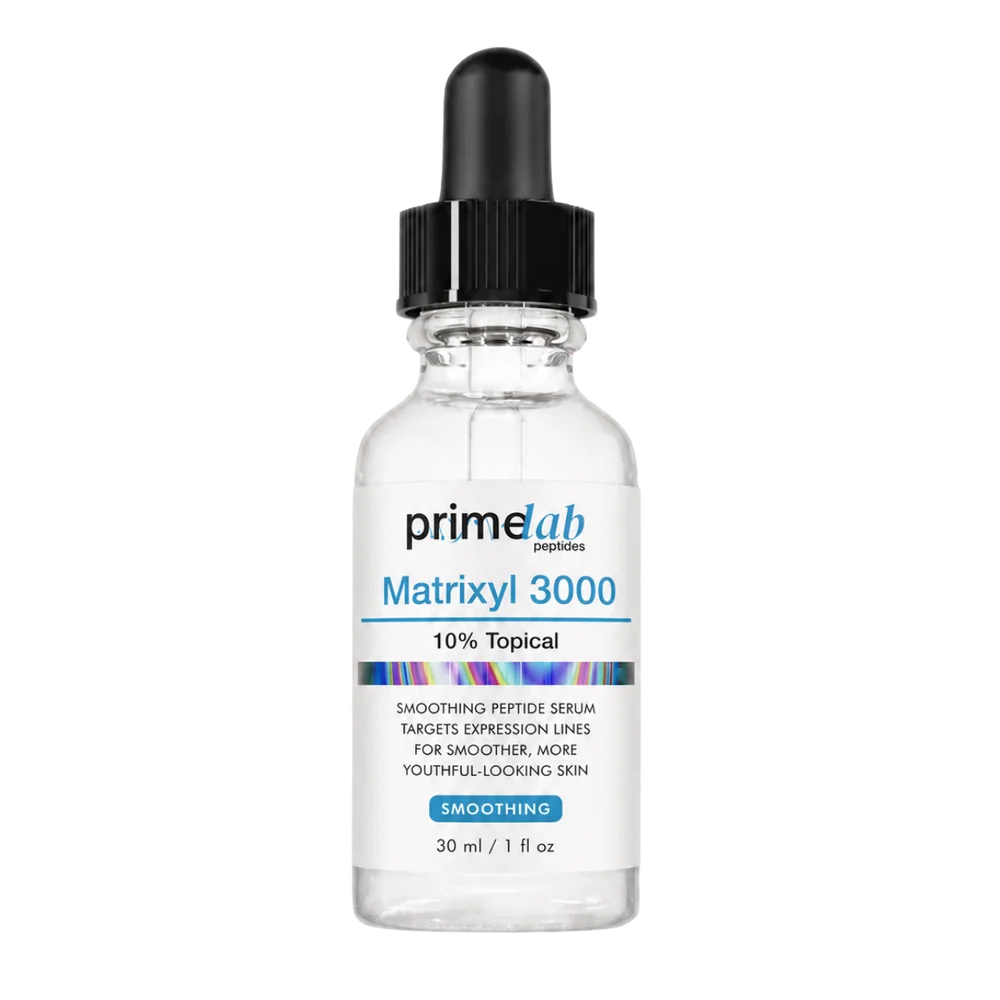
For high-purity research peptides, we point researchers to Prime Lab Peptides for Matrixyl 3000 (Topical Serum).
Why Prime Lab Peptides?
- ▪Top-rated on Trustpilot: Independently reviewed as the highest-rated peptide lab on Trustpilot — making it the best current source in the USA.
- ▪Third-party tested: Every batch ships with a Certificate of Analysis (COA) confirming purity and composition.
- ▪Consistent quality: ISO-aligned manufacturing and handling keep product integrity reliable batch to batch.
- ▪Cold-chain integrity: Temperature-controlled shipping and storage across the whole fulfilment chain.
- ▪Research-grade purity: Fit for educational and research use that demands high-quality peptides.
Note: Product availability and specifications subject to change. Verify current product details on supplier website.
References
- 1
International Journal of Cosmetic Science (Wiley)Lintner K, Peschard O — biologically active peptides moving from laboratory curiosity to functional skin-care ingredients, including the palmitoylated matrikine rationale.
- 2
Frontiers in Chemistry (PMC)Errante F et al. — review of cosmeceutical peptides (signal, carrier and neurotransmitter-inhibitor classes) and the evidence supporting their claimed cosmetic activity.
- 3
Journal of Biological Chemistry (PubMed)Katayama K et al. — the original 1993 report that a pentapeptide (KTTKS) from type I procollagen promotes extracellular-matrix production by fibroblasts.
- 4
Cosmetics (MDPI)Schagen SK — review of topical peptide treatments and anti-aging results, covering signal peptides such as the Matrixyl family and honest limits on the evidence.
- 5
International Journal of Cosmetic Science (PubMed)Robinson LR et al. — double-blind, placebo-controlled facial study showing topical palmitoyl pentapeptide (Pal-KTTKS) improved the appearance of photoaged skin over ~12 weeks.
- 6
International Journal of Molecular Sciences (PMC)Pickart L, Margolina A — regenerative and protective actions of the GHK-Cu peptide, the copper-complexed relative of the GHK motif in palmitoyl tripeptide-1.
- 7
Indian Journal of Dermatology, Venereology and Leprology (PubMed)Pai VV et al. — review of topical peptides as cosmeceuticals, emphasizing modest effect sizes and the primacy of sunscreen and retinoids in skin aging.
- 8
Biomolecules & Therapeutics (PMC)Choi YL et al. — dermal stability and in-vitro skin permeation of KTTKS and palmitoyl-KTTKS, characterizing how palmitoylation improves peptide penetration.
How to apply Matrixyl 3000
- 1Blend Matrixyl 3000 into a clean, water-based serum or cream base at the intended percentage (commonly 3 to 10 percent).
- 2Patch-test on a small area of skin first to check tolerability.
- 3Apply a thin layer to clean, dry skin as documented in cosmetic research (often once or twice daily).
- 4Store the raw powder and the finished serum sealed, cool and away from light; refrigerate water-based serums.
Matrixyl 3000 — frequently asked questions
How is Matrixyl 3000 used?
Matrixyl 3000 is a topical cosmetic peptide applied to the skin as part of a serum or cream — not injected or taken by mouth. It is blended into a water-based base at a chosen percentage and applied to clean skin.
What concentration of Matrixyl 3000 is typical?
Cosmetic formulations commonly use roughly 3 to 10 percent. Higher is not necessarily better and can affect texture, stability and skin tolerability. The strength shown on this page is a formulation reference, not a dose to inject.
Do I need bacteriostatic water or syringes for Matrixyl 3000?
No. As a topical peptide, none of the injectable-peptide supplies (bacteriostatic water, insulin syringes, alcohol swabs) apply — it is dissolved into a serum or cream base and applied to the skin.
How should I store Matrixyl 3000?
Keep the raw powder sealed, cool, dry and away from light. A finished water-based peptide serum is best refrigerated and used within a few weeks, since peptides in solution degrade over time.
Is research-grade Matrixyl 3000 an approved drug?
No. Matrixyl 3000 is a cosmetic-grade ingredient for topical formulation and research, not an approved medicine; the evidence supports only modest topical, cosmetic effects. Everything here is research and educational information, not medical advice.
New protocols & dosing updates
Reconstitution charts, new peptide protocols and safety updates — straight to your inbox. No spam, unsubscribe anytime.