
MK-677 (Ibutamoren, 25 mg) Dosage Protocol
MK-677 (Ibutamoren) is an orally active, non-peptide ghrelin-receptor agonist and growth-hormone secretagogue studied in human trials but never approved for any indication — a research-chemical-tier compound.
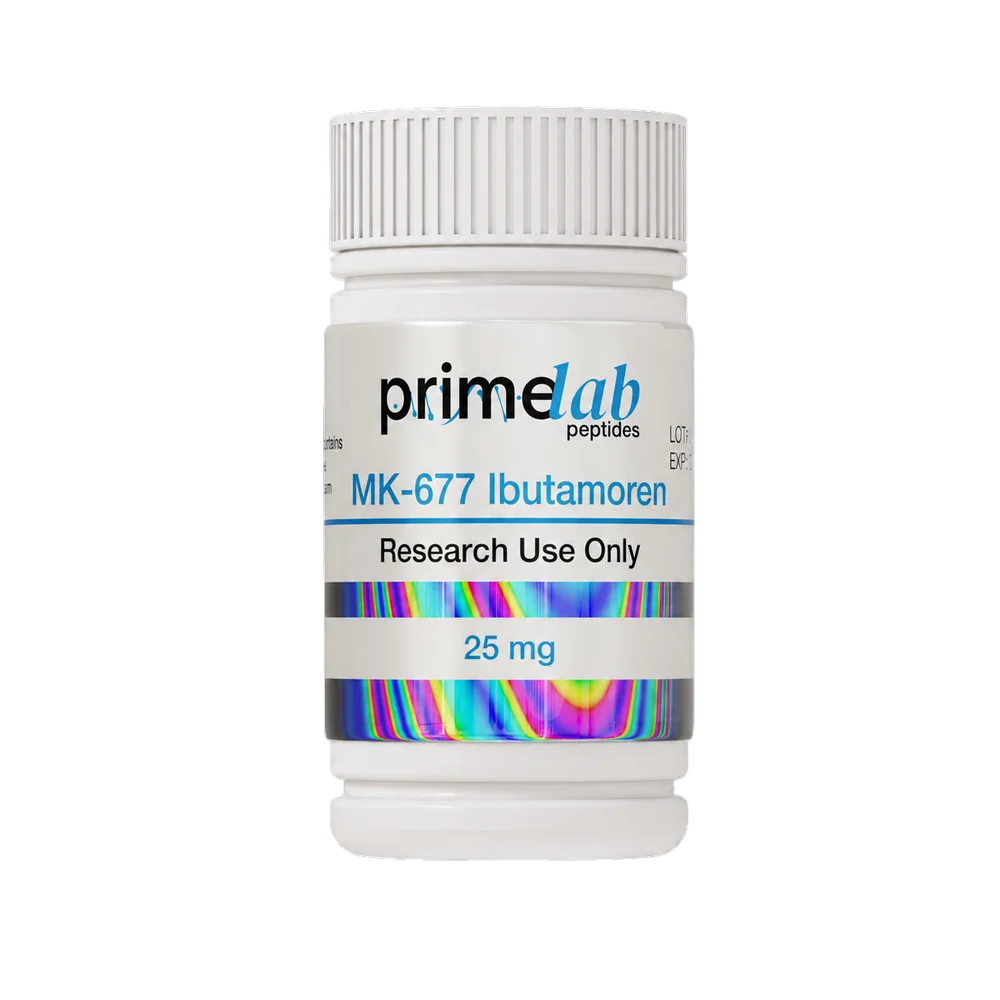
Non-peptide ghrelin (GHS-R1a) receptor agonist; mimics ghrelin to pulse endogenous GH and raise IGF-1.
Human trials used 5-25 mg orally once daily; most body-composition data centre on 25 mg/day.
Orally active and stable — supplied as 10 mg or 25 mg capsules or 25 mg/mL liquid; no reconstitution needed.
Store sealed, cool, dry and out of light; keep liquid preparations refrigerated and away from moisture.
Looking for results? See MK-677 before and after — what the research actually shows (honest, research-based, no transformation photos).
Quickstart Highlights
MK-677 (Ibutamoren, also written MK-0677) is an orally active, non-peptide ghrelin-receptor agonist and growth-hormone secretagogue — a small spiro-indane molecule engineered by Merck to survive the gut and stimulate the body’s own growth-hormone release after a pill rather than an injection[2]. In the published literature it is studied for raising GH and IGF-1, increasing fat-free (lean plus water) mass, appetite, and sleep architecture, and it reached mid-stage human trials for GH deficiency, frailty, body composition and Alzheimer’s disease before development was discontinued[1][3]. Unlike the injectable peptides elsewhere in this library, it is a non-peptide secretagogue, and it was never approved for any indication in any major jurisdiction.
The figures below reflect published research and pharmacology conventions and are provided strictly for research and educational reference — not medical advice, a dosing recommendation, or a suggestion that MK-677 should be taken by a person.
Supplies Needed
Because MK-677 is taken by mouth, the “supplies” are about accurate measurement and honest labelling — not sterile injection. Nothing here is exotic; identity and purity of the material matter far more than any single tool.
Protocol Overview
In research settings MK-677 is supplied most often as capsules (commonly 10 mg or 25 mg) or as a 25 mg/mL liquid for laboratory measurement. With 25 mg capsules and a once-daily reference amount, a 30-count bottle maps to roughly one month of the dose that appears in the trials.
The dominant real-world variable is not measurement but material: grey-market GH-secretagogue products have repeatedly been found under- or over-dosed, so a third-party certificate of analysis (identity plus quantitative assay) is the only meaningful check on what a sample actually contains[6].
Dosing Protocol
The amounts that appear in the published research, presented as historical reference data so the literature can be read accurately — not as a protocol to follow or a claim that any dose is safe.
| Context in the literature | Daily Dose | Notes / Timing |
|---|---|---|
| Pharmacology / dose-ranging | 5–10 mg (1× daily) | Lower end; still raised GH pulses in short studies[2] |
| Most body-composition & IGF-1 trials | 25 mg (1× daily) | The dominant dose across the major RCTs[1][5] |
| GH-deficiency / provocative testing | Single oral doses reported | Studied as a GH-stimulation probe in some settings[6] |
Why MK-677 draws research interest
These are the directions researchers and the peptide community most often explore MK-677 for — so you know you’re in the right place. They describe what is being studied, not proven benefits, approved uses, or promised results.
GH / IGF-1 elevation
Studied as an oral secretagogue that raises 24-hour growth-hormone pulses and IGF-1 without injections (research-chemical tier).
Body composition
Investigated in trials for effects on fat-free mass and appetite in older and catabolic-state subjects.
Sleep architecture
Examined for changes in slow-wave and REM sleep tied to nocturnal GH secretion.
Bone & recovery signals
Studied as an adjunct in hip-fracture recovery and bone-turnover research; results were mixed.
Evidence ranges from early laboratory work to clinical trials depending on the use — the sections below cover the actual data and sources.
5 – 25 mg by mouth, with 25 mg/day the dominant dose across the major RCTs[1].
Once daily — the long apparent half-life (~24 h) sustains IGF-1 across the day, so multiple doses are not used[6].
Studies dosed either morning or night; night dosing is sometimes used for sleep/appetite reasons, but no optimal time was established.
Investigational / research-chemical. Real human RCT data exist, but there is no approval and several failed efficacy endpoints[3].
Oral Dosing Guide
MK-677 is an oral compound, so there is no reconstitution, no bacteriostatic water and no syringe math — the dosing question is simply which whole-milligram amount the literature studied, and how often. Across the human trials the answer is strikingly consistent.
Standard / Gradual Approach
Unlike titrated injectables, MK-677 was generally dosed at a fixed daily amount rather than stepped up over weeks. Dose-ranging work found that even 5–10 mg once daily raised GH pulses in short studies, while 25 mg/day became the standard in the body-composition and IGF-1 trials[2][5]. IGF-1 elevation builds over the first one to two weeks and then plateaus.
A frank note on scaling: the trial data give no support for pushing past 25 mg on the assumption that “more GH is better.” Above the studied range there is no efficacy evidence and the dose-dependent liabilities — appetite, fluid retention, glucose elevation — get worse, not better[1].
Storage Instructions
MK-677 (as the ibutamoren mesylate salt) is reasonably stable as a dry solid. Keep capsules or powder sealed, cool, dry and away from light, ideally with a desiccant to control moisture.
Liquid preparations are more vulnerable to degradation and microbial growth and are generally kept refrigerated. Discard any liquid that becomes cloudy, discoloured or is past a documented handling window.
Important Notes
Practical points that keep the historical reference data legible and flag the effects that follow directly from the mechanism.
- ▪Fixed dose, not titrated: Unlike injectable GLP-1 or GHRH peptides, MK-677 was dosed at a steady daily amount — stepping the dose is not part of the reference literature.
- ▪Once daily is enough: The ~24-hour apparent half-life sustains IGF-1 across the day, so splitting the dose adds no documented benefit[6].
- ▪Identity & purity dominate: Oral grey-market material is the real risk surface — only a third-party COA confirms what a capsule actually contains.
- ▪Metabolic caution is not optional: In the two-year Nass trial MK-677 raised fasting blood glucose and reduced insulin sensitivity — a direct GH-axis effect, and the single most important reason chronic metabolic safety is unresolved[1].
- ▪Banned in sport: MK-677 is a prohibited substance under WADA (growth-hormone secretagogues, S2 class) at all times[7].
How This Works
MK-677 is an agonist at the growth-hormone secretagogue receptor type 1a (GHS-R1a) — the same receptor the stomach-derived hormone ghrelin activates. By binding GHS-R1a in the hypothalamus and pituitary it amplifies the pulsatile release of growth hormone, largely by mimicking ghrelin and opposing somatostatin tone. Because GH drives hepatic production of insulin-like growth factor 1, the downstream result is higher circulating GH and a sustained rise in IGF-1[1][2]. Crucially, it preserves the pulsatile pattern of GH secretion rather than clamping GH at a constant high level, and it depends on a functioning pituitary — it cannot raise GH if the gland cannot respond.
Two consequences flow directly from the ghrelin-receptor target and define the honesty picture. First, ghrelin is the body’s principal hunger signal, so agonising GHS-R1a increases appetite — a receptor-level effect, not an incidental one. Second, the GH axis is counter-regulatory to insulin, so raising GH tends to raise fasting glucose and can reduce insulin sensitivity[1]. Both effects are predictable from the mechanism and both showed up consistently in trials.
Lifestyle Factors
In the trials that define this molecule, GH/IGF-1 elevation did not translate into strength or functional gains on its own — MK-677 moved biomarkers but not hard clinical endpoints, so any real-world programme leans on resistance training, adequate protein and sleep rather than the compound doing the work[1].
Because appetite stimulation and fluid retention are the most reliable effects, dietary discipline and attention to sodium, hydration and body-weight trend are the practical variables people track in the literature — and anyone with glucose-tolerance concerns has a direct mechanistic reason for caution.
Potential Benefits & Side Effects
What the controlled human literature reports MK-677 is studied for — framed honestly. Biomarker effects are well established; hard clinical benefits repeatedly were not, and research-chemical use is not equivalent to a supervised, approved course.
Reported Effects
- ▪GH & IGF-1 elevation: Once-daily oral dosing reliably raised 24-hour GH profiles and pushed IGF-1 into a younger-adult range while preserving pulsatility[2][4].
- ▪Fat-free mass: Studied for increases in lean (plus water) mass and energy expenditure in obese and older-adult trials — though fat mass did not fall[5].
- ▪Protein-sparing in catabolism: Attenuated nitrogen loss during caloric restriction in a diet-induced catabolism study[1].
- ▪Appetite & sleep: Increased hunger is a direct ghrelin-receptor effect, and interactions with sleep-associated GH pulses were noted — but neither was developed into an approved use.
- ▪Efficacy that did not materialise: Honestly, it did not improve strength/function in older adults, did not reduce fat mass, and did not slow Alzheimer’s progression — the gap between moving a biomarker and helping a patient is why development stopped[1][3].
Common Side Effects
- ▪Appetite & water-driven “gains”: As a ghrelin agonist it increases hunger markedly, and much of the measured lean-mass gain was water and appetite-driven rather than clean muscle[5].
- ▪Fluid retention & oedema: Peripheral oedema, joint aches and carpal-tunnel-type symptoms were reported — classic GH-excess effects[1].
- ▪Glucose & insulin: Raised fasting blood glucose and reduced insulin sensitivity in the two-year trial — the most consistently flagged concern[1].
- ▪Cardiac signal in comorbid elderly: Fluid-retention physiology and reports of congestive heart failure in older treatment groups made the benefit-risk balance unfavourable in frail populations[1].
- ▪Unknown long-term risk: Chronically elevated IGF-1 is a theoretical long-term proliferative concern the trials were too short to resolve — an open, unquantified limitation rather than a proven harm.
Oral Administration
Oral dosing is simple, but accuracy and honest record-keeping are the whole point of a reference protocol. There is no injection technique here.
Before You Dose
- ▪Confirm the material’s identity and strength against a third-party certificate of analysis before anything else — this is the dominant real-world variable.
- ▪Decide a consistent daily time and stick to it; the trials dosed once daily and did not establish an optimal morning-versus-night window.
- ▪For liquids, use a graduated oral syringe (dose = mL × 25 mg); for powder, an analytical balance readable to 1 mg — visual estimation is unreliable at these masses.
Taking Your Dose
- ▪Take the single daily oral dose with water; food is not required but can blunt the appetite surge for some.
- ▪Do not double up after a missed day — once-daily, fixed-amount dosing is what the literature describes.
- ▪Log the dose, time and any appetite, fluid-retention or glucose observations to keep the record accurate.
After Dosing
- ▪Reseal capsules or liquid promptly and return them to cool, dry, dark (or refrigerated, for liquids) storage.
- ▪Track body weight and any oedema over the first two weeks, when IGF-1 and fluid effects build toward plateau.
- ▪Anyone with glucose-tolerance concerns has a direct mechanistic reason to monitor fasting glucose rather than assume it is unaffected.
Recommended Source
For high-purity research peptides, we point researchers to Prime Lab Peptides for MK-677 (25 mg Capsules).
Why Prime Lab Peptides?
- ▪Top-rated on Trustpilot: Independently reviewed as the highest-rated peptide lab on Trustpilot — making it the best current source in the USA.
- ▪Third-party tested: Every batch ships with a Certificate of Analysis (COA) confirming purity and composition.
- ▪Consistent quality: ISO-aligned manufacturing and handling keep product integrity reliable batch to batch.
- ▪Cold-chain integrity: Temperature-controlled shipping and storage across the whole fulfilment chain.
- ▪Research-grade purity: Fit for educational and research use that demands high-quality peptides.
Note: Product availability and specifications subject to change. Verify current product details on supplier website.
References
- 1
Annals of Internal Medicine (PubMed) — Nass et al. 2008Two-year randomized trial of oral MK-677 (ghrelin mimetic) in healthy older adults: restored IGF-1, raised fat-free mass, but increased fasting glucose and reduced insulin sensitivity with no strength/function gain.
- 2
J Clin Endocrinol Metab (PubMed) — Copinschi et al. 1996Seven-day treatment with oral MK-677 in normal young men increased 24-hour GH profiles and IGF-1 while preserving pulsatility; established oral activity and dose range.
- 3
Neurology (PubMed) — Sevigny et al. 200812-month RCT (n=563) of MK-677 in mild-moderate Alzheimer’s: robust IGF-1 rise but no slowing of cognitive decline — negative for the primary endpoint.
- 4
J Clin Endocrinol Metab (PubMed) — Chapman et al. 1996Daily oral MK-677 stimulated the GH/IGF-1 axis in healthy elderly subjects, raising both into a younger-adult range.
- 5
J Clin Endocrinol Metab (PubMed) — Svensson et al. 1998Two-month treatment of obese subjects with oral MK-677 25 mg/day increased GH secretion, fat-free mass and energy expenditure, without fat-mass loss.
- 6
PubChem Compound Summary: Ibutamoren (MK-0677)NIH pharmacology record for ibutamoren — GHS-R1a agonist, chemistry, and long-acting oral secretagogue properties.
- 7
World Anti-Doping Agency — Prohibited List (S2)Growth-hormone secretagogues, including MK-677, are prohibited at all times under class S2 (Peptide Hormones, Growth Factors and Related Substances).
- 8
DrugBank — Ibutamoren (DB12064)Pharmacology, target and development status of ibutamoren, including its investigational, unapproved status.
How to take MK-677
- 1Confirm the capsule strength and your target dose from the schedule on this page (each capsule is a fixed strength).
- 2Take the required number of MK-677 capsules by mouth once daily, swallowed whole with water, with or without food.
- 3Keep the daily dose consistent and follow any documented gradual 4-week escalation steps.
- 4Store the capsules sealed at room temperature, dry and away from light — no mixing or refrigeration needed.
MK-677 — frequently asked questions
How is MK-677 taken?
MK-677 is taken by mouth as one or more capsules once daily, swallowed whole with or without food. There is no mixing, reconstitution, or injection — it is an oral small-molecule compound, not an injectable peptide.
Do I need bacteriostatic water or syringes for MK-677?
No. Because MK-677 is an oral capsule, none of the injectable-peptide supplies (bacteriostatic water, insulin syringes, alcohol swabs) apply — you simply take the capsule(s) by mouth.
How many capsules make up each dose?
Each capsule is a fixed strength, so a target dose is reached by taking the matching number of capsules at that strength. The dosing table on this page lists the reference dose for each step of a documented research schedule — match your capsule strength to it rather than assuming a fixed number.
How should I store MK-677?
Keep the capsules in their original sealed container at controlled room temperature, dry and away from heat, light and moisture, and follow the specific storage guidance supplied with your product. No refrigeration or reconstitution is required.
How does MK-677 differ from injectable peptide protocols?
The main practical difference is the route of administration: MK-677 is swallowed as a capsule, so there is no reconstitution, bacteriostatic water, or sterile injection technique involved. Its specific mechanism of action and the research behind it are described in the "How This Works" section on this page.
Is the research-grade MK-677 sold here approved for human use?
No. Research-grade MK-677 is supplied strictly for laboratory and research purposes and is not an approved medicine for human use — regardless of whether an approved pharmaceutical product containing this ingredient exists. Everything here is research information, not medical advice; consult a licensed healthcare professional and the approved product labeling before any use.
New protocols & dosing updates
Reconstitution charts, new peptide protocols and safety updates — straight to your inbox. No spam, unsubscribe anytime.