
Argireline (10% Topical) Dosage Protocol
Argireline (Acetyl Hexapeptide-8) is a topical cosmetic peptide studied for the appearance of expression wrinkles — a cosmetic-tier ingredient framed by formulation percentage, not injection.

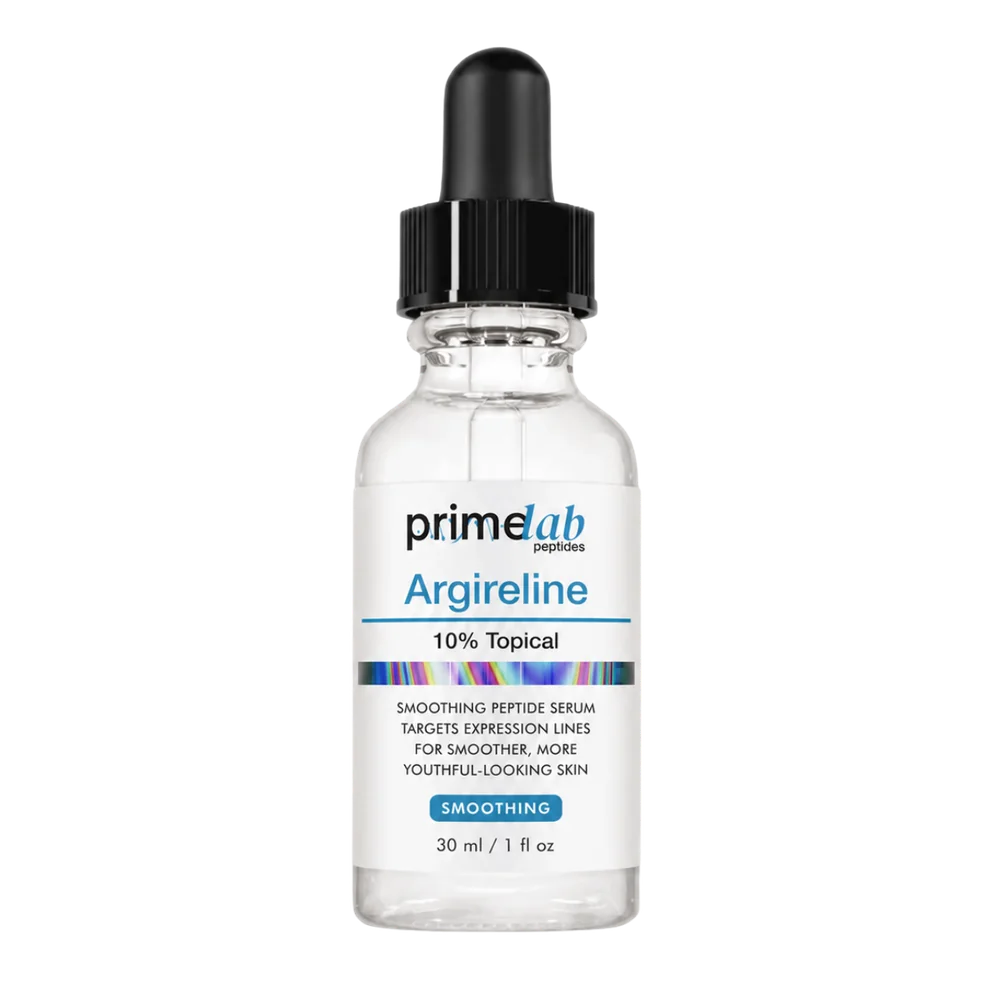
A SNAP-25-mimetic hexapeptide (Ac-EEMQRR-NH2) studied for interfering with SNARE-complex assembly and pre-synaptic neurotransmitter release in vitro.
Framed as a formulation percentage, not a dose. Cosmetic literature uses 5-10% of the aqueous Argireline solution in a leave-on product, applied once or twice daily.
Topical only. Supplied as a ~10% aqueous solution/serum or as a powder for compounding into a 5-10% leave-on emulsion. Not for injection or ingestion.
Store cool and dark; refrigeration extends stability. Peptide solutions degrade with heat, light and oxidation; protect from freeze-thaw cycles.
Quickstart Highlights
Argireline is the trade name for acetyl hexapeptide-8 (older INCI name acetyl hexapeptide-3) — a six-amino-acid cosmetic peptide, Ac-EEMQRR-NH2, patterned after the N-terminal tip of the synaptic protein SNAP-25[1]. It is applied to intact skin as a leave-on topical and is studied for the appearance of dynamic expression lines (crow’s-feet, forehead and glabellar folds), which is why it is often described — loosely and generously — as a topical “muscle-relaxing” botulinum-toxin analogue[3].
Argireline is a cosmetic ingredient, not an approved drug[8]; the figures below reflect published cosmetic-science conventions and are provided strictly for research and educational reference — not medical advice, not a treatment claim, and not a protocol to follow.
Supplies Needed
Everything a documented topical routine relies on. Nothing here is exotic — a clean surface, gentle handling and a stable, well-preserved product matter far more than any single tool.
Protocol Overview
A leave-on serum is used sparingly — a thin layer over a small area such as the periorbital zone — so a typical 30 mL bottle lasts many weeks of once- or twice-daily use. Because the studied benefit is on appearance and reverses when application stops, the practical “supply” question is continuity rather than a finite course.
Plan around the review windows used in the literature: appearance changes, where reported, emerged gradually over roughly 28–56 days of consistent twice-daily application, so budget a supply that covers at least one full study-length window before judging any effect.
Dosing Protocol
Reference concentrations and application frequencies drawn from the cosmetic literature — a description of what appears in studies and on ingredient lists, not a protocol to follow.
| Phase / Week(s) | Application | Frequency |
|---|---|---|
| Patch test (day 0) | Small amount to inner forearm; check for irritation | Once, 24–48 h before first facial use |
| Weeks 1–4 | Thin layer of 5–10% Argireline solution to clean, dry target area | Twice daily (AM & PM), leave-on |
| Weeks 4–8 | Continue the same thin-layer application; assess appearance gradually | Twice daily, leave-on |
| Maintenance | Ongoing application to sustain any appearance benefit | Once or twice daily; benefit reverses if stopped |
Why Argireline draws research interest
These are the directions researchers and the peptide community most often explore Argireline for — so you know you’re in the right place. They describe what is being studied, not proven benefits, approved uses, or promised results.
Expression-line appearance
Studied topically for the visual appearance of dynamic (mimic) wrinkles around the eyes and forehead — cosmetic tier, modest effect sizes.
Peptide skin penetration
Investigated in percutaneous-penetration models to understand how much of a large, charged hexapeptide crosses the stratum corneum.
Topical alternative interest
Explored in the cosmetic literature as a leave-on ingredient of interest to those comparing topical peptides against injectable neuromodulators.
Formulation & stability
Studied for how carrier, pH and concentration affect the appearance benefit and shelf stability of the finished cosmetic.
Evidence ranges from early laboratory work to clinical trials depending on the use — the sections below cover the actual data and sources.
5–10% Argireline solution in a leave-on serum, gel or emulsion (~0.005% actual acetyl hexapeptide-8)[1].
A thin layer patted onto clean, dry skin over the target area; used as supplied, no dilution or measurement.
Once or twice daily, leave-on; studies typically ran twice-daily over 4–8 weeks.
Dosing & Application
For a topical, “dosing” is really formulation concentration plus application frequency — there is no vial to reconstitute and no syringe to draw. What follows is reference data from the cosmetic literature and typical commercial practice, presented for educational context only.
Standard / Gradual Approach
There is no titration in the injectable sense. Reference protocols simply use a product at the studied concentration — a 5–10% Argireline solution — and apply it consistently, judging the appearance change gradually over four to eight weeks rather than escalating a dose. “More is better” is not supported: pushing concentration far above the studied range raises cost and formulation instability without demonstrated proportional benefit.
The single most common error is confusing two different percentages. Commercial “Argireline solution” is itself dilute — on the order of 0.05% actual acetyl hexapeptide-8 — so a “10% Argireline” product contains roughly 0.005% pure peptide, not 10%. Raw powder is nearly 100% peptide, so a formulator compounding from powder targets a far lower weight percentage to reach the same active level.
Storage Instructions
Peptides in water are prone to hydrolysis, oxidation and microbial growth, so a finished Argireline product needs a proper preservative system and should be kept cool and out of direct light. Concentrated solutions are best refrigerated; avoid repeated freeze–thaw, which degrades the peptide.
Keep containers airtight to limit oxidation, note the shelf life printed on the finished product, and discard if the solution changes colour, smell or clarity — signs of degradation or contamination.
Important Notes
Practical points that keep a topical routine consistent and set honest expectations.
- ▪Percentage is not potency: A 10% Argireline solution is only ~0.005% actual peptide; do not read the label percentage as pure-peptide strength.
- ▪Delivery is the ceiling: The molecule is large (~889 Da) and highly charged, so only a small fraction crosses the stratum corneum and essentially none reaches deep facial muscle[5][6].
- ▪Reversible & appearance-level: Any benefit is on the look of fine dynamic lines and fades when application stops — there is no lasting structural change.
- ▪Not a botulinum-toxin substitute: Independent peptide reviews place Argireline in the “limited evidence” category and caution that effects are far below injectable neuromodulators[3][7] — a reason honest sources do not claim equivalence.
- ▪Topical only: There is no research supporting injecting or ingesting Argireline; raw “research use only” powder is an unapproved cosmetic raw material of unverified purity.
How This Works
Argireline’s sequence mimics the N-terminal end of SNAP-25, one of the SNARE proteins that let a neurotransmitter-filled vesicle dock and fuse at the nerve ending — the same protein that botulinum toxin type A cleaves. In cell-free and cell-culture systems the hexapeptide can compete for a place in that complex, destabilising it and reducing catecholamine and acetylcholine release[1][4]. Less neurotransmitter at the neuromuscular junction would, in theory, mean weaker contraction of the small facial muscles that fold skin into expression lines.
The honest caveat is delivery. This is a competitive, reversible interaction — not the enzymatic cleavage botulinum toxin performs — and it was largely characterised in vitro, where the peptide is delivered straight to the target. On real skin the large, water-loving molecule must first cross the lipid barrier of the stratum corneum, and penetration studies show only a small fraction gets through[5][6]. The gap between a mechanism seen in a dish and what actually reaches facial muscle is the single most important thing to understand about Argireline.
Lifestyle Factors
In the cosmetic literature Argireline is one input among many: it is typically layered into a broader routine — gentle cleansing, daily sunscreen and consistent moisturising — rather than used as a standalone fix, since photoprotection and skin hydration influence the appearance of fine lines at least as much as any single active.
Because the studied benefit is gradual and reversible, consistency over weeks matters more than concentration; realistic expectations and a patch-tested, well-formulated product do more for the experience than chasing a higher percentage.
Potential Benefits & Side Effects
What the small, cosmetic-tier human literature reports — mostly appearance endpoints from single-region studies, several manufacturer-associated. This is not the large, independent, randomised evidence that supports approved medicines, and effect sizes are modest.
Reported Effects
- ▪Appearance of expression lines: A foundational open study of a 10% Argireline emulsion applied twice daily to crow’s-feet reported up to ~30% reduction in wrinkle depth by profilometry over ~30 days[1] — a developer-linked result not independently replicated at that magnitude.
- ▪Instrumental roughness: A randomised, placebo-controlled eye-cream study in Chinese subjects found a statistically significant but modest improvement in roughness parameters over four weeks[2].
- ▪Neurotransmitter-release modulation: In-vitro assays show the peptide inhibits SNARE-dependent exocytosis, the mechanistic basis for the “topical muscle-relaxing” analogy[1][4].
- ▪Tolerability: Across the small studies it is generally reported as non-irritating at cosmetic concentrations, with no serious adverse events characteristic of use[3].
Common Side Effects
- ▪Contact irritation / allergy: As with any topical, sensitive individuals can react; a 24–48 h patch test is standard cosmetic practice before facial use.
- ▪Modest, reversible effect: Not an adverse event but a candid limitation — any benefit is small, on appearance only, and disappears when application stops.
- ▪Overstated-efficacy risk: The main hazard is expectation, not safety — marketing that implies botulinum-toxin-like results overstates a delivery-limited mechanism[3].
- ▪Unverified raw material: Powder or solution sold “for research” is an unregulated cosmetic raw material of unknown purity; contamination and mislabelling are the real safety concerns.
- ▪Never inject or ingest: Argireline is a cosmetic topical; injection or ingestion is unstudied, off-label and potentially hazardous misuse.
How to Apply
Topical application is simple; consistency and clean skin matter more than technique.
Skin Preparation
- ▪Cleanse the target area with a gentle cleanser and let the skin dry fully — apply to clean, dry skin, not over heavy occlusives.
- ▪Patch-test a small amount on the inner forearm 24–48 h before first facial use if the product is new to you.
- ▪Confirm the product is a leave-on aqueous serum, gel or emulsion at roughly pH 5–6, where the peptide is most stable.
Applying the Product
- ▪Dispense a small amount and pat a thin layer over the target area (for example the periorbital zone), avoiding the lash line and mucous membranes.
- ▪Use it as supplied — no dilution or measurement is required by the end user.
- ▪Let it absorb for a minute before layering anything else.
After Application
- ▪Follow with a moisturiser and, in the morning, sunscreen — photoprotection matters more for fine-line appearance than any single active.
- ▪Reseal the container airtight and store it cool and out of direct light to protect the peptide.
- ▪Apply consistently once or twice daily and judge appearance over weeks, not days; the benefit reverses if you stop.
Recommended Source
For high-purity research peptides, we point researchers to Prime Lab Peptides for Argireline (10% Topical Solution).
Why Prime Lab Peptides?
- ▪Top-rated on Trustpilot: Independently reviewed as the highest-rated peptide lab on Trustpilot — making it the best current source in the USA.
- ▪Third-party tested: Every batch ships with a Certificate of Analysis (COA) confirming purity and composition.
- ▪Consistent quality: ISO-aligned manufacturing and handling keep product integrity reliable batch to batch.
- ▪Cold-chain integrity: Temperature-controlled shipping and storage across the whole fulfilment chain.
- ▪Research-grade purity: Fit for educational and research use that demands high-quality peptides.
Note: Product availability and specifications subject to change. Verify current product details on supplier website.
References
- 1
International Journal of Cosmetic Science (Wiley)Blanes-Mira et al. (2002) — the foundational Argireline study: a 10% hexapeptide emulsion reduced periorbital wrinkle depth up to ~30% over 30 days, with in-vitro neurotransmitter-release data.
- 2
American Journal of Clinical Dermatology (Springer)Wang et al. (2013) — randomized, placebo-controlled study of a 10% Argireline eye cream in Chinese subjects showing a modest but significant roughness improvement over 4 weeks.
- 3
International Journal of Cosmetic Science (PubMed)Gorouhi & Maibach (2009) — review of topical peptides in aged skin, classing neurotransmitter-inhibiting peptides like Argireline as limited-evidence cosmetics.
- 4
Journal of Neurochemistry (PubMed)Blanes-Mira et al. (2004) — small peptides patterned after the SNAP-25 N-terminus inhibit SNARE-complex assembly and regulated exocytosis (the proposed mechanism).
- 5
Cutaneous and Ocular Toxicology (PubMed)Kraeling et al. (2015) — in-vitro skin penetration of acetyl hexapeptide-8 from a cosmetic formulation; only a small fraction crosses the stratum corneum.
- 6
European Journal of Pharmaceutical Sciences (PubMed)Hoppel et al. (2015) — topical delivery of acetyl hexapeptide-8 from different emulsions; vehicle composition strongly limits how much peptide penetrates.
- 7
Experimental Dermatology (PubMed)Reddy et al. (2012) — bioactive oligopeptides in dermatology (Part II); independent review cautioning that neuromodulator peptides show small effects.
- 8
U.S. FDA — Is It a Cosmetic, a Drug, or Both?FDA cosmetic regulatory framework: cosmetics are regulated for safety and labelling but are not approved for efficacy and may not claim to alter body structure or function.
How to apply Argireline
- 1Blend Argireline into a clean, water-based serum or cream base at the intended percentage (commonly 3 to 10 percent).
- 2Patch-test on a small area of skin first to check tolerability.
- 3Apply a thin layer to clean, dry skin as documented in cosmetic research (often once or twice daily).
- 4Store the raw powder and the finished serum sealed, cool and away from light; refrigerate water-based serums.
Argireline — frequently asked questions
How is Argireline used?
Argireline is a topical cosmetic peptide applied to the skin as part of a serum or cream — not injected or taken by mouth. It is blended into a water-based base at a chosen percentage and applied to clean skin.
What concentration of Argireline is typical?
Cosmetic formulations commonly use roughly 3 to 10 percent. Higher is not necessarily better and can affect texture, stability and skin tolerability. The strength shown on this page is a formulation reference, not a dose to inject.
Do I need bacteriostatic water or syringes for Argireline?
No. As a topical peptide, none of the injectable-peptide supplies (bacteriostatic water, insulin syringes, alcohol swabs) apply — it is dissolved into a serum or cream base and applied to the skin.
How should I store Argireline?
Keep the raw powder sealed, cool, dry and away from light. A finished water-based peptide serum is best refrigerated and used within a few weeks, since peptides in solution degrade over time.
Is research-grade Argireline an approved drug?
No. Argireline is a cosmetic-grade ingredient for topical formulation and research, not an approved medicine; the evidence supports only modest topical, cosmetic effects. Everything here is research and educational information, not medical advice.
New protocols & dosing updates
Reconstitution charts, new peptide protocols and safety updates — straight to your inbox. No spam, unsubscribe anytime.