

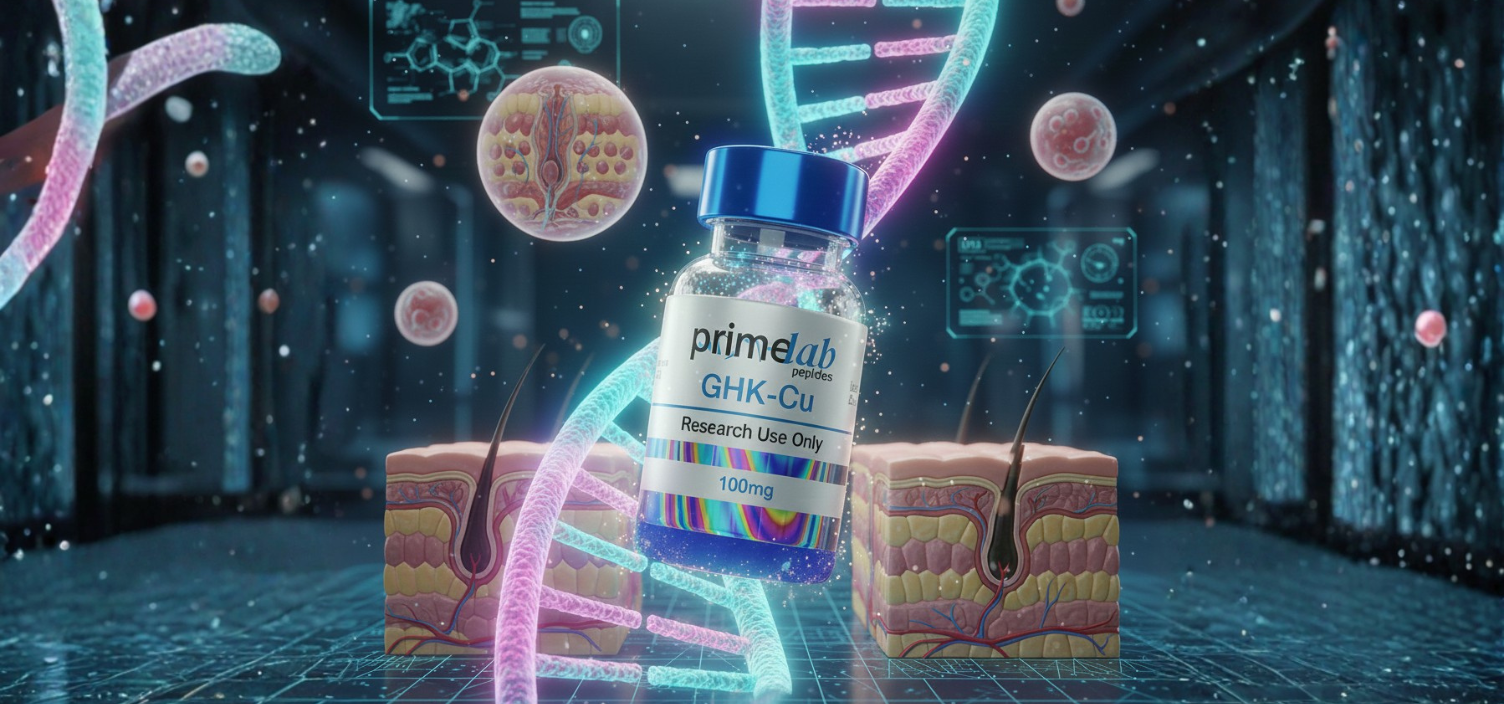
GHK-Cu (Copper Peptide)
Naturally occurring copper complex of the tripeptide Gly-His-Lys. Best known for skin repair, wound healing, and cosmetic anti-aging. Discovered in 1973 from human plasma. Blue solution
Declines with age: Plasma GHK-Cu is ~200 ng/mL at age 20 → ~80 ng/mL by age 60. This natural decline may contribute to age-related loss of skin repair capacity and collagen quality.
⚡ Executive Summary
GHK-Cu is a small, human tripeptide bound to copper(II) that acts as a copper carrier and pro-repair signal in skin and connective tissue. It supports collagen/glycosaminoglycan synthesis, controls matrix turnover (MMPs/TIMPs), and modulates inflammatory signaling. Human data exists for wound care and cosmetic skin rejuvenation; hair benefits are promising but preliminary.
Jump to section
Overview
🧬 What is GHK-Cu?
GHK-Cu is a copper(II) complex of the tripeptide glycyl-L-histidyl-L-lysine that’s naturally present in plasma, saliva, and urine.
First isolated by Loren Pickart from human plasma in 1973. It signals tissue repair and serves as a copper chaperone.
🔧 Why Copper Matters
Copper is a cofactor for cuproenzymes like lysyl oxidase (collagen/elastin cross-linking) and SOD1 (antioxidant defense).
GHK binds copper with high affinity — similar to albumin — enabling safe delivery and signaling at nanomolar concentrations.
Cosmetic Skin Support
Topical serums/creams with “Copper Tripeptide-1” for texture, fine lines, and tone. Optionally paired with HA for synergy.
Post-Procedure Care
Human data shows support for CO₂ laser resurfacing recovery. Randomized split-face trials available.
Chronic Wound Care
RCT data in diabetic foot ulcers using GHK-Cu gel adjunctively. Clinical application under clinician supervision.
Hair/Scalp (Emerging)
Softer evidence; often AHK-Cu analog. Consider as scalp health adjunct, not minoxidil/finasteride replacement.
Entity Properties
| Aliases | GHK-Cu, Copper Tripeptide-1 (INCI), Prezatide Copper |
|---|---|
| Sequence | Gly-His-Lys + Cu(II) |
| Molecular Weight | ~403 Da (peptide ~340 Da + Cu²⁺) |
| Discovery | 1973 by Loren Pickart (isolated from human plasma) |
| Natural Levels | ~200 ng/mL (age 20) → ~80 ng/mL (age 60) |
| Solution Color | Blue (due to Cu²⁺ complex) |
| Primary Route | Topical (serums, creams, gels) |
| Solvent | Distilled water ± glycerin/HA ± buffer (pH ~6-7) |
| Storage | Cool, dark, airtight; protect from light |
Concentration math: % w/v = (mg/mL) ÷ 10. So 10 mg/mL = 1.0%; 1 mg/mL = 0.1%. For a 50 mg vial in 10 mL → 5 mg/mL = 0.5% w/v solution.
Mechanism of Action
GHK-Cu acts through multiple complementary pathways to support tissue repair and remodeling. The copper complex is essential for most biological effects.
🧱 Stimulates New Matrix
Increases collagen and glycosaminoglycans (dermatan/chondroitin sulfate). Upregulates decorin, a proteoglycan that organizes collagen fibrils.
⚖️ Balances Remodeling
Modulates metalloproteinases (MMP-2) and tissue inhibitors (TIMPs) to promote healthy turnover — clearing old matrix and laying down new.
🔥 Quiets Inflammation
Lowers IL-6 output from dermal fibroblasts under TNF-α stimulation. Reduces TGF-β signaling in vitro. Anti-inflammatory without immunosuppression.
🧬 Signals Repair Genes
Broad gene-expression modulation toward pro-repair programs. COPD lung fibroblasts shift from destruction to remodeling pathways.
Synergy with HA: GHK-Cu + hyaluronic acid can synergistically increase collagens I/IV/VII in skin models. This is why many commercial serums combine both ingredients.
Evidence Landscape
GHK-Cu evidence varies by application. Skin repair and cosmetic rejuvenation have the strongest human data; hair applications rely more on analogs and preclinical work.
Chronic Wound Care
RCT in diabetic foot ulcers: GHK-Cu gel improved median closure (98.5% vs 60.8%) and rate of healing vs. vehicle, adjunct to standard care.
Post-Procedure Healing
Randomized split-face trials show improved healing and appearance after CO₂ laser resurfacing with topical copper tripeptide complexes.
Cosmetic Rejuvenation
Multiple cosmetic trials and reviews demonstrate improvements in texture, fine lines, and overall skin quality with consistent topical use.
Hair/Scalp
AHK-Cu analog shows ex vivo human follicle data: elongation and dermal papilla proliferation. Limited clinical translation; consider as adjunct only.
📈 Key Research Highlights
-
✓
1973: Isolated from plasma by Pickart; age-related decline documented
-
✓
Wound RCT: Multicenter, randomized, evaluator-blinded trial in diabetic foot ulcers
-
✓
Laser healing: Split-face design shows faster recovery and better cosmetic outcomes
-
✓
Mechanistic bedrock: In vivo studies confirm collagen/GAG synthesis, decorin upregulation, MMP/TIMP balance
-
✓
Gene expression: Broad pro-repair gene shifts in multiple cell models
Comparison
GHK-Cu is strongest for skin repair/rejuvenation. For hair, evidence favors standard-of-care (minoxidil ± finasteride) with copper peptides as adjuncts.
GHK-Cu
Collagen/GAG synthesis; MMP/TIMP balance; anti-inflammatory; copper delivery; pro-repair genes.
Evidence: RCT wound care; split-face laser; cosmetic trials
AHK-Cu (Analog)
Signals dermal papilla activity; anti-apoptotic effects in hair follicles ex vivo.
Evidence: Ex vivo human follicles; limited clinical
Retinoids
↑ Cell turnover; collagen I/III synthesis. Gold standard for photoaging.
Evidence: Strong (especially Rx tretinoin)
Minoxidil
Vasodilation; prolongs anagen phase. Robust RCT evidence for pattern hair loss.
Evidence: Many RCTs (robust)
Stacking tip: GHK-Cu pairs well with HA for barrier support and collagen synergy. With retinoids or vitamin C, stagger applications (AM vs PM or alternating nights) to minimize irritation. Always use SPF daily.
FAQ
📋 GHK-Cu Buyer & Formulator Checklist
-
✓
Verify purity: Request a COA with ID tests (HPLC/MS)
-
✓
Confirm identity: Look for INCI “Copper Tripeptide-1” on cosmetic labels
-
✓
Pick the right vehicle: Serum/cream with HA for dry skin; light serum for oily skin/scalp
-
✓
Mind concentration: Use % w/v = (mg/mL)/10 rule; patch test first
-
✓
Check color & stability: Blue tint is normal; store cool, dark, airtight
-
✓
Stack safely: Separate actives by time if sensitive; pair with SPF daily
-
✓
Track results: Monthly photos, consistent lighting; log irritation and improvements
Bottom line: GHK-Cu is a credible skin-repair signal with human data in wound care and post-procedure settings, plus growing cosmetic support for rejuvenation. Hair claims are promising but early — use it as an adjunct, not a replacement for proven therapies. For best results, look for quality sources, pair with HA, and track progress monthly.