

Angiogenesis remains one of the most dynamic areas in regenerative biology, where peptides are being studied for their potential influence on vascular growth and tissue formation. In the Journal of Cell Science[1], researchers reported that elastin-derived peptides enhanced endothelial cell migration and tubulogenesis by upregulating the expression of MMP1 and MT1-MMP. Building on these findings, ongoing investigations continue to explore how such peptides may contribute to controlled tissue repair processes under laboratory research conditions.
At Dosage Peptide, we support scientific exploration by providing research-focused peptide formulations developed with an emphasis on purity, consistency, and analytical precision. Our goal is to contribute to evidence-based peptide research through scientifically grounded discussions, reliable research standards, and ongoing support for experimental investigations across metabolic, regenerative, and biomedical research fields.
How do KLOW peptides influence angiogenesis at the molecular level?
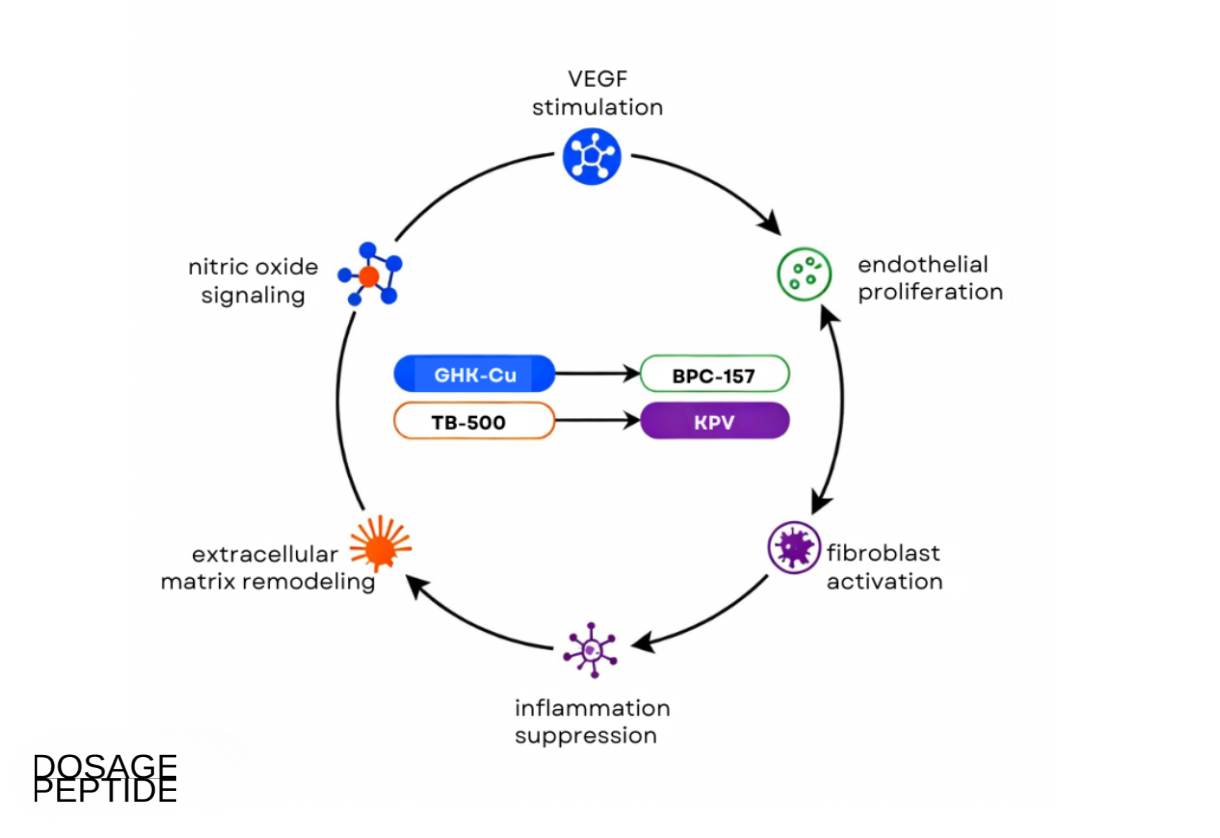
KLOW peptides influence angiogenesis at the molecular level by modulating pathways involved in vascular growth and endothelial activity. Research published in the Journal of Circulation[2] highlights that they stimulate endothelial proliferation and vessel formation through VEGF- and nitric oxide-mediated mechanisms. These findings provide strong evidence of their mechanistic relevance in angiogenic research.
The following molecular interactions further elucidate their angiogenic influence:
- GHK-Cu: Upregulates VEGF gene expression, enhancing endothelial cell growth in controlled models.
- TB-500: Facilitates extracellular matrix remodeling, supporting vascular sprouting and structure formation.
- BPC-157: Modulates nitric oxide signaling, promoting balanced vasodilation in experimental studies.
Together, these actions create a coordinated molecular network that supports angiogenic activity within tissue microenvironments. Therefore, KLOW peptides offer researchers a valuable framework for studying vascular formation processes in non-clinical, laboratory-based experiments.
What cellular pathways mediate tissue repair by KLOW peptides?
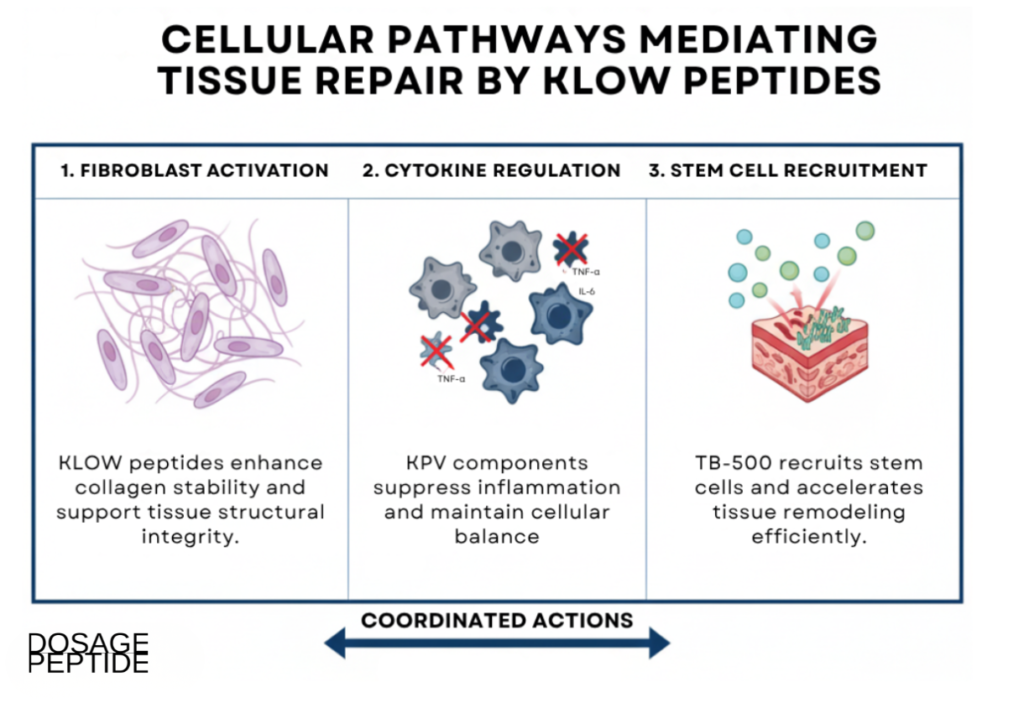
The cellular pathways that mediate tissue repair by KLOW peptides involve the activation of fibroblasts, the regulation of cytokines, and the recruitment of stem cells. Together, these processes enhance collagen synthesis and reduce inflammation. Moreover, they support cellular regeneration and structural remodeling, creating a consistent and reliable foundation for controlled regenerative research.
The following key mechanisms drive tissue regeneration effectively:
1. Fibroblast Activation
KLOW peptides stimulate fibroblast proliferation, enhancing collagen deposition and extracellular matrix stability. This cellular activation supports the structural integrity of tissues, ensuring their strength and elasticity during experimental regenerative studies.
2. Cytokine Regulation
KPV components suppress key inflammatory cytokines, including TNF-α and IL-6, to reduce localized inflammation. This controlled response helps maintain cellular balance, creating optimal conditions for precise and efficient tissue repair within experimental settings.
3. Stem Cell Recruitment
TB-500 facilitates the recruitment of stem and progenitor cells to injury sites. These recruited cells accelerate regeneration by promoting new tissue growth and contributing to the organized structural remodeling observed in experimental models.
What scientific evidence supports anti-inflammatory and regenerative roles?
Scientific evidence supports the anti-inflammatory and regenerative potential of KLOW peptides through extensive peer-reviewed studies. GHK-Cu has been shown to activate genes involved in wound healing and defense against oxidative stress. Moreover, it enhances cellular communication and tissue remodeling. Together, these effects highlight its contribution to molecular processes underlying regeneration, offering promising insights for ongoing peptide-based research in controlled laboratory environments.
In addition, preclinical studies from the National Institutes of Health[3] highlight KPV’s ability to suppress inflammation by reducing cytokine release and tissue swelling. Similarly, animal-based studies on BPC-157 have shown reduced fibrosis and enhanced soft-tissue recovery. Collectively, these findings form a coherent scientific foundation supporting the peptides’ experimental roles in anti-inflammatory and regenerative mechanisms.
What are the future research directions and clinical potential?
The future research directions and clinical potential of KLOW peptides focus on understanding their molecular mechanisms, pharmacokinetics, and translational applicability. According to research insights from the Institute of Developmental and Regenerative Medicine (IDRM) at the University of Oxford[4], ongoing studies emphasize the importance of developing safe, effective, and evidence-based frameworks for regenerative and therapeutic advancements within controlled scientific environments.
To advance this promising research, the following key areas require exploration:
- Molecular Target Identification: Future studies should map specific receptor interactions and signaling pathways, providing insight into how KLOW peptides influence cellular repair and regeneration mechanisms.
- Pharmacokinetics and Dose Optimization: Investigations must determine stability, absorption, and bioavailability profiles to define effective dosage parameters for preclinical and experimental applications in controlled settings.
- Clinical Validation: Rigorous, ethically approved trials are essential for confirming efficacy, reproducibility, and safety, thereby enabling a data-driven transition from experimental research to potential clinical relevance.
Advancing Regenerative Science Through Research-Driven Peptide Innovation at Dosage Peptide
Researchers often face challenges in sourcing consistent, high-purity peptides that meet rigorous laboratory standards. Variations in peptide composition, lack of verified data, and limited reproducibility can compromise experimental outcomes. Moreover, maintaining precise molecular stability and documentation across multiple study conditions remains a critical pain point in peptide-based regenerative research.
At Dosage Peptide, we support peptide research through scientifically focused discussions involving compounds such as KLOW and their potential relevance in regenerative science, cellular signaling, and experimental peptide investigations. Our research-driven approach emphasizes formulation consistency, purity standards, and evidence-based scientific exploration to support reproducible laboratory studies and high-integrity research outcomes across evolving biomedical fields.
FAQs
What is the primary research focus of KLOW peptides?
The primary research focus of KLOW peptides is on cellular regeneration and tissue repair mechanisms. They are studied for their influence on fibroblast activity and angiogenic signaling. Moreover, researchers explore their molecular pathways to better understand controlled regenerative responses.
How are KLOW peptides utilized in experimental studies?
KLOW peptides are utilized in controlled laboratory experiments for studying cellular repair and molecular signaling. Researchers analyze their effects on tissue remodeling and angiogenesis. Additionally, these investigations contribute to understanding peptide-based regenerative processes under non-clinical conditions.
What components make up the KLOW peptide complex?
The KLOW peptide complex includes GHK-Cu, BPC-157, TB-500, and KPV. Each component contributes distinct biochemical roles in cellular activity. Together, they create synergistic pathways that enhance peptide research in tissue regeneration and molecular biology.
Why are KLOW peptides significant in regenerative research?
KLOW peptides are significant because they enable researchers to study key molecular interactions involved in tissue recovery. They provide valuable data on cellular regeneration mechanisms. Furthermore, their composition offers reproducible insights for advancing experimental regenerative science.
References
- Robinet, A., Fahem, A., Cauchard, J.-H., Huet, E., Vincent, L., Lorimier, S., Antonicelli, F., Soria, C., Crépin, M., Hornebeck, W., & Bellon, G. (2005). Elastin-derived peptides enhance angiogenesis by promoting endothelial cell migration and tubulogenesis through up-regulation of MT1-MMP. Journal of Cell Science, 118(2), 343-356.
- American Heart Association. (2002). Vascular endothelial growth factor up-regulates nitric oxide synthase expression in endothelial cells. Circulation, 106(14), 1909-1912.
- Pickart, L., & Margolina, A. (2015). GHK peptide as a natural modulator of multiple cellular pathways in skin regeneration. Biomolecules, 5(1), 589-622.
- Institute of Developmental and Regenerative Medicine [IDRM], University of Oxford. (n.d.). About IDRM. https://www.idrm.ox.ac.uk/about-us/about-IDRM