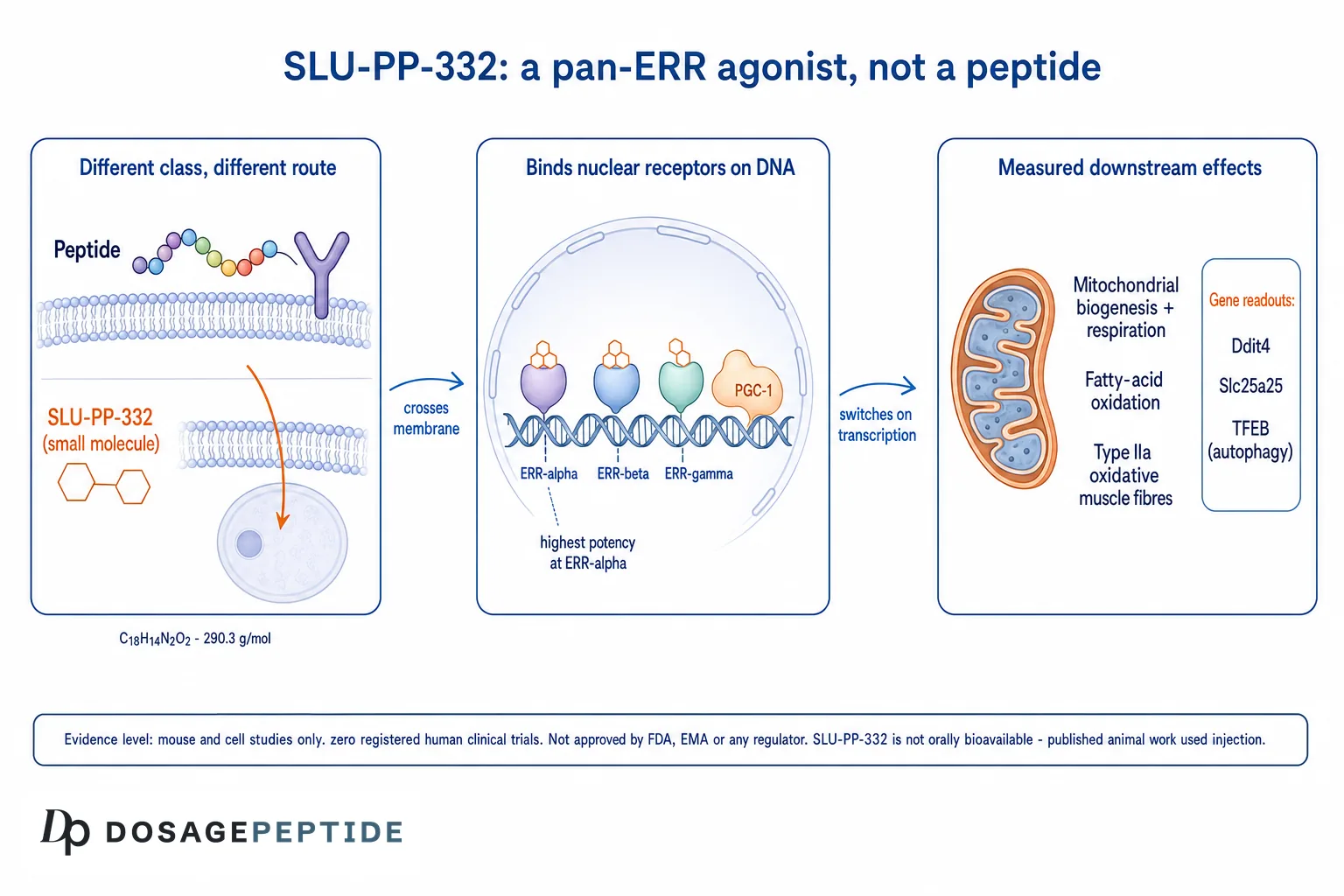
SLU-PP-332 is not a peptide. It is a small synthetic organic molecule — a pan-agonist of the three estrogen-related receptors (ERRα, ERRβ, ERRγ), a family of orphan nuclear receptors that sit inside the cell and act as transcription factors controlling mitochondrial and fatty-acid-oxidation genes. It is sold and discussed alongside research peptides, but chemically and mechanistically it belongs to a different class entirely, and every efficacy finding attached to it comes from mice or cells in a dish. As of 26 July 2026 there is not one registered human clinical trial of SLU-PP-332 anywhere on ClinicalTrials.gov, and no regulator anywhere has approved it for any use.
What is SLU-PP-332?
SLU-PP-332 is a synthetic hydrazide-class small molecule — 4-hydroxy-N’-[(naphthalen-2-yl)methylidene]benzohydrazide, molecular formula C18H14N2O2, molecular weight approximately 290.3 g/mol[14]. It was first reported in 2023 in ACS Chemical Biology as a synthetic pan-agonist active at all three ERR subtypes, with the highest potency at ERRα — reported EC50 values of 98 nM at ERRα, 230 nM at ERRβ and 430 nM at ERRγ, ERRα being the subtype that had previously resisted agonist design — and with pharmacokinetics sufficient for use as an in vivo chemical tool[1]. For the laboratory handling reference for the vial (research use only, no human dosing) rather than the science, see the separate SLU-PP-332 5 mg vial protocol page (its URL path is a legacy site category, not a chemical classification); this article deliberately contains no dosing information.
Why “not a peptide” is the most useful correction
Peptides are amino-acid chains: large, water-loving, digested in the gut, and acting predominantly on receptors on the outside of the cell membrane. SLU-PP-332 does none of that. It is a compact aromatic molecule that crosses the membrane, enters the nucleus and binds a transcription factor directly. The consequences are practical, not semantic: stability, solubility, handling, metabolism and detection windows all follow small-molecule rules, and the metabolic fate mapped for it in vitro — in human liver S9 fractions and microsomes, never in a dosed human — is classic hepatic Phase-I/Phase-II chemistry: hydroxylation, reduction, glucuronidation and sulfation[8][9]. Reasoning about it by analogy to BPC-157 or a GLP-1 analogue starts from the wrong template; our research-compound glossary keeps these class distinctions separate.
Where SLU-PP-332 came from
The lineage is academic, not pharmaceutical-pipeline. A 2020 paper described converting GSK4716, an ERRβ/γ-selective agonist, into compounds with pan-ERR (α/β/γ) activity, establishing the chemotype[12]. SLU-PP-332 itself was characterised by a group led by Thomas P. Burris, with co-authors at Saint Louis University, Washington University School of Medicine, the Salk Institute, Baylor College of Medicine and City of Hope[1]. The original paper is explicit about its own ambition: the authors describe the molecule as having “sufficient pharmacokinetic properties to be used as an in vivo chemical tool.” That is the language of a probe compound, not a drug candidate, and three years of follow-up chemistry has not changed it: the most recent structure–activity analysis still calls SLU-PP-332 a “widely used chemical probe” and a benchmark for newer analogues[10].
How does SLU-PP-332 work?
The ERRs are orphan nuclear receptors, not estrogen receptors
ERRα, ERRβ and ERRγ are named for their sequence similarity to the classical estrogen receptors, and that name causes endless confusion. They do not bind estrogen. They are “orphan” receptors — no endogenous hormone ligand has been established — and they are constitutively active: they sit on DNA driving their target genes, with output tuned mainly by receptor abundance and by which coactivators (notably the PGC-1 family) are bound. With no natural ligand to copy, a synthetic agonist has to stabilise the active receptor conformation from scratch, which is why ERRα agonism was a “significant” design difficulty before SLU-PP-332[1].
What the receptors control
The ERRs are, functionally, master regulators of oxidative metabolism. Their target genes cover mitochondrial biogenesis, the electron transport chain, the TCA cycle and fatty-acid oxidation, in the tissues that burn the most fuel: skeletal muscle, heart, kidney and brain. Activating all three at once therefore does not flip one switch — it raises the gain on a whole metabolic transcriptional programme.
The measured downstream effects
In a skeletal-muscle cell line, SLU-PP-332 increased mitochondrial function and cellular respiration[1]. Two genes recur across the literature as readouts: Ddit4, which is induced by acute aerobic exercise and which pan-ERR agonists induce robustly, and Slc25a25, a mitochondrial carrier gene[6][11]. A separate strand of work found that TFEB — the master regulator of the autophagy–lysosome pathway, the cell’s recycling machinery — is a direct ERR target gene, with ERR activation raising TFEB expression and downstream autophagy genes in neonatal rat ventricular myocytes and in the mouse C2C12 myoblast line[5]. So the programme is broader than “more mitochondria”: it also touches organelle turnover and quality control.
Two mechanistic caveats. First, in the original mouse work the endurance benefit was ERRα-dependent, so this is not a generic “pan” effect where any subtype will do[1]. Second, transcriptional agonism is intrinsically broad. A membrane-targeted agent such as SS-31 / elamipretide, which acts on the inner mitochondrial membrane itself, has a narrow physical site of action; a nuclear-receptor agonist changes what a cell transcribes in every tissue expressing the receptor. That breadth is the source of both the interest and the uncertainty.
Why is SLU-PP-332 called an “exercise mimetic”?
Because it reproduces part of the gene-expression signature of acute aerobic exercise — and that is the whole of the claim. The original paper showed SLU-PP-332 inducing an ERRα-specific acute aerobic exercise genetic programme in mice[1], and a later study found that both SLU-PP-332 and SLU-PP-915 induced Ddit4 in mouse skeletal muscle at levels matching or exceeding those induced by treadmill running, depending on the muscle examined[6]. That is a striking result, and it is why the compound got attention.
It is also routinely over-read. A transcriptional signature is not the physiology. Exercise is mechanical loading, cardiovascular and respiratory adaptation, neural and motor-unit adaptation, connective-tissue and bone remodelling, thermoregulatory stress, appetite and sleep signalling, and a systemic endocrine response — none of which a nuclear-receptor agonist supplies. Loading a muscle’s oxidative gene programme while nothing is actually pulling on the tendon is a partial overlap, not a substitution: the phrase is pharmacologists’ shorthand for phenocopying some exercise-responsive transcription. Tellingly, the strongest recent result in this area is synergy: in mice, the orally active analogue SLU-PP-915 enhanced Ddit4 and mitochondrial gene expression further when combined with exercise training[6]. The research direction is additive to training, not a replacement for it.
What does SLU-PP-332 research actually show?
Seven distinct lines of preclinical work exist. Read the model column before the finding column; it determines what the finding means.
| Finding | Model | Evidence level | Source |
|---|---|---|---|
| Pan-agonism of ERRα/β/γ, highest potency at ERRα; increased mitochondrial function and cellular respiration | Cell-based receptor assays / skeletal-muscle cell line | In vitro | [1] |
| Increased type IIa oxidative muscle fibres; enhanced exercise endurance — treated mice ran roughly 70% longer and 45% further than vehicle controls; ERRα-dependent acute aerobic exercise gene programme | Mice (injected) | Animal in vivo | [1] |
| Increased energy expenditure and fatty-acid oxidation; decreased fat-mass accumulation; improved insulin sensitivity | Diet-induced-obese mice | Animal in vivo | [2] |
| Improved ejection fraction, reduced fibrosis, increased survival — without affecting cardiac hypertrophy; ERRγ identified as the main mediator | Pressure-overload heart-failure mice (SLU-PP-332 and SLU-PP-915) | Animal in vivo, disease model | [3] |
| Reversal of age-related albuminuria, podocyte loss, mitochondrial dysfunction and inflammatory cytokines after 8 weeks of treatment | 21-month-old mice (human tissue used only to measure ERR expression, not treated) | Animal in vivo, ageing model | [4] |
| TFEB identified as a direct ERR target gene; ERR activation drives autophagy–lysosome genes | Neonatal rat ventricular myocytes and mouse C2C12 myoblasts | In vitro, mechanistic | [5] |
| Effects on myoblasts isolated from inactive women’s surgical muscle biopsies (viability, oxidative stress, senescence, myotube formation) | Human-derived cells in culture — no person was dosed; authors call it a pilot study | Ex vivo, pilot | [7] |
| Human clinical efficacy or safety | — | None. Zero registered trials. | [13] |
Three things that table cannot convey. First, the pattern is consistent across the class: a 2026 systematic review of the 2020–2024 literature, covering animal and cell models only, reports the same triad for pan-ERR agonists generally — enhanced fatty-acid oxidation, more type IIa fibres, improved endurance[11]. Second, the ageing-kidney study implicates cGAS–STING and STAT3 signalling[4], and it is frequently miscited as containing human data: its human component is ERR expression measured in tissue, and no human was treated. Third, the single study that has touched human material is a pilot in which myoblasts from the 10 inactive women’s surgical biopsies were treated in a dish[7] — no person was dosed, it yields no safety or dose information, and it is simultaneously the strongest human-adjacent evidence that exists. The mouse disease models are hypothesis-generating for future drug development; nothing in this literature supports treating obesity, heart failure or kidney disease in a person.
SLU-PP-332 vs SLU-PP-915: what is the difference?
Oral bioavailability, and it is the single most misreported fact in this entire topic. The 2025 paper characterising the oral activity of SLU-PP-915 — a chemically distinct pan-ERR agonist first reported alongside SLU-PP-332 in the 2023 Circulation heart-failure study[3] — states plainly that SLU-PP-332 improves aerobic performance in mice but lacks oral bioavailability[6]. Every “exercise in a pill” headline attached to SLU-PP-332 is therefore literally wrong about the compound it names: the published mouse work used injection (intraperitoneal), not oral dosing[6]. The pill, insofar as one exists in preclinical research, is 915.
| SLU-PP-332 | SLU-PP-915 | |
|---|---|---|
| Target | Pan-agonist, ERRα/β/γ; highest potency at ERRα[1] | Pan-ERR agonist, chemically distinct scaffold[6] |
| Oral bioavailability | No[6] | Yes — the reason it was made[6] |
| Route in published animal work | Injection (intraperitoneal)[6] | Orally active |
| Ddit4 induction in muscle | Robust[6] | Robust; synergises with exercise training[6] |
| Heart-failure model | Improved ejection fraction, less fibrosis, better survival[3] | Same model, same direction of effect[3] |
| Metabolites mapped in vitro | Nine identified (six Phase I, three Phase II conjugates)[9] | Seven identified (Phase I only)[9] |
| Human trials | None[13] | None[13] |
Do not let sources blur the two. Several findings genuinely cover both compounds — the heart-failure study[3], the doping-control assay work[9] and the systematic review[11] — but any page that attributes oral dosing to SLU-PP-332 has confused the molecules.
What are the limits and open questions?
- No human trials at all. A search of ClinicalTrials.gov on 26 July 2026 for SLU-PP-332, SLU-PP-915 and “pan-ERR agonist” returned zero registered studies — none completed, none recruiting, no registered Phase I[13].
- No human pharmacokinetics. Everything known about how the human body handles this molecule comes from liver S9 fractions and microsomes in a test tube[8][9]. There is no human absorption, distribution, half-life or clearance data, and consequently nothing that could underpin a human dose. This is why our SLU-PP-332 vial reference page is framed as laboratory handling for research use, not as a human protocol.
- No regulatory approval anywhere. Not FDA, not EMA, no regulator, no indication. There is no approved product; the literature treats it as a chemical probe[10].
- “Without evident toxicity” means in those animal models. The systematic review uses that phrase about obesity-model rodents[11]. It is not a human safety statement, and it cannot be repurposed as one. There is also no long-term data in any species.
- Nothing has been looked for in people. No specific human harm has been demonstrated — but no one has searched for one either, which is a different situation from “clean.”
The honest verdict: SLU-PP-332 is a scientifically important tool compound. It solved a real medicinal-chemistry problem (ERRα agonism), produced coherent results in several independent mouse models, and opened a target class that a decade ago looked undruggable. It is also a molecule with zero human evidence, no approval, no human dosing basis and no oral bioavailability. Both halves are true at once, and any source giving you only one of them is selling something.
Is SLU-PP-332 banned in sport?
Effectively yes — and reasoning through why matters, because the logic generalises to other research compounds.
There are two independent routes to prohibition. First, the World Anti-Doping Agency’s Prohibited List includes metabolic modulators among its prohibited classes, and the doping-control literature on SLU-PP-332 cites its exercise-mimetic activity as the rationale for developing detection methods[8]. Second, and more decisively, the WADA Prohibited List contains a catch-all category (S0, non-approved substances) covering any pharmacological substance with no current approval by any governmental regulatory health authority for human therapeutic use — prohibited at all times, in and out of competition. SLU-PP-332 has no such approval anywhere, so it lands squarely in S0 on that basis alone. This is the S0 definition applied to a regulatory status; ERR agonists are not called out by name, and athletes should read the current List and consult their anti-doping organisation directly rather than rely on any third-party summary.
It is also detectable — the operationally relevant point. Two independent 2026 studies have published LC-MS/HRMS characterisation of SLU-PP-332 metabolism in human liver preparations specifically for doping-control purposes. One reported twelve hydroxylated and reduced-hydroxylated metabolites plus direct glucuronidation and sulfation of the parent compound[8]; the other identified nine metabolites for SLU-PP-332 and seven for SLU-PP-915, explicitly framed for sports drug-testing programmes[9]. When two labs publish metabolite panels for a compound in the same year, the era of invisibility to testing is over.
How does SLU-PP-332 compare to other metabolic research compounds?
It is grouped loosely with other “exercise mimetics” and mitochondrial agents, and that grouping obscures how different their mechanisms are.
AICAR is the closest sibling and the most instructive contrast. AICAR works through AMPK — an energy-sensing kinase that responds to falling cellular energy charge and acts fast, post-translationally, phosphorylating existing proteins. SLU-PP-332 works through nuclear receptors and changes which genes get transcribed. Same headline, different biological layer, different time course, different failure modes. Our explainer on AICAR as an AMPK-directed exercise mimetic covers that mechanism in depth, and the corresponding AICAR 50 mg vial reference sits alongside it.
MOTS-c is a mitochondrial-derived peptide — an actual peptide, unlike SLU-PP-332 — that also converges on AMPK signalling; see how MOTS-c interacts with AMPK under cellular energy stress. SS-31 (elamipretide) is different again: it localises to the inner mitochondrial membrane rather than acting on gene expression or a signalling cascade. Across this group, SLU-PP-332 is distinguished by having the most clearly defined molecular target and receptor pharmacology — and no human data at all.
Preserving oxidative muscle quality is a live question wherever body composition changes rapidly, which is why the lean-mass question around GLP-1 compounds comes up in the same conversations. No published work tests SLU-PP-332 for that purpose in humans, and treating a mouse fibre-type shift as a solution to a human clinical problem is exactly the leap this article exists to discourage.
Frequently Asked Questions
Is SLU-PP-332 a peptide?
No. SLU-PP-332 is a small synthetic organic molecule — a benzohydrazide with a naphthalene group, formula C18H14N2O2, around 290 g/mol[14]. Peptides are amino-acid chains that typically act on cell-surface receptors. SLU-PP-332 enters the cell and binds nuclear receptors that regulate gene transcription. It is commonly catalogued alongside research peptides, which is why the misclassification spread, but its chemistry, metabolism and mechanism are all small-molecule.
What does SLU-PP-332 actually do?
It activates all three estrogen-related receptors (ERRα, ERRβ, ERRγ), with the highest potency at ERRα. Those receptors are transcription factors governing mitochondrial biogenesis and fatty-acid oxidation. In cells it increased mitochondrial function and respiration; in mice it shifted muscle toward type IIa oxidative fibres and improved endurance, and it induced a gene programme resembling the response to acute aerobic exercise. All of that evidence is preclinical.
Has SLU-PP-332 been tested in humans?
No. There are zero registered human clinical trials on ClinicalTrials.gov as of 26 July 2026. The only human-derived data is one pilot study in which myoblasts isolated from the surgical muscle biopsies of the 10 inactive women in a 20-woman cohort were treated with the compound in cell culture — cells in a dish, not people. No published study has administered SLU-PP-332 to a human being, so there is no human efficacy, safety or pharmacokinetic data of any kind.
Is SLU-PP-332 FDA approved?
No. It is not approved by the FDA, the EMA or any other regulatory authority, for any indication, in any country, and there is no approved medicinal product containing it. The literature describes it as a chemical probe or tool compound, and it is supplied strictly as a research chemical for laboratory use.
What is the difference between SLU-PP-332 and SLU-PP-915?
Both are pan-ERR agonists, but they are chemically distinct and one crucial property separates them: SLU-PP-332 is not orally bioavailable, while SLU-PP-915 was specifically engineered to be orally active. Published mouse work with SLU-PP-332 used intraperitoneal injection. In mice, SLU-PP-915 additionally synergised with exercise training to further raise Ddit4 and mitochondrial gene expression. Both improved outcomes in a mouse heart-failure model; neither has human trial data.
Is SLU-PP-332 really “exercise in a pill”?
No, and the phrase is doubly wrong. First, SLU-PP-332 is not orally bioavailable, so it is not a pill in any published research. Second, it reproduces part of the gene-expression signature of acute aerobic exercise, not exercise itself — no mechanical loading, no cardiovascular or respiratory adaptation, no neural adaptation, no connective-tissue remodelling. The most interesting recent finding in this family is that a pan-ERR agonist worked with training, not instead of it.
Is SLU-PP-332 banned by WADA?
Effectively yes. Metabolic modulators are a prohibited class under WADA rules, and because SLU-PP-332 has no approval from any governmental health authority for human therapeutic use, it also falls under the Prohibited List’s non-approved-substances catch-all (S0), prohibited at all times. In-vitro metabolite panels and LC-HRMS/MS characterisation were published in 2026 specifically for doping-control purposes, so analytical targets for detection now exist. Athletes should verify against the current List.
Is SLU-PP-332 safe?
Unknown. There is no human safety data, no human pharmacokinetics, no dose-ranging study and no long-term data in any species. A systematic review noted no evident toxicity in the rodent obesity models it covered, which is a statement about those animals and cannot be extended to people. Because the ERRs are master metabolic regulators expressed in heart, kidney, muscle and brain, systemic pan-agonism produces broad transcriptional effects by design — which is precisely why long-term safety remains an open question.
References
- Billon C, et al. “Synthetic ERRα/β/γ Agonist Induces an ERRα-Dependent Acute Aerobic Exercise Response and Enhances Exercise Capacity.” ACS Chemical Biology. 2023. PMID 36988910
- Billon C, et al. “A Synthetic ERR Agonist Alleviates Metabolic Syndrome.” Journal of Pharmacology and Experimental Therapeutics. 2024. PMID 37739806
- Xu W, et al. “Novel Pan-ERR Agonists Ameliorate Heart Failure Through Enhancing Cardiac Fatty Acid Metabolism and Mitochondrial Function.” Circulation. 2023. PMID 37961903
- Wang XX, et al. “Estrogen-Related Receptor Agonism Reverses Mitochondrial Dysfunction and Inflammation in the Aging Kidney.” The American Journal of Pathology. 2023. PMID 37717940
- Losby M, et al. “The Estrogen Receptor-Related Orphan Receptors Regulate Autophagy through TFEB.” Molecular Pharmacology. 2024. PMID 39168657
- Billon C, Appourchaux K, Côté I, Burris TP. “An orally active estrogen receptor-related receptor agonist, SLU-PP-915, enhances aerobic exercise capacity.” Journal of Pharmacology and Experimental Therapeutics. 2025;393(1):103787. PMID 41421047
- Bonanni R, et al. “Targeting ERRs to counteract age-related muscle atrophy associated with physical inactivity: a pilot study.” Frontiers in Physiology. 2025. PMID 40692696
- Avliyakulov NK, et al. “Analysis and Identification of In Vitro Metabolites of Exercise Mimetic SLU-PP-332 ERRα/β/γ Agonist for Doping-Control Purposes.” Drug Testing and Analysis. 2026. PMID 41688415
- Möller T, Krug O, Thevis M. “In Vitro Metabolism and Analytical Characterization of SLU-PP-332 and SLU-PP-915: Novel Pan-ERR Agonists With Doping Potential.” Rapid Communications in Mass Spectrometry. 2026. PMID 41588687
- Okda HE, et al. “Chemical optimization of the exercise mimetic SLU-PP-332 enables insight into estrogen-related receptor signaling.” International Journal of Biological Macromolecules. 2026. PMID 41850449
- de Souza-Lima J, et al. “[Pharmacological Activation of ERRα/β/γ as an Exercise Mimetic: Potential Therapeutic Applications].” Revista Médica de Chile. 2026. Article in Spanish. PMID 42024694
- Shahien M, Elagawany M, Sitaula S, et al. “Modulation of estrogen-related receptors subtype selectivity: Conversion of an ERRβ/γ selective agonist to ERRα/β/γ pan agonists.” Bioorganic Chemistry. 2020. PMID 32683181
- ClinicalTrials.gov registry search, interventions “SLU-PP-332”, “SLU-PP-915” and “pan-ERR agonist”. Queried 26 July 2026: zero registered studies. ClinicalTrials.gov
- PubChem Compound Summary, CID 5338394 (SLU-PP-332), CAS 303760-60-3; C18H14N2O2, MW 290.3. National Library of Medicine. PubChem CID 5338394
Research use only. SLU-PP-332 is an unapproved laboratory chemical intended exclusively for in-vitro and non-human research conducted by qualified investigators. It is not a dietary supplement, not a drug, and not approved by the FDA, EMA or any other regulatory authority for human or veterinary use. Nothing on this page is medical advice, a treatment recommendation, or an endorsement of human administration, and no dosing guidance for humans is provided or implied. dosagepeptide.com is an independent reference library and sells nothing; all statements above describe published preclinical findings and their evidence level, not clinical outcomes. Consult a qualified healthcare professional for any medical question, and always confirm the current WADA Prohibited List and your local regulations before handling research compounds.